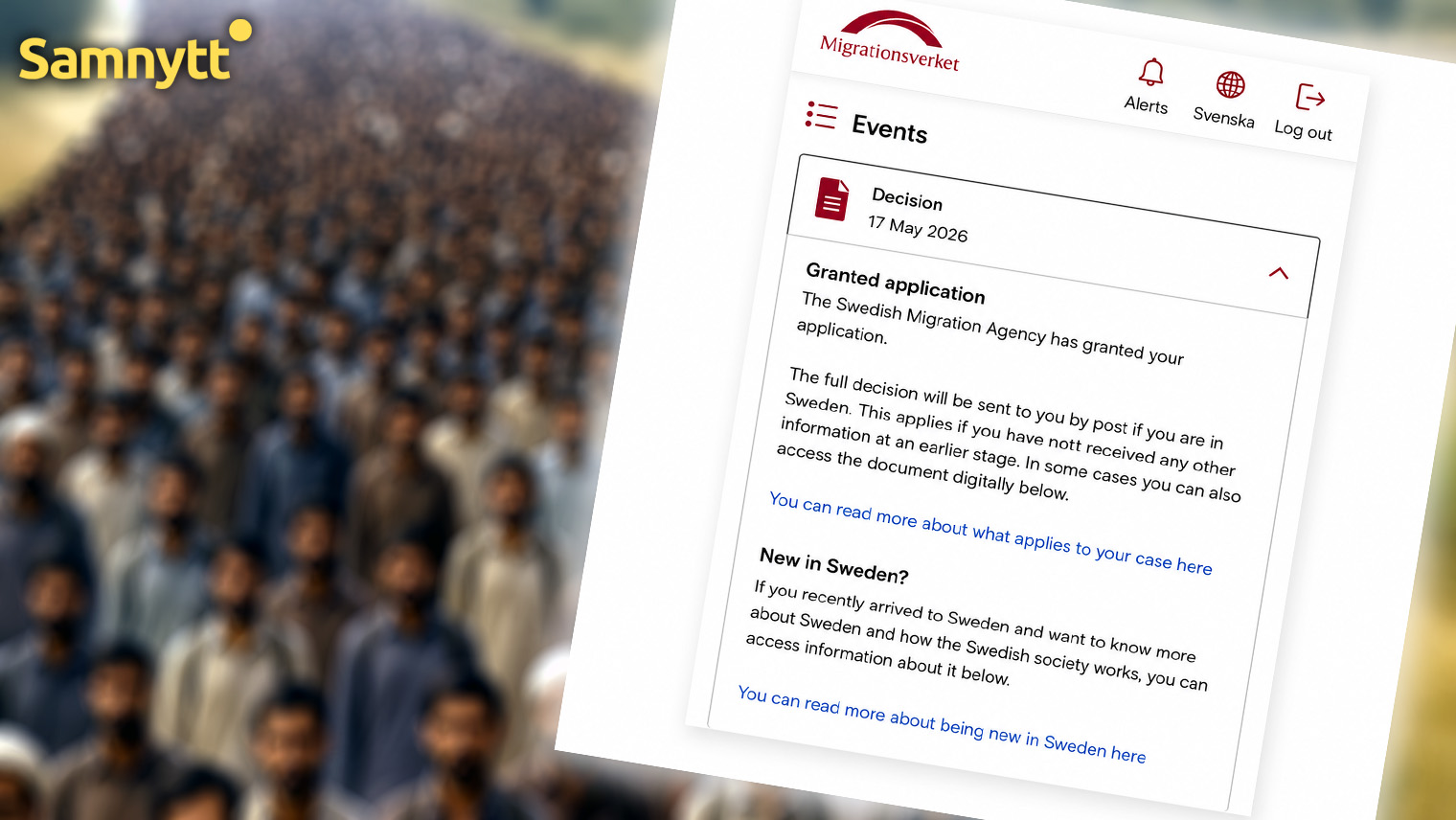
The Swedish Migration Agency has significantly increased the pace of handling citizenship cases this spring—at the same time as new, considerably tougher rules are on the horizon. The agency now confirms that staff in citizenship departments have been ordered to work overtime, including weekends, to approve more decisions before the legislative changes come into force on June 6.
According to information circulating on social media, several people have received Swedish citizenship decisions dated on Saturdays and Sundays during May. For example, there are decisions from May 3, 9, and 17—all weekends. This is reported by Verifiera.
The Migration Agency’s press department states that overtime work has occurred within the citizenship section—not just on weekdays, but now also on weekends.
Sharp Increase in Finalized Cases
Statistics simultaneously show that the number of resolved citizenship cases has increased significantly since the turn of the year. In January, just over 2,500 decisions were made. By February, the figure had risen to about 3,000, and in March to around 3,560 decisions. In April, nearly 3,800 cases were resolved. This means the number of decisions has increased by approximately 46 percent since the beginning of the year.
ALSO READ: Inside the Migration Agency: Clans, Swedes in the Minority, and a Culture of Silence
The development marks a clear reversal compared to autumn 2025, when processing slowed down sharply after the Migration Agency introduced stricter control procedures and more security checks in citizenship cases.
Criticized Shortcomings in Controls
The changes were prompted by criticism from the Swedish National Audit Office, which in a review pointed out extensive deficiencies in the agency’s handling of citizenship cases. In several instances, mandatory register checks were either omitted or carried out inadequately.

According to the Migration Agency’s own annual report, the issues involved omitted checks against, among others, the Schengen Information System and crime/records databases. The investigations in individual cases were also sometimes deemed insufficient.
The agency noted at the time that the problems were more pronounced in citizenship cases than in other parts of its operations.
ALSO READ: Voices from the Migration Agency: “It’s Not Just Corruption—It’s Serious Crime”
In 2025, the tightened control measures led to longer processing times and a marked drop in the number of resolved cases. Some decision-making was temporarily paused, especially in cases that might have been approved.
New Rules from National Day
On June 6, the new citizenship law will take effect. The reform entails several stricter requirements compared to the current regulations.
ALSO READ: Tidö Government Tightens Citizenship Requirements: “Reasonable and Fair”
Among other things, the residence requirement in Sweden is raised from five to eight years. There will also be requirements for self-sufficiency, knowledge of Swedish and civics, and stricter assessments of lifestyle and character. The requirements to prove one’s identity are also tougher.
Applications not decided before the legislative change will be assessed under the new regulations.
Intense Final Push Before Regulatory Change
The fact that the processing pace has increased precisely in the months before the law change raises questions about how the agency is prioritizing its work during the transition to the new rules.
At the same time as the government has emphasized the need for tighter requirements and increased control, the spring has largely seen a focus within the agency on increasing the number of resolved cases where the possibility of granting citizenship is significantly greater.
The government has also instructed the Migration Agency, in its 2026 directive, to both shorten processing times and increase productivity. The agency is, among other things, to report how many cases are resolved per employee and how large a share is handled within set time frames.
ALSO READ: LIST: Where Sweden’s New Citizens in 2025 Are From
This is now backfiring on the government’s own policy, as several thousand citizenships could be granted without the special requirements that could have been prevented by a different directive, such as a moratorium pending the new rules.
The Migration Agency has so far declined to comment in detail on the reasons behind the mandated weekend overtime or how long it will continue.
ALSO READ: Testimonies from Inside the Migration Agency: “The Tidö Government Is the Enemy”