The share of your salary that actually ends up in your own wallet differs dramatically across European countries. A new compilation shows that Sweden still ranks among the most highly taxed nations on the continent. The tax authorities take nearly half if you earn a little above average, which is significantly more than in much of Eastern Europe and also more than in most Western European economies. On top of that, there is also VAT and excise taxes.
The differences between Europe’s tax systems are enormous. Some countries have relatively flat taxes, while others, like Sweden, use highly progressive systems where high earners pay an ever-increasing share in taxes and contributions. This is reported by Euro News.
According to calculations based on OECD data, PwC’s tax summaries, and national sources, the net salary for a single person without children ranges from just over 50,000 euros in some countries to nearly 87,000 euros in others.
Sweden Among Europe’s Harshest Tax Countries
At the bottom of the list is Belgium, where an employee retains just above 50 percent of their income. Close behind are Denmark and Sweden, where almost half of the income, 48 percent, disappears in taxes and social contributions.
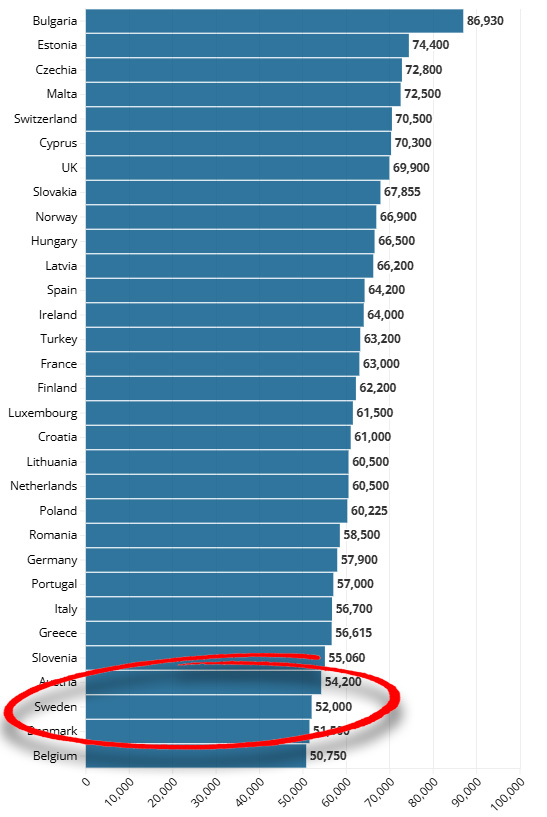
Austria, Slovenia, and Greece are also among the countries where those with slightly higher incomes get to keep relatively little of their salaries. Meanwhile, Norway stands out among the Nordic countries, with nearly 67 percent of income remaining in the employee’s pocket. Finns also face markedly milder taxation than Swedes.
Eastern Europe Most Favorable for High Earners
The most favorable countries are primarily in Eastern Europe. Bulgaria tops the list, with net income for workers at nearly 87 percent. Estonia, the Czech Republic, and Malta are also in that range.
READ ALSO: The EU Now Wants to Force Swedish Companies to Pay More Taxes
A common feature among many of these countries is lower marginal tax rates, simpler tax systems, and often a cap on social contributions. This means that those earning a bit more get to keep a much larger share of their salaries than in the Nordics and Western Europe.
Big Differences Among Europe’s Largest Economies
Among Europe’s five largest economies, the UK offers the highest net salary at these income levels. Nearly 70 percent of gross salary is left after tax.
Spain and France are in the middle, while Germany and Italy rank lower with a significantly higher tax burden.
Sweden and Western Europe Squeeze High Earners the Most
The pattern is clear across Europe. Western and Northern Europe generally impose the highest taxes on high earners, while Central and Eastern Europe often offer a lower tax burden.
READ ALSO: Tidö Parties Warn of Red-Green Election Win: ‘Tax Shock’
Countries such as Sweden, Denmark, Belgium, Germany, France, and the Netherlands are characterized by high marginal taxes and comprehensive social contributions. In several cases, there are also regional and municipal taxes that further erode the net salary. In Sweden, municipal income tax is the largest item.
Big Salary Differences Between Countries
Switzerland is the only European country where the median salary for a single person without children exceeds 100,000 euros. Within the EU, Luxembourg has the highest average salaries.
Several Eastern and Central European countries are well below 50,000 euros per year. In Sweden, the annual median salary before tax is 445,200 kronor, which is just over 41,300 euros after conversion.
The Highest Marginal Taxes Are in the Nordics
The highest marginal taxes are found primarily in the Nordic countries and Western Europe, where top rates often lie between 45 and 60 percent. In much of Eastern Europe and the Balkans, the levels are significantly lower.
This means that the gap between gross salary and actual disposable income is often much wider in countries like Sweden than in, for example, Bulgaria or Estonia.