This week, Statistics Sweden (SCB) presented new figures on Sweden’s population and how many people have a foreign background. From once being one of the world’s most homogeneous and stable countries, Sweden is today one of the Western world’s most heterogeneous nations—with all that entails. This transformation has occurred in just a few decades and against the will of the Swedish people.
The statistics apply to official residents who, at the turn of the year, had some form of foreign background one generation back. This includes those who are foreign-born as well as those born in Sweden with one or two foreign-born parents. Third-generation immigrants—meaning Swedish-born individuals who are children of two second-generation immigrants—are not counted. Consequently, the actual share is even higher than the official figure, which stands at 35.7 percent. In 1930, Sweden had 1.5 percent with a foreign background.
This figure makes Sweden one of the most heterogeneous countries in the Western world after the USA, alongside countries such as Canada, Australia, New Zealand, France, and the United Kingdom.
READ ALSO: Morgan Johansson’s Researcher Brother: Immigration a Great Gain for Sweden
The so-called Swedish super-diversity refers to an ethnic-cultural, linguistic, racial, and religious diversity, according to left-wing researcher Tobias Hübinette.
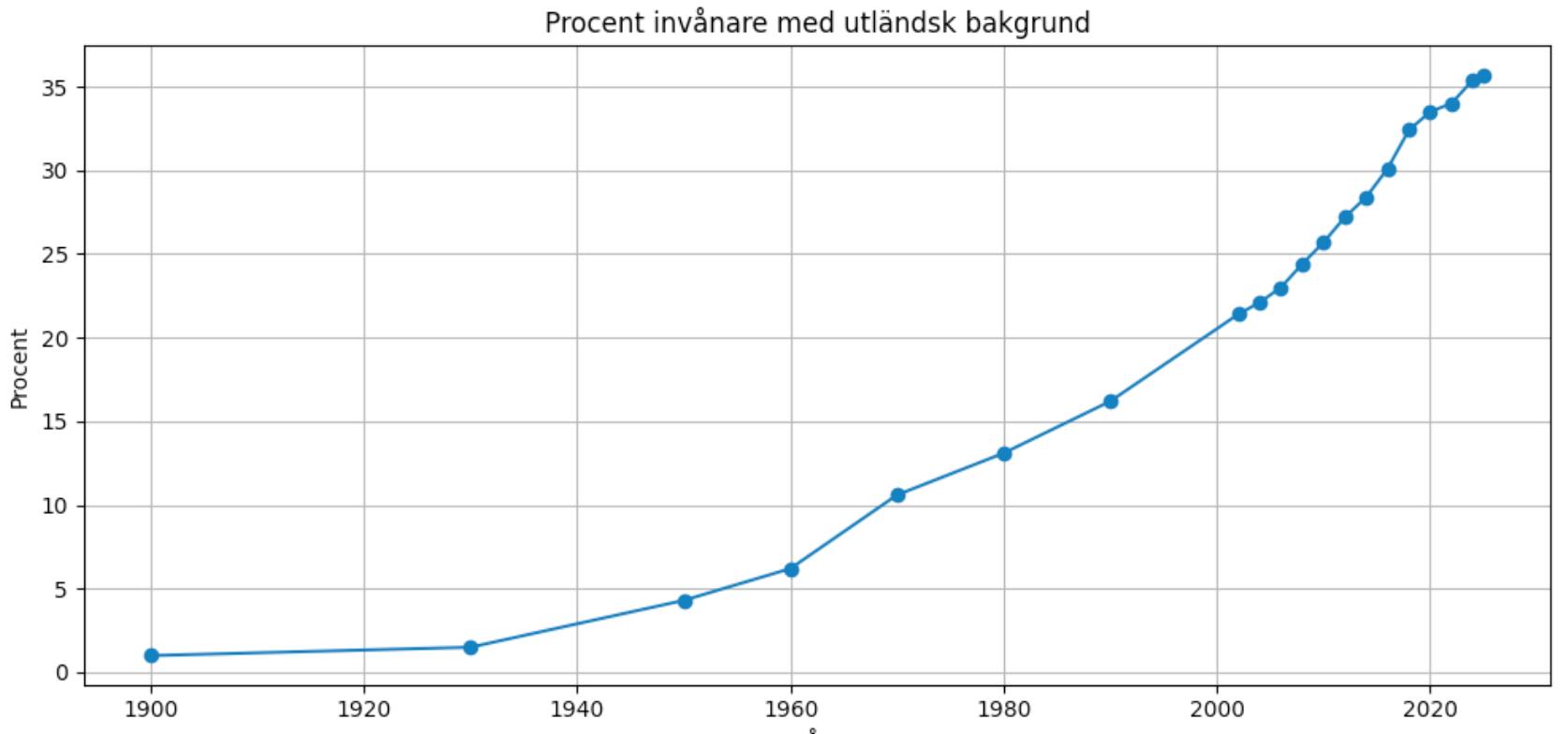
Share of people with foreign background in different age groups:
0–9 years: 39.7% (possibly around 44% including third generation)
10–19 years: 39.5% (possibly around 44% including third generation)
20–29 years: 42.9%
30–39 years: 42.2%
40–49 years: 43.6%
50–59 years: 22%
Largest Share of Muslims
From once also being one of the world’s most secular countries, Sweden now has a large Muslim population. According to Hübinette, the proportion of Muslims is currently about 13–14 percent. In the age group 0–39 years, it is even higher, up to 25 percent. This means that Sweden is the Western country—with the exception of the Balkan countries—with the highest percentage of Muslims.
In Malmö, ethnic Swedes are already a minority, and Stockholm and Gothenburg are quickly heading in the same direction. Malmö has almost 59 percent with a foreign background, Gothenburg 49 percent, and Stockholm 46 percent.
READ ALSO: New Interactive Map Shows Sweden’s Demographic Transformation