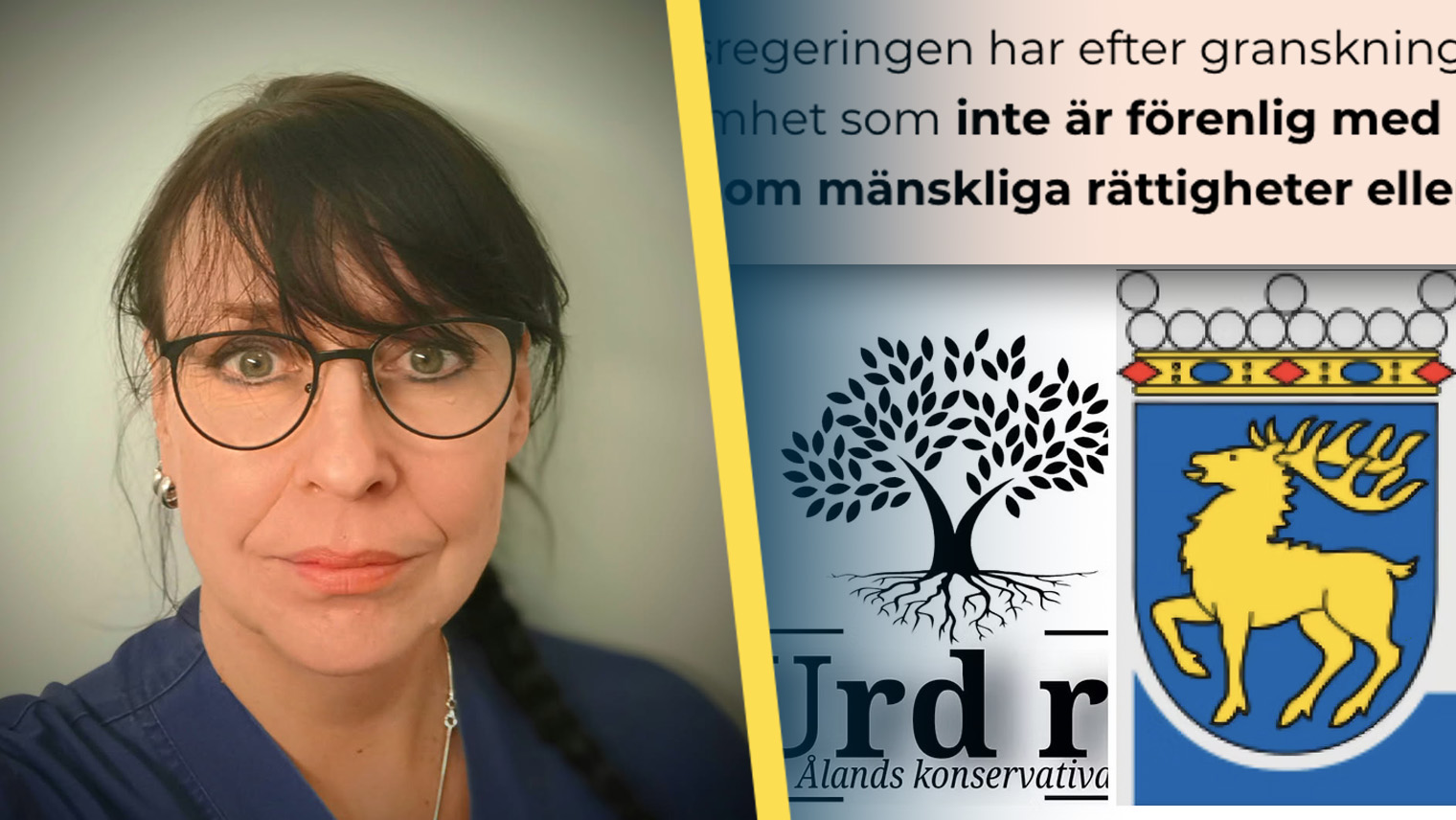
More and more Swedes are moving to Åland in hopes of a calmer societal climate and a government work that differs from the Swedish one. But when intensive care nurse Anette Lehtinen describes her association’s contact with the regional government, a more complex picture emerges: the view on violence, equality, and public guidelines is in many ways the same as in Sweden. The conservative association is denied support because it openly acknowledges that women can also use violence against men.
When Anette Lehtinen tells her story over the phone, she starts with her background. She is from mainland Finland, “from a small town,” as she puts it. After working as an intensive care nurse in Oslo, Copenhagen, and Stockholm, she moved to Åland over two decades ago. Here, she started a family with her partner and has been living ever since.
The conservative association she is involved in is small, with about ten members. When they applied for operational support, they were rejected, and the motivation stated that their view on violence in close relationships was part of the assessment.
READ ALSO: Legal scandal in silence: Young men convicted of rape without evidence
“It seems that what they saw as the biggest problem was our view on violence in close relationships. That we also say that women can commit violence against men,” she says.
Officials are trained in these theories… and then they come out as police officers or lawyers and believe that this is for real.”
Anette Lehtinen, Åland
The documents referred, among other things, to the Istanbul Convention.
“Apparently, they interpret it as if raising that issue means that you are even against the Istanbul Convention in some way,” she says.
The Istanbul Convention – formally the Council of Europe Convention on preventing and combating violence against women and domestic violence – was adopted in 2011. It aims to strengthen countries’ work against gender-based violence, with a focus on women’s vulnerability.
The document assumes that violence in close relationships largely stems from inequality and structural gender patterns. The convention is guiding in many European countries and is often used in gender equality work and in public guidelines. Critics argue that it is a feminist convention that invisibilizes men’s vulnerability.
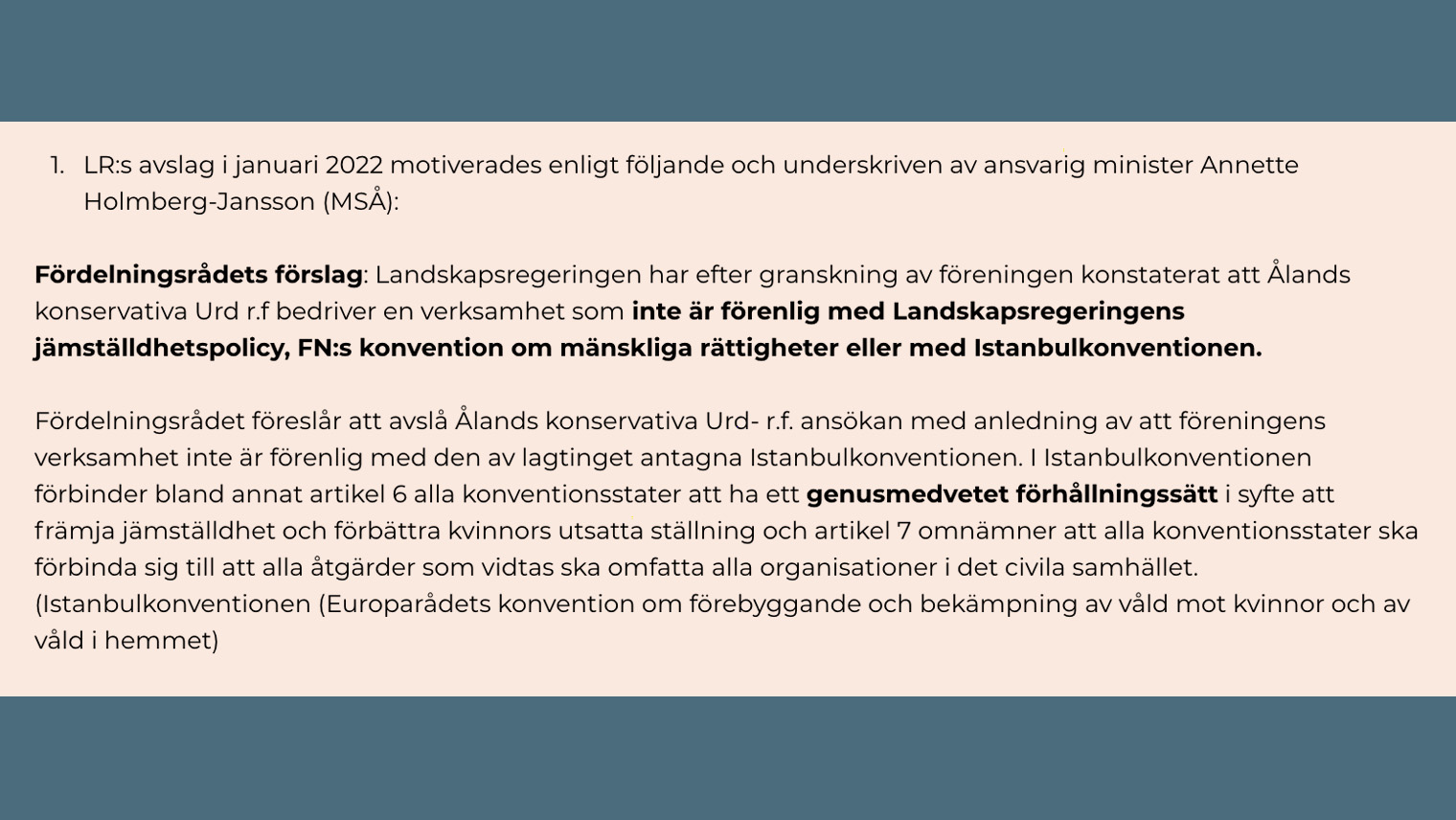
After the rejection, the association appealed, and the Supreme Administrative Court considered that the process needed to be redone. The substantive issue was not examined. When the case returned to the regional government, the same quotes and questions reappeared.
A process that looked the same – regardless of the government
When the handling started over, the authority requested clarification of the association’s views on “equality, violence, and racism.” The latter concerned a shared Facebook post where Anette linked to an article from the magazine Kvartal about the American school system.
“You were not allowed to think that,” Lehtinen tells Samnytt.
Meanwhile, Åland had held elections and the government had changed. A moderate minister responsible for the initial decision had been replaced by a socialist in the next. But according to Anette, there was no difference in how the case was handled.
“We didn’t really notice any difference in their approach. The same difference,” she says.
READ ALSO: The Mannaminne Network leads the protests against the breakdown of the rule of law
When the Istanbul Convention was no longer used as a basis, the reference was instead made to Åland’s sustainability agenda, the regional version of Agenda 2030.
“Suddenly, it was that agenda that was used as a justification for us not to receive support,” she says.
She reflects on how many officials are trained in the same theories and frameworks, regardless of which government is in power.
“Officials are trained in these theories… and then they come out as police officers or lawyers and believe that this is for real,” she says.
This is something Samnytt has previously written about, when we looked at the activities of the association Mansfrid Sverige. Magnus Falkman, who is the chairman in Sweden, also argues that it is the educational material itself that leads astray.
READ ALSO: Feminist filter: How violence against men is swept away from the government’s educational material
For Anette Lehtinen, therefore, it is not the individual rejection that is most important, but what the process says about which perspectives are allowed in the public sphere. When she follows how concepts and guidelines are used, she sees the same thresholds as Samnytt has previously described: that activities that highlight men’s vulnerability risk ending up outside the framework, even when they rely on official statistics from several Nordic countries.
The conservative association in Åland chose not to provide any further explanations.
“We thought that this will either make or break. We will not play that game. The conversation turns to how the media influences the debate,” she says.
What role do you think traditional media has played in spreading this narrative?
“Huge, almost bigger than politics, I would say. They are completely uninterested in highlighting any other perspective than men’s violence against women,” she says.
Immigrated Swedes and an unexpected similarity
During the conversation, Anette also describes how many of the association’s members have immigrated from Sweden. Several of them state that they sought Åland in hopes of a different societal climate. But after a while, many make the same observation:
“The majority are Swedish immigrants who, in good faith, have moved here and thought that it was fantastic. And then suddenly you see that no, here it was the same as in Sweden,” she says.
The similarities are not always noticeable in everyday life but become visible when you follow how authorities interpret guidelines and documents.
“So it is exactly the same ideologies that dominate here,” Lehtinen says and discusses how mass migration has affected Sweden.
Åland, with about 30,000 inhabitants, is quickly affected by changes, she tells Samnytt.
“If it starts, it goes very fast here… if you get a couple of hundred here, it’s all over,” she says.
An experience that many recognize
Which document ultimately had the greatest significance in the decision about the association’s support cannot be fully established. Yet, the case follows the same pattern as Samnytt has previously reported: how questions about women’s violence against men often end up in the background or provoke a stronger reaction than the statistics themselves or the individual stories.
This also applies in Åland. Anette describes how even the formulation that “violence in close relationships can go both ways” became a point that authorities returned to in their assessment. It is something she recognizes from the Swedish debate – and something that several Swedes who have moved to Åland also believe they see when they engage locally.
READ ALSO: Men discouraged from reporting violence – and a legal system that does not want to listen
For Anette Lehtinen, therefore, it is not the individual rejection that is most important, but what the process says about which perspectives are allowed in the public sphere. When she follows how concepts and guidelines are used, she sees the same thresholds as Samnytt has previously described: that activities that highlight men’s vulnerability risk ending up outside the framework, even when they rely on official statistics from several Nordic countries.
It is in the reflection between two countries – and two similar ways of handling the issue – that Anette places her own experience. And it leaves her with a quiet conclusion: that in Åland, as in Sweden, it is still difficult to have a broad conversation about violence in close relationships – and that it is still taboo to talk about women’s violence against men.
READ ALSO: 800 bombings later – Swedes seek shelter on Åland