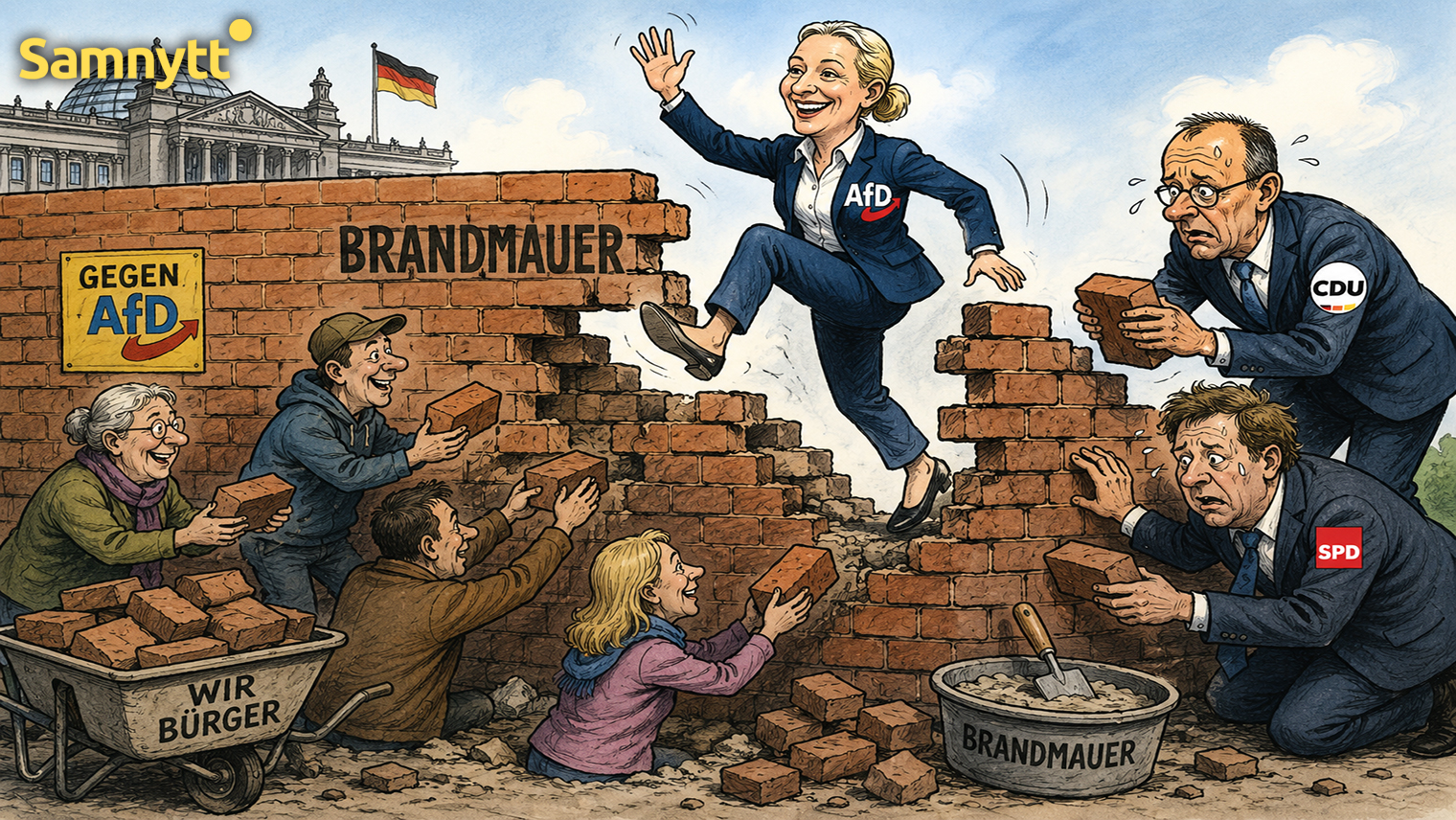
Germany’s political establishment has for years tried to keep Alternative für Deutschland away from all political influence. But the so-called Brandmauer (firewall) strategy has not stopped the party. On the contrary, AfD has grown, while the established parties’ ability to form functional governments has become increasingly limited. Now the question comes to a head in Saxony-Anhalt, where AfD polls above 40 percent. In the midst of this development, a vice-chairman of the large German police union GdP has also urged police officers to prepare to refuse orders under a future AfD government—a move that has sparked an intense debate over where the defense of democracy ends and the undermining of democratic elections begins.
There are few political symbols that say more about today’s Germany than a demonstration in Bitterfeld, Saxony-Anhalt. There, Christian Democrats from the CDU gather together with Social Democrats, Greens, and representatives of the far-left Die Linke under the slogan Bunt statt braun—”colorful instead of brown”—to protest Alternative für Deutschland, AfD.
It is rare for conservatives and Marxists to find themselves on the same side. But ahead of the state election in Saxony-Anhalt on September 6, it has become an expression of how dramatic the political situation has become. According to the analysis published by The Economist, AfD polls above 40 percent and may, under a proportional voting system where absolute majorities are normally very rare, get the chance to form the first AfD-led state government in Germany’s history.
“Die brandmauer” That Became a Political System
For several years, the established parties’ management of AfD has been based on the so-called Brandmauer—firewall. Above all, the CDU has made the principle central. The party formalized as early as 2018 a prohibition against political cooperation with both AfD and Die Linke. In Sweden, the same policy long prevailed towards the Sweden Democrats.
AfD has been accused of being one of the more radical “right-wing populist” parties in Europe, of racist rhetoric, and of being pro-Russian despite the invasion of Ukraine. Preventing such a party from gaining governing power, thanks to such rhetoric, is portrayed not as ordinary party tactics but as a defense of the Federal Republic’s democratic foundation. Again, there are strong similarities with how rhetoric has sounded towards the Sweden Democrats.
SEE ALSO: Alice Weidel: AfD Will Take Power – Here Are the Reforms the Party Leader Wants to Implement
But over time, the firewall has developed into something much bigger than a ban on coalition cooperation, something more akin to political persecution. As The Economist describes, it has almost become an organizing principle for public life. Bills cannot be pursued if they risk depending on AfD votes. Parliamentary rules have been changed to prevent AfD from blocking judicial nominations. The party’s members have been kept away from posts like vice president of the Bundestag—and even from the parliamentary football team. Outside of politics, business organizations have withdrawn invitations to AfD politicians after protests. The problem is that the strategy has not achieved its goal—if anything, just the opposite.
AfD Has Doubled Its Support
When Friedrich Merz, now Chancellor and CDU leader, promised in 2018 to halve AfD’s voter support, the idea was that CDU, through stricter migration policy and competent governance, would win back voters from the right. The result has been the opposite.
Illegal immigration has fallen sharply, but at the same time, AfD has toughened its rhetoric, including demands for remigration and talk of “population replacement” in the same way as the Sweden Democrats in Sweden. The rhetoric has resonated with the German people. The CDU is near record-low poll numbers, while AfD for months has been far ahead. Since Merz promised to halve the party’s support, it has instead doubled.
This is where The Economist’s analysis becomes especially interesting. “Die brandmauer” has not only failed to weaken AfD. In several respects, it has actually helped to strengthen the party. No one likes an anti-democratic bully, and that is how many voters perceive firewall politics.
SEE ALSO: New Poll: AfD Largest Party – Establishment Parties Plunge
In municipalities and states where AfD is the largest party, the principle becomes increasingly difficult to practice. Bitterfeld’s CDU mayor Armin Schenk wants to keep what he describes as an extreme right-wing AfD away from power. But in his own municipality, he notes that the firewall does not exist in practice—AfD holds 15 of the town council’s 40 seats, and many decisions simply cannot be made without the party’s participation.
When Everyone Else Has to Govern Together
At the state level, the paradox becomes even clearer. After AfD’s strong election result in 2024, Saxony and Thuringia ended up with CDU-led government formations that are politically precarious or unstable. When parties from right to left are forced to cooperate to keep a large opposition party out of power, it simultaneously reinforces AfD’s own narrative of the others as “Kartellparteien”—cartel parties that are really all part of the same political system. In Sweden, the Sweden Democrats have talked about the “seven-leaf clover” as a similar unholy alliance.
Saxony-Anhalt could take the contradiction to its logical conclusion. If AfD wins an outright majority, the firewall no longer matters. But if the party falls just short, the CDU may be forced to seek support from essentially all other parties, including Die Linke, to keep AfD out of government. If AfD, at the same time, became twice as large as the CDU but was still excluded from government, The Economist notes, the question of the political system’s democratic legitimacy would no longer be asked solely by AfD’s own voters.
SEE ALSO: German Christian Democrats Open to Cooperation with the Left—to Stop AfD
Thus, the CDU has painted itself into a corner. In practice, “die brandmauer” means that a traditional center-right party can only seek coalition partners to the left. This is especially true of the Social Democratic SPD, which despite having imploded to single-digit voter support, has found itself in or near federal power for almost the entire period since 1998.
Dissatisfaction among voters is also growing. Support for the principle of maintaining a firewall against AfD has, according to The Economist, fallen from a clear majority to 41 percent and looks set to drop further as the pro-German party grows and its problem framings gain even stronger support in German everyday life.
Hard for the CDU to Tear Down the Wall
At the same time, there is no easy retreat. If the CDU abandons the firewall, the party risks splitting and losing voters in the other direction. The experience is discouraging. When the CDU in Thuringia voted together with AfD in 2020 to elect a prime minister, it triggered a political storm that contributed to the fall of CDU leader Annegret Kramp-Karrenbauer.

When Merz in January 2025 had the CDU vote with the AfD in symbolic measures against migration, massive protests followed, and the left party Die Linke was strengthened in the subsequent election. CDU now faces a dilemma without any obvious solution—cooperate with AfD and risk an internal revolt, or continue to isolate the party, thus making increasingly unlikely coalitions necessary.
Isolation Releases AfD from Responsibility
Perhaps even more troubling is The Economist’s conclusion that the firewall has changed AfD’s own incentives. In other European countries, populist parties have at times moderated their positions to become governing-capable and accepted as coalition partners. AfD does not need to do this. If all other parties announce in advance that cooperation is ruled out, there is no price to pay for continued so-called radicalization.
AfD MP Torben Braga describes the mechanism unusually openly. Those who wanted to move the party to the center have lost the debate, he says, since the election results keep improving without any such change. At the same time, there is a fear that purging the most extreme forces would alienate parts of the electorate. “The Brandmauer protects us from having to deal with very difficult questions,” Braga observes.
This also applies to governing capability. According to The Economist, AfD is plagued by scandals, power struggles, and internal conflicts, not least regarding foreign policy, and is claimed to lack a coherent government program. But as long as the party is permanently excluded from power, it never needs to prove its promises work in reality.
Political scientist Christian Stecker at Technische Universität Darmstadt sums up the problem—the firewall protects AfD from the possible disappointment that democratic accountability usually brings. A party that never has to govern can promise almost anything. In Sweden, however, support for the Sweden Democrats has not waned during the current term even though they are not in the government, but have in practice been seen as a governing party through the Tidö Agreement.
Next Step: Ban the Party?
As isolation strategies have not worked, some politicians have begun to advocate for an even stronger instrument—a ban on AfD. The German constitution has, since the days of Nazism, allowed the banning of parties that attack the democratic constitutional order.
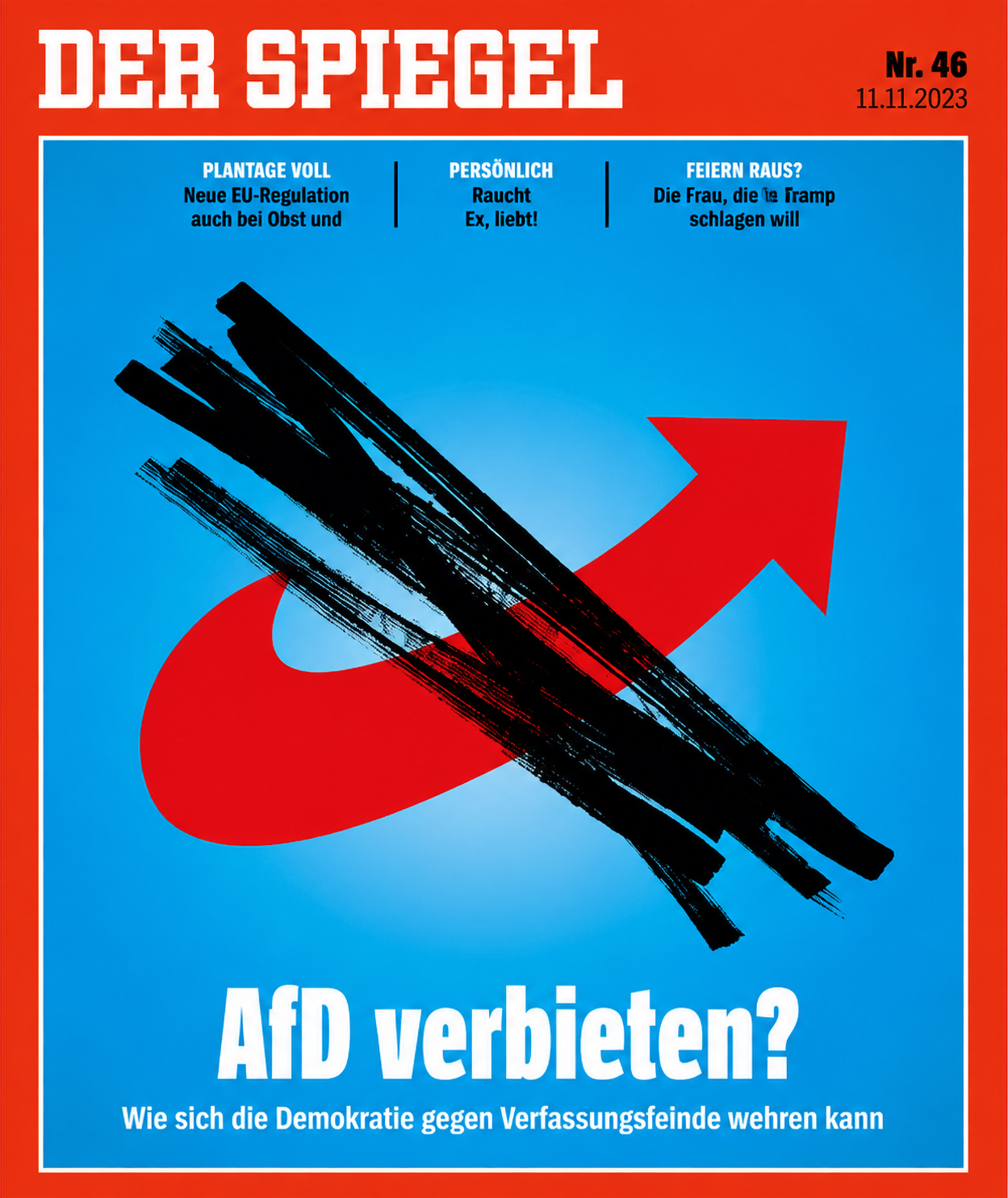
But this path is also problematic. It is uncertain whether there would be enough parliamentary support, and a ruling in the constitutional court could take several years. In the meantime, AfD continues to grow.
SEE ALSO: Politicians Try to Ban AfD
Accusations against the party of being undemocratic are also more political than objective. At the same time, another discussion has opened that illustrates how far the conflict around AfD has now come.
Police Union Leader: Prepare to Refuse Orders
Sven Hüber, vice president of the large police union Gewerkschaft der Polizei, GdP, published an article in the August issue of the union’s magazine titled “Is There an Elephant in the Room… Saying No the Right Way”.
The starting point is the possibility that AfD will get government responsibility and control over an interior ministry in a German state. Hüber reminds police officers of their oath to defend the constitution and argues this means an obligation to actively defend the free democratic order. According to his reasoning, police cannot accept forces that are hostile to the constitution, regardless of political or religious background, and he claims AfD is such a force. A very large share of the German people, however, do not agree.

GdP complemented the article with a brief information sheet about civil servants’ so-called Remonstrationspflicht—the duty to object to what is assessed as an unlawful order. A police officer who believes an order is criminal is encouraged, according to the materials, to refuse to follow it and state their legal objections.
In Deutschlandfunk’s account, the reasoning goes further. Hüber urges his colleagues in Saxony-Anhalt to prepare for a possible AfD government, and writes that under certain circumstances police may need to resist, something reminiscent of a military coup in countries where the “wrong” party has taken power in general elections.
Measures against an AfD government, in his view, would be legitimate if the government violated the constitution. He further points out that riot police, on orders from the federal interior minister, must, together with Bundespolizei, be deployable in another state to restore constitutional order.
The important thing to understand about this controversy is to distinguish between two claims. That a German police officer should not carry out an illegal order is not, in itself, a revolutionary principle. The controversial issue is that the reasoning is explicitly placed in the scenario where AfD, after democratic elections, takes over the government—a scenario critics argue risks preemptively treating such a government as a constitutional threat without objective grounds.
The Police Union Itself Distances Itself
The reactions were so strong that GdP’s largest regional organization, North Rhine-Westphalia, publicly distanced itself from its vice chairman. The organization emphasized that the service oath does not deprive police of their right to vote, and that a union decision not to cooperate with AfD can be a legitimate political position—but that this is not a legal consequence of the police officer’s oath.
Hüber’s theses were described as too extreme and in some areas also legally incorrect. GdP North Rhine-Westphalia simultaneously stressed that the police must of course be alert to threats to the rule of law from radical parties, regardless of political direction, but that action must be based on the constitution and current law, not sweeping politicized statements.
Deutsche Polizeigewerkschaft, DPolG, also reacted strongly. Its chairman Heiko Teggatz called the scenarios largely unrealistic and accused the GdP of trying to exert political influence over its members.
Historian Hubertus Knabe, former head of the Stasi Memorial in Hohenschönhausen and a well-known critic of East Germany’s communist dictatorship, went even further. He argued that the reasoning was reminiscent of the worldview of East Germany and noted Hüber’s background as a political officer in the East German border troops. According to Knabe, in practice, the statement means that police are being prepared to refuse to obey a government that has come to power through democratic elections.
A Democratic Paradox Increasingly Hard to Avoid
The two debates—over the firewall and over the police’s relationship to a potential AfD government—are at root about the same problem. How does a democracy defend itself against a party its opponents view as a threat to democracy when that party simultaneously gains support from an ever-larger share of voters? Is the threat really to democracy itself, or is it in reality only to the sitting political power?

Germany’s established parties regard parts of AfD as extremist based on what they themselves consider to be real and serious grounds. Whether this is objectively true, however, there are divided opinions about. The Economist’s analysis meanwhile shows the political costs of a strategy where isolation in practice becomes permanent and all other political collaboration is subordinated to the goal of keeping a certain party out of power. Sweden has had similar bad experiences during the period 2010–2022.
SEE ALSO: AfD Big Winner in State Elections in Germany
“Die brandmauer” was intended to weaken AfD. Instead, the party has doubled its popular support. It was supposed to protect traditional parties. Instead, it forces them into ever more inexplicable, unholy coalitions. It was supposed to isolate AfD’s allegedly extreme elements. Instead, it has reduced the party’s incentive to liberalize and freed it from the responsibility and willingness to compromise that usually comes with governing power.
Now, moreover, the even more sensitive question arises as to what happens if voters actually give AfD the government. In a rule-of-law state, no government, no matter how large the democratic majority behind it, is entitled to give illegal orders. Police and other public officials are bound by law and constitution, not by a government’s unlimited will.
But that principle also applies in the other direction—a democratically elected government cannot be treated as illegitimate in advance simply because it consists of a party that large segments of the political establishment see as dangerous or as a threat to their own political power.
That is why Hüber’s statement is so explosive. It puts a finger on the conflict that the firewall has so far managed to postpone. As long as AfD could be kept far from government, the question was theoretical. Now that the party approaches or surpasses 40 percent, it becomes concrete.
Germany may thus be approaching a point where it is no longer enough to ask how AfD can be stopped. The tougher question is how the democratic state should relate to the fact that a very large part of its own voters no longer accepts the political boundaries the established left-liberal system has tried to uphold.
And that may be the most worrying conclusion in The Economist’s analysis—the old order still holds together, but the very mechanism that was supposed to protect it may at the same time have contributed to making its future much more uncertain.