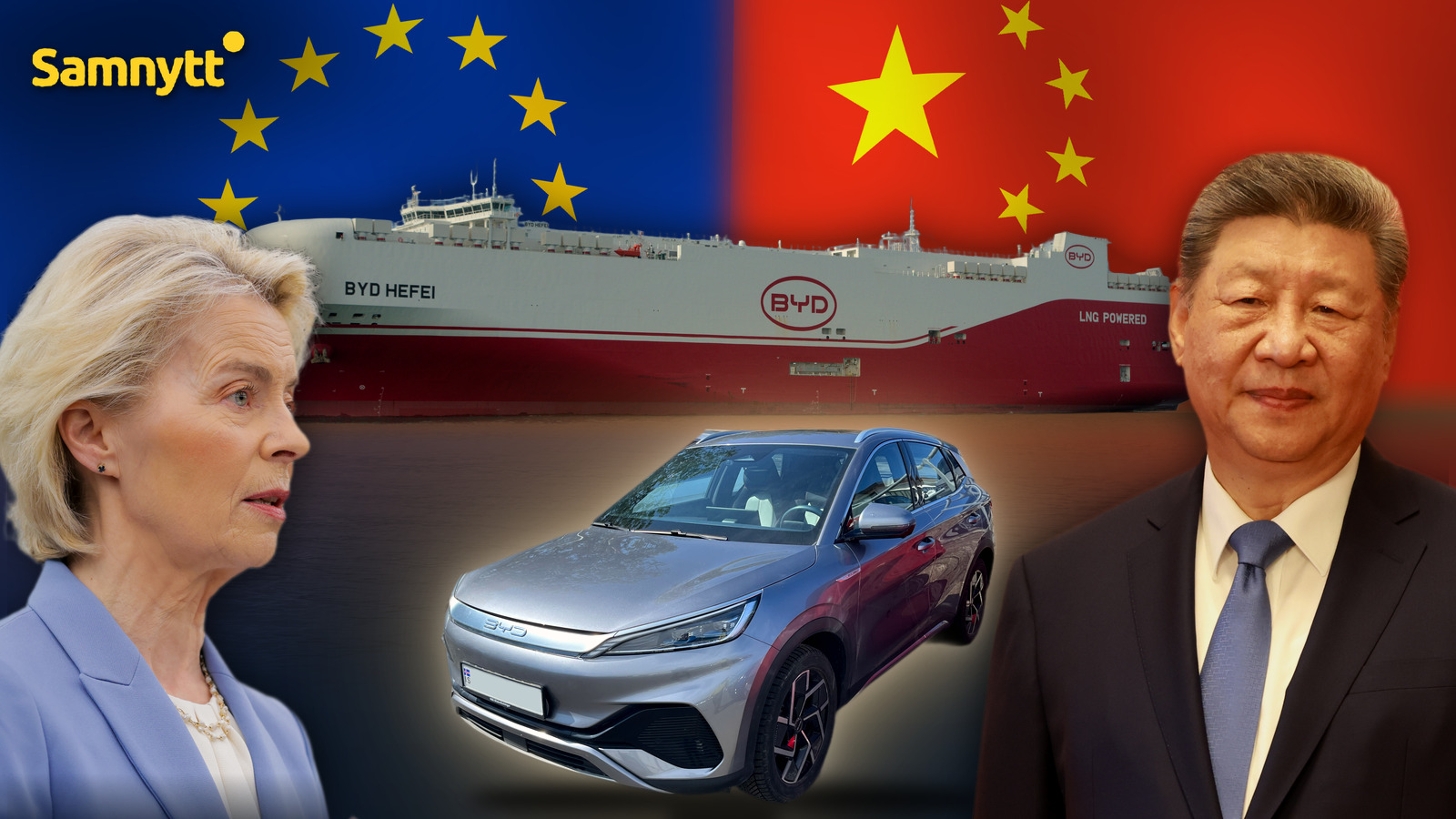
China has rejected the EU’s attempt to persuade the country to voluntarily curb the rapidly growing export of hybrid cars to Europe during the ongoing “green transition.” The statement comes as the European Commission seeks a solution to ease the trade conflict without having to introduce new punitive tariffs.
EU Trade Commissioner Maroš Šefčovič began two days of talks in Beijing on Thursday. Ahead of the meetings, the EU had attempted to get China to agree to a limitation on the export of hybrid cars to the European market. The idea was for China to remain around 15 percent of the EU market, compared to today’s level of over a third. This is reported by the Financial Times.
But according to two diplomats familiar with the plans, the Chinese government has said no. EU officials informed member countries of the response on Wednesday, which means the Commission is now considering other ways to limit imports.
One alternative being discussed is a temporary so-called safeguard measure that can be used to restrict imports even without the EU having to prove that China has engaged in unfair trade practices.
READ ALSO: Wallenberg: The EU Has Gone Too Far – Risks Shooting Europe in the Foot
The model would mean that Chinese car manufacturers could sell a limited number of hybrid cars on the EU market. For vehicles sold beyond that cap, a sharply increased additional tariff could be imposed.
Could Affect More Countries
According to the diplomats, the EU hopes to find a level that China can accept without responding with its own trade barriers. At the same time, there is a problem. Such a safeguard measure would likely also need to include other countries exporting hybrid cars to the EU.
This includes countries such as the UK, South Korea, and Japan. These countries would then receive their own quotas based on their previous exports to the EU.
READ ALSO: China and Saudi Arabia Sell Russian Gas and Oil to Europe
The European Commission’s goal is to find at least one measure that can reduce China’s growing trade surplus with the EU, without escalating the conflict.
Chinese Countermeasures
One option is to introduce new tariffs or other punitive measures, but there are concerns that such decisions would lead to Chinese countermeasures and a rapidly escalating trade conflict.
The background is that the EU has already imposed extra tariffs on Chinese-made electric cars after an investigation into state subsidies. These tariffs can reach up to 35 percent on top of the ordinary EU tariff of 10 percent.
After the EU’s new tariffs on electric cars, exports of Chinese hybrid cars to Europe have increased sharply – and have become a new point of contention between Brussels and Xi Jinping’s government in Beijing.
READ ALSO: EU Official on Criticised Trade Agreement With the US: Important Not to Please Russia and China