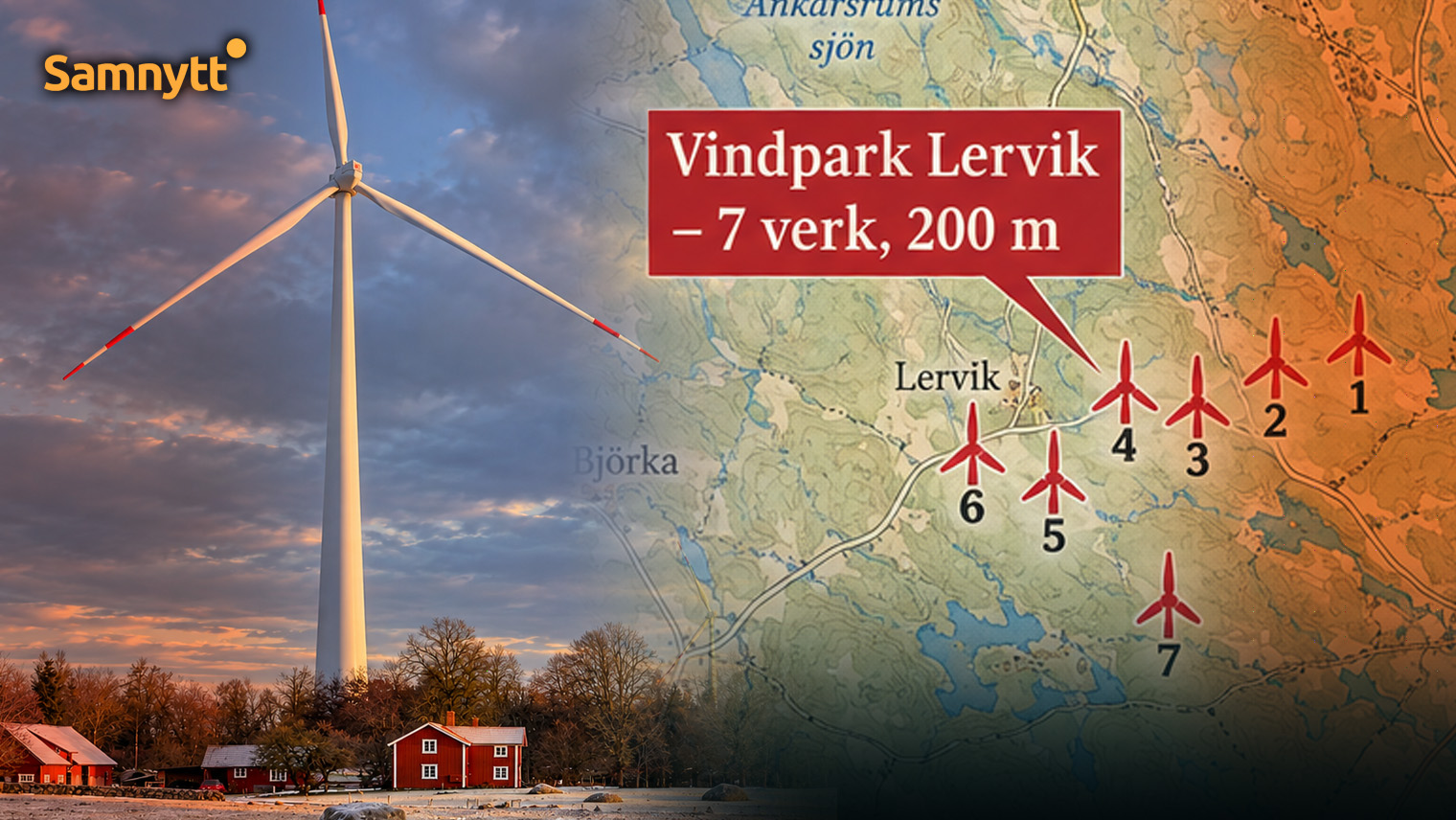
Five wind turbines stand within a kilometer of Kjell-Åke Arvidsson’s childhood home outside Hjorted. The closest is about 650 meters from his house. Together with Peter Jangeby and Åsa Borger, he describes how life has changed since the 200-meter-high towers were erected—while research shows wind turbines can decrease the value of nearby homes by 10–15 percent or more.
“It’s a constant noise. That’s what never used to exist before,” says Kjell-Åke Arvidsson.
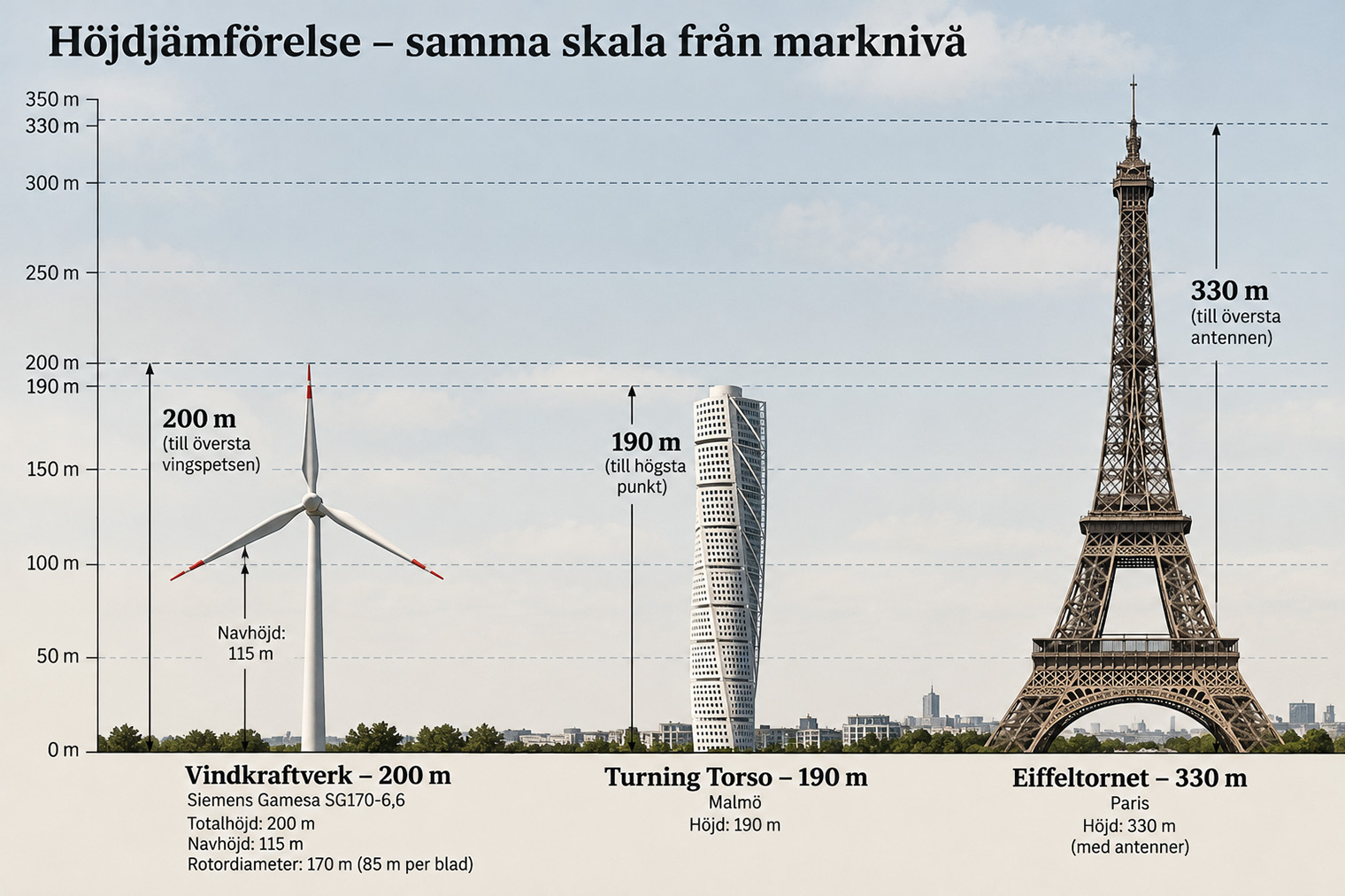
The Lervik Wind Farm is located northwest of Hjorted in Västervik Municipality and consists of seven Siemens Gamesa SG170-6.6 wind turbines. The towers are 115 meters tall, the rotors are 85 meters, and the total height is 200 meters. Together, they have a capacity of 46.2 megawatts and an estimated annual output of about 120 GWh.
At 200 meters, these turbines are taller than Malmö’s Turning Torso (190 meters) and reach just over 60 percent of the Eiffel Tower’s height (330 meters).
Construction began in winter 2023. The turbines were erected in autumn of the same year, and the wind farm was formally commissioned in spring 2024. The permit allowed for eight turbines, but the company decided to build seven.
The three people Samnytt interviewed live at different distances from the park. Arvidsson has about 650 meters to the nearest turbine, Jangeby about 1.3 kilometers, and Borger around three kilometers. Yet all describe how wind power has changed their living environment and quality of life.
Five Turbines Within a Kilometer
Kjell-Åke Arvidsson, 60, lives on his family farm. Except for a period spent elsewhere, this place has been his home since childhood.
“This is my parents’ farm. I was born and raised here.”
Today, he has five wind turbines within a kilometer. The closest is about 650 meters from his house, according to Arvidsson. He describes the area as formerly almost silent, with no traffic sounds or other continuous disturbances. Now there is a persistent noise that never disappears.
“It’s a constant humming, you could say. That’s what never used to be here.”
How does it affect you?
“You always hear that sound as soon as you get up in the morning and open your eyes. And when you’re lying there trying to sleep. That’s what’s sometimes hard.”
READ ALSO: Wind Power Disturbs Neighbors – County Administrative Board Drops the Case
Arvidsson says it’s not just the swooshing of the blades.
“It’s a mechanical noise. A humming noise, from the gearboxes inside the turbines.”
Three residences around Lervik were identified before construction as being located in an area where the calculated noise level was close to the reference value. Västervik Municipality stated that the company would measure the noise after commissioning and the environmental and building committee could also check after complaints.
This takes a mental toll. The thought has crossed my mind to move somewhere else where I can find peace and quiet.
Peter Jangeby, Västervik Municipality
For Arvidsson, the difference compared to life before wind power is hard to describe in decibels. It’s about the noise and lights that were never a part of the home environment before now becoming unwanted elements.
“The Thought Has Crossed My Mind to Move”
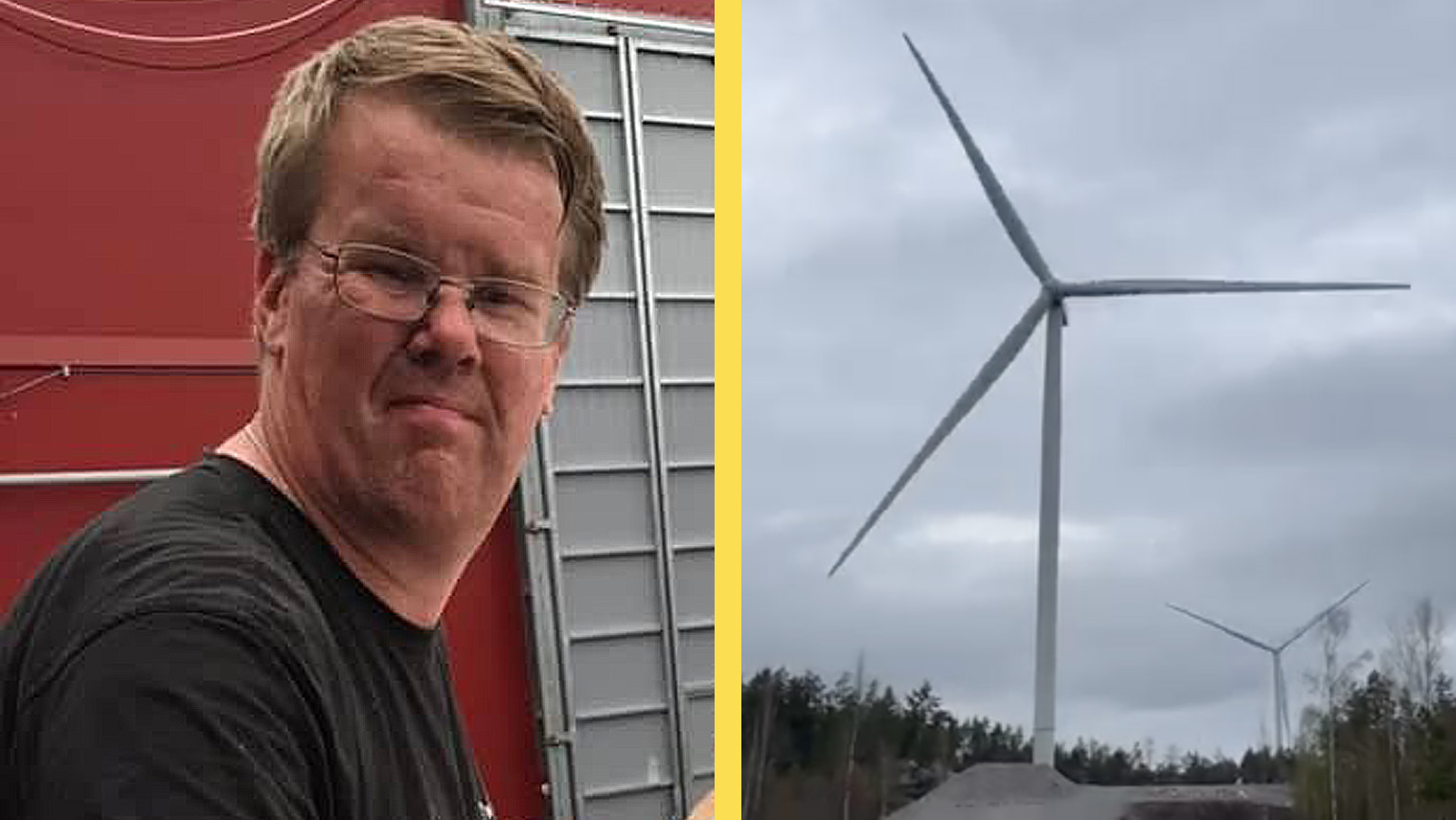
Peter Jangeby moved to the area in the summer of 2013. The nearest wind turbine is about 1.3 kilometers from his home, while the others are further away.
He describes how the disturbance varies with weather and wind direction. Some days are much quieter; other times, there’s a grinding and pulsating noise.
But it’s not only his home that has changed. His relationship to the surrounding nature has also been affected.
“The places I used to go to, if I visit them today, they’re not pleasant anymore. If the wind is in the wrong direction, there’s a hell of a swooshing sound.”
How has it affected you personally and how you feel in your home today?
“This takes a mental toll. Sometimes I consider moving away and finding peace and quiet somewhere else.”
For Jangeby, the lost tranquility is what he feels most keenly. Areas in the forest he once visited for the experience of nature are no longer the same when the turbines are audible. He has also had his property appraised, but isn’t sure what it would actually fetch if sold with the turbines in place. For him, the reasoning is simple.
“If I go house-hunting in the countryside and see this view, I’d just turn around and drive home.”
READ ALSO: Wind Power an Economic Total Flop: “No Profitability”
“The Sound of an Airport”
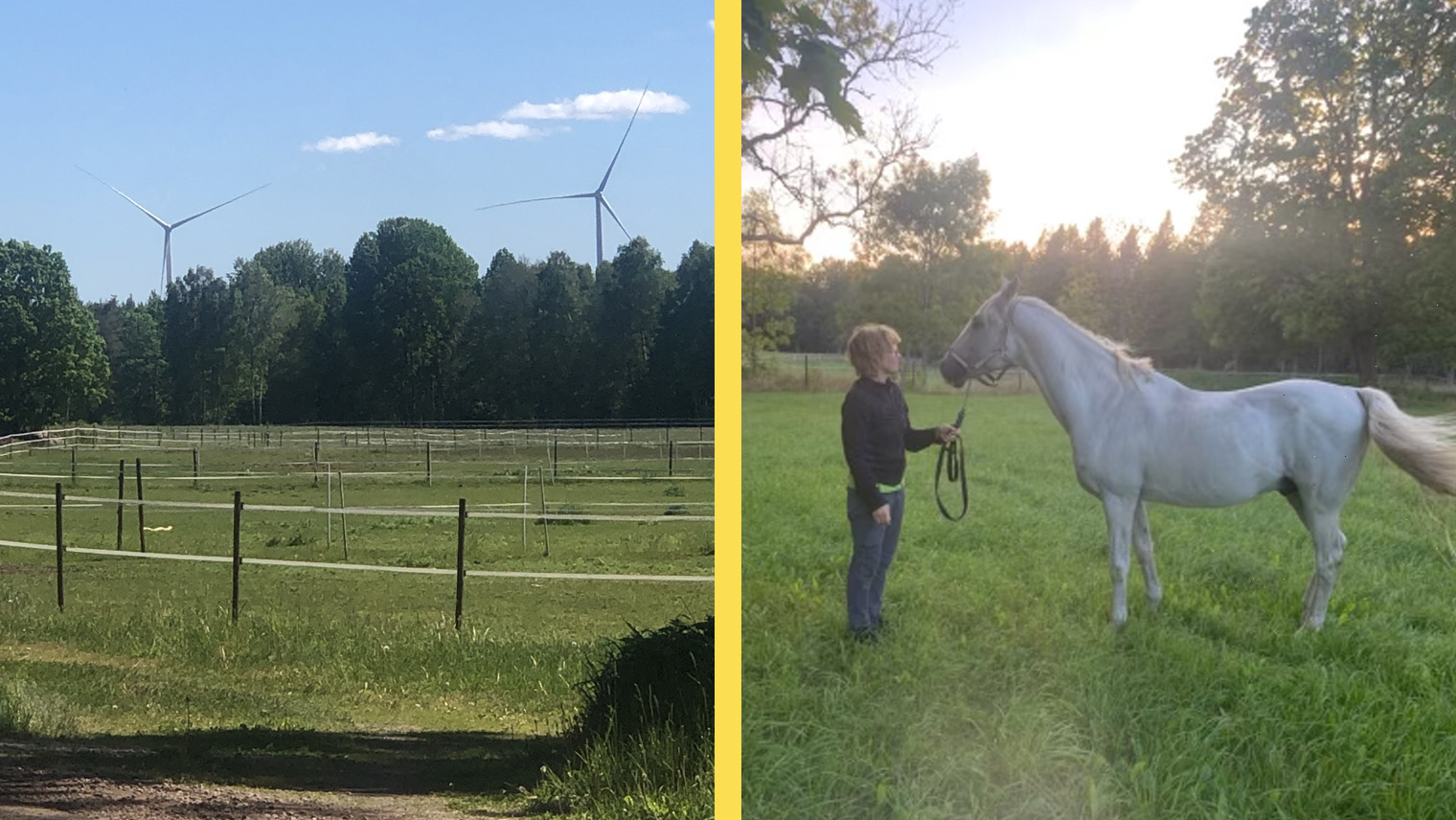
Åsa Borger lives much further away. She moved to her farm in 2011. The property is about 20 hectares and she keeps, among other things, horses there. From her house, it’s about three kilometers to the wind turbines, but she still hears them.
“The noise can be really loud here too. Not very often, but in certain weather, like southern wind and humid air.”
She sometimes compares it to the sound of an airport.
“Some days we don’t hear them at all. But when it’s disturbing, it’s really disturbing. It’s hard to sleep.”
READ ALSO: Swedish Armed Forces: Wind Power a Threat to National Security
Sometimes, the only option is to close the windows. But for Borger, this solution illustrates the problem itself. She didn’t move to the countryside to have to shut out her surroundings.
“When you have a farm, you spend a lot of time working outside.”
READ ALSO: Asbestos Found in Several Wind Turbines: “Just the Beginning”
From the part of the farm where she works with the horses, she can clearly see four of the seven turbines.
“Visually, it’s a huge difference. I feel bad every day I see them. I get angry too.”
You feel run over, and as if someone has stolen something from the peace and nature you used to have. // We got no information at all.
Åsa Borger, Västervik Municipality
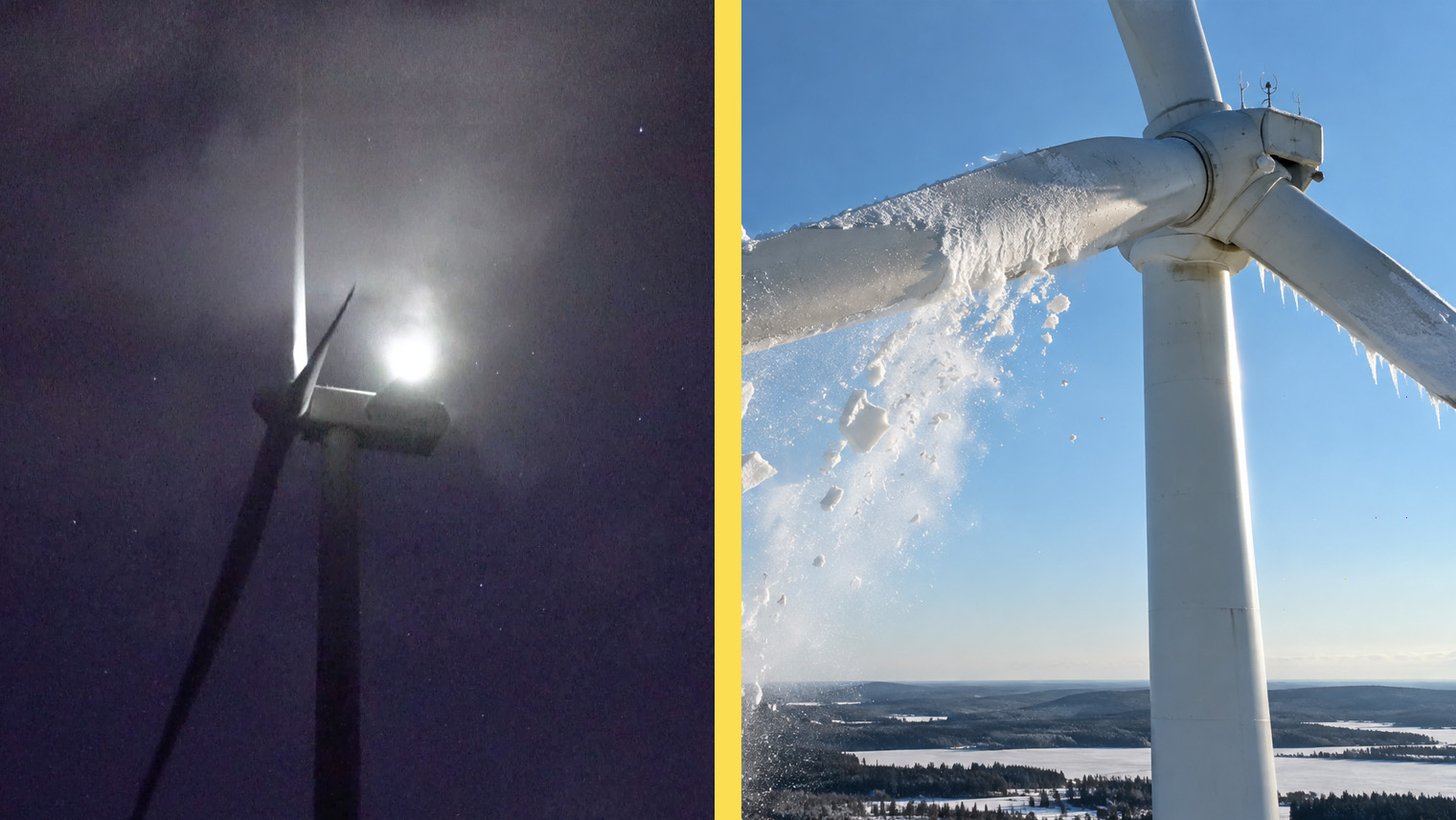
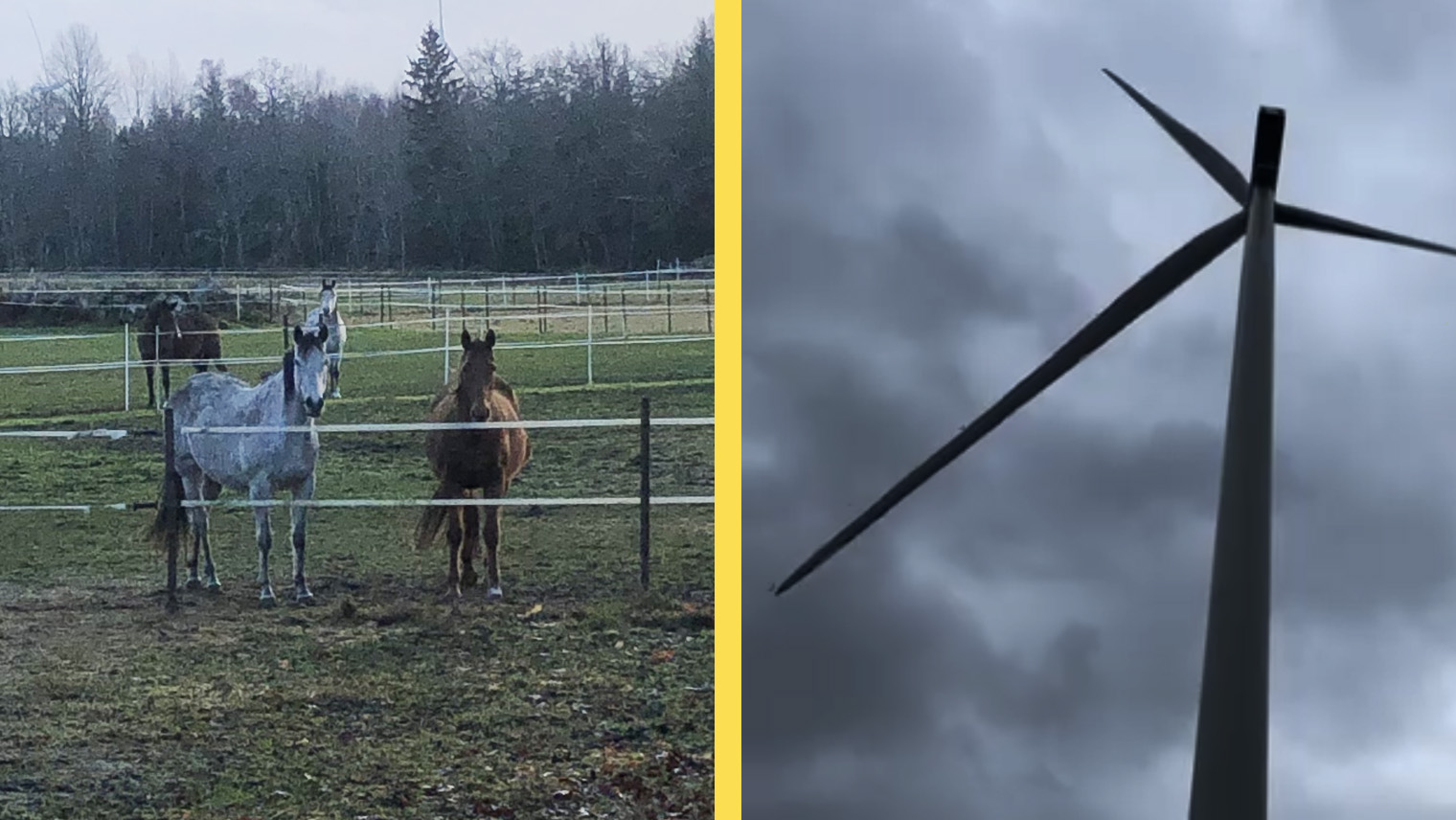
Borger also says that at one point, when the turbine noise was especially strong, she noticed the horses appeared stressed. During the dark season, the blinking aviation lights add to the disturbance.
“If it’s humid, the light spreads out. And it blinks rapidly too.”
She finds it hard to believe that anyone who hasn’t lived next to modern wind turbines really understands the scale.
“I think it’s difficult to understand until you’re affected yourself. It’s only then you start looking into things.”
READ ALSO: The Wind Turbine’s 79-Meter Blade Flew Off
“Someone Has Stolen Something”
When Borger describes what’s really been lost, it’s less about kilowatt-hours or decibels. It’s about the place she chose to live.
“You feel run over, and as if someone has stolen something from the peace and nature you used to have.”
She’s also critical of the information process before construction. Borger says her family received no information at all when the project was first planned, and only found out much later, in connection with a cable installation query.
“We got no information at all.”
READ ALSO: Expert: Sweden Doesn’t Need Any More Wind Turbines
The project changed owners during the long process leading up to construction. Samnytt has not been able to determine exactly what information was sent to Borger’s household at the different stages.
Shadows Over the Family Farm
For Arvidsson, the problems aren’t limited to sound. During parts of the year, the rotor blades pass in front of the sun and cast moving shadows over his home.
“Now the shadow period begins for me. It’s between October and March, when it’s sunny.”
Lervik has a system intended to limit shadow flicker. Before construction, the municipality said the turbines would have automatic shadow controls and shut down when risk thresholds were exceeded.
Arvidsson says the allowed shadow time has already been used up before his own worst shadow period has even started. He criticizes Västervik Municipality, which is responsible for oversight, arguing the rules become meaningless if the turbines keep operating anyway.
“Those eight hours are already spent by the time my period begins. They should be shut off.”
He feels the municipality fails to carry out proper checks.
“The municipality is the oversight authority. But nobody cares.”
The proximity also affects work on his own land. Arvidsson works in the forest and says his property line lies about 200 meters from one of the turbines.
In winter, he worries about ice throw from the rotor blades.
“I work there with a chainsaw.”
He says he doesn’t know of any actual ice throw accidents at Lervik, but the risk is always in the back of his mind when working close to the turbines.

Research: Homes Near Wind Turbines Lose at Least 10–15 Percent in Value
For homeowners, another question arises: what happens to property values? Arvidsson won’t put a number on his own farm.
“I can’t give any figures, but I think it’s obvious that the value has been affected.”
He also has a holiday home on the property that he could sell.
“It’s probably not a good deal today. I don’t think so.”
READ ALSO: Municipalities Abandon Wind Power After Failure – Trying to Sell
Jangeby has already had his property appraised, but the real test will only come if and when it’s listed and potential buyers see the turbines. There is now extensive Swedish research showing wind power actually affects house prices.
Professors Hans Westlund and Mats Wilhelmsson analyzed over 600,000 Swedish house sales between 2005 and 2018. The study was published in 2025 in the journal Economic Analysis and Policy.
They simply don’t care about the countryside. As long as we don’t have wind turbines in Stockholm, nothing will change, unfortunately. Those who make the decisions have probably never visited facilities like this. That’s the first thing they ought to do.
Kjell-Åke Arvidsson, Västervik Municipality
The results show a value drop of about 10–15 percent for properties within two kilometers of wind turbines. The effect diminishes with distance and, according to the study, vanishes between about six and ten kilometers. The researchers also found greater effects in southern Sweden.
READ ALSO: No Compensation for Homeowners Affected by Wind Turbines
The decline in value started as soon as the construction process began and continued after commissioning. This means a homeowner may be financially impacted before the wind turbine has even produced its first kilowatt-hour.
The government has now also taken note of the problem by appointing an inquiry into a possible right for neighbors to demand that wind power companies buy out their property.
READ ALSO: New Billion Krona Support for Wind Power – Taxpayers Take On Some Risk
The premise is that the owner should receive the price the home would have fetched if the wind farm hadn’t been built. The government explicitly states the purpose is to shift the risk of decreased property value from homeowners to operators. The inquiry is to be completed by April 1, 2027.
We’re afraid of this new government, since they support wind power more.
Åsa Borger, Västervik Municipality
Samnytt will soon follow up by contacting local realtors about wind power’s impact on property values, as well as examining how a new government intends to handle the issue.
“Live There for a Week”
For Arvidsson, there is also a political dimension. He perceives a great distance between decision-makers and those who end up living next to the installations. His suggestion for politicians is concrete.
“They should bring a camper and live 100 meters away for a week to experience reality.”
He describes wind power as an urban-vs-rural issue.
“They simply don’t care about the countryside. As long as we don’t have wind turbines in Stockholm, nothing will change, unfortunately.” He continues:
“Those who make decisions have probably never visited facilities like this. That’s the first thing they could do.”
READ ALSO: Threat from Wind Power Halved the Value of Sven and Görel’s House
In 2021, Västervik Municipality decided to pause new wind power projects and use the local veto on further developments until an updated wind plan had taken legal effect.
But the decision didn’t cover Lervik, as the municipality had already approved the project. For Arvidsson, then, the political shift came too late. The turbines already stand around his farm.
Worries About What Will Happen After the Election
After the parliamentary election, there is a new worry among those interviewed—what happens to wind power policy next term? Borger fears a government pushing a more expansive wind power agenda.
“We’re afraid of this new government, since they support wind power more.”
READ ALSO: Green Party: Likes Wind Power – But Not in Our Backyard
No new government has taken office yet, so it’s unclear what energy policy will actually be pursued. But the concern has a concrete political background.
The Social Democrats ran on increasing the pace of wind power expansion. The party wants, among other things, to resume Svenska Kraftnät’s work connecting offshore wind, enable economic support for offshore wind, and introduce a “speed bonus” for municipalities that change a previous wind power veto to a yes.
At the same time, the party wants municipalities to take a stance earlier in the permit process, not abolish the veto. Still, Borger fears municipalities’ ability to say no may be weakened in practice.
“I think it might stay, but I believe they’ll find ways around the veto so it becomes useless.”
She questions how politicians who want to build more wind power reason.
“Do they even read the facts? It’s hard to understand how anyone could think it’s good. It’s so strange.”
READ ALSO: Record Production and Record Losses – Researchers Warn About a Wind Power Crisis
Jangeby also situates his experience in a broader political context. He follows, among others, wind power critics Christian Steinbeck and Christian Sandström and is critical of how wind power’s local consequences are highlighted in public debate.
Jangeby also criticizes public service, which he argues paints an overly positive picture of wind power and plays down the impact on those forced to live with turbines nearby.
For local residents, the issue is no longer theoretical. Changing the national wind power policy may decide whether Lervik is the endpoint of expansion — or the beginning of more.
Next Project: Half a Hectare of Batteries
The energy buildout around Lervik may not be over. Eurowind wants to supplement the wind farm with a battery storage unit of up to 30 megawatts, occupying up to 0.5 hectares.
The environmental and building committee sent the matter back for review in May. The idea is to store electricity so it can be supplied to the grid at times other than when it’s produced.
READ ALSO: Politicians Nationwide Trained in Wind Power – The Industry’s Own PR Agency Leads the Course
For local residents, the plans mean yet another industrial site in the area. Peter Jangeby has campaigned against the battery storage and sees it as yet another intervention in an area already changed greatly by the wind park. Borger is also critical.
“Now new things are popping up, because now battery storage is to be built everywhere.”
What do you think about battery storage in the forest?
“A battery storage isn’t nice either—putting half a hectare of batteries in the forest. What if there’s an accident?”
She says the plans have been appealed by residents closer to the proposed site. For Borger, there is another red line. Västervik has identified areas for new wind power planning, and Tekniska verken has previously worked on a wind power project at nearby Rumhult.
The municipal pause on new wind power means no new parks will be approved until a new wind power plan has legal force. But just knowing more wind power might end up closer to the farm is enough for Borger to have made up her mind if it happens.
“There’s not a chance I’d stay then, I can tell you.”
You would move?
“I’d have to move.”
READ ALSO: Wind Turbine Noise Plagued the Village – Now It’s Being Torn Down
Steinbeck and Blomgren Have Warned
Samnytt has previously interviewed several critics of Sweden’s wind power expansion. Entrepreneur and economist Christian Steinbeck has pointed to wind power’s economics and what he describes as “subsidy capitalism.”

He has criticized situations where high wind output coincides with low demand, pushing electricity prices to zero or into the negative.
READ ALSO: Economist on the Green Transition and Subsidy Capitalism: “It’s Like Planned Economy”
Nuclear energy expert Jan Blomgren has highlighted, from a technical perspective, the issue of weather-dependent production—a power system must continuously balance production and consumption.
Batteries can be used for short-term storage and balancing, but the energy amounts needed to supply an entire country for extended periods are of a completely different order of magnitude.
READ ALSO: Wind Power Fiasco in Germany: The Giant Bankrupt
In Lervik, the national energy debate isn’t abstract. It stands 650 meters from Kjell-Åke Arvidsson’s home. While politicians discuss new electricity production, faster permits and economic incentives, he hears the rotor blades outside the house where he grew up.
“This place was quiet and calm during my childhood. Now it isn’t, anymore.”
investigations?
Appreciate Samnytt? Show it by subscribing or donating.
DONATE VIA SWISH
123 083 33 50