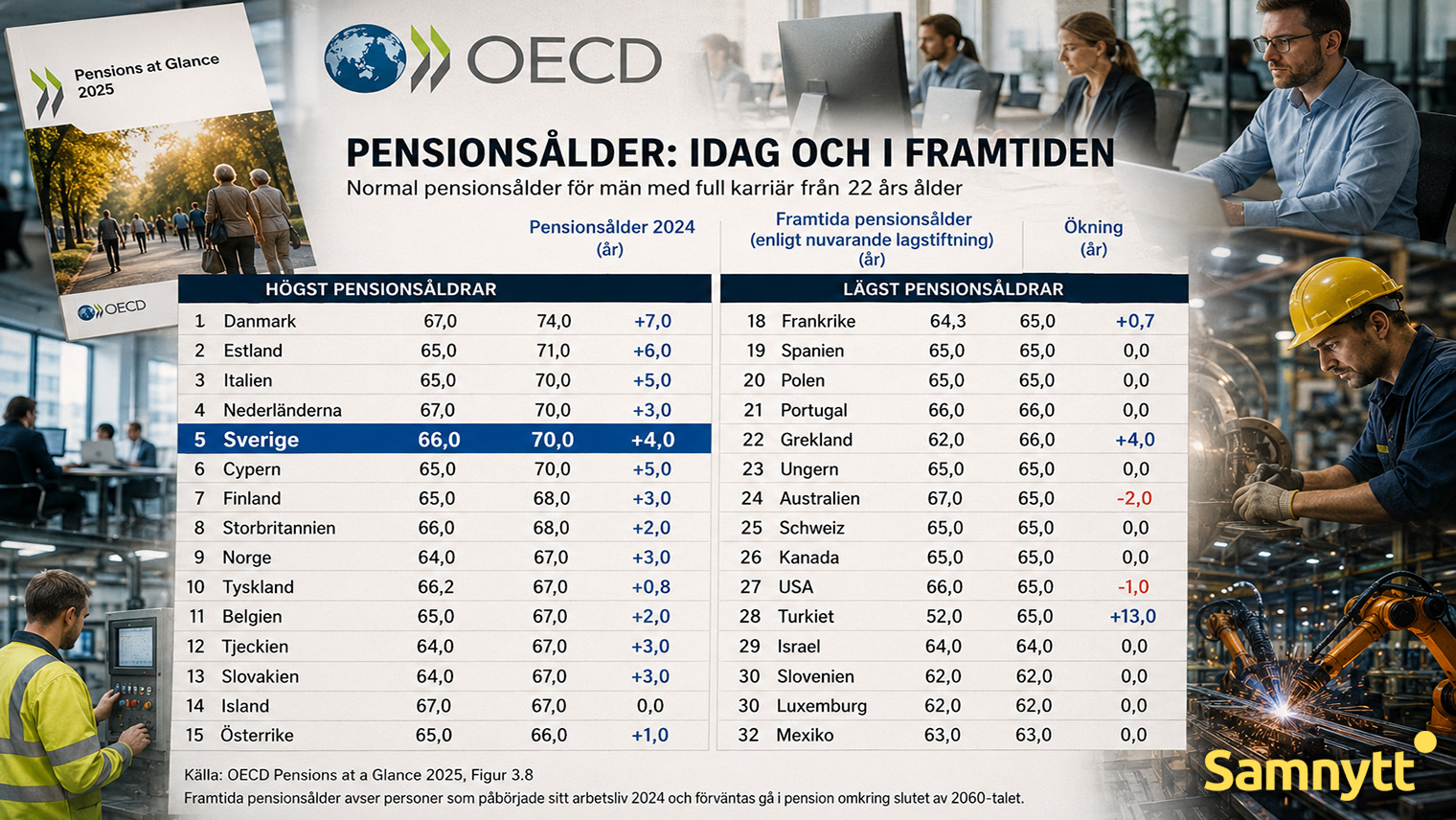
Swedes will need to work ever longer before they can retire. According to the OECD’s latest forecast, the normal retirement age is expected to rise to 70 for the generation now entering the workforce—one of the highest levels in Europe. At the same time, developments raise questions about whether increasing the retirement age is truly the only solution as the labor market rapidly changes, shaped by AI and other structural factors.
The average retirement age in the EU is expected to increase by about two years by the end of the 2060s. For men, it will rise from 64.7 to 66.7 years, and for women from 64.0 to 66.6 years. But Sweden is going significantly further than the average.
According to the OECD report ‘Pensions at a Glance 2025,’ the normal retirement age for those who started working in 2024 is expected to reach 70, for both men and women. This represents an increase of about four years compared to the current level and places Sweden among the countries with the highest retirement ages in Europe.
Only Denmark is expected to surpass this, with a retirement age as high as 74, while Estonia will reach 71 years. Italy, the Netherlands, and Cyprus are also expected to end up at 70 years.
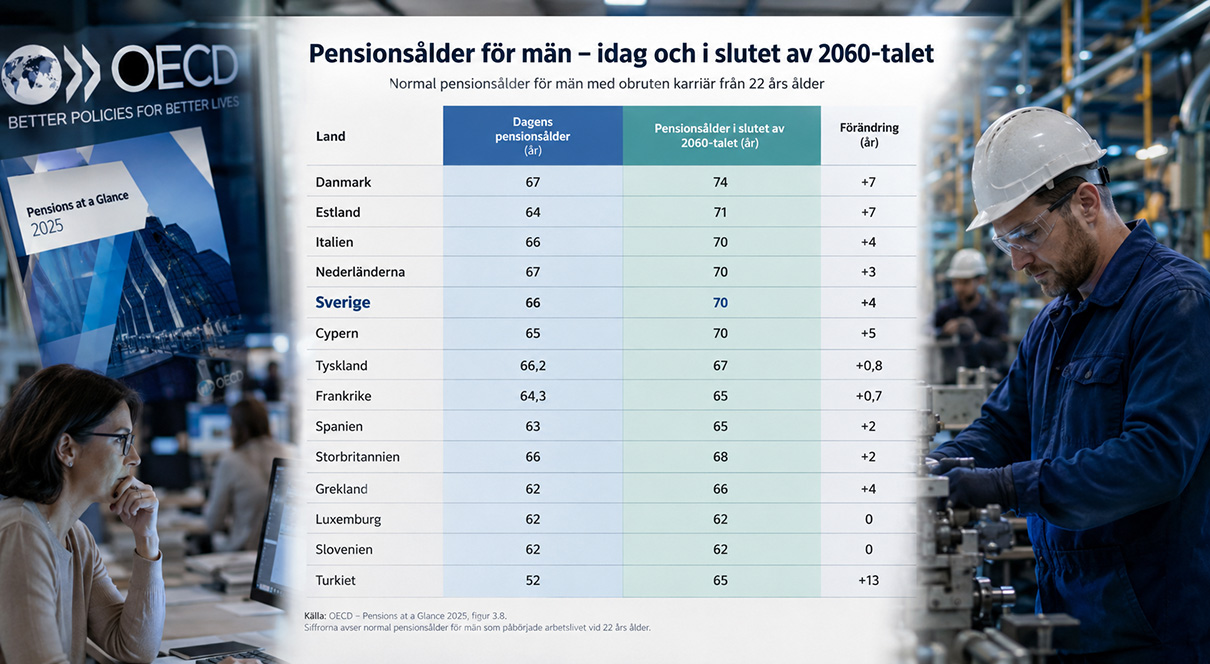
At the other end of the scale are Slovenia and Luxembourg, where the retirement age is expected to remain at 62 under current legislation. For women in the EU, Poland is also projected to have the lowest retirement age in the future, at 60 years.
OECD: Raising the Retirement Age Strengthens Pension Systems
The OECD states that more and more countries are choosing to raise the retirement age to strengthen the long-term financing of public pension systems.
ALSO READ: Green multi-billion fiascos drain the pension system – criticism of AP funds’ investments is growing
The organization points to three main options: raising the retirement age, raising pension contributions, or lowering pension levels. According to the OECD, the first path is the most common, as it can improve public finances without having to lower pensions.
Sweden Already Stands Out in the Labor Market
At the same time, there is an important difference between Sweden and many other OECD countries. Sweden is already one of the countries where the most elderly people work. The OECD highlights Sweden along with Denmark, Estonia, Iceland, Japan, and New Zealand as countries where employment among those aged 55 to 64 is very close to that of the broader workforce.
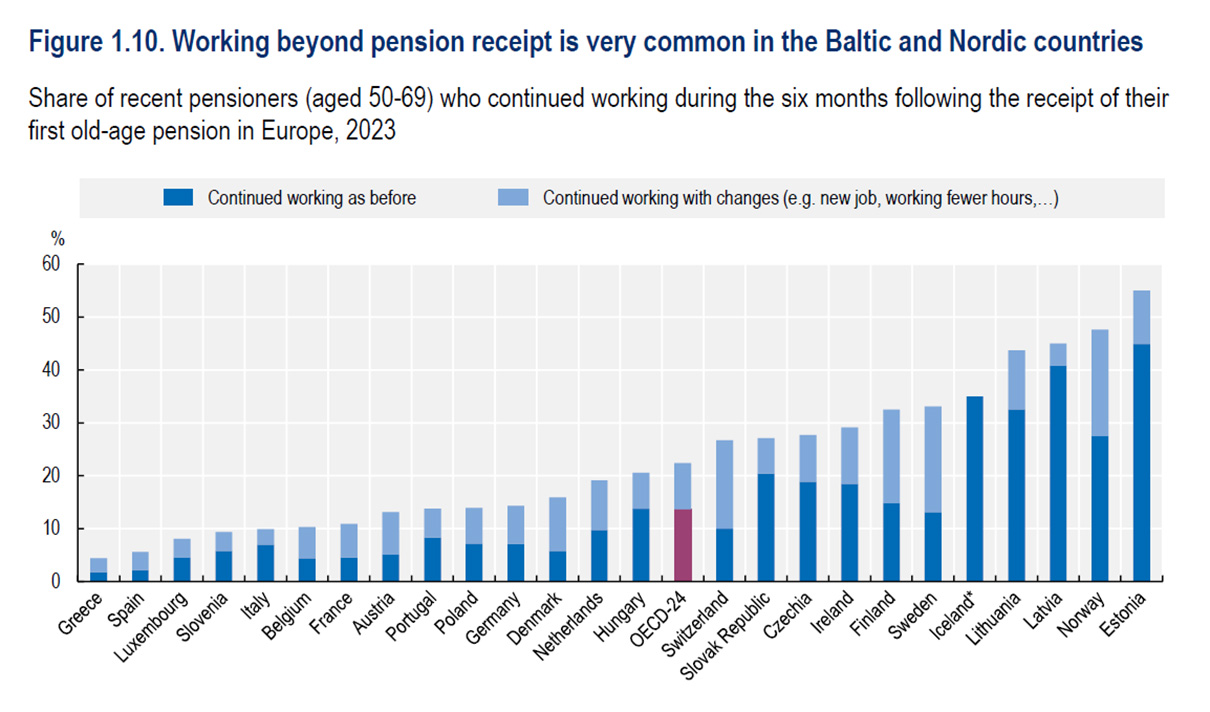
This means Sweden already has a remarkably high workforce participation rate among older people compared to much of Europe.
Analysis: Age Demographics Is Only Part of the Picture
The OECD mainly attributes rising retirement ages to an aging population, fewer children, and a growing share of pensioners relative to the working-age population. The organization estimates that the number of people over age 65 per 100 working-age inhabitants will increase from 33 in 2025 to 52 in 2050 within the OECD countries.
But this picture is not uncontroversial. Several economists have pointed out that the dependency burden is not determined solely by age demographics. Productivity growth, technological development, the employment rate, and the proportion of the population actually working all play a decisive role for public finances.
ALSO READ: These Professions Retire the Oldest
During the 2000s, for example, Sweden has undergone significant demographic change without the fears often expressed at the turn of the century—such as those in the widely noted debate about the so-called “meat mountain”—fully materializing. Higher productivity, automation, and increased labor force participation among older people have helped mitigate the effects.
At the same time, several analyses have shown that the economic effects of immigration vary greatly depending on how well newcomers establish themselves in the labor market. The OECD itself points out that immigration’s impact on public finances depends on factors such as education, employment, and integration, but also contends that it cannot be described as a simple net figure, primarily because there has been resistance to calculating immigration’s costs.
AI May Change the Entire Playing Field
Another factor that the OECD’s pension forecasts take into account only to a limited extent is the rapid development of artificial intelligence. Several international analyses indicate that AI could automate a large proportion of today’s jobs—including in skilled white-collar professions—at the same time as the technology is expected to increase productivity and create new tasks.

What the net effect will be remains uncertain. The OECD stresses that research to date does not show any clear evidence of large-scale net decreases in employment, even though many professions are being affected by the technology. At the same time, McKinsey contends that as much as more than half of Europe’s current work hours could in theory be automated with technology already available.
This means that the labor market today’s 20-year-olds will encounter as they approach retirement will likely look very different from what the OECD’s projections are based on.
The Future Is Not Set
The fact that, under current legislation, the retirement age is expected to rise to 70 does not mean this development is locked in. Pension systems are regularly reformed and influenced by political decisions, economic trends, productivity, employment, and technological transformation.
The question, therefore, is not just how long Swedes can work—but also what the labor market will look like when today’s young people approach retirement.