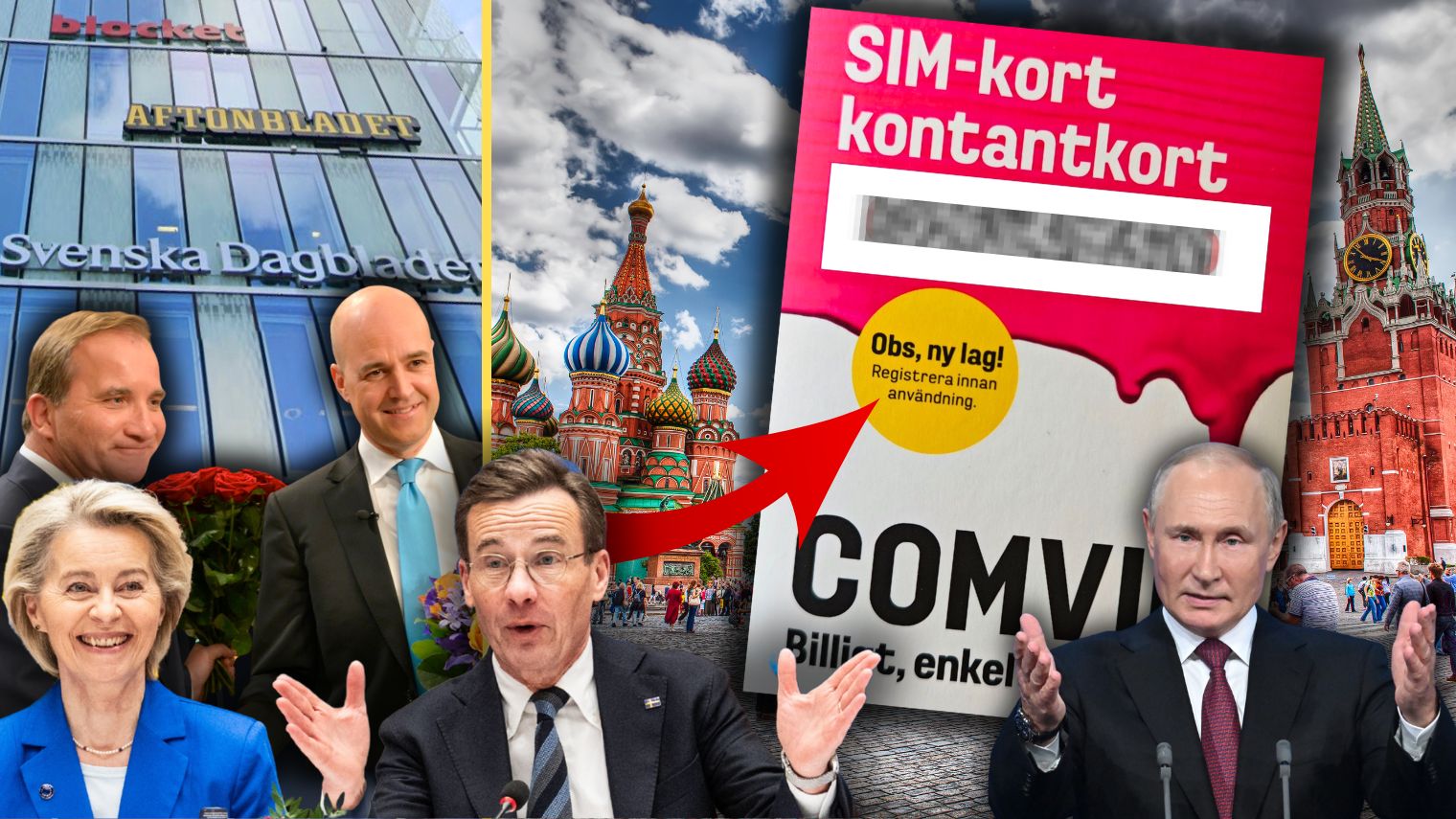
Svenska Dagbladet (SvD) is sounding the alarm about Russia’s attempts to establish a more state-controlled internet, where authorities are now blocking American messaging apps and have previously introduced mandatory SIM card registration – which has essentially eliminated the possibility of anonymous communication. These mass surveillance measures are suddenly portrayed as a frightening development in Sweden’s mainstream media. What SvD fails to mention, however, is that Sweden already has a similar system and that further surveillance measures are on the way through the EU’s Chat Control law, which a majority of the Parliamentary Committee on Justice has signaled support for implementing in Sweden.
On Thursday this week, Svenska Dagbladet, via journalist Amos Rova, reports on the Russian app Max, described as an all-in-one service where users can send messages, make calls, conduct payments, and log into government sites.
According to the report, this setup in practice gives the state access to large amounts of user data. The app is also said to come pre-installed on new mobile phones, computers, and smart TV devices, which is argued to allow the authorities to access citizens’ messages and calls, thereby making private communication subject to surveillance.
The purpose of Russia blocking messaging apps from the US is, according to Western media, a step to centralize all digital communication under state control and steer users towards the domestically-developed app Max, where the state then gets access to information that previous apps have not provided according to Russian law.
Data collection – fake encryption?
From the Russian side, such measures are often presented as necessary to combat terrorism, fraud, and serious crime – the same argument used when unregistered SIM cards were previously banned in Russia. At the same time, accusations are raised that American messaging services collect large amounts of user data on Russian citizens, information that is transferred abroad without oversight and could potentially be utilized by intelligence services.
Furthermore, SvD reports that it’s not only American messaging services being blocked, but also the Russian app Telegram, which claims to protect users’ freedom and anonymity. According to media and social media reports, however, the app is still possible to use and is likely considered the country’s most popular messaging service among Russian citizens. Even TikTok continues to be permitted, probably because the platform complies with Russian legislation and provides certain user data to the authorities.
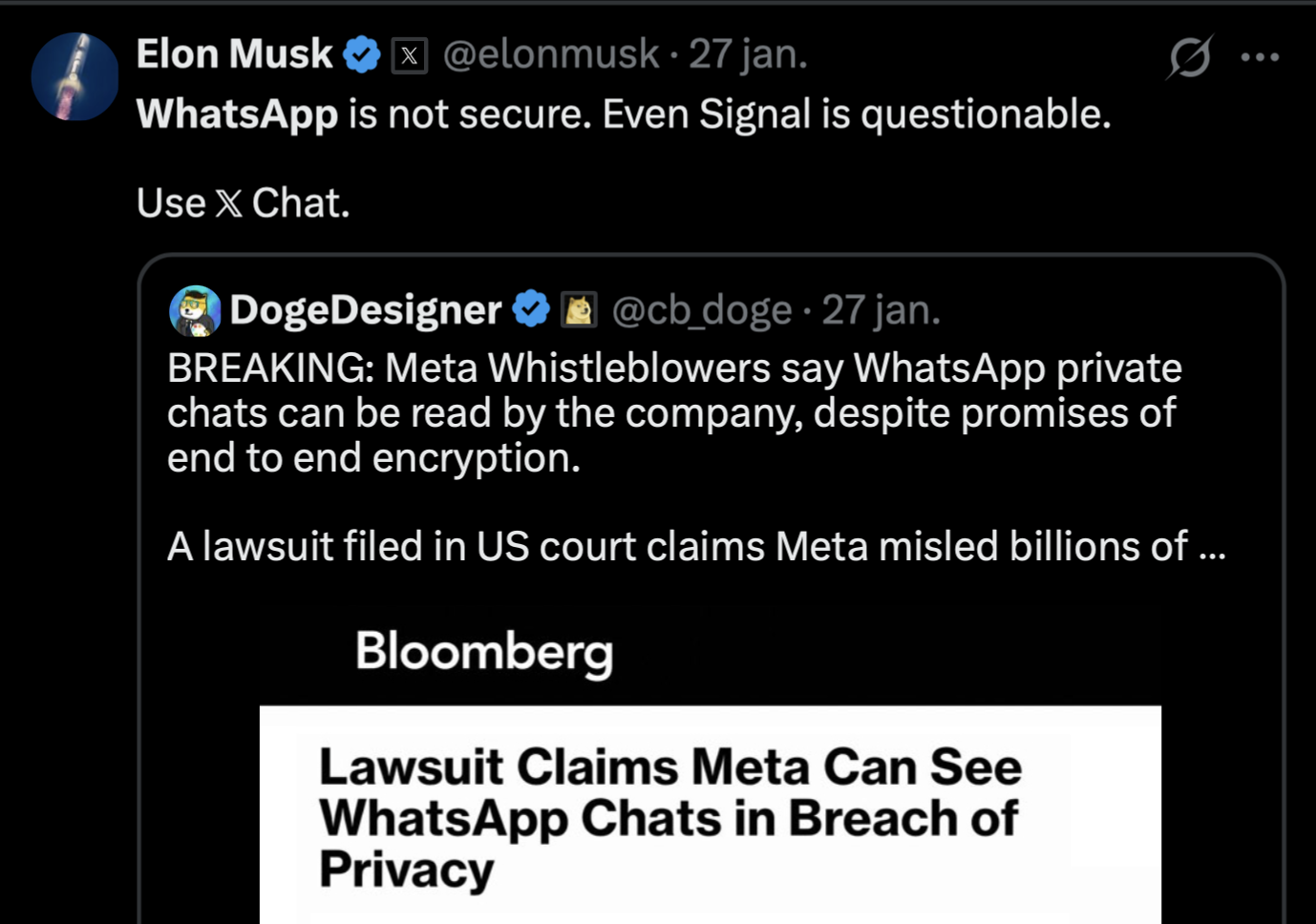
Even in the West, the security of large American messaging services is far from undisputed. Tesla and X owner Elon Musk has repeatedly criticized WhatsApp and its parent company Meta, claiming the service is not as private as many believe. For example, Musk posted on social media that “WhatsApp exports user data every night,” thus questioning the app’s security and the company’s handling of user information – criticism that highlights concerns about communications data being used for more than just encrypted messaging.
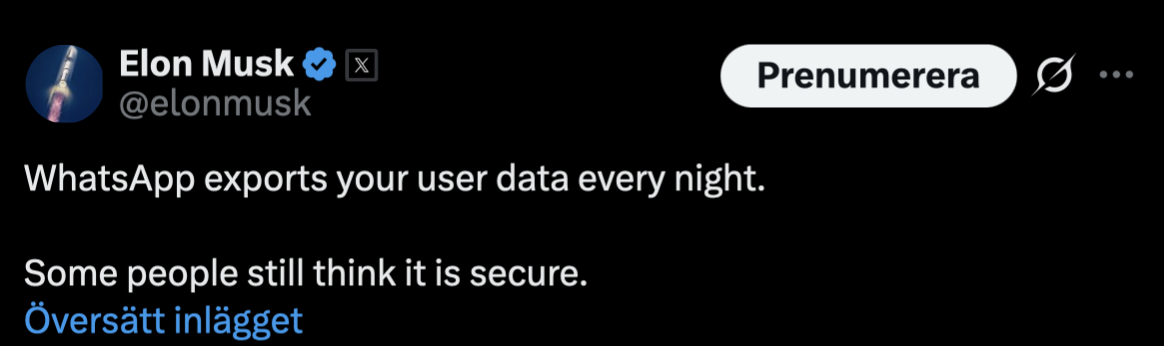
The criticism coincides with other well-known allegations and legal challenges against Meta‑owned WhatsApp, where some argue the company’s marketing of end-to-end encryption may be misleading and that even metadata and some user information can be analyzed or shared within the group.
Meta themselves have strongly denied claims that they have access to WhatsApp message content, and reiterate that encryption prevents both them and outsiders from reading private messages.
Pretext when Russia does it
In Western reporting, such as in SvD’s article, the restriction of US-based social media platforms is described as a pretext for the Russian state to expand government surveillance of the population and gain greater insight into people’s communications.
Whatsapp and Telegram also offer “end to end” encryption, meaning no third party has access to calls or messages.
Russian officials state that the apps’ owners have refused to store Russian users’ data in the country, which violates Russian law.
The state has claimed that blocking the apps is to protect citizens from scam calls. Meanwhile, data from the Russian Central Bank shows that the majority of fraud occurs on regular mobile networks, not the apps. Telecom experts and Russian citizens tell the BBC that the talk of protection against scam calls is merely a pretext, and that blocking is a way to expand state control over the people.
Svenska Dagbladet 19/2 2026
How the balance actually looks in the Kremlin’s internal deliberations is difficult to establish from open sources, and we are unlikely ever to know. But it’s not obvious that this is the most relevant discussion to have in Sweden, either. Developments in Russia take place outside the EU and do not directly affect the daily lives of Swedes – or, for that matter, other Europeans. Even so, it is often portrayed as a seriously worrying development, perhaps in line with a media-established image of Russia as an imminent threat to the EU and something that should be isolated from contact with the union.
Meanwhile, corresponding or similar surveillance measures within Sweden and the EU often receive much less attention, if any at all. This is where the real interest lies. In fact, surveillance in Sweden and the EU is more likely to be presented as positive efforts to counteract the same so-called pretexts of terrorism and crime.
At home, it is seen as legitimate to increase surveillance to reduce shootings and bombings, even though citizens in practice have very limited influence over how surveillance is conducted. Moreover, authorities are completely uninterested in presenting it in more detailed terms. It is precisely in this contrast that SvD’s recent article raises questions about attitudes toward such developments at home.
To underline the image that freedom is shrinking even further in the East, SvD, referring to the BBC, points out that Russia has banned the anonymous use of prepaid cards – meaning that everyone must now register their prepaid cards in order to make calls or send messages over the telephone network.

The same thing in Sweden
When SvD sounds the alarm over surveillance in Russia, one might ask why the now left-liberal newspaper turns a blind eye to the situation in Sweden. This is a question that AFS party leader Gustav Kasselstrand raised in a video post on social media over the weekend, where he observed that the situation in Sweden in practice looks much the same as in Russia.
For several years now, it has not been possible for Swedes to buy phone cards without registering them, a measure justified by the need to combat serious crime in Sweden. Registration with ID or BankID is now required, allowing the state to link calls and texts to an identified individual. In other words, the state knows who calls a particular number, sends a specific message, and where it happens – something that seems to have escaped Schibstedt-owned SvD.
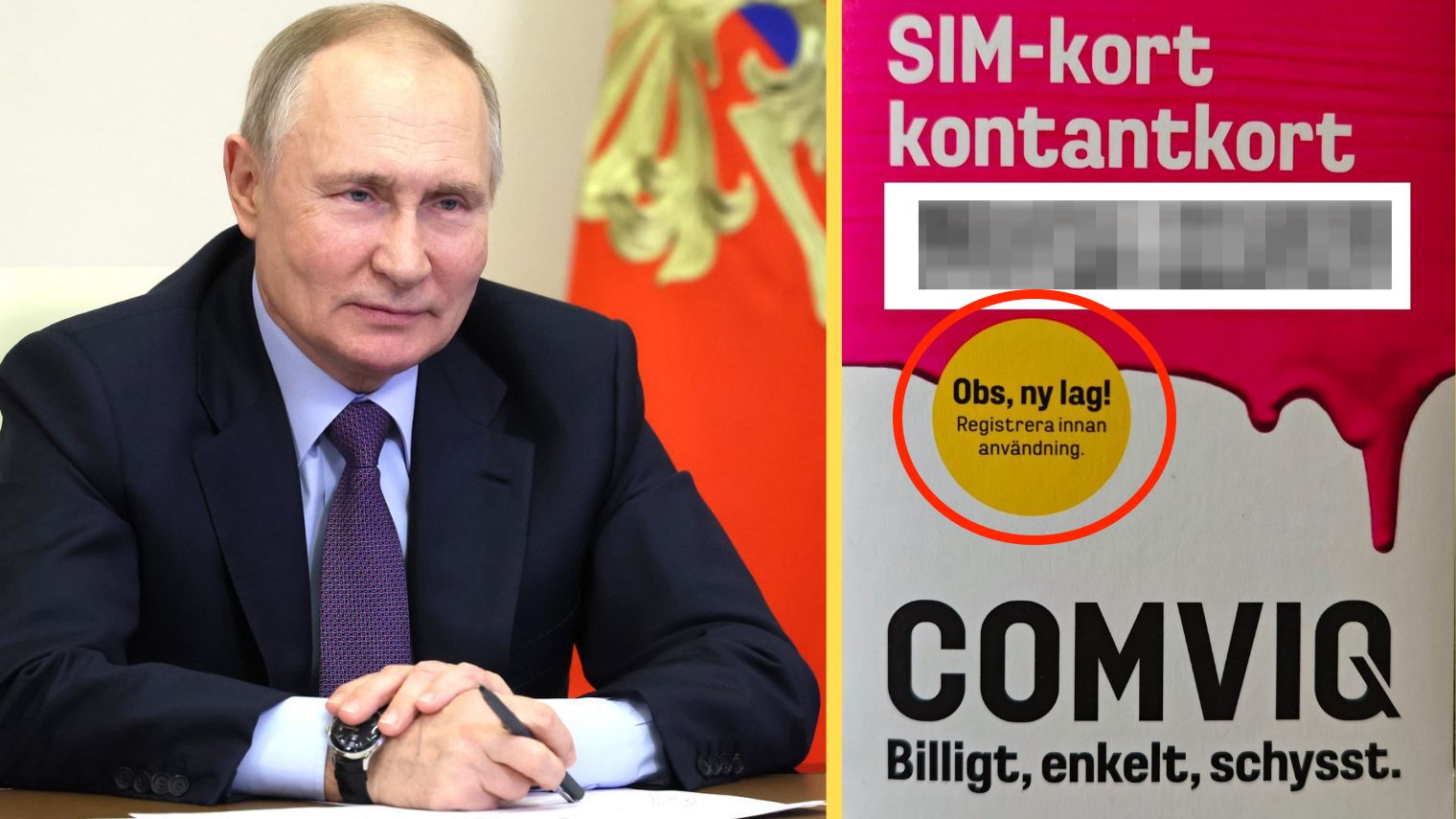
In practice, registered SIM cards have not prevented gang criminals from communicating via mobile phones, as many circumvent the rules by using SIM cards registered to proxies, eSIMs, and the like. Instead, the law has mainly restricted citizens’ privacy and the right to private communication. Step by step, these limitations are introduced under the pretense of contributing to a better society, but the broad effect mainly hits ordinary citizens.
ALSO READ: EU presents ‘center for democratic resilience’
But the bill’s purpose for registered prepaid cards may not primarily have been to combat serious crime. Critical voices, such as Gustav Kasselstrand, argue that it is actually about expanding state surveillance powers and further restricting our civil liberties – including targeting voices critical of the establishment – in an increasingly digitalized society.
ALSO READ: EU establishes ‘Ministry of Truth’ to combat ‘disinformation’
The law gives the security establishment new tools for control, tools or control mechanisms allocated to the same actors who contributed to today’s situation in Sweden, and who thus risk using them more broadly, including against those who challenge the authorities. The development hasn’t even stopped with the surveillance laws enacted so far in Sweden.
ALSO READ: von der Leyen’s re-election promise: Limit freedom of expression with ‘democracy shield’
The outlook is bleak even in Brussels, where EU leaders have for several years worked hard to gradually restrict rights and freedoms under attractive packaging, while few have insight into the already extensive state surveillance. A comprehensive tool called Chat Control is about to become reality if the EU establishment and several of the parliament’s pro-EU parties have their way. The proposal is now said to have the support of a majority of the Justice Committee’s members.
ALSO READ: The government wants to read your email – says yes to EU’s mass surveillance
Alongside Chat Control, other censorship mechanisms have been rolled out in the EU. For example, the new DSA law (Digital Services Act) risks restricting freedom of expression – all under the guise of protecting democracy, where censorship is to be used as a means of maintaining freedom.
ALSO READ: Chat Control moves forward – green light for supranational mass surveillance
But critical articles about the same developments in Sweden, the EU, and among NATO allies are often rare. The EU, for example, is working to break encryption in messaging services via the new Chat Control law, which would force providers to give authorities full access to content by scanning private conversations under the pretext of protecting citizens from crime. It is still highly unclear where the collected information will be stored, but critics point out it’s hardly possible to scan all messages without simultaneously gaining insight into all content.
ALSO READ: 100 freedom of expression experts urge the EU to scrap the DSA
In this way, EU citizens risk being subjected to surveillance that in practice resembles what Russia is introducing via its state messaging app Max. The development is thus much the same, but at home, it is rarely portrayed by establishment media as freedom-limiting or anti-democratic.
Wiretapping without suspicion of crime – ‘preventive purpose’
In recent years, Sweden has taken several steps toward a more comprehensive surveillance society. Politicians and police authorities have repeatedly highlighted preventive coercive measures as a necessary tool in the fight against crime and to clean up the criminality that has arisen in recent years.
Some years ago, the Police Authority was given the right to use wiretapping without suspicion of a crime. This means the authority can secretly wiretap or monitor people – including those who are not even criminals – for preventive purposes, without any investigation into a crime already having started. Previously, the Security Service had the right to use such secret coercive measures without concrete suspicion of a crime.
ALSO READ: IT security expert on Chat Control: “Our politicians have been thoroughly duped”
At the same time, there is still great uncertainty about who may become subject to these measures and under what circumstances they are applied. For ordinary citizens, it is also unclear how the collected data is handled and stored after an intervention.
Telecom operators store data
In response to the so-called challenges that politicians, police, and security services claim have suddenly appeared out of nowhere in recent years of mass immigration, those same politicians and authorities have argued that more tools are needed to deal with rising crime.
It is worth noting that the security agencies now welcoming the laws and tools which critics say have become Sweden’s surveillance society never warned politicians or the wider public about the large-scale mass immigration, despite large groups of people – often without or with fake documents – streaming into the country, without any pre-emptive actions from the authorities.
ALSO READ: ‘Rapid response system’ and own influencers – how the EU will strengthen control over your opinions
In recent years, citizens have seen news of one surveillance law after another being introduced or on the way, both in Sweden and at the EU level, justified by the need to strengthen the ability to manage the situation and combat serious crime.
One example is 2019, when the parliament passed a new general data retention law effective from October 1 of that year. The law replaced the previous data retention law, which the EU Court had invalidated because it conflicted with EU law and constituted a serious intrusion into privacy – something critics argued had no place in a democratic society.
Despite this, the Committee on Justice considered that surveillance should be expanded, pushed for it, and proposed a notice to the government to review the scope of the data retention obligation.
The new data retention law means that all citizens are in practice treated as potential suspects. Telecom and data operators must store data on electronic communications, including who called whom, when calls and internet traffic took place, and some location data. This data can then be requested by law enforcement in investigations of serious crimes.
Formally, the purpose was to adapt Swedish law to EU law and continue the fight against crime, but critics argue that even the new law constitutes a significant intrusion into individuals’ privacy and civil liberties, since large parts of the population’s communications are still stored without any requirement of suspicion of crime.
ALSO READ: DSA is not digital safety – it’s digital abuse of power
The majority of the Parliament’s parties – including the Sweden Democrats – voted for the bill. Many critics then pointed out that the retention is still extensive, effectively creates a form of mass surveillance, and risks restricting the right to private communication since the state sees who talks or otherwise communicates with each other. They also argued that the law does not fully achieve a legally secure balance between fighting crime and protecting individual privacy.
Bahnhof’s CEO Jon Karlung was one of those who criticized the law. He emphasized that he is not opposed to data retention as a tool for law enforcement, but that it must be done safely with strict proportionality requirements. In his view, suspicion of serious crime and court review should be required to access information in each individual case, to ensure individual privacy.
Staring eastwards
Another example is the so-called FRA law introduced in 2008 with the motivation of strengthening Sweden’s ability to detect external threats in an increasingly digitalized world, as it was sold. Through the law, the National Defence Radio Establishment received expanded powers for signal intelligence in cable-bound traffic crossing the country’s borders.
Critics, however, have long warned that the system in practice enables a very broad collection of electronic communication, where large amounts of traffic from ordinary citizens risk being caught as it crosses Sweden’s borders. The law has thus been described as one of the most extensive surveillance tools in modern Swedish times, with a constant conflict between the state’s security interests and the protection of personal privacy.
ALSO READ: The prison sentence against Samnytt places Sweden in the same league as Russia and Belarus
At the same time as SvD sounds the alarm about Russia’s surveillance society, where registered SIM cards and blocking of American messaging services show how terrible things are in their country, a similar development here at home and in the EU at large – which has been ongoing for many years and continues to expand – seems to almost completely escape the critical attention of the establishment media.
With the FRA law, data retention, registered SIM cards, covert wiretapping without suspicion of crime, and the soon to be enacted Chat Control law that will pierce encrypted messages, Swedish citizens risk, in practice, the same type of mass surveillance – but the mainstream media are fully preoccupied with staring eastward and pretending the problem doesn’t exist at home.
Less than 1% of our readers support us
Hundreds of thousands read Samnytt, but only 1 in 100 contribute. Help us grow and continue delivering in-depth reporting and investigations.
Without your support, Samnytt does not exist.
No advertisers. No government support. Only our readers. Thanks to you, Samnytt has published over 33,000 articles that challenge the official narrative in Sweden.
123 083 33 50
Swish any amount
Thank you for reading and supporting Samnytt