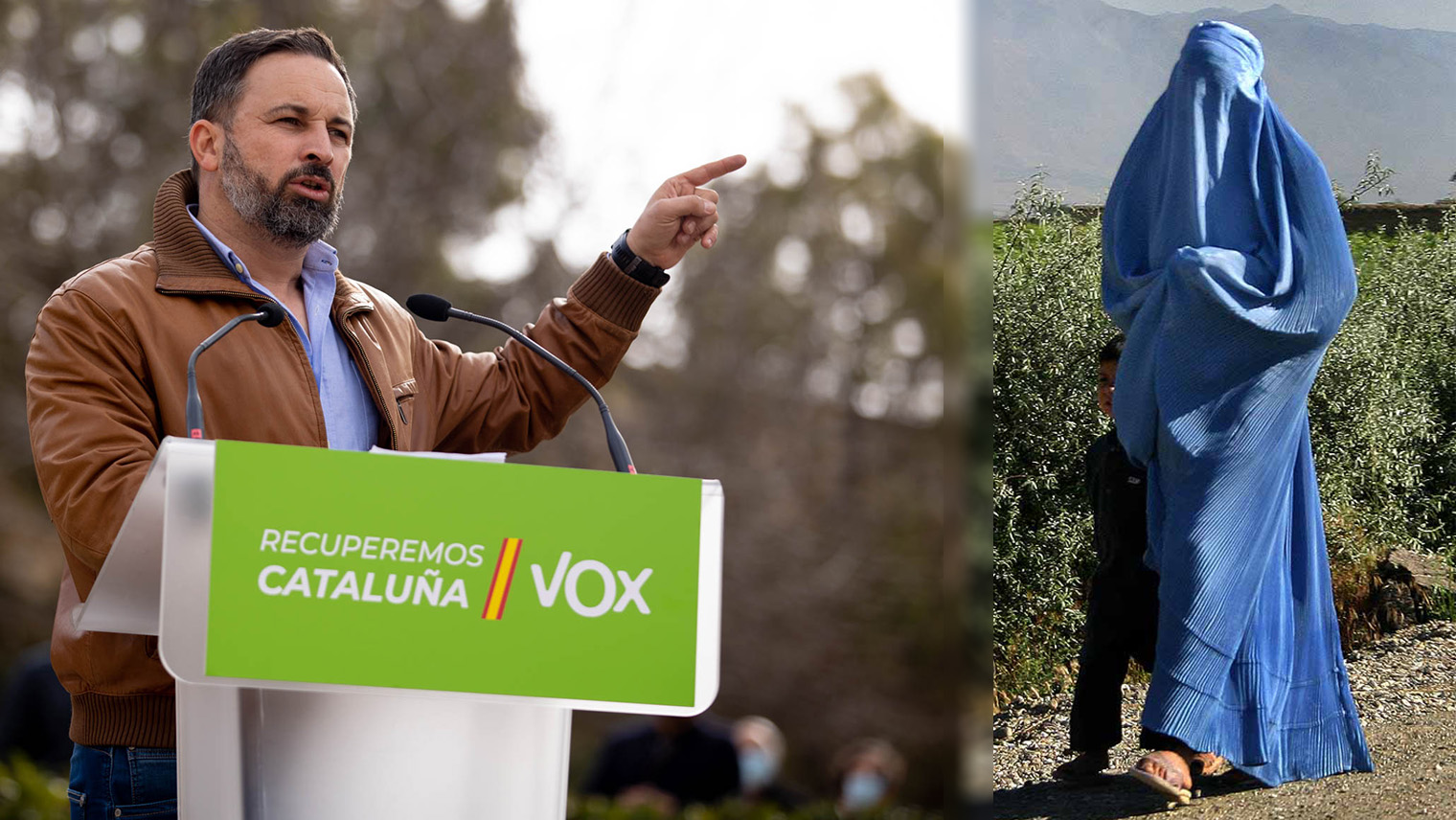
The socialist-led majority in the Spanish parliament voted down a bill to ban full-body Muslim garments for women in public spaces. The decision faces harsh criticism from the opposition, which accuses the government side of talking about feminism while simultaneously rejecting measures against the oppression of women.
It was on Tuesday that the Spanish parliament’s lower house rejected a bill from the conservative party Vox to ban oppressive Muslim garments such as the burqa and niqab in public environments.
The vote was close: 177 members voted no, while 170 voted yes. The proposal received support from the conservative Partido Popular as well as the regional UPN.
That was not enough to push the issue further when the united left stood in the way. Crucial was the no vote from several left-wing parties and regional actors, but also, somewhat unexpectedly, from the Catalan party Junts, which otherwise advocates a pronounced restrictive migration policy.
Vox: ‘Erases Women’s Identity’
In its legislative proposal, Vox stated that the use of full-face veils is an expression of women’s oppression. The party clarified that these garments result in ‘a very clear consequence in the form of erasing women’s personal identity from public life’ and symbolize ‘submission to men.’

The proposal also included concrete measures: prison sentences of up to three years for anyone forcing someone to wear these garments, as well as possible expulsion from the country for serious violations.
Accused of Being ‘Opportunistic’
The opposing side, however, rejected the initiative. From the government and its partner parties, Vox was accused of pursuing the matter out of what they called ‘political opportunism,’ with no actual concern for women’s rights.
At the same time, it was claimed that a ban on Muslim oppression of women risked being in conflict with constitutional protections for religious freedom and the prohibition of religious discrimination — an argument that carried more weight for the political majority than the risk of discrimination against women within religion.
READ ALSO: ‘Green transition’ may have caused massive power outage in Spain
Critics argue that this reasoning means that consideration given to religious expression — even those that are oppressive to women — is put before women’s freedom from social or cultural coercion.
Alternative Proposal from Junts
The Catalan party Junts voted against Vox’s proposal, despite sharing the goal of limiting full-face veils in certain contexts. The party instead presented its own, more limited legislative proposal.
READ ALSO: Major party takes a stand against oppression – proposes ban on full-face veil
Among other things, they are open to a ban on full-face veils in schools, but not in public spaces and not in contexts where women wearing the veil could become subject to legal action.
‘They Fill Their Mouths with the Word Feminism’
Vox party leader Santiago Abascal sharply criticized the decision and accused the left of hypocrisy. On social media he wrote:
“This prison for women was defended yesterday in Congress by PSOE and the other left-wing parties, with the support of Junts, which now embraces the Islamic Republic of Catalonia. All of them fill their mouths with the word ‘feminism’.”
Esta cárcel para las mujeres fue defendida ayer en el Congreso por el PSOE y las demás izquierdas, con colaboración de Junts que ya abraza la República Islámica de Cataluña.
A todos ellos se les llena la boca con la palabra "feminismo". pic.twitter.com/xqzN1iK4EE— Santiago Abascal ???????? (@Santi_ABASCAL) February 18, 2026
Limited Problem – But A Principled Issue
The number of women in Spain who wear the burqa or niqab is still considered small, even though concrete figures are lacking. The country has about 2.5 million Muslims, but not all follow traditions such as full-face veils for women.
READ ALSO: Spanish amnesty for illegal immigrants could double the number
Several European countries — including France, Belgium and Denmark — have already introduced bans on face-covering garments in public spaces, often citing reasons of security or gender equality. In Sweden, the government supported by the Sweden Democrats has not fulfilled voters’ expectations to move in the same direction.
Criticism Against Amnesty for Illegals
The Spanish left-wing government has also recently come under heavy criticism for its decision to grant amnesty to all of the country’s illegal immigrants. This concerns at least half a million people who can now stay instead of being deported.
The criticism is partly directed at the decision itself and the consequences it may have, not only for Spain, but also for other EU countries, since former illegals will now have access through the EU’s free movement. But it is also criticized as self-serving, as a majority of those granted amnesty are thought likely to vote for the left.
READ ALSO: Ekeroth: Spain rewards illegal immigration and restricts freedom of speech – EU turns a blind eye