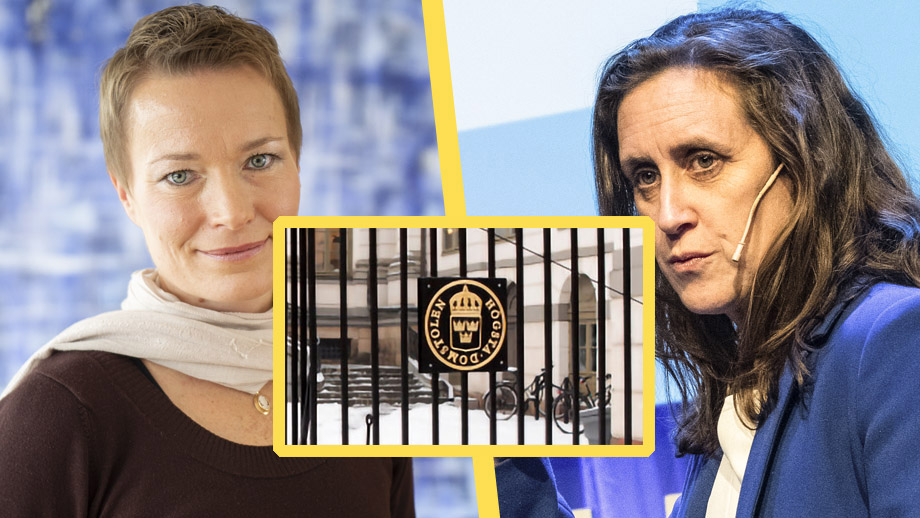
Despite the Supreme Court ruling that SVT subjected Linda Karlström to a significant intrusion on her private life, she is awarded no damages. After her victory in the district court, she has now lost in both the Court of Appeal and the Supreme Court. The verdict raises questions about press ethics, responsibility and legal protection—especially in light of other high-profile damages cases.
The Supreme Court has now brought an end to the protracted dispute between Linda Karlström and the Swedish state. The court concurred with the lower courts’ finding that the publication in ‘Vaccinkrigarna’ represented a ‘significant intrusion’ into Karlström’s private life. Nevertheless, she is denied compensation.
The court motivated the decision by stating that the documentary concerned a topic of great societal interest—the anti-vaccination movement—and that Karlström, through her statements, had made herself a public figure. Therefore, the journalists’ methods, including false identities and hidden cameras, were considered justified given freedom of expression.

At the same time, the court acknowledged that the violation was serious. However, it was not enough for the state to be considered to have failed in its ‘positive obligations’ under the European Convention.
Three Courts – Three Different Emphases
The Stockholm District Court sided with Karlström in March 2023. The court ordered the state to pay SEK 100,000 in damages and determined that the Swedish system for media responsibility did not provide sufficient protection for private life in the type of undercover journalism used in this case.
ALSO READ: SVT Smeared Vaccine Critics – State Ordered to Pay 100,000
The Svea Court of Appeal overturned the ruling in November 2024. The court agreed that SVT’s actions amounted to an invasion of privacy—and that Karlström’s rights carried somewhat more weight than the journalists’ freedom of expression—but still found that the state had not failed in its obligations. The ability to sue for defamation and have the Broadcasting Review Board review the matter was deemed sufficient protection.
READ MORE: Linda Karlström Forced to Pay Half a Million After SVT Violation: “That’s a Lot of Money”
Now, the Supreme Court has upheld the Court of Appeal’s conclusion: no compensation, and Karlström must pay the legal costs in both the district court and court of appeal.
“It Felt Like They Violated My Home”
In an exclusive interview with Samnytt, Karlström described how SVT employees entered her home in Finland under false pretenses and filmed her.
– It felt like they violated my home, she said.
READ MORE: EXCLUSIVE: Linda Karlström on SVT’s Abuse: “It Felt Like They Violated My Home”
The consequences, according to Karlström, were far-reaching: loss of assignments, social ostracization and public calls to distance oneself from her. In a news column, Samnytt journalist Mattias Albinsson harshly criticized SVT, arguing that their approach was so low it could hardly be called journalism—their methods targeted a private individual in her most protected sphere, not someone in power.
READ MORE: No, SVT, This Is Not Journalism
Funcke: Method Legal – But Must Be Used Extremely Restrictively
Freedom of expression expert Nils Funcke has pointed out that the core issue concerns how the material was obtained. Undercover journalism is not illegal, but must be used very restrictively.
He also emphasized that the Swedish self-regulation system primarily examines published content—not the journalistic methods—which was central to the district court’s ruling and the court of appeal’s acquittal of the state.
Press Ethics in the Shadow of Legal Freedom
The criticism against Swedish Television concerns not just legality but journalistic ethics. Opinion pieces have claimed that SVT revealed nothing new about Karlström, using hidden cameras more to mock and stigmatize her in her home—an approach lacking in journalistic merit.
SVT’s management, meanwhile, has defended the documentary as an award-winning and necessary investigation into what they see as a socially dangerous movement. According to SVT, criticizing vaccines by asserting that the risks outweigh the benefits should, in their view, be weeded out from the constitutionally protected freedom of expression and opinion.
Contrast: The Damir Case and Record Compensation
The debate has also highlighted other cases for contrast. The seriously criminal Damir Al-Ali from Syria received SEK 840,000 in compensation after his age was subsequently lowered and his punishment deemed excessively harsh.

The outcome sparked massive criticism, not least because the crimes—kidnapping rapes—were exceptionally serious and the higher age used as a basis for sentencing was, by many, considered correct.
READ MORE: Damir Receives Nearly a Million in Damages After Kidnapping Rapes—Sentence Was TOO HARSH
Samnytt later revealed that after Damir received compensation, he quickly committed new serious crimes against Swedish seniors. He pretended to be a representative from an elderly man’s bank, offering protection against fraud. In reality, it was Damir who was the fraudster, scamming the retiree out of more than three million kronor.
READ MORE: REVEALED: Received 840,000 from the Chancellor of Justice—Stole Over THREE MILLION More from Pensioner
That the state pays record compensation in such a case, while a private individual whose home was violated by public service is denied compensation despite acknowledgment of the violation, has been described by critics as an upside-down rule of law.