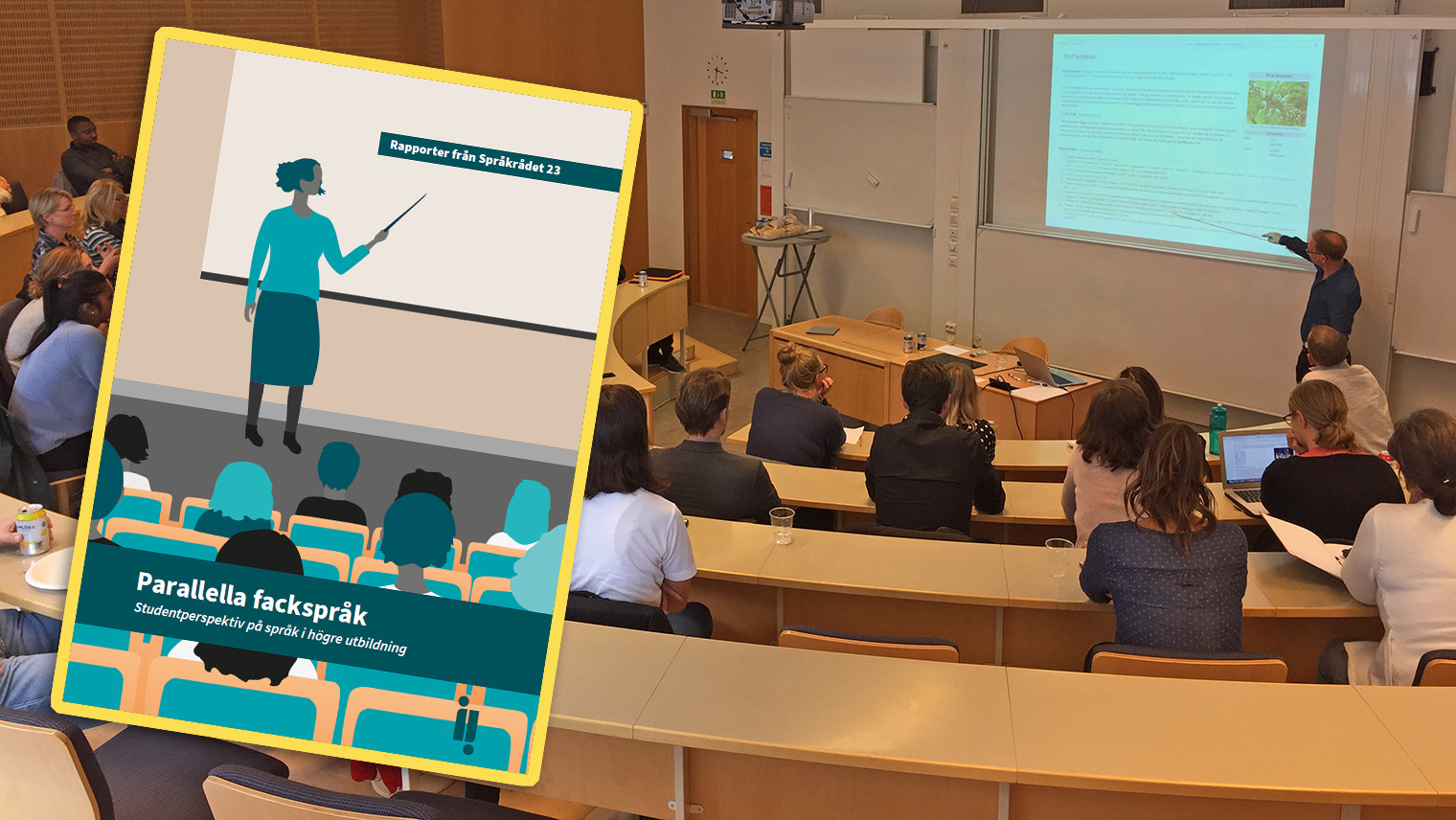
A recent report from the Language Council of Sweden shows that Swedish students in higher education are overwhelmingly in favor of instruction in Swedish—both spoken and written. The results point to a clear gap between how education is delivered today and what students themselves are asking for.
The importance of the Swedish language is much discussed today, often in the context of migration and integration or how Swedish is being marginalized in public spaces due to segregation. However, an older issue is how English is encroaching into various areas in Sweden. One sector particularly affected is academia, where Swedish has almost been sidelined in favor of English based on :censored:6:cdd6bbaa89:ist arguments.
The report, “Parallel Technical Languages: Student Perspectives on Language in Higher Education,” which is based on responses from 1,000 students at Swedish universities, presents a strikingly consistent picture: students want to study in Swedish. This applies to lectures, seminars, group work, supervision, exams, and thesis writing.
In many situations, about nine out of ten students prefer Swedish over English. The preference is strongest in supervision and group work, where 92% and 90% respectively choose Swedish over English.
Even in aspects where English is usually considered most established—such as course literature and thesis writing—a clear majority want to use Swedish. Only 16–24% say they prefer English in these situations.
This is in line with the report’s public summary, which clearly states that students prefer Swedish in almost all aspects of teaching.
Strong Support for Swedish Technical Language—And a Gap with Faculty
The report also shows that students attach great importance to learning Swedish technical terminology, both to succeed in their studies and to prepare for working life. Many believe that professions in health care, education, social work, and other key societal roles require strong communication skills in Swedish.
At the same time, students feel that teachers do not always emphasize the importance of Swedish technical language to the same extent as the students themselves do. This points to a clear gap between students’ needs and how instruction is actually organized.
Increased Use of English—But Not with Students’ Support
English has become increasingly common in Swedish higher education. Research compiled in the report shows that the use of English as a language of instruction has risen steadily—both in individual courses and in entire programs, particularly in technology, natural sciences, and parts of the social sciences.
The report refers, among other things, to studies showing that about a quarter of all courses taught in Swedish have no Swedish course literature whatsoever. This means students are expected to study in English even when the official language of the course is Swedish.
The differences between subject areas are significant. Students in technology and natural sciences are more open to English, though still in the minority, while students in health and medical care, social care, and teacher education almost unanimously prefer Swedish—likely because their future professions require advanced communication in Swedish.
Language Council: “An Important but Often Overlooked Perspective”
Lena Lind Palicki, Head of Division at the Language Council, emphasizes that the student perspective has long been missing from the debate on language choice in higher education.
“There is great demand for Swedish technical language—at least from the students,” she says, arguing that the findings should be seen as a call to universities and colleges to create better conditions for the development and use of Swedish terminology in parallel with English.
International Ambitions—National Requirements
Since the implementation of the Bologna Process, internationalization has been a clear goal for Swedish universities. English has been highlighted as a means to attract international students and increase :censored:6:cdd6bbaa89: mobility. At the same time, the Language Act establishes Swedish as the main language of Sweden and stipulates that authorities—including universities and colleges—are responsible for developing Swedish terminology.
The report argues that parallel language use is an explicit ideal in universities’ language policies, but that it is often unclear how this should be implemented in practice. In many cases, there are no strategies for how Swedish technical language should be taught, developed, and maintained within education.
Significant Variation Depending on Courses and Programs
Exact figures vary greatly between universities and subjects, and the report provides no national totals. However, referenced research shows a distinct pattern:
• The share of courses and programs taught in English is increasing.
• English-language course literature dominates in many fields.
• A large proportion of technology and science education programs use English as the primary language.
• In the humanities, law, teacher education, and healthcare professions, English is less common.
Overall, this means students often encounter more English in instruction than official language policies and the law would suggest.
A Crossroads for Swedish Higher Education
The report’s conclusion is clear: Swedish students want to study in Swedish—and they want Swedish technical terminology to have a natural place in their education. At the same time, developments are moving toward increasing use of English in both teaching and course material.
The question now is how universities should balance internationalization with their legal duty to safeguard and develop Swedish as a scientific language.
Or as the Language Council puts it: “The students’ clear stance should lend new weight to discussions about how Swedish and English can both be given good opportunities to advance side by side in the future.”