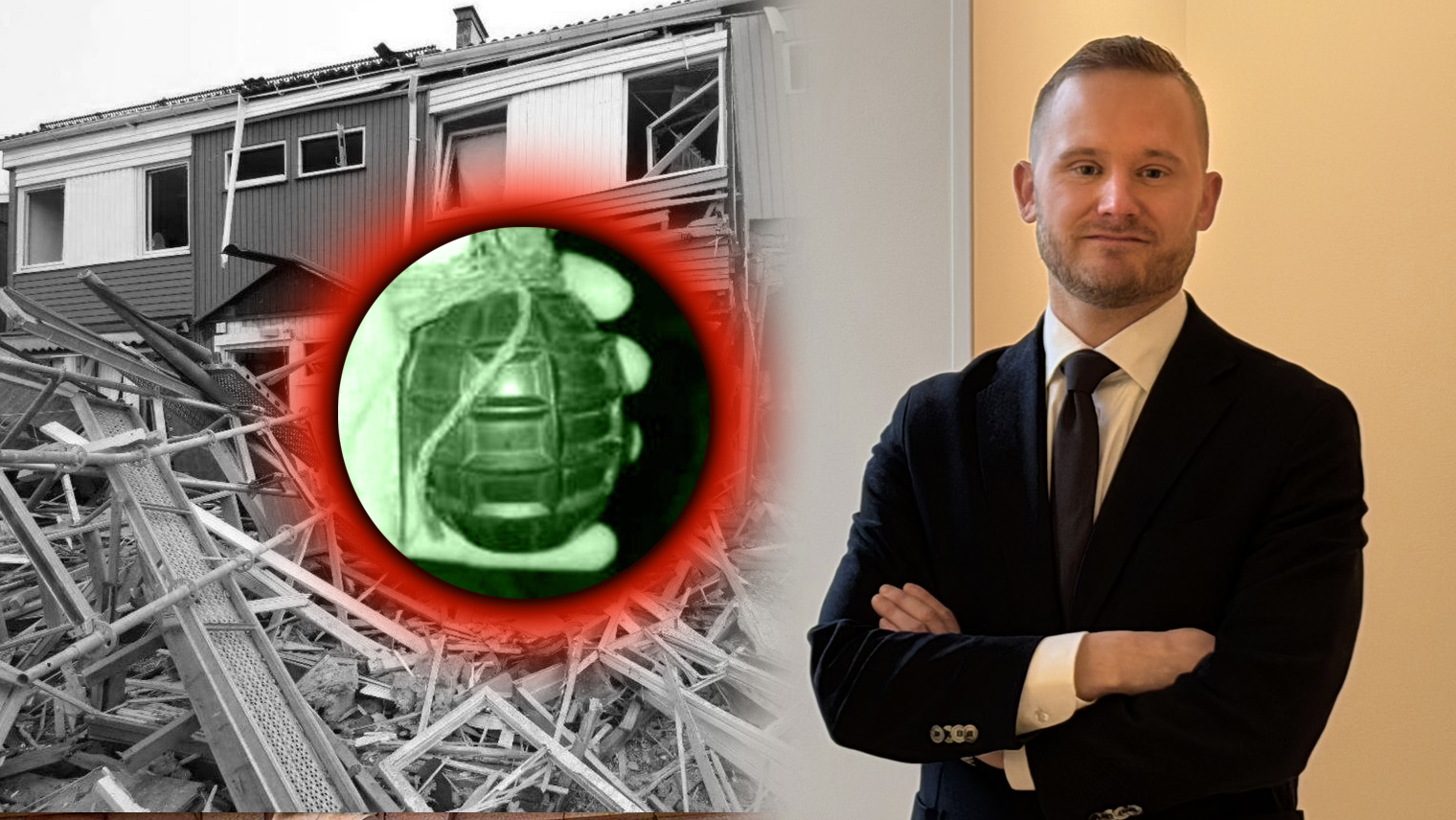
Samnytt meets the Sweden Democrats’ deputy party leader and chair of the Riksdag’s Committee on Justice, Henrik Vinge, at the Riksdag – just before the party’s press conference on new crime policy proposals. In an exclusive interview, he explains why bombings continue despite a decrease in shootings, how the state should act when ever-younger children are used in serious crime, and why crucial measures are blocked by today’s constitution.
Bombings in residential buildings, shootings on open streets, and ordinary people affected despite having no criminal connection. At the same time, the government points to statistics showing a decline in shootings.
Samnytt asks Henrik Vinge (SD) when Swedes can expect this reality to end—not just in the statistics, but in people’s everyday lives. Vinge links his answer directly to the proposals presented the same day—and to the next election.
– It depends entirely on how we do this autumn. What I am presenting today is the ultimate blow to gang crime. It’s what will truly crush the gangs—making it impossible for criminal gangs to operate in Sweden.
Children have always had trouble thinking about consequences, have been impressionable, fairly easy victims for adults. What’s new is that we have thousands of adults in Sweden who are prepared to exploit children to commit very serious violent crimes.
Henrik Vinge (SD)
He is clear that these measures require continued majority backing.
– This will become reality if we are part of a majority constellation—practically, if the Tidö parties get a majority. If we don’t, then this won’t become reality. That kind of crime will persist.
Jailing Gang Criminals Aged 13
One proposal that has sparked strong reactions from prosecutors and the media is the ability to detain 13-year-olds who commit very serious crimes. When Samnytt asks about the purpose of jailing such young offenders, Vinge stresses it’s about protecting others—and sometimes the child themselves.
ALSO READ: The Convention on the Rights of the Child Must Not Become the Gangs’ Safety Net
– If we have 13- or 14-year-olds running around the street detonating bombs and shooting others, then we have to lock them up. Because they are a mortal danger to others.

He also describes the environments many children live in.
– They often live cramped, maybe 8–10 people in one room. Often surrounded by adults with substance abuse issues. They may be exposed to all sorts, even sexually. He continues:
– If such a 13-year-old is locked up, it may be the first time in that child’s life they can sleep safely at night. One of the purposes of this is to remove them from that environment.
ALSO READ: Child soldiers murdered rival’s father—go unpunished
Samnytt asks for his view on the criticism—and the objection that gangs may then use even younger children instead.
What happens if the age limit is set at 13—are 11- and 12-year-olds then forced to kill instead?
– I see this as addressing a symptom. Ultimately, these 12-, 13-, 14-year-olds are not the root of this problem. He elaborates:
– Children have always had trouble thinking about consequences, have been impressionable, fairly easy victims for adults. What’s new is that we have thousands of adults in Sweden prepared to use children to commit very serious violent crimes. He continues:
– If we get rid of the adult gang criminals, these children will no longer commit such violence.
Less than 1% of our readers support us
Hundreds of thousands read Samnytt, but only 1 out of 100 contribute. Help Samnytt grow and continue delivering in-depth reports and investigations.
No advertisers. No state support. Only our readers. Thanks to you, Samnytt has published over 31,000 articles challenging the established narrative in Sweden.
Thank you for reading and supporting Samnytt
Criticism from Authorities – Shifting Responsibility?
Samnytt addresses the extensive and broad criticism from the Prison and Probation Service, referral bodies, and other authorities, not least regarding jailing 13-year-olds.
ALSO READ: Swedish Prison Service: No to Jailing Child Soldiers
Most referral bodies and authorities, including the Prison and Probation Service, are very critical of your proposals. Does that say something about the culture within these authorities, do you think?
– I would say that it does. He explains further:
– I would say that’s an expression of how one can behave if one can afford not to take responsibility. If you don’t have responsibility for a situation, you can always choose the morally superior, ‘good’ position. Without responsibility for the consequences, you can always choose the ‘kind’ option.
ALSO READ: Majority Child Soldiers on Murder Missions in Denmark – Are from Sweden
The SD official continues:
– But for those who actually have to take responsibility for the consequences, they can’t afford to. They must make the decision that leads to the best possible outcome. I would say it’s about these authorities not having to take responsibility for Sweden. He continues:
– Clearly that’s a problem, but that’s why politicians must sometimes stand up to these referral bodies and say that we have responsibility for the bigger picture, and therefore we will not follow your advice in this grave situation.

Expulsion of foreign nationals convicted of crimes is sometimes ordered, but not enforced. Why doesn’t that system work?
– The first problem is that the decision often isn’t made in court because the prosecutor doesn’t request it. We’ve fixed that now, so it will soon be mandatory to consider it. Henrik Vinge continues:
– The second problem has been that courts sometimes decide it’s impossible to deport, because the destination country is deemed unsafe. We’ve addressed that too. He explains:
– Now the court will ignore that; it will only decide about the expulsion. The Migration Agency then decides if deportation is currently possible or not. Previously, there were too many limitations regarding where one can be deported. He continues:
– We’ve seen examples of Denmark deporting to parts of Afghanistan that Sweden doesn’t. Sweden says it’s unsafe, Denmark says it’s safe. This assessment will improve greatly going forward at the Migration Agency.
ALSO READ: Here are Ida’s Child Soldiers – Carried Out Bombing in Stockholm
Henrik Vinge summarizes:
– The estimate is that there will be six times more expulsions. It will be a sixfold increase as a result of these measures.
How do you handle countries refusing to accept their nationals deported from Sweden after crimes here?
– Yes, exactly. There are several such cases. But they are becoming fewer and fewer because we’re having a dialogue with those countries. What we’re saying is, if you want to take part in our aid programs, for example, then you have to cooperate. He continues:
– It’s not a unilateral gift from Sweden; if we are to help with development of schools and infrastructure in a given country, we want something in return. And what we want is for them to take back their nationals. He goes on:
– And that has worked well. For example, we’ve seen Somalia start accepting returns, as has Iraq.
ALSO READ: Reports: Deportation to Somalia Halted at the Last Minute
When asked about the practical results, Henrik Vinge explains:
– On the one hand, we remove these people, but we also apprehend criminals who flee Sweden and hide in those countries—because their police now help us find them. There are hundreds of such cases now; we’ve brought criminals back from those countries, convicted them in Sweden, and subsequently deported them. He concludes:
– So we simply decide to put an end to the naive policy Sweden has long practiced, just giving money without getting anything back.
Should families of those involved in organized gang crime or terrorism also be deportable?
Vinge replies that it’s a legitimate discussion, but distinguishes between what is optimal and what is achievable now.
– I absolutely think that going after people around active gang criminals would probably be very effective. We might talk about deportation, about withdrawing benefits, about making life harder for those around the gang criminals. He adds:
– But you also have to think about what is achievable in the short term.
Voting Rights for Non-Citizens?
At the end of the interview, Samnytt raises a question put forward by Kent Ekeroth—whether non-citizens should be able to vote in local and regional elections, ahead of the 2026 election.
ALSO READ: Ekeroth: Withdraw Voting Rights Before It’s Too Late
Kent Ekeroth recently wrote an editorial in Samnytt about stopping non-citizens from voting in the 2026 election. Later the same day, SD addressed the same issue on social media. Will it happen? Is SD pushing the matter?
Henrik Vinge is clear about the party’s position and current politics.
– Our view is that only citizens should be able to vote. But we are alone in thinking so. We have tried, but as I said, you can’t get everything. He continues:
– This parliamentary term we have mainly focused on two things: drastically reducing immigration and increasing remigration, and stopping serious crime. He sums up:
– These have been our priorities. Next term, if we get another chance, we’ll be able to add several good proposals. This could very well be one of them.
At least 3,000 people with foreign or dual citizenship could be subject to deportation, which would break up several of the most violent gangs, create a shock effect, and in practice make organized crime in Sweden impossible.
Henrik Vinge (SD)
Repeatedly in his interview with Samnytt, Vinge points to the constitution as the greatest obstacle to breaking the gangs for good.
– To truly hit the gangs, we need a constitutional amendment. We must be able to criminalize participation in criminal gangs. That’s when we can break them completely. He concludes:
– If we win the 2026 election, we will win that vote in the autumn. Then this will come into force from January 2027.
3,000 Criminals Could Be Eligible for Deportation
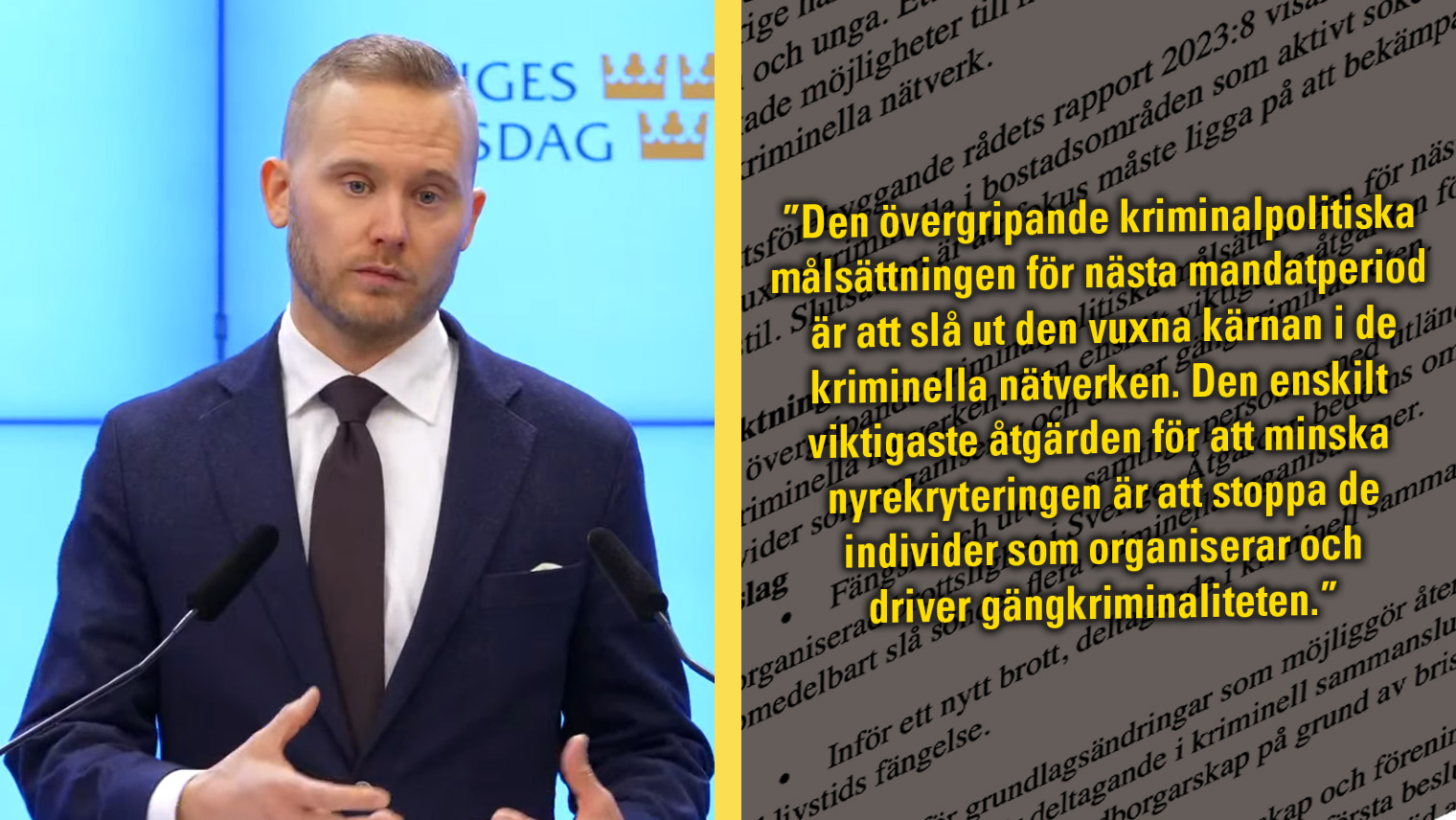
During the press conference, Henrik Vinge summarizes that the Sweden Democrats want to introduce a new crime—participation in a criminal organization—which in severe cases could lead to life imprisonment. In connection, the party seeks constitutional amendments that would allow Swedish citizenship to be revoked from those convicted of such participation, and to deport foreigners after serving sentences due to lack of good conduct.

Vinge claims this fully complies with international law, and that the obstacle today is political reluctance, not legal hindrance. He says that if the Tidö parties retain a majority, this could become reality next term.
ALSO READ: 800 bombings later – Swedes seek refuge on Åland
Vinge explains that the proposals could not be implemented earlier because both citizenship and freedom of association are currently protected by the constitution. Criminal networks are thus legally considered associations, which he says makes it impossible to criminalize participation itself.
Amending the constitution requires two parliamentary decisions with an election in between, and Vinge further stated during the press conference that SD has tried to pass this for over ten years. In the previous term, they were close, but the Social Democrats voted no. According to Vinge, Sweden thus lost four years that could have been used to break up gang structures.
According to the SD leader, the goal is to eliminate organized crime by targeting active gang criminals, rather than waiting for them to commit new serious crimes. This is also emphasized in Samnytt’s interview at the Riksdag. The crime of participating in a criminal organization would be tried in court based on police intelligence, within the framework of a regular legal process.
He further states that at least 3,000 people with foreign or dual citizenship could be up for deportation, which he claims would break up several of the most violent gangs, create shock, and in practice make organized crime in Sweden impossible.

???? Many Read Samnytt But Few Support
Support the newspaper so we can continue scrutinizing the establishment and reporting what other media omit.
Swish: Donate any amount to 123 083 3350