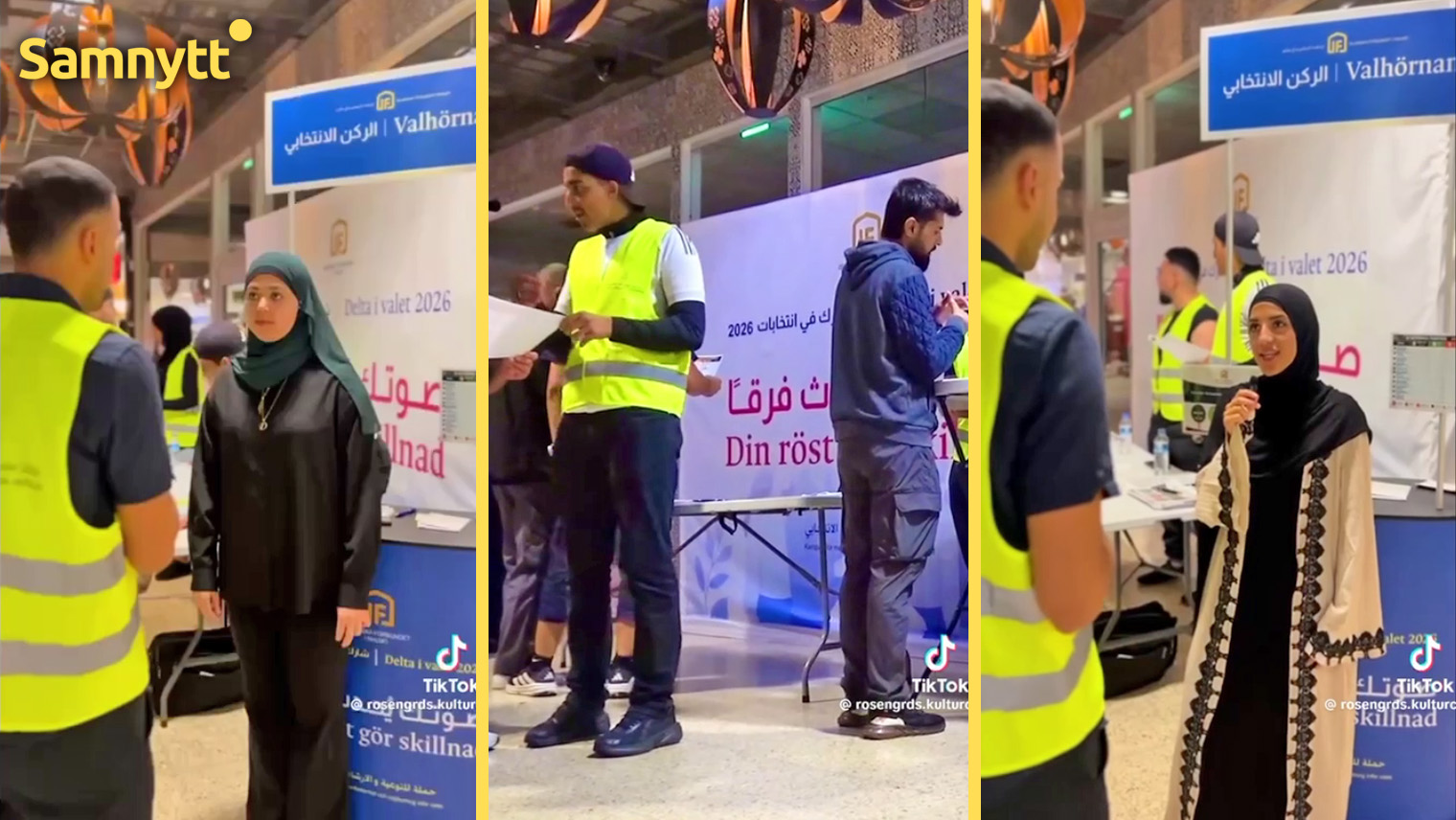
Early voting is increasing sharply in several of Sweden’s immigrant-dense areas, while surveys show a clear left-wing tilt among voters there. In Rosengård, Muslims are encouraged to vote after Friday prayers, and election ambassadors are going door-to-door. This development is welcomed by those seeking to reduce disparities in voter turnout—but at the same time, it raises concern on the right that Sweden’s changing demographics are also shifting the political balance of power and the values guiding the nation’s continued development.
There appears to be unusually strong voter mobilization underway in several of Sweden’s million-program housing and marginalized areas ahead of the September 13 election.
The identity-politics-inclined left-wing researcher Tobias Hübinette points to preliminary figures on early voting and describes increases of 100–200 percent compared to the corresponding period before the 2022 election in, among others, Skäggetorp in Linköping, Tensta in Stockholm, and Bergsjön in Gothenburg. At the same time, early voting has increased significantly less nationally.
A summary presented by Sweden Democrat (SD) politician Kent Ekeroth points in the same direction. In 19 vulnerable areas, where the same early voting locations could be compared, the number of ballots cast during the first six days is said to have increased from 6,929 to 13,860—essentially doubling. The material indicates a much smaller increase for the country as a whole.
It is still not known what the final voter turnout will be or how the new votes will be distributed among the parties. However, several surveys simultaneously show that the electorate in these vulnerable areas differs significantly politically from Sweden as a whole, with a heavy majority for the Social Democrats and also the Left Party.
Significantly More Identify with the Left
A recent survey from Järvaveckan Research, conducted by Indikator Opinion, covers 1,663 people in vulnerable areas and 1,669 in the rest of Sweden. In vulnerable areas, 43 percent place themselves on the left and 21 percent on the right. In the rest of Sweden, the relationship is nearly the reverse: 44 percent place themselves on the right and 37 percent on the left.
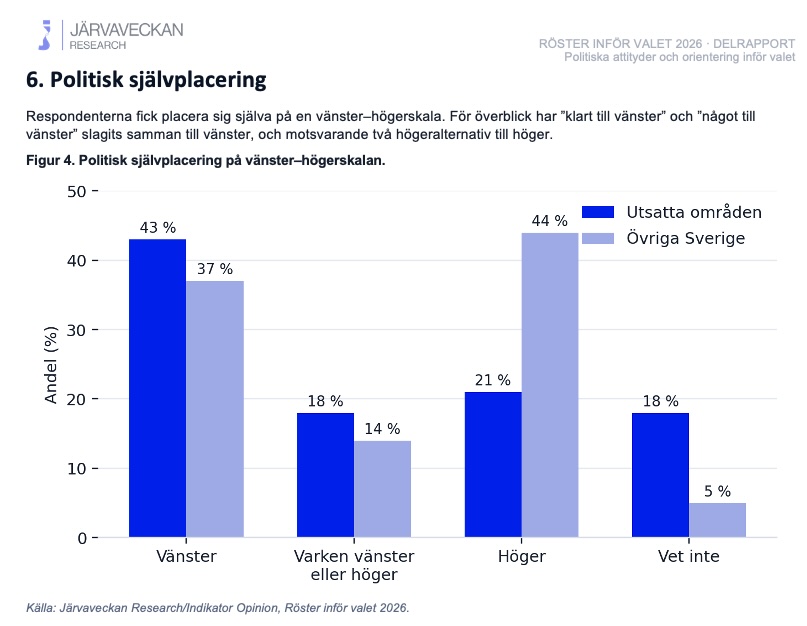
At the same time, a total of 36 percent in the vulnerable areas say either that they stand outside the left–right scale or that they don’t know. The survey also asks which parties people feel are actively trying to attract votes from people like them. The Social Democrats top the list in vulnerable areas with 60 percent, followed by the Left Party at 45 percent. Next come the Sweden Democrats at 42 percent and the Moderates at 40 percent.
Among those for whom religion is very or quite important, the corresponding figures for the Social Democrats and the Left Party are even higher: 66 and 50 percent, respectively. Järvaveckan emphasizes, however, that the question does not measure which party the respondents intend to vote for. The report’s authors also warn against treating people in vulnerable areas or those with a foreign background as politically homogenous groups.
READ ALSO: Hesa Fredrik Sounds—But No One Warns of the Invasion
In several policy areas, their views also deviate from the traditional left–right pattern. For example, support for lower payroll taxes is higher among people with foreign backgrounds than Swedes. Nevertheless, SCB’s (Statistics Sweden) party sympathy survey from May provides additional support for the idea that left-wing parties have an advantage among foreign-born citizens. Both the Social Democrats and the Left Party, according to the agency, enjoy greater support among foreign-born than native-born Swedes.
The Left Party Can Challenge the Social Democrats in Certain Groups
The Social Democrats’ previously very strong position in immigrant-dense areas is, at the same time, no longer a given. Hübinette refers, among other things, to a reader poll on the Arabic-language news site Alkompis, where 62 percent said they intended to vote for the Left Party, compared to 25 percent for the Social Democrats. He assesses that the Palestinian issue may be a key explanation, as the Left Party has been less unequivocal in distancing itself from Hamas compared to the Social Democrats.
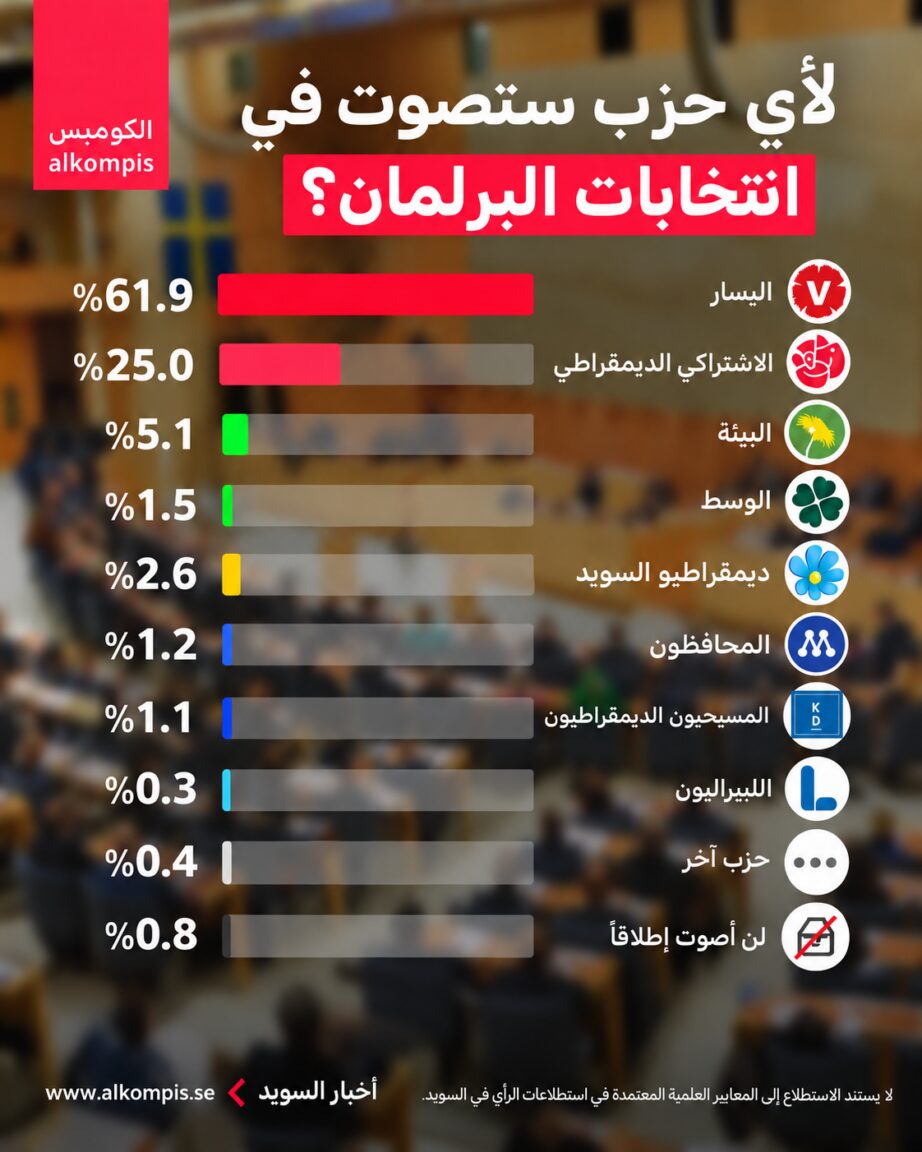
The reader poll is not a representative opinion survey, and the numbers cannot therefore be applied to Arabic-speaking voters in general. But Hübinette’s conclusion is that the Social Democrats can no longer automatically count on domination in the million-program areas as they once could.
Imam Urges Congregation to Vote
At the same time, organized efforts are underway to bring more voters to the polls. In Rosengård in Malmö, the Islamic Association is running the campaign “Your Vote Makes a Difference.” Multilingual election ambassadors are knocking on doors and present outside the mosque to inform voters. During the Friday sermon, the imam also urges the congregation to exercise their right to vote.
“We want to increase voter turnout,” says Nabil Abdulmajid, spokesperson for the Islamic Association in Malmö, to SVT.
He describes the interest in this year’s election as much greater than it was four years ago. According to him, the campaign is about people understanding their democratic right and being able to access information in their own language.
SVT’s reporting does not state which party or parties the imam urges the congregation to vote for. However, the Islamic Association itself describes one of its goals as increasing Muslims’ “participation, influence, and representation” in society’s institutions and to promote issues relevant to the Muslim group’s interests.
A Long History of Cooperation
At the same time, there is a documented history of cooperation between Muslim organizations and the Social Democrats. In the late 1990s, the Social Democratic Brotherhood Movement—now Social Democrats for Faith and Solidarity—cooperated with Sweden’s Muslim Council.
In a jointly published report from 1999, concrete goals were set to increase Muslim political representation, such as getting more Muslims onto Social Democratic municipal, regional, and parliamentary lists. Reporting on the project described the campaign ahead of the 1998 election as successful. The Muslim Council’s mobilization was deemed to have contributed to higher voter turnout among Muslims and to very high support for the Social Democrats.
Today, Faith and Solidarity is still an official affiliated association within the Social Democrats. The association states that it has about 2,300 members and around 80 local branches, and describes itself as a platform for politics and religion to meet. This points to historical and organizational links between Social Democracy and religious groups but is not, in itself, clear evidence that today’s mobilization in Rosengård is actually done on behalf of the Social Democrats.
Jomshof: “Have Chosen to Fill In with New Ones”
On the right, the development is interpreted much more critically. Sweden Democrat MP Richard Jomshof argues that the Social Democrats have compensated for lost traditional voters through immigration.
“When the old voters have largely chosen to abandon, primarily, the Social Democrats, they have chosen to replenish with new ones,” he writes on X.
De hymlar inte om detta längre. När de gamla väljarna till stor del har valt att överge primärt Socialdemokraterna, har man valt att fylla på med nya. Genom massinvandring och ett ständigt krypande för islamisterna, är planen att säkerställa vänstermajoriteten. Beklagligt att… pic.twitter.com/IfSdKG1qB4
— Richard Jomshof (@RichardJomshof) September 9, 2026
He simultaneously accuses the Social Democrats of appeasing Islamist forces and believes the center-right parties have failed to grasp the long-term significance of these changes.
SD politician and Samnytt CEO Kent Ekeroth goes even further. In an editorial, he urges voters with Swedish backgrounds to mobilize to a similar extent.
READ ALSO: Ekeroth: “Swedes Must Mobilize Like MENA Immigrants Do”
Ekeroth’s reasoning is that extensive immigration, combined with major differences in party affinities between different population groups, is gradually changing the conditions for democratic government change. He directs his criticism primarily at the center-right parties, whom he thinks should have understood the political implications of migration and citizenship policies.
His conclusion for election day is that Tidö voters need to respond to rising voter turnout in the suburbs with mobilization of their own. The stay-at-homes must get up. Those wavering between right and left should choose the former, as more is at stake than just traditional economic left–right politics.
590,000 May Vote—But Not for Parliament
A complication in discussing voter turnout in immigrant-dense areas is that the three elections being held simultaneously have different rules for suffrage. Swedish citizenship is required to vote for parliament. However, foreign citizens may vote in the municipal and regional council elections.
EU citizens and citizens of Norway and Iceland may do so if registered in the municipality. For citizens of other countries and stateless persons, they must have been registered in Sweden for at least three consecutive years before election day.
SCB’s preliminary calculation for the 2026 election is that around 7.8 million Swedish citizens registered in Sweden are eligible to vote in all three elections. In addition, there are just over 590,000 foreign citizens who may vote in the municipal and regional elections—but not in the parliamentary election.
The about 600,000 figure referenced in the debate therefore does not represent all foreign citizens in Sweden, but the group who fulfill the requirements for voting in municipal and regional elections. For comparison, about 600,000 such voters existed in 2022. Their voter turnout then was only 30 percent, compared to 86 percent among registered Swedish citizens.
This also means that a sharp increase in early voting in an area does not automatically mean an equally large increase in parliamentary votes. Some of the voters may be foreign citizens only casting ballots in municipal and regional elections.
At the same time, during the current parliamentary term, approximately 200,000 Swedish citizenships have been granted. Figures from the Migration Agency show that 85–90 percent of these were granted to people from non-Western countries.
Could Be an Important Factor on Election Day
It is thus still not possible to determine how large the political effect will be in the end. Early voting shows how many votes are cast—not the voters’ backgrounds or which parties they support. But the combination of sharply increased early voting in several vulnerable areas, previously much lower turnout, and a documented left-wing tilt among many of these voters means that mobilization may well affect the election results.
For those working for higher turnout, this trend is primarily a sign of greater democratic participation in areas that have long seen low voter engagement. Critics view the same trend from a completely different perspective—as an example of how migration policy has not only changed Sweden’s population but also the composition of the electorate and thereby the long-term balance of political power.
Which of these pictures weighs heaviest will ultimately be a political judgment. But that turnout in several immigrant-dense areas now appears to be increasing sharply is a development that could matter when the votes are counted after election day.