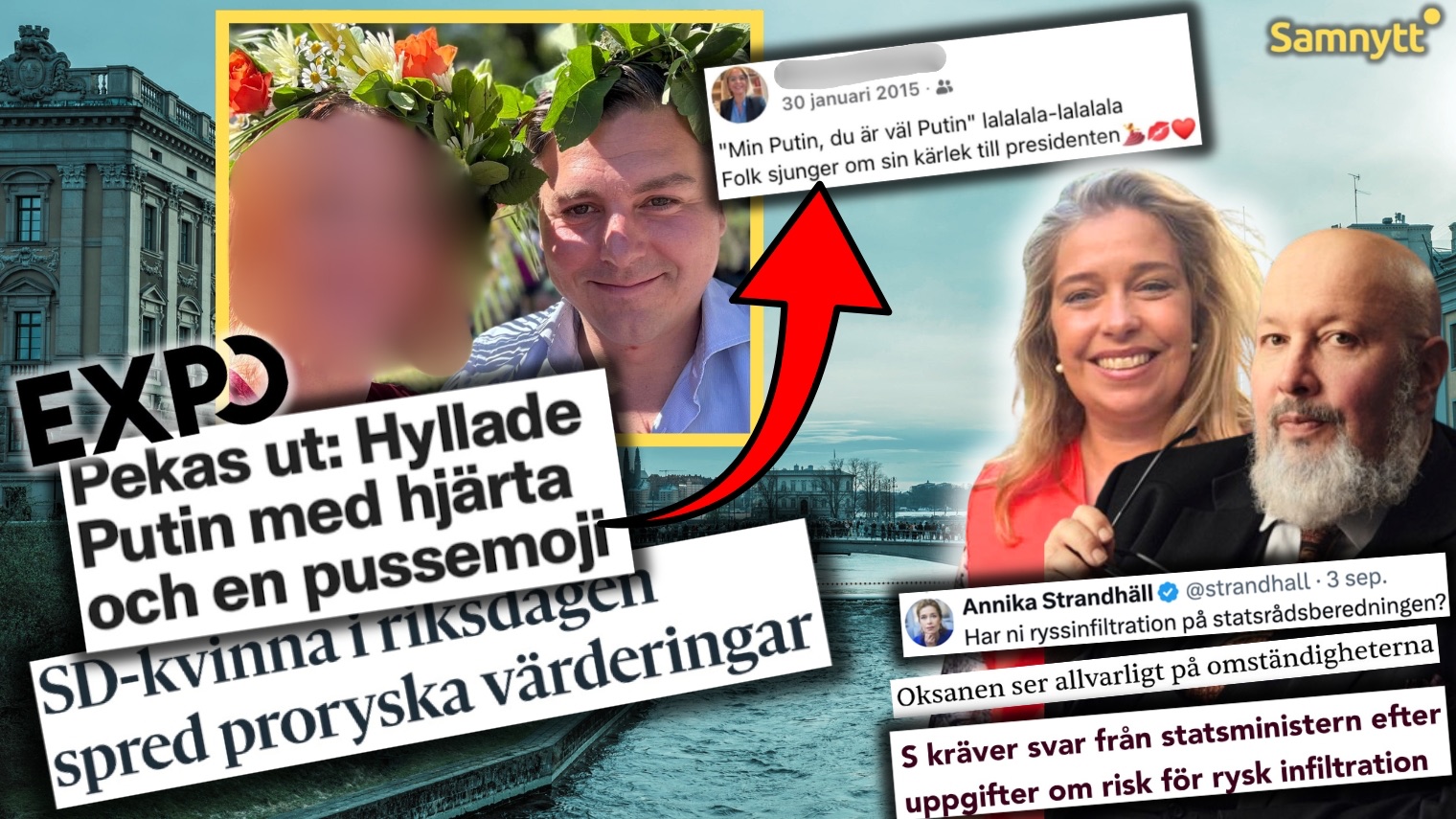
OPINION • Over the past week, Expo, establishment media, and the Social Democrats have gone big with claims that the Sweden Democrats have a ‘pro-Russian’ individual within the party, a ‘Russian infiltrator.’ Now, the woman in question is also labeled ‘suspected spy’ on social media. Establishment media describe the SD woman using phrases like ‘linked to Russian state actors.’ Indeed, she’s been so thoroughly suspected that through drawn-out insinuations and so-called experts, the media have already established she’s sent by the Kremlin. Annika Strandhäll goes so far as to defend describing the woman as ‘suspected spy’, simultaneously suggesting her Russian background is sufficient evidence. But what is this alleged ‘infiltration’ really about? Samnytt has reviewed the extensive media reporting.
After a period of unfavorable opinion polls, where the Tidö parties have narrowed the red-green bloc’s lead, the Social Democrats received an unexpected opportunity to direct attention at their political rival, the Sweden Democrats. This happened after the far-left site Expo last week exposed one of the party’s parliamentary staffers and painted an extensive security scandal linked to Russia.
The reports are further amplified by a political climate in which parliamentary parties endlessly discuss Sweden’s new security situation. Since then, headlines have followed each other, with various ‘mappings’ and ‘experts’ contributing to the suspicion around the woman, pushing claims of infiltration—especially focusing on the Sweden Democrats, parliament, and the Government Offices.
Establishment media are eager to present Expo as a trustworthy source, not least by terms like ‘the Expo Foundation’ or ‘Expo magazine’, often complemented by descriptions like ‘independent anti-racist foundation’ and an actor scrutinizing extremism. The image being conveyed is thus of a politically unaffiliated actor standing neither to the right nor left on the political spectrum.
Compare this with how establishment media describe alternative media, where it’s not uncommon to see phrases like ‘far-right hate site.’ Here the reader is signaled from the start how the sender should be regarded.

That people at Expo’s editorial office through the years have had—and still have—clear connections to left-wing extremism, as well as the editorial operation’s outspoken opposition to Sweden Democrats, is rarely or never mentioned when establishment media describe Expo.
READ ALSO: Expo: We will ‘make things uncomfortable’ for alternative media
At the same time, it’s hard to ignore that Expo can’t really be described as an ordinary magazine, but rather as a far-left doxxing site with a strong, recurring focus on the Sweden Democrats and the political environment surrounding the party. Investigations into other political environments or religious extremism receive significantly less, if any, coverage.
READ ALSO: Expo exposes SD politician and former Ikea manager as Putin supporter—but emails show otherwise
Time and again, their revelations are based on individual posts and comments on social media, sometimes old and sometimes recent, which are then woven into far-reaching discourse about people’s political stances, contacts, networks, and alleged links to foreign narratives. Preferably, connections to the Russian government in Moscow.
This is then reinforced by having one of the establishment’s so-called experts add further weight to the suspicions already painted, by piling up claims and placing them in a larger context. At the same time, establishment media fuel the so-called investigation by chasing SD through parliamentary corridors and public meetings, until the pressure mounts and the party leadership acts, forcing a politician out.
Recruited Säpo Chief to ‘Counter Racism’
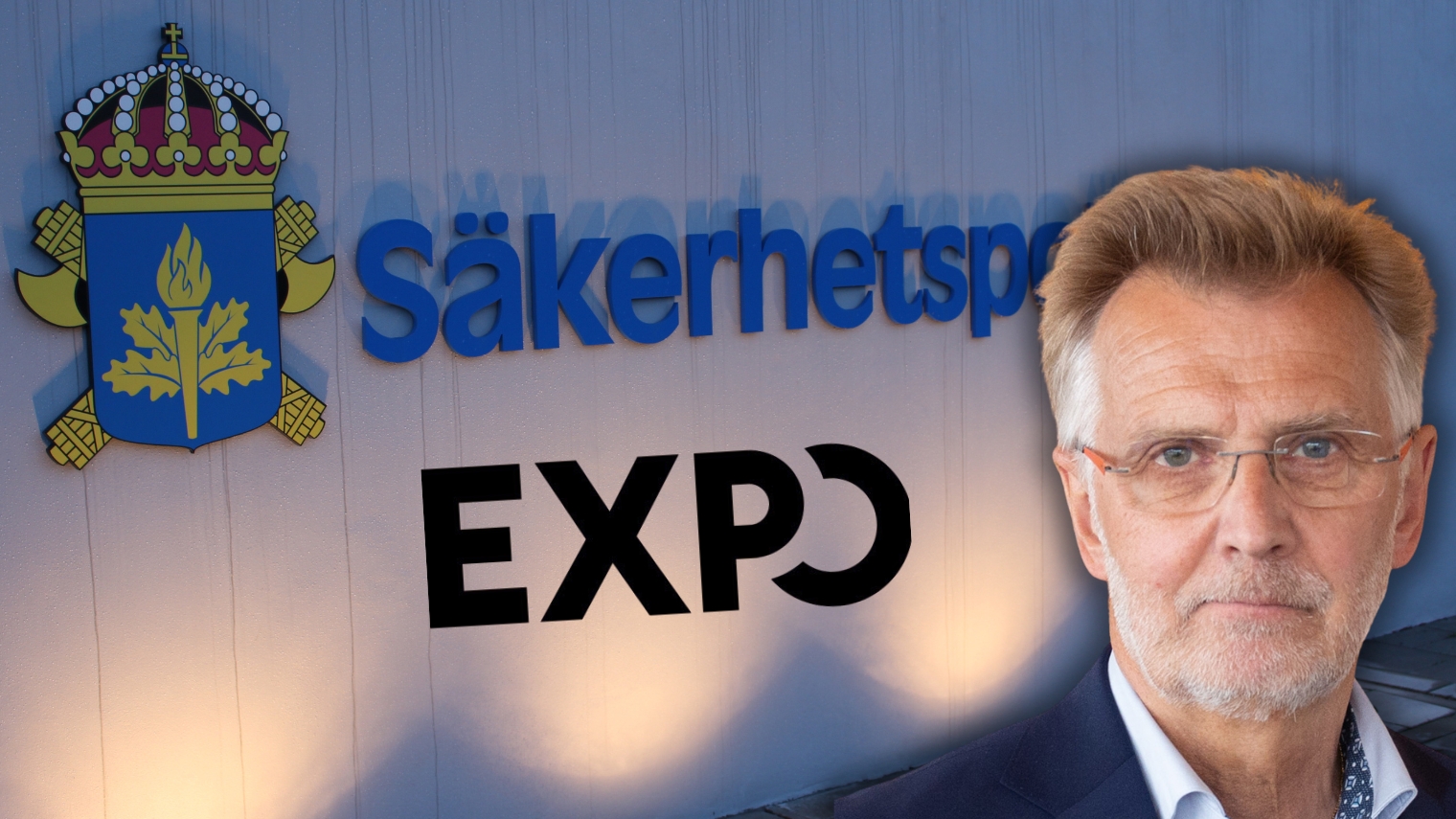
Since August this year, Expo’s board has received a rather interesting addition in the form of former Säpo chief and Migration Agency director Anders Danielsson. He joins chairperson—and asylum activist—Anne Ramberg, vice chairperson and so-called troll-hunter Robert Aschberg, as well as a number of other left-liberal profiles.
He has a long police career behind him, including as County Police Commissioner. Then he was Director General for the Security Police and Migration Agency.
Now, he joins the board of Expo, a far-left organization largely engaged in exposing and mapping people in SD environments.
READ ALSO: Alexander Bengtsson after Expo: ‘I had a spiritual awakening’
So what does it mean for a person with Danielsson’s background to step into the organization? What experiences, information, and networks does he bring from his previous roles? And what significance will this have for Expo’s mapping activities?
These are by all means highly relevant questions when someone with this background enters. Danielsson is clear that he is proud and honored to contribute to the fight against what he describes as racism, and to protect democracy. Apparently, that is best done at the far-left doxxing site.
– I am both proud and honored to join Expo’s board. Throughout my career I have emphasized the importance of protecting human rights and defending the democratic rule of law, Danielsson said in August and continued:
– It is with great respect that I now join Expo’s board and have the opportunity to continue working against racism and protecting our democracy. Democracy isn’t something we can take for granted.
If the move to Expo is so obvious for anyone wanting to defend democracy, what does that say about which people and environments have had significant influence over Swedish authorities through the years?
We’re not going to talk about Expo’s focus areas and their flashy board appointments, but such backgrounds are definitely interesting to understand what this publication is all about.
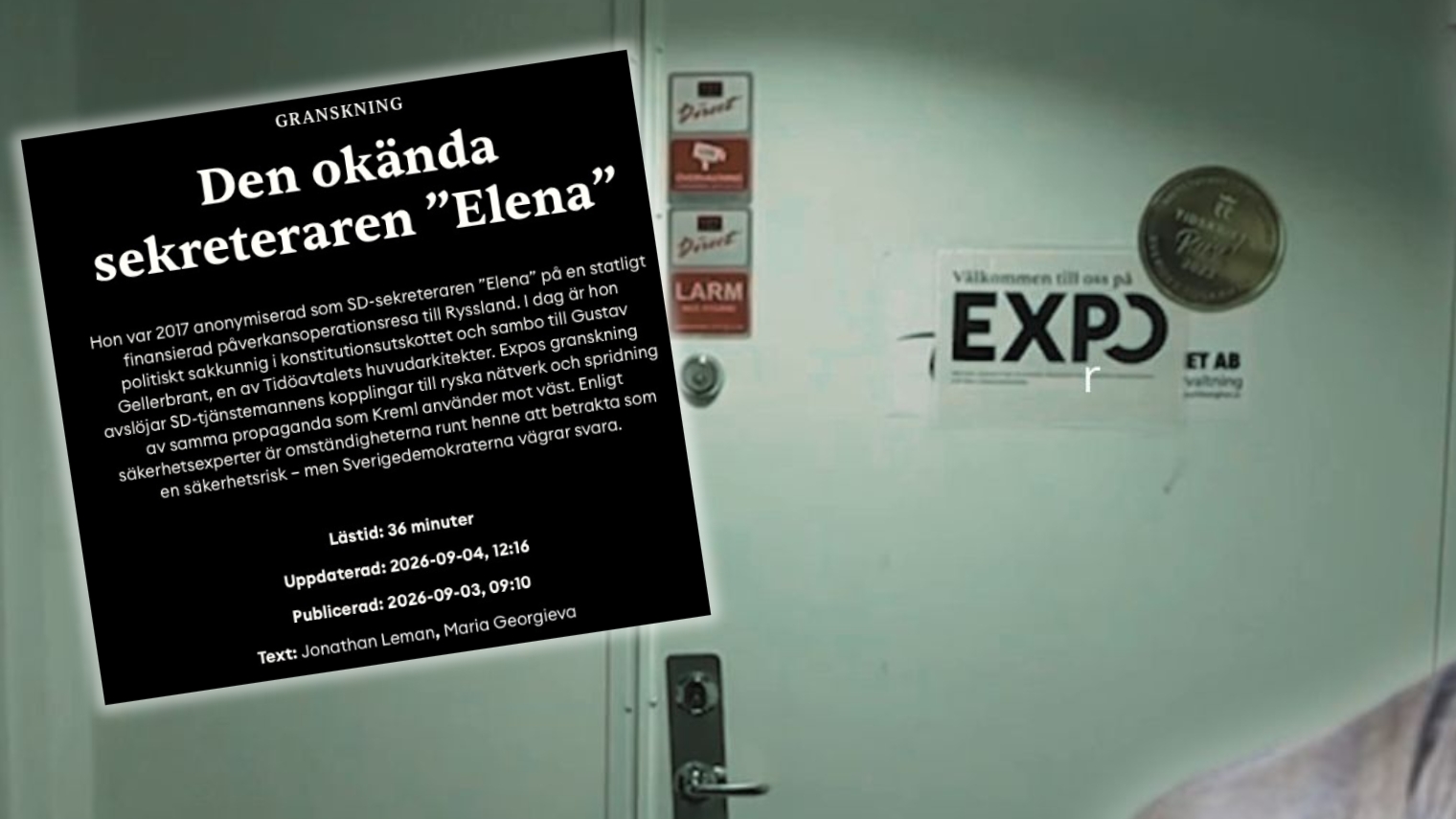
Last week, Expo published an article shining a spotlight on a 43-year-old, Russian-born woman who has lived in Sweden for about 22 years. According to graphics by the far-left site, she immigrated in 2004, while the main text says she arrived in 2006.
Lied about ‘sham marriage’
Expo goes so far as to claim that the woman came to Sweden via a sham marriage without providing any concrete evidence for readers to believe this was in fact the case.
Her path to Swedish residency went, according to a source to Expo, through a sham marriage. And six years later, in February 2012, she was granted Swedish citizenship.
– Expo about the woman
Expo was later forced to issue a correction. The information about a sham marriage was incorrect, something the far-left doxxing site hadn’t checked. The SD woman, in fact, was never married.
Correction (20260904): In a previous version of the text, it was incorrectly stated that NN entered into a sham marriage when she moved to Sweden. That was wrong, NN has never been married.
Expo’s correction
But it doesn’t end there. Expo also intensifies the picture of a possible infiltrator by highlighting that the woman has changed to a Swedish-sounding name. In reality, the name isn’t particularly ‘Swedish-sounding.’
She retained part of her previous name, added a Swedish part, and kept her Russian first name. To call out the name change this way, however, contributes to painting a picture of something more mysterious and spy-like than the facts support.
Today, the woman is a political adviser in the Committee on the Constitution and, according to Expo, since 2024 has a relationship with SD leader Gustav Gellerbrant. He is a former Moderate, previously served as political adviser to then Justice Minister Beatrice Ask. After the 2014 election loss, Gellerbrant joined the Sweden Democrats and is currently the party’s head of coordination at the Government Offices.
This is the connection Expo uses to create an impression that Russia has infiltrated the Government Offices. According to the far-left site, the SD woman has for years engaged in spreading Russian propaganda, specifically messages from the Kremlin, Expo claims.
The whole thing hardly sounds convincing and raises a number of questions, which is precisely the effect Expo seems to want just days before the election. The problem for the far-left doxxing site is that some of these posts were published twelve years ago, at a time when relations between Sweden and Russia were very different. Having ties to one’s homeland, or once expressing appreciation for a political leader in one’s country of origin, is hardly unusual or notable in itself.
Of course, there are also security risks to consider when people with foreign backgrounds are recruited to security-sensitive positions. One example is the risk of clan infiltration, which has been highlighted in the Police Authority. Both the Security Service and Armed Forces have suffered serious security incidents, such as the much-publicized Iranian spy brothers.
But that’s also why security clearances are carried out, and according to the Sweden Democrats, they have been in this case as well. Such assessments can include the person’s relationships, foreign connections, and possible conflicts of loyalty. It’s entirely reasonable to ask about these issues or be cautious, especially in today’s uncertain security situation.
Accused of Questioning Swedish Media
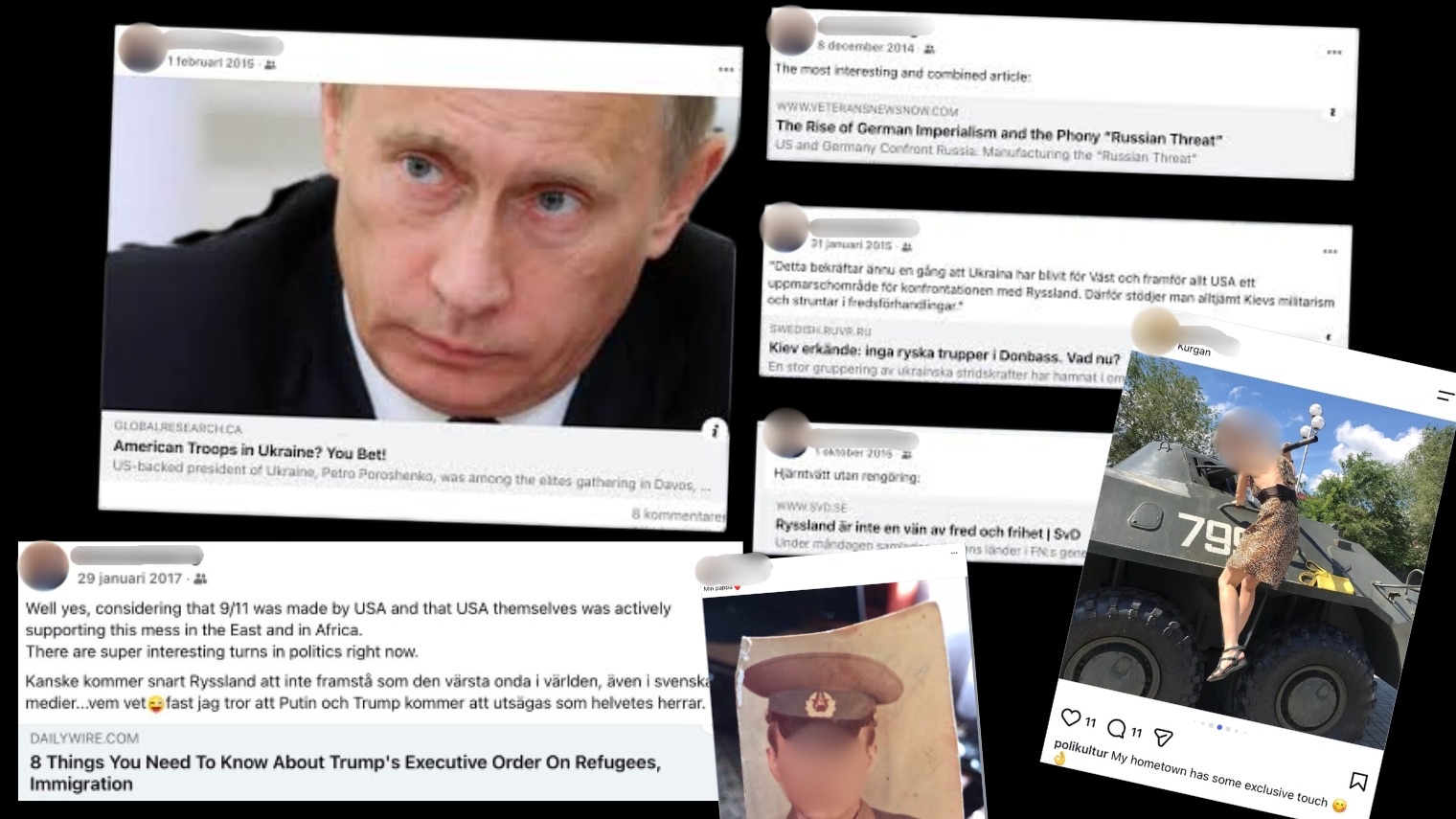
Samnytt has compiled a collage of screenshots from the posts Expo uses as evidence for calling the woman ‘pro-Russian’ and depicting her as a possible infiltrator and a so-called security threat.
Among other things, Expo highlights a post where the SD woman uses the term ‘mass brainwashing,’ to support their narrative of her questioning Swedish institutions. She also comments on a news article in SvD with the words ‘brainwashing without cleaning.’
On Facebook, X and in Russian Telegram channels, NN has undermined trust in Swedish institutions by dismissing them as tools for ‘mass brainwashing,’ called Western leaders Nazis, and spread Kremlin narratives about an alleged ‘genocide of Slavic peoples’—rhetoric that supports Putin’s ambition for a multipolar world where Russia’s dominance is restored after the Soviet Union’s fall.
She has also spread conspiracy theories questioning the Covid vaccine from her X account.
Expo about the SD woman
The SD woman may be born in Russia, but today she is a Swedish citizen and has lived in Sweden since 2004 or 2006, depending on which year is accurate in Expo’s own article. She’s thus lived in Sweden for about 22 years and, like other Swedish citizens, has a constitutionally protected right to criticize Swedish media, authorities, politicians, the EU, and societal institutions.
This applies even when the criticism is harsh, uncomfortable, or even incorrect. Her Russian background alone does not make criticism a form of foreign influence in Sweden.
That’s easy to forget, but it applies equally to a Swedish citizen with Russian, Somali, Afghan, or Iraqi background. It’s a basic right in Sweden. The question, then, is why her openly expressed societal criticism on social media, after nearly two decades in Sweden, should now be used as a sign of a security risk, specifically referencing her Russian background.
Is it really ‘influence’ undermining Swedish institutions to express your own opinions? If so, the definitions of democracy and influence have taken on a rather strange meaning today. That someone expresses opinions Expo dislikes may be controversial, wrong, or politically uncomfortable—but it’s not in itself evidence of Russian infiltration in Sweden.
If there is concrete evidence of improper influence or contact with Russian intelligence, it should certainly be scrutinized, just like any other foreign power. But critiquing Swedish institutions, expressing positive views about a politician, questioning established views, bringing another perspective to open debate on social media, or sharing news articles is something else entirely.
Such things can be controversial or uncomfortable for some to see, but that is not the same as infiltrating Sweden—or an indication in itself that someone poses a security risk. It is about using one’s democratic right.
Moreover, it appears that many of Expo’s examples are taken from around 2014–2015—in other words, over ten years ago.
Her Father Served in the Soviet Army
Expo brings out the next ace: her father was an officer in the Soviet Union’s army, and in 2017 she posted a picture of him with a heart.
From there, at least in Expo’s reasoning, it’s not far to hints she has ties to Russian intelligence. As if every other man in the Soviet Union did not at some point have a connection to the military.
If nothing else, according to Expo, her hometown has a ‘military-industrial profile’:
Documents obtained by Expo show that XX was born in the Siberian city of Kurgan, known for its military-industrial profile. She is, according to family photos posted on social media, the daughter of a Soviet officer.
Expo simultaneously pulls up newer material than the decade-old posts. There are posts and shares from 2024–2025 which Expo claims align with Kremlin narratives, as well as participation in a Telegram group where the far-left site argues there is conspiratorial and extremist content.
In 2024, XX commented in the group requesting more material and videos regarding a post about the ERICS cooperation as proof that Russia is not isolated at all.
These things can, of course, be discussed and are more relevant for a current assessment than a single post from 2015. But even here, the question remains what this actually shows about her current loyalties and actions. So far, Expo has only shown she requested information in a comment thread about whether Russia is isolated or not.
How Much of an Expert is the Expert?
They also bring in the so-called security expert Patrik Oksanen—the former writer at a local paper in Hälsingland turned security policy and Russia expert—to reinforce it all.
Oksanen can be described as a Center Party profile, debater, and ‘senior fellow’ at the liberal think tank Frivärld, who has long championed Swedish NATO membership. He is identified as a strong advocate for Swedish membership and has also pushed for Sweden to sign the DCA agreement.
READ ALSO: Center Party NATO lobbyist attacks Samnytt
Alongside that, the expert has made a number of controversial statements about various events, including the Nord Stream sabotage, where his clear personal stances have come through in his analyses. When gas was still bubbling up from the pipelines in the Baltic, he made definitive statements in both SvD and TV4. TV4 hosts even had to remind Oksanen at the time that it was not yet known what had happened.
His analysis later turned out to be incorrect, as German authorities arrested and sought people connected to the other side. From a truly critical standpoint, some of his analyses could therefore be described as conspiratorial. Still, he is repeatedly presented as some kind of objective security analyst.
READ ALSO: Finnish security service: Russia not behind Baltic cable damages
It is the same expert Expo now brings forward to further bolster the suspicion of the SD woman in parliament. Oksanen’s assessment is that the woman undermines Swedish media via what he describes as a ‘consistent mirroring of Russian narratives and positions.’
– By repeating Kremlin’s narratives, she helps normalize the Russian perspective, create polarization, and among other things, undermine trust in Swedish media, he says to Expo.
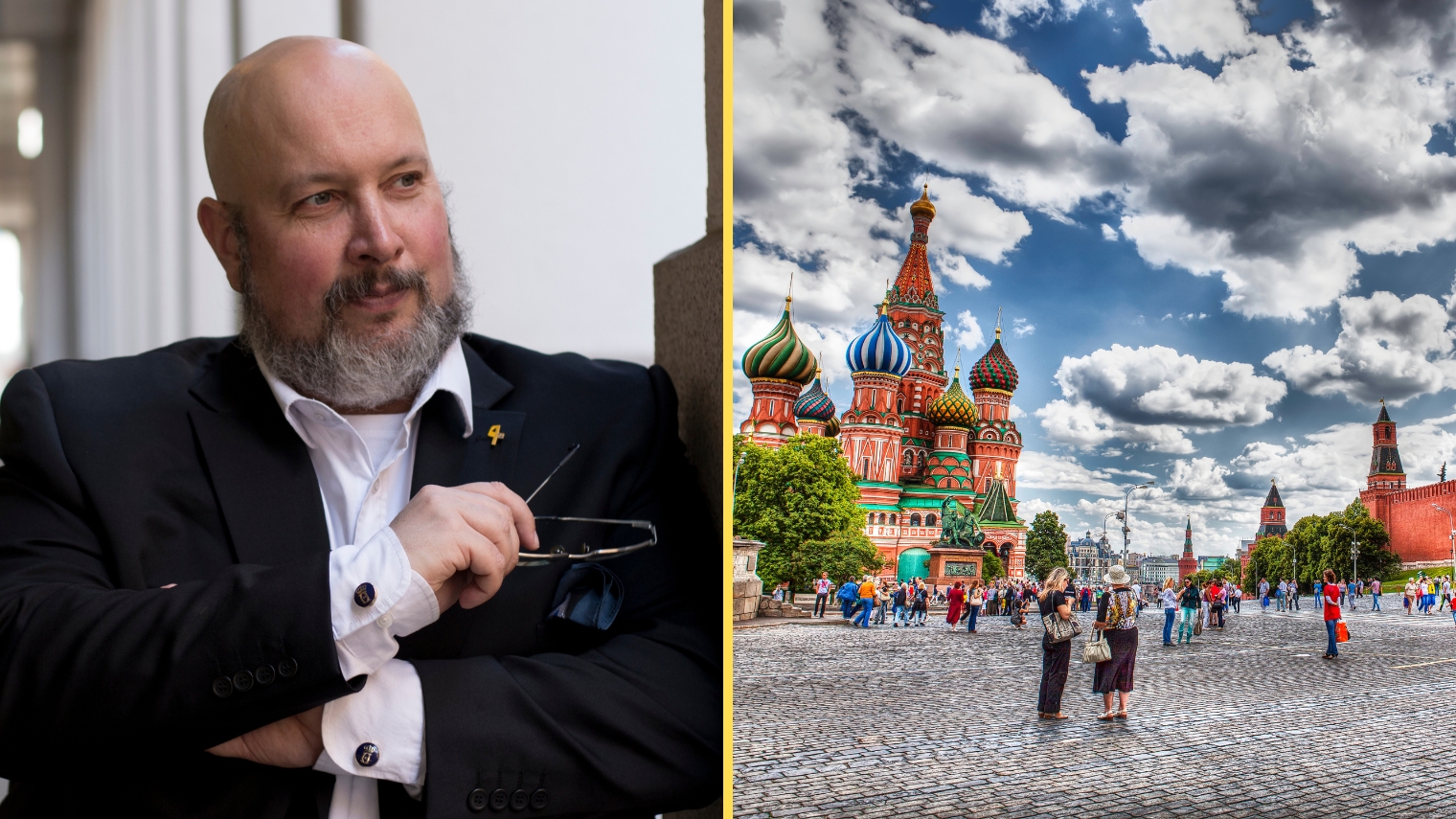
Furthermore, the so-called security expert asserts that the woman’s Facebook posts amount to an influence campaign, even though she lacks a larger platform and seems not to have reached beyond her own circle of friends.
– The purpose of Russian propaganda and narratives is to fuel conflicts or break down trust, in order to destabilize the West. The strategic goal is for Russia to get the EU and NATO to fall apart, he says to Expo, and continues:
– It is a means to achieve a new European security architecture where Russia can again be an empire.
Oksanen instead links her posts to supposed attempts to weaken the EU and pave the way for a Russian empire.
– Propaganda and disinformation are supposed to pave the way for and normalize a Russian ’empire’ in a world where several great powers compete.
READ ALSO: Västerås changed view on Russian Orthodox church after visit by Patrik Oksanen
The situation, of course, gets more complicated and sensitive when the woman is in fact the partner of Gustav Gellerbrant, head of coordination between the Sweden Democrats and the government—a role close to the government’s work and Prime Minister Ulf Kristersson. At first glance, and with bold headlines, it is understandable that this raises questions.
But what exactly has she expressed recently or at least after the invasion of Ukraine that would make her an infiltrator? Other posts have instead dealt with how she experiences her Russian background in Sweden and the EU after the changed security situation.
She also writes that this concerns a genocide of all Slavic peoples, which clearly includes both the Ukrainian and Russian people. It’s also a view that US President Donald Trump has repeatedly touched on, citing extensive Russian and Ukrainian casualties. Trump has often spoken about the massive loss of life on both sides.
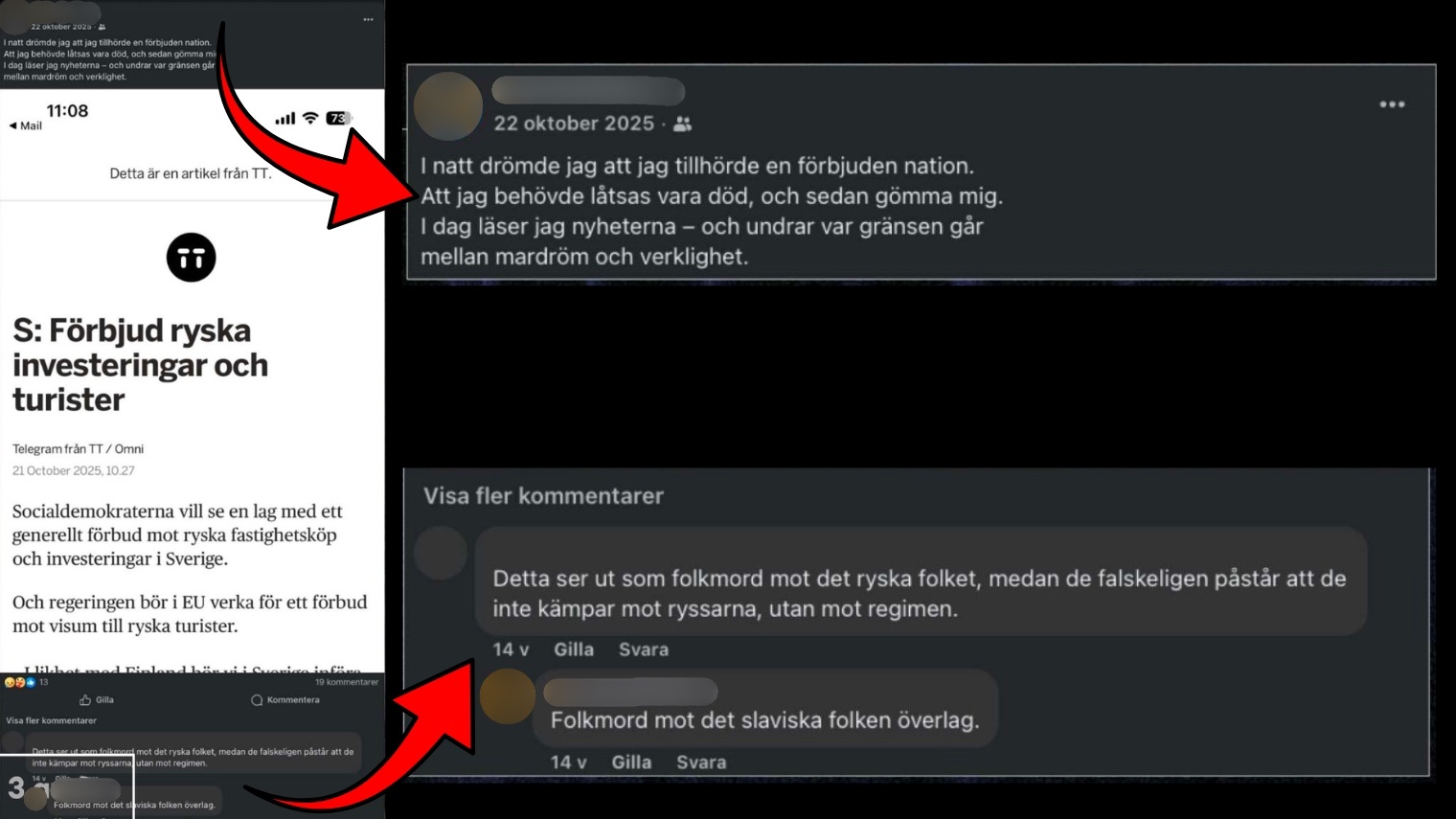
It’s one thing to state that such information may be politically sensitive and appear highly notable within the Swedish consensus corridor, among those mainly consuming SVT’s or Expressen’s take on the conflict. Such things may, of course, raise questions. But what is actually presented in Expo’s article is mainly quotations from articles that may seem controversial, together with interpretations and conclusions, rather than concrete evidence for the sweeping claims being made.
We don’t even know if the woman was being ironic, or if she wrote other things in the comment threads that give those quotes a different context and clarify what she actually meant.
Still, establishment media again choose to forward the far-left doxxing site’s claims without any significant critical scrutiny of the posts. This pattern is recurring: as soon as Expo publishes an article, it is picked up and the site is routinely described as neutral and a truth-teller investigating extremism. Seldom, however, are the claims, sources, and far-reaching conclusions themselves examined.
This is problematic, even if the media have at least refrained from publishing the woman’s name or picture—she is neither a politician nor a public figure—for old posts about her thoughts or hobbies. Expo has long faced criticism for exaggeration, far-reaching inferences, and presenting their own interpretations as if they were obvious conclusions.
Perhaps the establishment media should apply a much more critical eye than what often seems to be the case when things like this are quickly picked up and passed along. When we have previously reviewed the source material behind similar exposés, it has often emerged that Expo hugely exaggerated things beyond what the actual background supported.
The Woman’s ‘Putin Praise and Kiss’
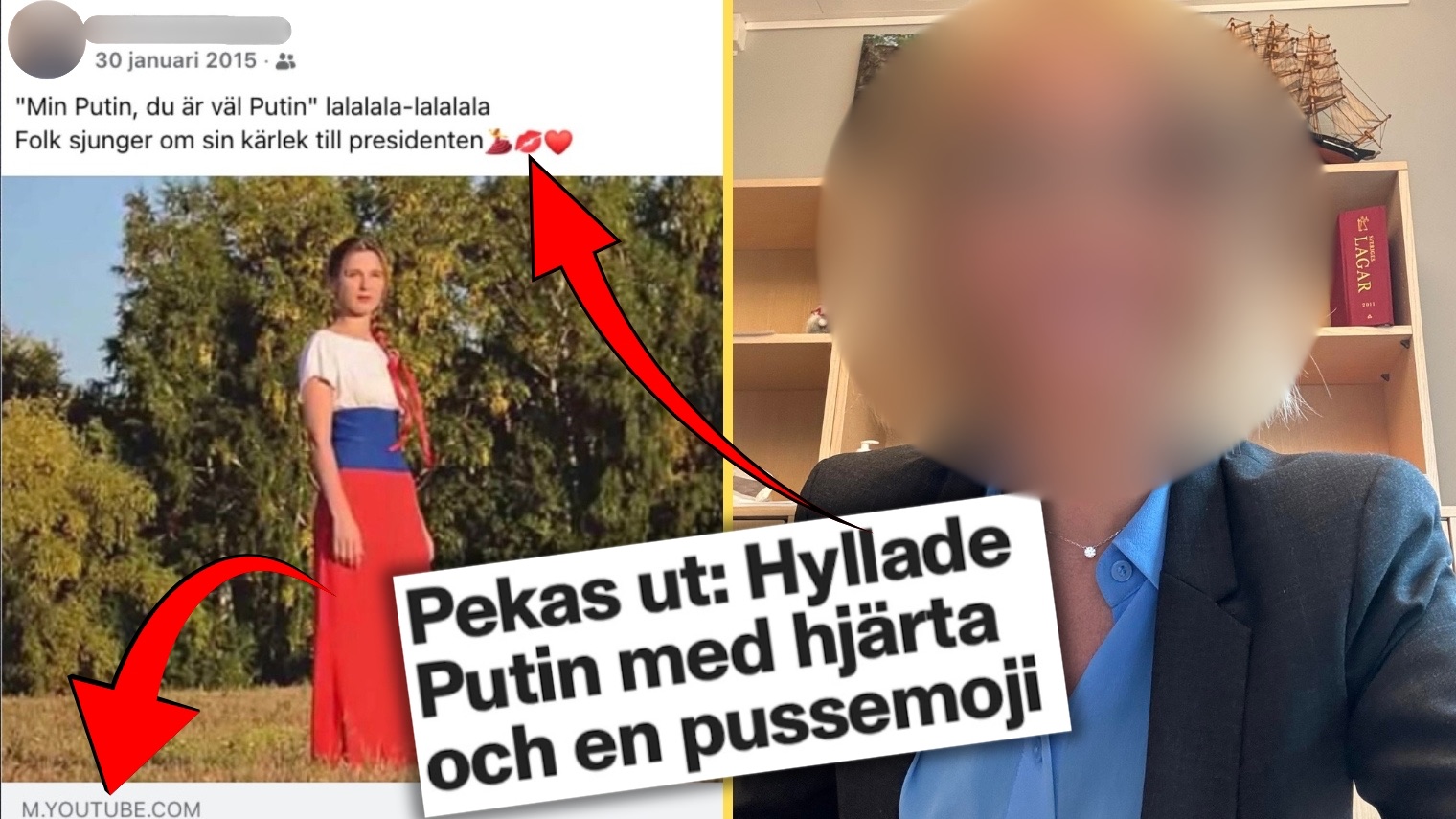
What else has Expo found here? In a Facebook post, the SD woman is said to have expressed herself positively about the Russian president, Vladimir Putin, something the Social Democrat–affiliated newspaper Aftonbladet headlined a few days before the election: ‘Praised Putin with heart and kiss emoji.’
The sharing is from over a decade ago. What did the so-called praise consist of? She shared a music video from YouTube where a Russian artist sang about Putin, wrote a few positive words about the president, and added emojis: a heart and a kiss.
What says she still feels the same way today, after everything that has happened? Have all those at Expo themselves always had the same political sympathies for the same politicians over their entire lives? A decade is a long time, and political views can change—not least when the world changes. It should also be added that at the time, the SD woman expressed criticism of Putin’s domestic policy in posts.
It is also worth remembering that the Swedish view on Russia did not always look like it does today. Ten years ago, relations were much more normalized, even if tensions had begun to grow after Russia’s annexation of Crimea in 2014.
Other examples can be raised from the same period her posts were published and accused of being Kremlin propaganda—for example, former Prime Minister Fredrik Reinfeldt (M), who in 2014, regarding Russia’s annexation of Crimea, said it was ‘to some extent understandable that Russia acted out of concern for the Russian minority in Crimea and eastern Ukraine.’
– The starting point for understanding this is that there is a Russian-speaking part of Ukraine that sees itself ethnically as Russians. But that does not change the fact that Russia’s behavior is reprehensible. One must keep them apart, Reinfeldt said.
Another example, just to show what things sounded like when the political climate was different than today, is Stefan Löfven (S). He met with Vladimir Putin during his premiership, and as late as 2019, after Russia had annexed Crimea, Löfven praised Putin for being ‘objective, knowledgeable, and competent.’
Did these two gentlemen during the same period also spread ‘Kremlin’s narrative’ about the conflict in Crimea and eastern Ukraine, or express themselves positively about Putin as Russia’s leader?
According to so-called security expert Patrik Oksanen, this type of statement is considered a textbook example of Kremlin propaganda.
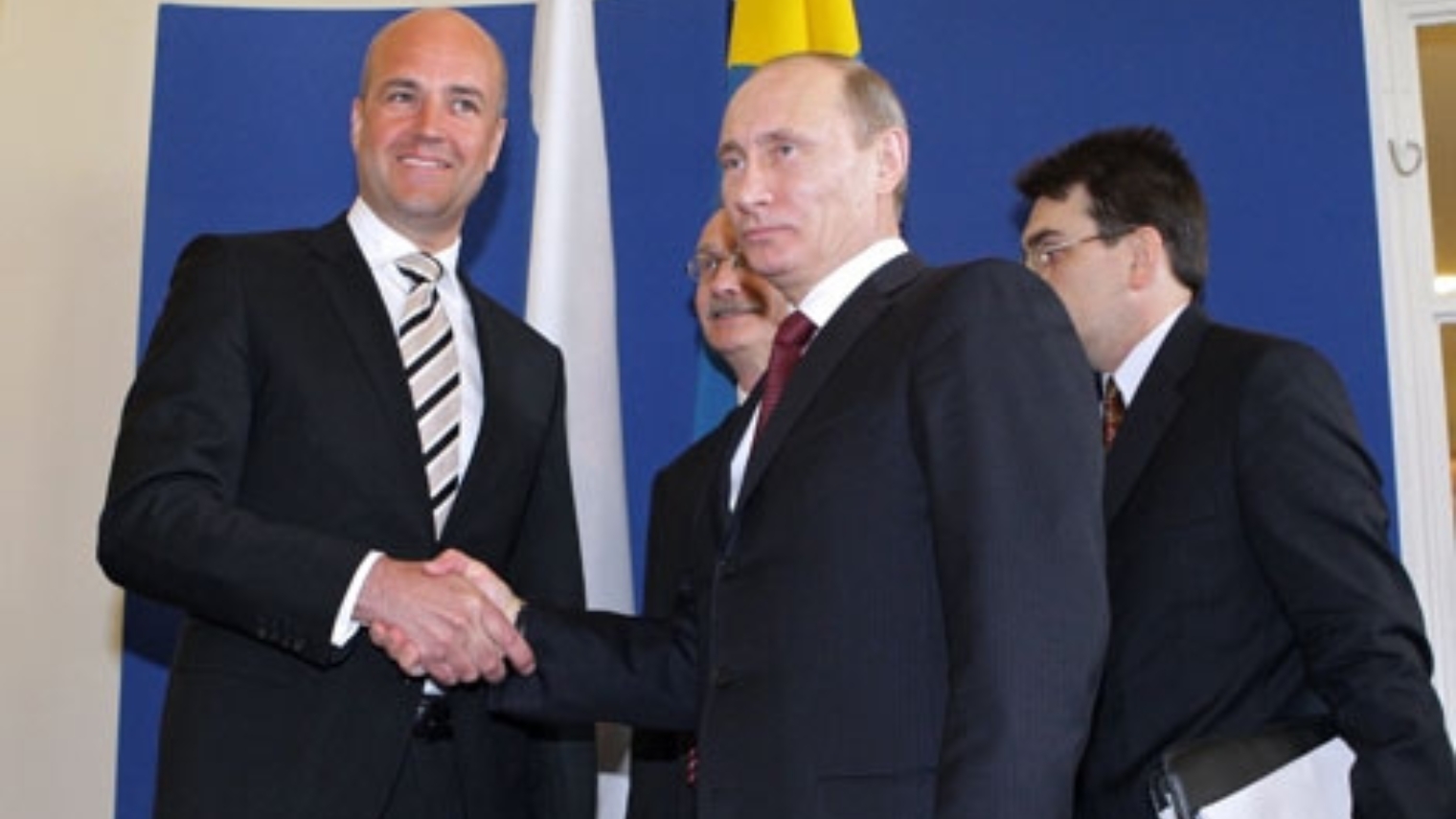
And regarding Reinfeldt, as well as the SD woman expressing something positive about Putin by sharing a music video on Facebook in 2015: It’s like assuming everyone who once appreciated party leader Fredrik Reinfeldt still does so today.
Reinfeldt is rather a good example of how people’s opinions about politicians can change over time. From 2006–2010 he was very popular; today, he is strongly questioned and despised by many due to his politics over two terms.
Political sympathies aren’t a lifelong contract, and a view at one point in time isn’t necessarily telling for many years later. Political views change over time.
Why should it be any different for Russians? Why assume that someone who once showed support for Putin is automatically a ‘Putinist’ for life?
This is an important perspective when old social media statements from this period are brought up and judged by today’s climate around Russia and the war in Ukraine, now in its fifth year, even though the conflict itself has lasted much longer.
But that does not of course mean her then sympathies are wholly irrelevant. Such a background can be relevant when assessing suitability for certain posts within the country’s most sensitive areas, just as strong ties to any other country could be.
Security Risk Close to the Prime Minister?
The woman’s partner is thus Gustav Gellerbrant, Sweden Democrats’ head of coordination among the Tidö parties at the Government Offices. The role involves coordinating the implementation of the Tidö Agreement and is a central political function near the government’s work and the Prime Minister.
Gellerbrant himself stated that he was completely transparent about the relationship during his security clearance. After Expo’s publication, SD also stated that he underwent a new security assessment. No agency, to public knowledge, has deemed he should leave his role due to any security risk.
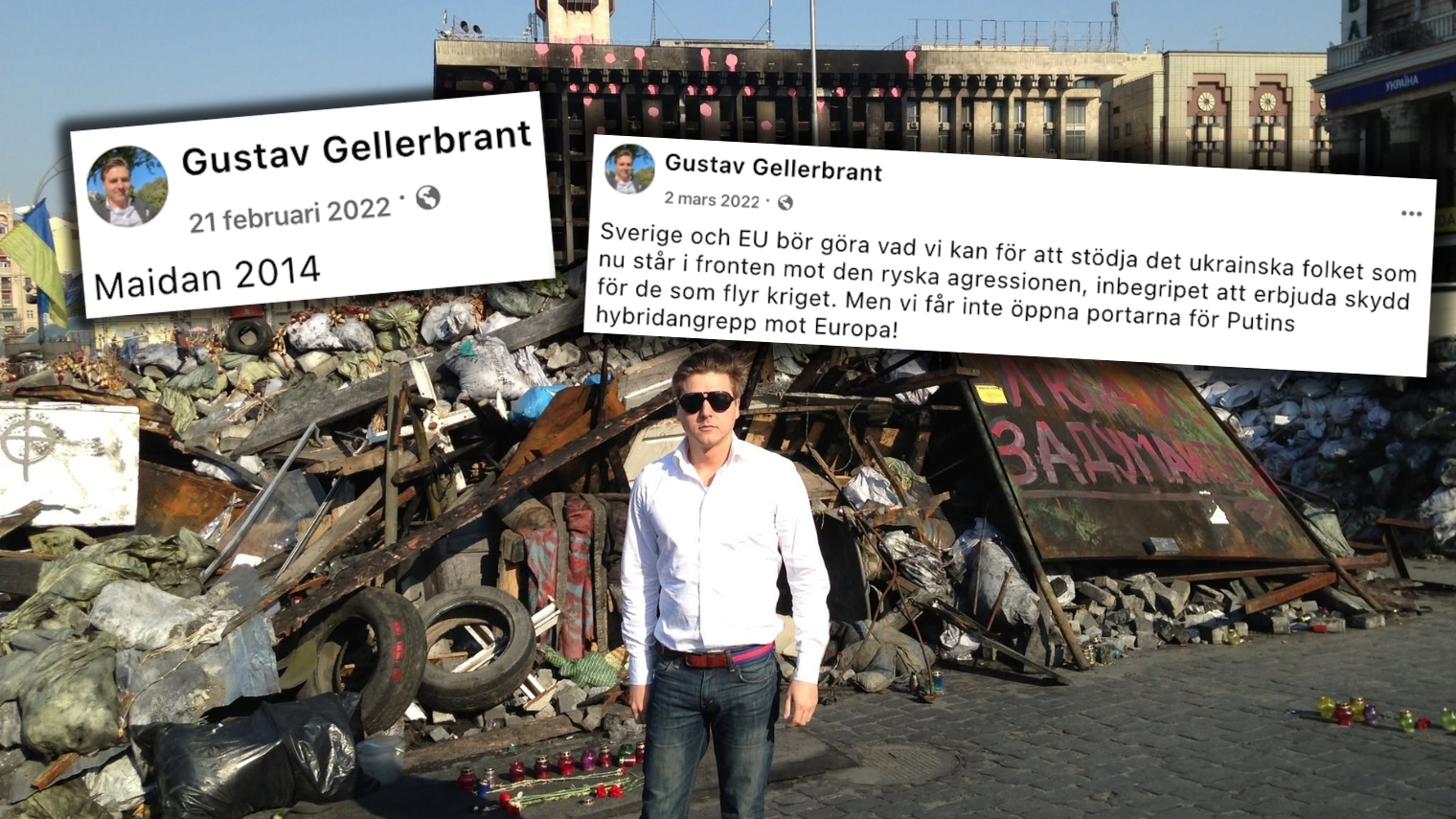
Another aspect neglected in the establishment media reporting on the case is that Gustav Gellerbrant’s pro-Ukrainian stance is well documented. He is seen in photos at Maidan Square in Kyiv in 2014, during the protests, and has repeatedly expressed support for Ukraine and taken a clear stand against Russia.
Against this background, to try extending the suspicion to him as a security risk seems, to say the least, a stretch.
Suspected for Cultural Interests
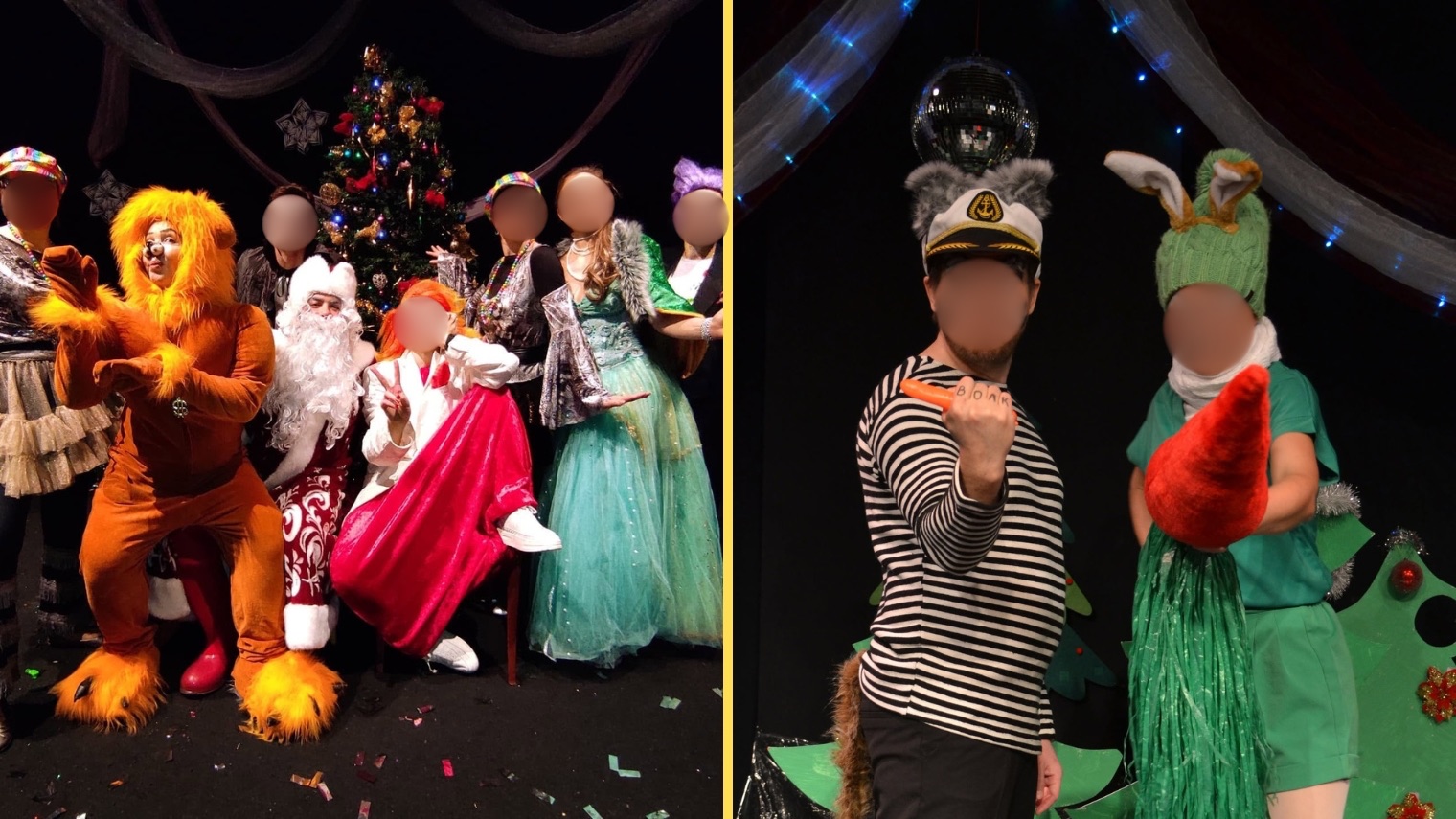
Besides social media posts, Expo has dug into the Russian-born SD staffer’s leisure interests. For about 16 years, she has been involved in a cultural activity: a Russian theater in Stockholm. This engagement began long before the Ukraine war or the changed security atmosphere.
In Expo’s portrayal, even this theater commitment becomes a significant part of the attempt to link the SD woman to Russian intelligence activity. But for all the sweeping insinuations, no concrete evidence is presented that her involvement had anything to do with Russian intelligence.
The reasoning is lengthy, but the connection to the SD woman is even weaker. So weak that Expo is largely forced to focus on the theater director instead of the SD woman.
READ ALSO: Sven Hirdman on Expressen’s Russia accusation: ‘Don’t have time for that nonsense’
The far-left doxxing site targets the theater director, who has a background as a researcher at Karolinska Institutet. They try to tie her to Russian state interests and intelligence, including her attendance at a defense conference in St. Petersburg in 2016.
– I attended as a guest—a Russian-speaking researcher from abroad. At the time, I was still working at Karolinska Institutet and was interested in possibilities for cooperation on early cancer diagnostics in Russia, the woman explained to Expo.
Further links are drawn to whoever sponsored theater activities in Stockholm and events many years ago—then pinned to the SD woman’s record.
But where is the evidence for any sort of infiltration? What Expo uncovers is that the theater has ties to representatives of the Russian state because it has hosted events. For example, New Year celebrations.
Expo’s review of the theater shows repeated interactions with Russian state representatives. Abyrvalg has been documented organizing New Year parties at the Russian embassy’s premises in Stockholm.
– Expo
1,000 Euros for Children’s Theater
There is also information in Expo’s article that the theater received Russian state support, and based on this everything is made suspect to new heights. One of the grants mentioned was mediated via a Russian compatriot organization under the Russian Foreign Ministry. Expo writes there are close connections to Russian intelligence, referencing decisions by other EU countries.
The grant from the organization to the theater amounted to about 1,000 euros and was intended for children’s theater. According to the details, this occurred on two or three occasions.
After Russia’s invasion of Ukraine, those responsible for the activity no longer wanted support from the Russian state. The theater accordingly has not received further such support, instead relying on membership fees and donations from the Russian diaspora in Sweden.
READ ALSO: Expressen links SD to Russia after London meeting—S politicians met the same party
According to Expo’s article, one interviewee at the theater also stated that the Russian embassy refused the theater money, citing a lack of funds. The operation also sought support via Region Stockholm in 2023. The SD woman signed the grant application, but it was declined.
Yet this is used as a building block in the suspicion against SD’s staffer, through a narrative that cultural activity was financed by the Russian state and served as cover for intelligence activity. Reference is made to security reports on how Russia uses cultural activity and other venues for influence and intelligence gathering.
That Russia uses embassies, cultural activities, and other venues for influence is naturally important to scrutinize. But it is quite another thing to draw the conclusion that someone engaged in such activities must have some kind of connection to Russian intelligence.
That a Russian theater for the diaspora has received grants from Russian state bodies for Russians abroad and organized New Year celebrations with the embassy is hardly in itself proof for what she is now lumped together with by Expo, security experts, and Social Democrat politicians.
Someone who moves to another country can reasonably still wish to keep contact with their homeland, language, compatriots, and culture.
S-Campaign: ‘Security Crisis – Russian Infiltration’
Expo’s article, which has been circulating in establishment media for nearly a week, didn’t leave the Social Democrats idle. The party quickly moved to reinforce the image of the Tidö government as so weak that it now allowed ‘Russian infiltration’ via the Sweden Democrats.
At the same time, establishment media pressed the Moderates and prompted rapid statements that SD should fire those involved.
– This is about the risk of Russian infiltration at the Prime Minister’s office. This is a security crisis at the Prime Minister’s own office, until proven otherwise. Therefore, Swedes deserve answers, said S leader Teresa Carvalho at a press conference.
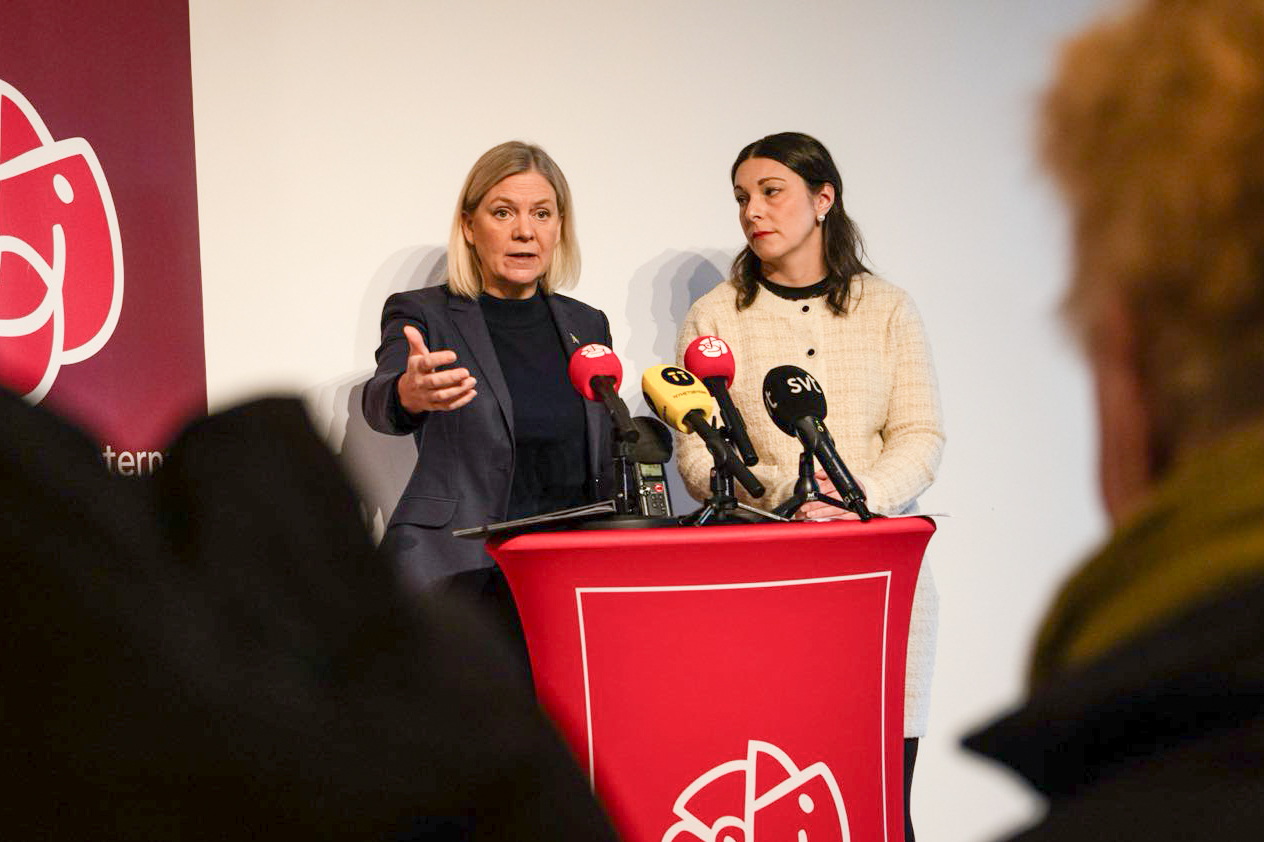
The Social Democrats argue that the woman’s old posts are part of ‘influencing public opinion.’ That way, they didn’t have to talk about domestic policy or the fact they lack solutions for the policies they have pursued over the years. Convenient to talk about Putin during the election campaign.
The goal is to create anxiety and division, sow doubt, and undermine trust in our democratic institutions. It’s about influencing public opinion – but also about accessing information, decision making, and the people who have influence over our society.
So we’re not talking about some abstract or hypothetical threat. It’s a threat that exists here. Against Sweden. Against our democracy and our institutions.
– Part of S press release after Expo article
The Media Whisper Game Moves Fast
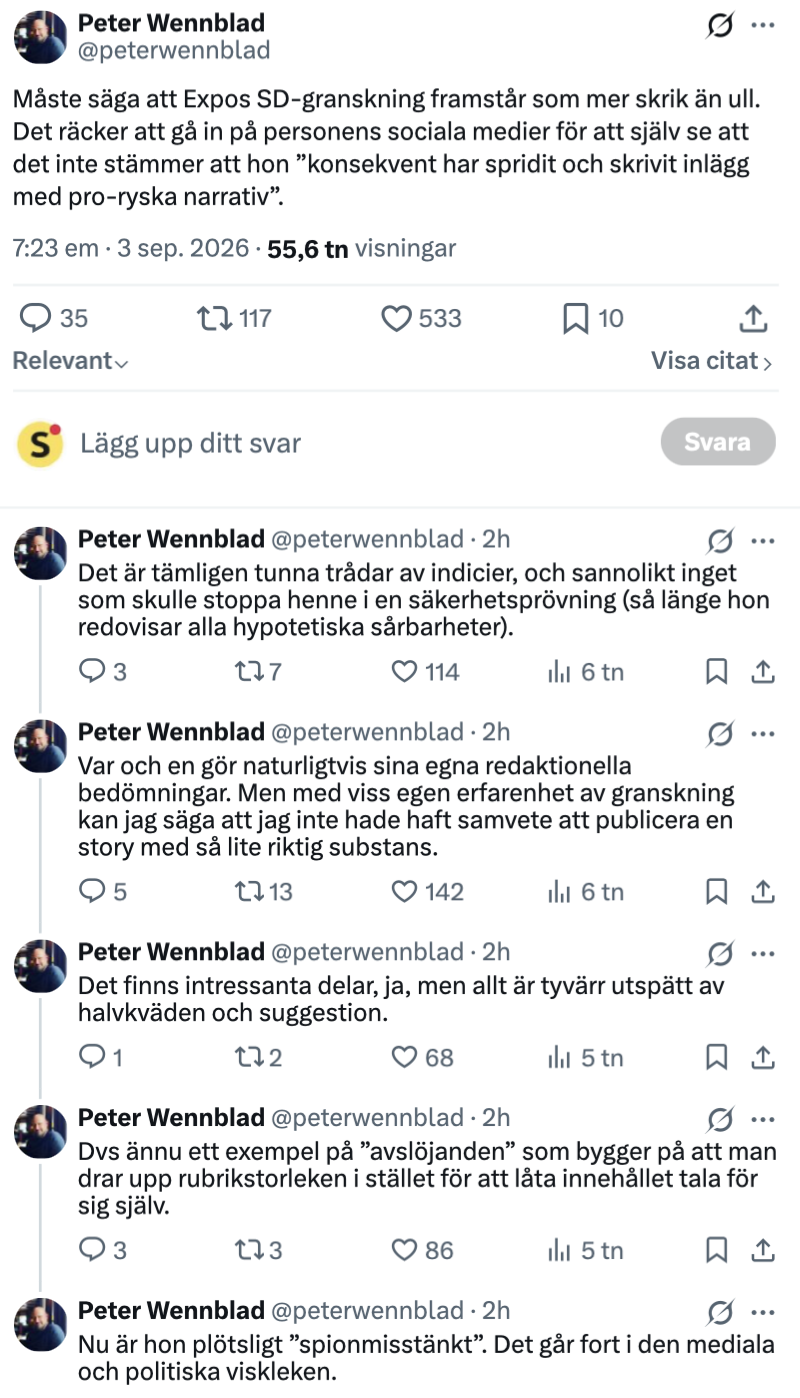
One not particularly impressed by Expo’s examination is Svenska Dagbladet’s editorial writer Peter Wennblad. In a social media thread, he dismisses the investigation as ‘more noise than wool.’
‘There are interesting parts, yes, but unfortunately everything is diluted with half-statements and suggestion. That is, another example of “revelations” that rely on increasing headline sizes rather than letting the content speak for itself,’ he writes about the Expo article and also:
‘Now she’s suddenly “spy suspect.” The game of media and political telephone happens quickly.’
Strandhäll and the ‘Spy Suspect’
Former Social Democratic minister and party leader Annika Strandhäll then tries to dismiss the SvD profile’s criticism of the Expo article by declaring the woman is indeed an infiltrator.
Strandhäll also defends the S-affiliated opinion shaper Daniel Suhonen’s assertion that the SD woman is a ‘spy suspect.’ But by whom? The Social Democrats’ campaign workers?
READ ALSO: Emilie compared Zelensky with Putin in 2023—now SD investigates its own politician
It’s a rather remarkable method for a party that likes to speak about democracy, legal certainty, and responsibility. Extreme boundary-pushing.
But according to S top politician Annika Strandhäll, the person’s Russian origin seems usable as a basis for far-reaching conclusions about her loyalty and intentions. ‘Being a Russian’ is enough to be judged in advance. See for yourself:
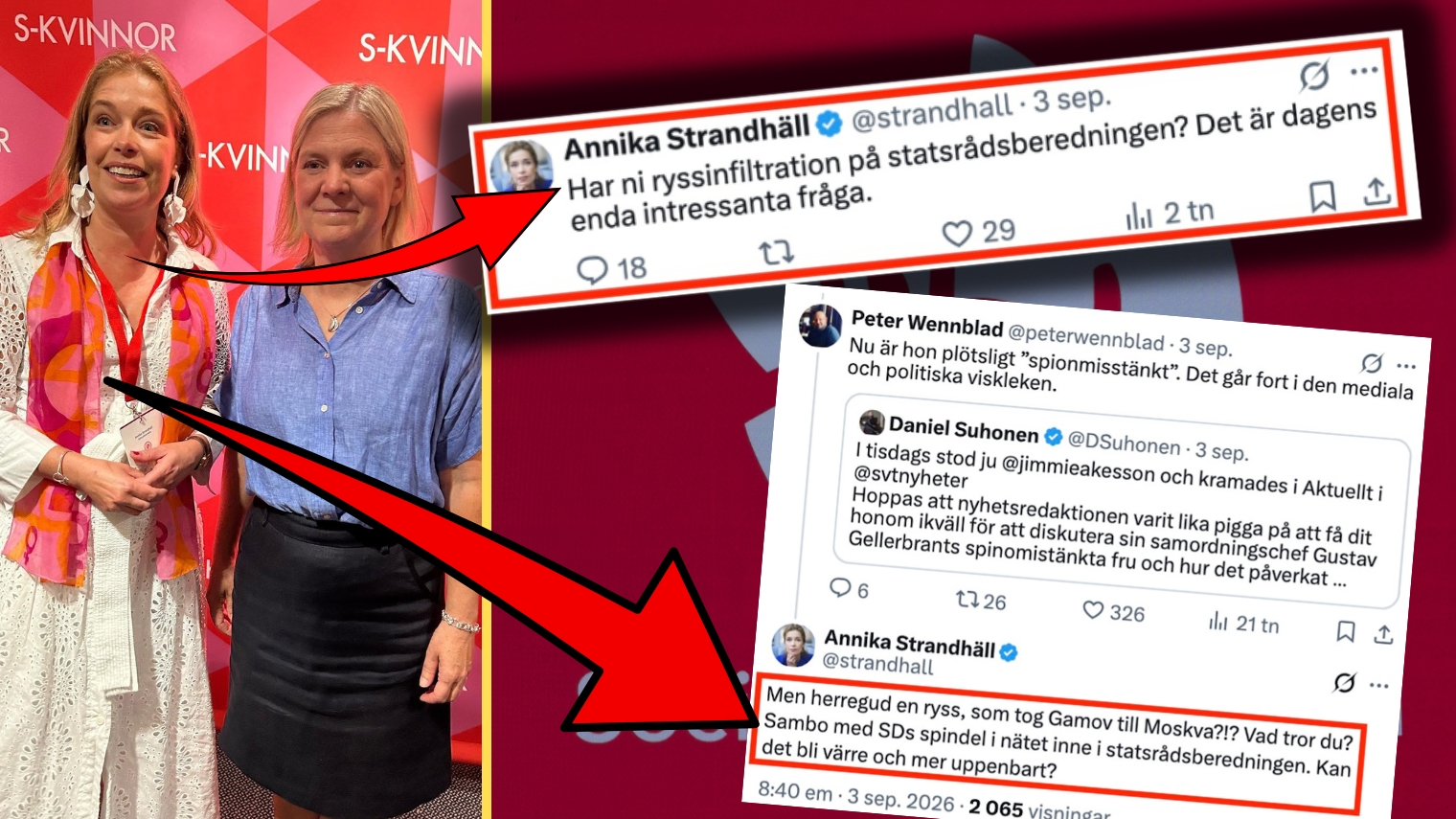
How would the reaction look if a politician reasoned the same way about someone with, for example, Somali background?
‘Do you have Somali infiltration in the Cabinet Office?’ ‘My god, a Somali.’ ‘Could it be worse or more obvious?’
But when the reasoning targets Russians, the question apparently becomes different. Principles of open borders, multiculturalism, anti-racism, and tolerance that Social Democrats and the politically correct establishment otherwise love to preach, suddenly seem less important.
READ ALSO: S-top Jamal El-Haj attended ‘Hamas conference’ planning meeting
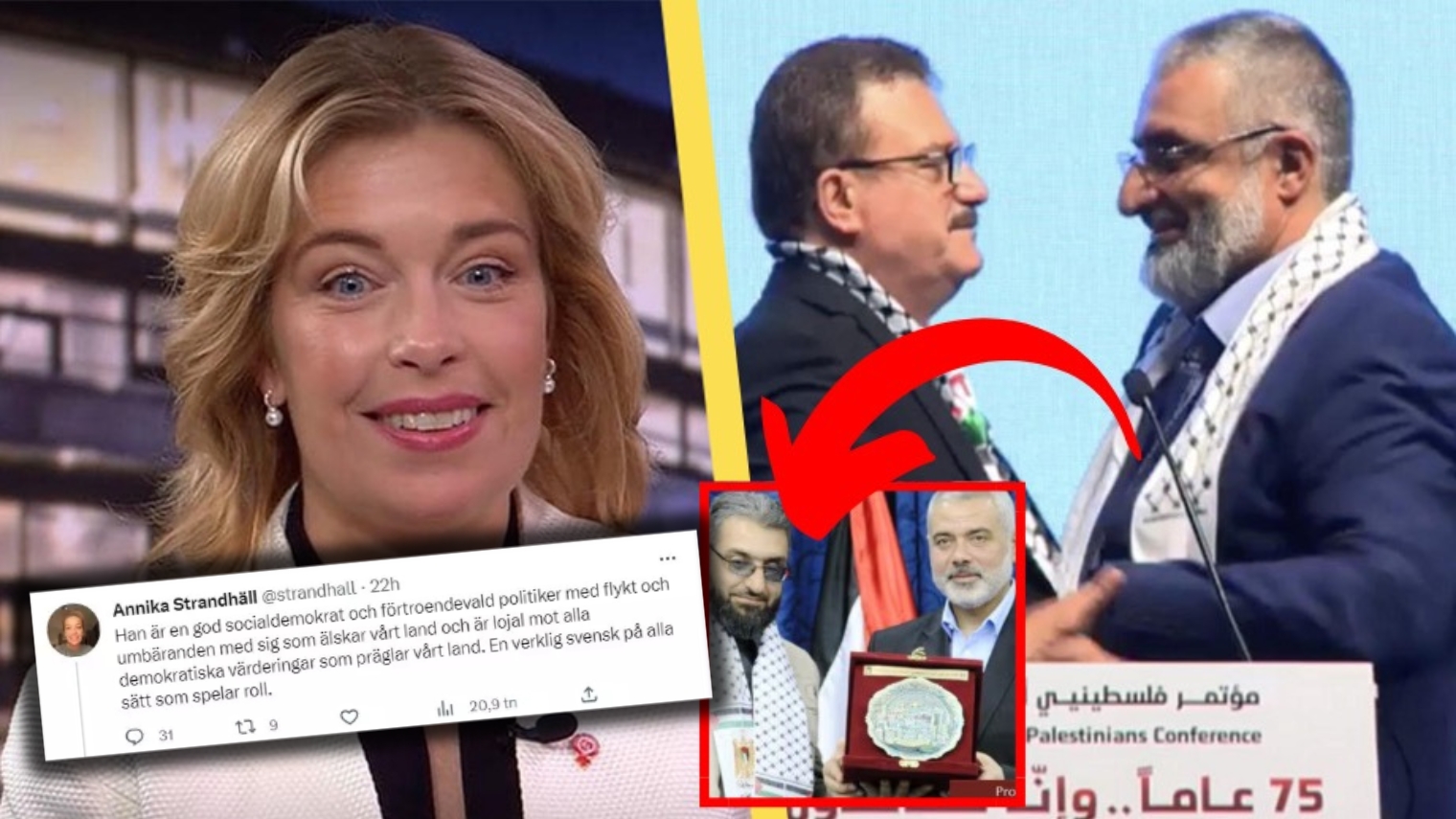
Here, a top Social Democrat’s view is especially interesting. When then-S MP Jamal El-Haj attended a Hamas-linked conference in Malmö, in both planning and onstage, the entire S leadership defended him repeatedly.
This despite the Palestinian Authority embassy in Stockholm confirming it was a ‘Hamas conference.’ The message: the S politician with Palestinian roots was trustworthy and the party continued to have faith in him, despite his participation.
Criticism was practically written off as racism and more. Eventually, the situation became impossible for S leadership to defend, and El-Haj had to step down.
Throughout, the consistent defense was that El-Haj had no links to Hamas or similar organizations in Gaza. Strandhäll herself vouched for him as ‘a good Social Democrat.’
Now, it’s the same Strandhäll helping drive the campaign and stick the ‘spy suspect’ label to a woman, with nothing more than a few screenshots in an Expo article from posts many years ago. The contrast is hard to miss. When it was El-Haj, trust lasted long; when it’s an SD woman, a few old Facebook posts suffice.
Expo and Strandhäll Are Wrong
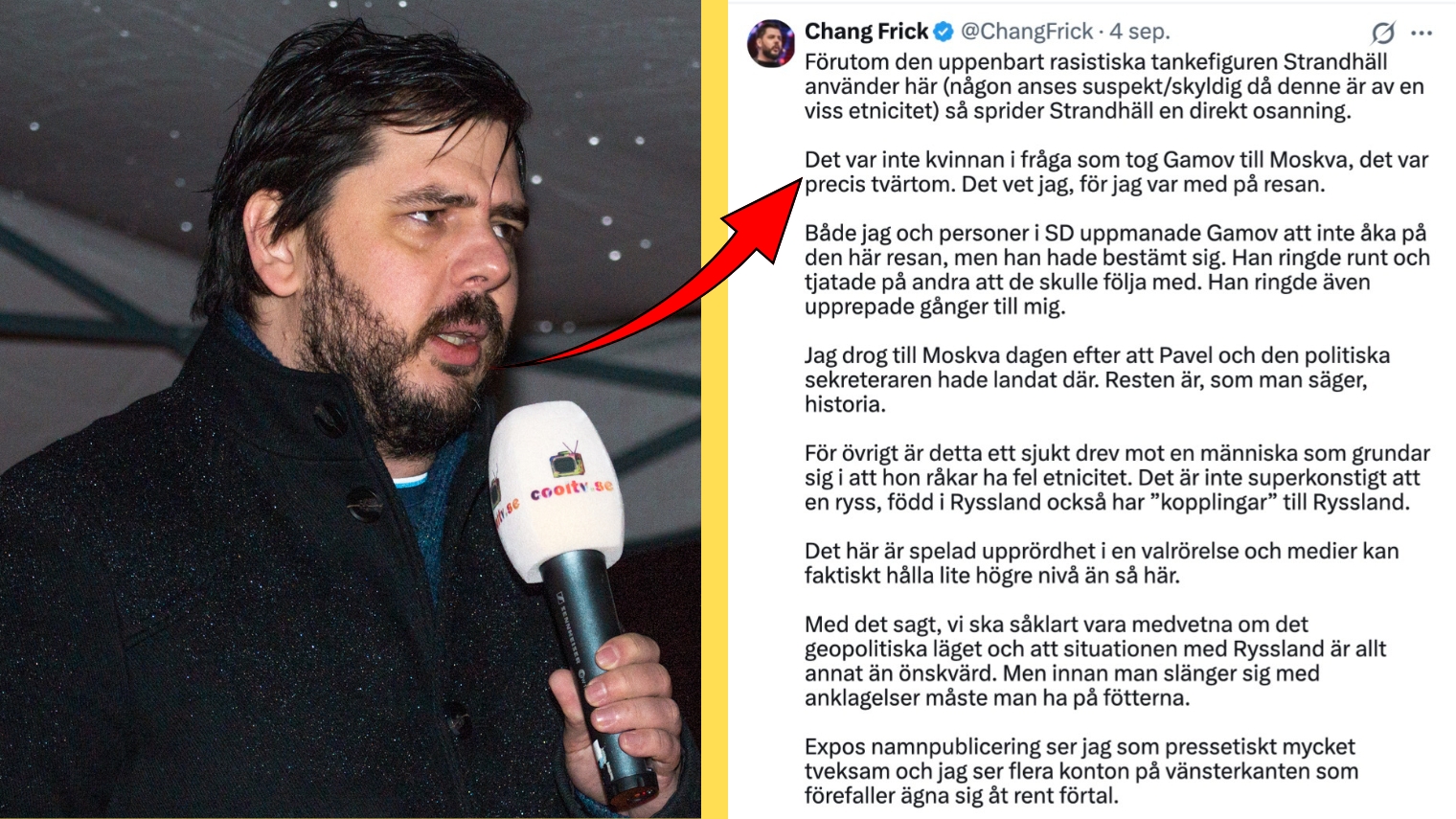
Both Expo and Strandhäll are also said to be off base regarding the SD woman’s Russia trip in 2017. ‘A Russian who took Gamov to Moscow?!?’ writes S-top about former SD MP Pavel Gamov’s 2017 trip to Moscow, supposedly at the initiative of the SD woman.
But right-wing commentator Chang Frick, who went on the trip and wrote a report about it, gives a different story. According to Frick, the woman was not part of the original plan but was persuaded to come along. Pavel Gamov reportedly called people throughout the party to get someone to join the trip.
By the way, this is a sick campaign against a person simply because of the ‘wrong’ ethnicity. It’s not all that strange for a Russian, born in Russia, to have ‘connections’ to Russia.
– Chang Frick about the Expo campaign.
At the same time, it’s worth stating the Moscow trip wasn’t just tourist travel. It was a trip to observe local and regional elections in Russia, and several advised against going. Still, the trip took place. There are of course actors, financing, and contacts around such a trip making it relevant from a security perspective. That aspect should not be brushed aside.
But the question is instead what the SD woman’s actual role on the trip was besides being a Russian interpreter, and what conclusions can sensibly be drawn from her participation.
Partner Comments on the Campaign
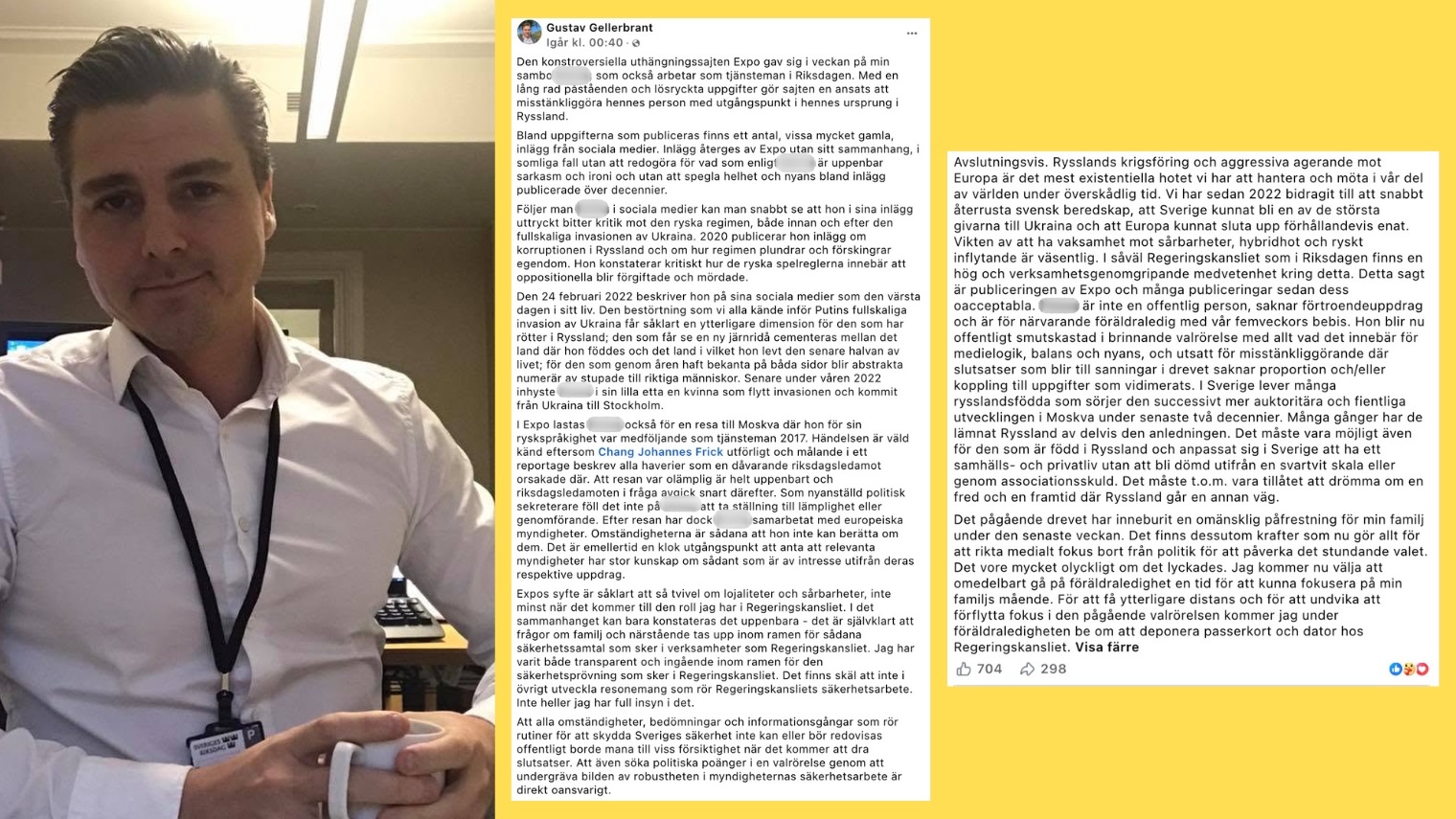
The woman’s partner, Gustav Gellerbrant, has also commented on the Expo article. In an open Facebook post, he describes the publication as an attempt by Expo to cast doubt on her loyalty due to her Russian birth. He also emphasizes that the publication came noticeably close to the election.
Gellerbrant adds that the woman has criticized the Russian invasion of Ukraine and Moscow’s political leadership. He also states that after a trip to Moscow in 2017 with an SD MP, she cooperated with European authorities afterwards.
READ ALSO: Met Russian woman 26 years ago – fired from the Tax Agency
This stands in clear contrast to Expo’s description of the same trip. Gellerbrant stresses the woman was newly employed as political secretary at the time and the trip wasn’t her initiative.
According to him, she participated mainly due to her Russian language skills, which were deemed relevant for the trip. He believes Expo’s description misrepresents both her role and her intention with the participation.
Zoom in to read Gellerbrant’s post on the situation:
TV4’s Kalla fakta Continues the Suspicions
On Monday, TV4’s Kalla Fakta, with ‘Troll Factory’ journalist Emil Hellerud, picked up Expo’s campaign against the woman—a few days before the election.
Just like ahead of the 2024 EU election, when TV4 published the “Troll Factory” investigation, about SD supposedly running satirical accounts on social media. The entire media establishment and parliament joined in with prolonged campaigns to give SD negative publicity. As usual, there’s silence regarding similar scrutiny of other parties.
TV4 suspects the woman based on jobs she applied for about 10–12 years ago, long before relations between Sweden and Russia hit current lows. Already in TV4’s article the reader is told the woman ‘is linked to Russian state actors.’ The evidence? Reference to Expo’s claims. That sets the tone and guides the reader from the outset.
READ ALSO: KTH professor fired for math research in Russia
They also bring in security and intelligence expert Jörgen Holmlund to fan the flames of suspicion against the woman, who has lived in Sweden since the early 2000s. This is done by claiming her government job searches as a political scientist ‘seem calculated.’
Strandhäll too has continued to fuel these baseless campaigns in establishment media by demanding that SD leader Jimmie Åkesson publicly declare how pro-Russian one may be as an SD representative and potential minister, with reference to ‘Russian contacts at the Prime Minister’s office.’
First, this concerns a staffer—not an SD politician or potential minister. Second, it is not even the woman who works in the Tidö coordination office. Talk about blowing things up. But that’s likely the whole point.
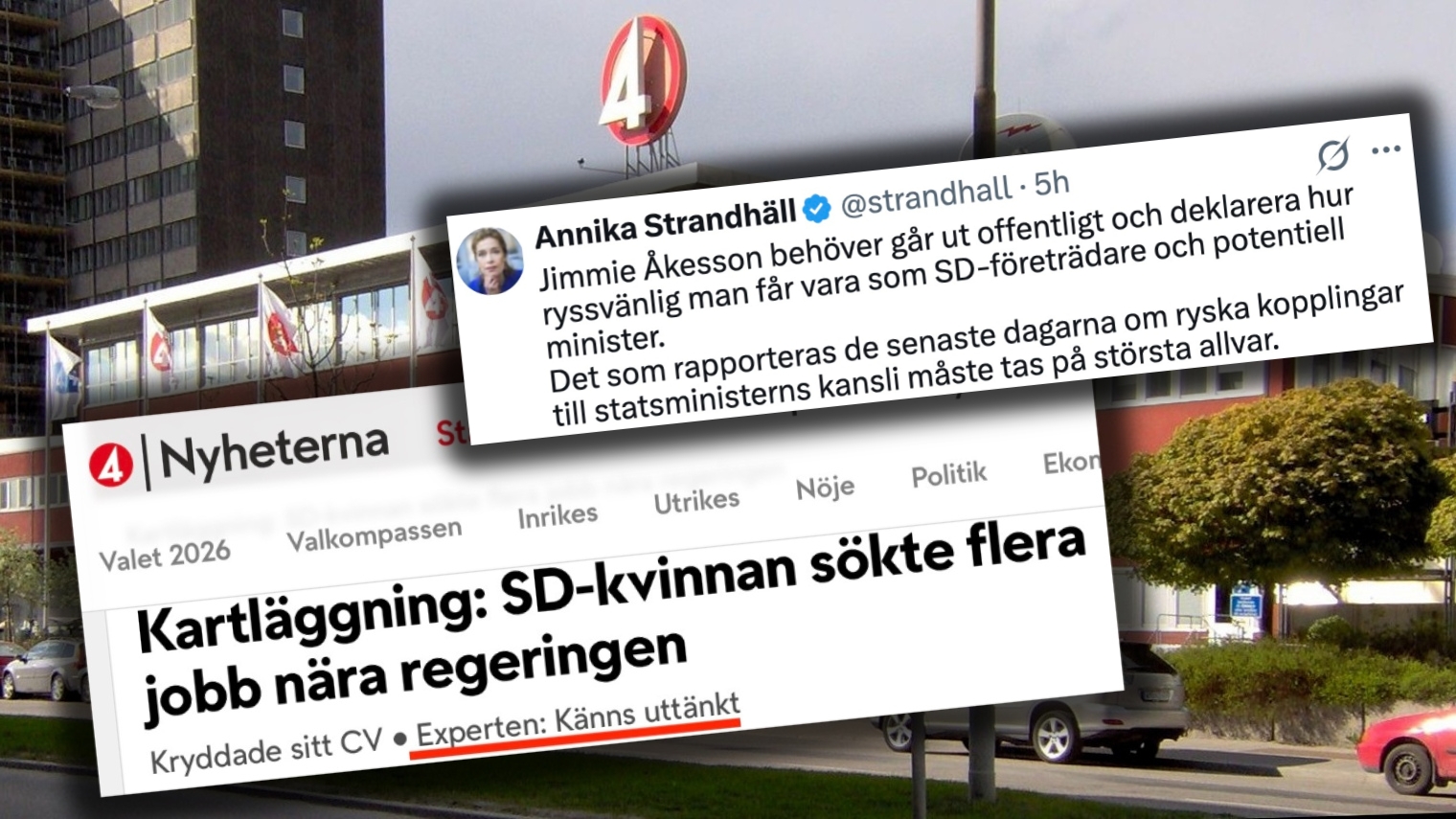
The woman has studied communication at Södertörn University and political science with a focus on crisis management and security at the Swedish Defence University.
That she has studied political science and applied for jobs in government is depicted as a spy thread, but it’s perfectly in line with her education and competence. What exactly is proved by someone applying for jobs in their field?
TV4 says, for example, she applied for a temp position as a caseworker at the Ministry of Culture’s division for democracy and civil society—a unit which, according to TV4, manages state support to religious communities, which ultimately also covers the Russian Orthodox Church.
The portrayal gives the impression she sought the job specifically to handle Russian Orthodox Church cases, although it’s actually much broader in scope.
Furthermore, she applied for the job as early as 2016, long before today’s deteriorated security situation. Still, TV4 spins that the Russian Orthodox Church later lost its funding, suggesting the woman wanted access to this context.
Common to the four jobs she applied for is that all are close to political areas with direct links to Russia. The units she applied to work at handle issues such as migration, asylum, and state relations with religious communities—including the Russian Orthodox Church—which Säpo has warned about links to Russian intelligence.
TV4 Kalla Fakta
The portrayal nearly makes it look like the woman applied specifically to handle this, even though the Russian Orthodox Church lost its funding only in 2024, after sanctions over the war and Säpo’s assessment that Russian intelligence uses churches.
Moreover, TV4’s Kalla fakta editorial claims the woman ’embellished’ her CV and tries to portray her as not having had the roles she states. The woman has told TV4 she has certificates from all her former employers supporting her information.
Nothing New for Säpo
In a Monday interview with Aftonbladet, SD leader Jimmie Åkesson said the party sees the revelations in the Expo article as serious.
At the same time, he stated that neither Säpo nor anyone else contacted the party following Expo’s article on the woman, which he suggests indicates the case isn’t as acute as the media suggests.
– No one has contacted us either before this article was published or after. That further strengthens my sense that no acute threat exists here, he said.
READ ALSO: SD fires Russian ski doctor – after pressure from Expo
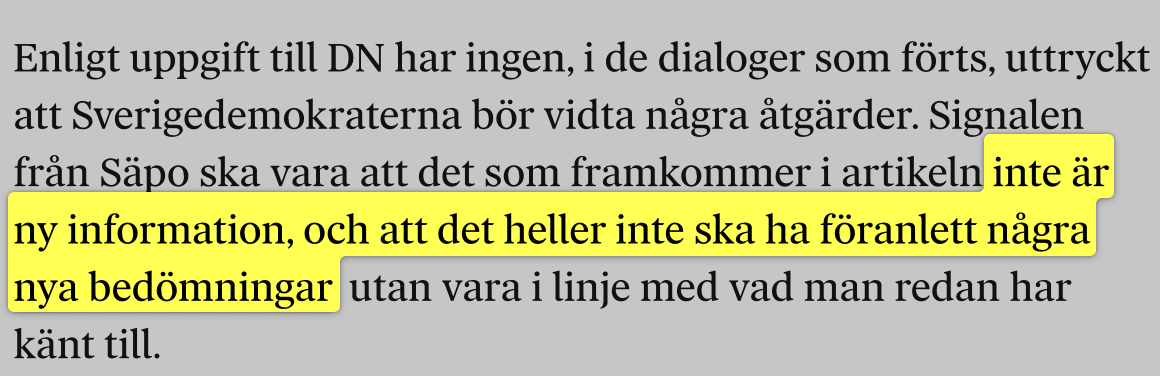
This is also the view emerging from Dagens Nyheter’s sources: the signal from Säpo is that Expo’s campaign and its revelations are not new information.
It’s a matter of information that hasn’t triggered any new assessment by the agency.
Bringing in a Ukrainian Expert—to Campaign
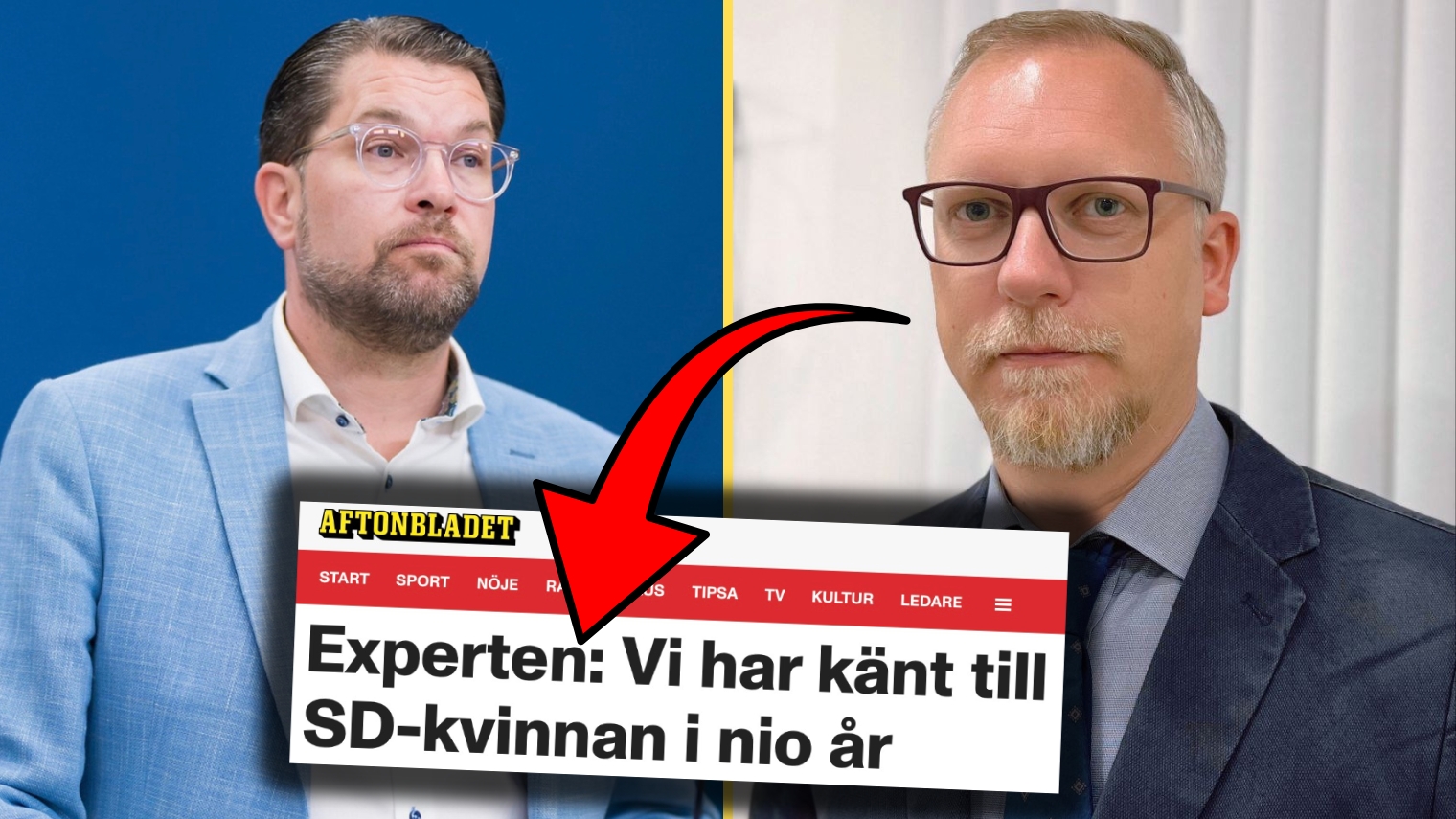
Aftonbladet, however, went all out and interviewed Ukrainian security expert Anton Shekhovtsov to further suspect the woman.
Shekhovtsov states they’ve had her on their radar for nine years, without giving details about what this means or the basis for it. The claim, at first glance, raises both surprise and further questions, especially for Jimmie Åkesson when confronted with it.
– For nearly a decade, she has been ‘flagged’ among me and my colleagues in security circles due to her relations with the Kremlin, Anton Shekhovtsov told Aftonbladet.
READ ALSO: Police officer with Russian background – Expressen forced her out, no action from Ombudsman
What Aftonbladet does not clarify is that the only concrete basis for the Ukrainian security expert keeping tabs on the woman is Chang Frick’s and Nyheter Idag’s previous reporting about her 2017 Moscow trip. Information now well known and simply checked by requesting records of who participated.
Describing it as if she has continuously been scrutinized or under surveillance by Ukrainian security experts for the following nine years is perhaps not strictly accurate, even if that’s how it is presented. It is, however, powerful ammunition for the campaign.
Double Standards for Immigrants
In Sweden, being labeled racist, Nazi, climate denier, anti-democrat, and now even suspected spy can happen surprisingly fast if your views fall outside the norm. When it comes to the latter, in public debate at least, being born in Russia and immigrating to Sweden might be enough to get labeled.
Even posts from many years ago, long before Ukraine’s invasion, are now dredged up to get people dismissed, even if they are doing their jobs well or simply to smear and disarm a political opponent before an upcoming election.
This while Swedish establishment media have for a long time fed the public with the idea that the Russian people are oppressed under Vladimir Putin’s iron hand, supposedly longing for Western freedom.
But when Russians actually come to freedom in Sweden or elsewhere in the EU, the logic suddenly changes. Then the same background, those freedom-seeking Russians, becomes a basis for suspicion. A person with Russian roots can quickly be labeled ‘pro-Russian,’ ‘infiltrator,’ or ‘spy suspect,’ and as a potential security risk.
But the same questions don’t seem to be asked when it comes to other foreign influence or infiltration. Expo places great weight on anything that may appear positive towards Russia, but similar investigations regarding foreign influence tied to the Middle East or Africa are absent.
These include foreign financing of mosques and religious activities, related literature and preachers, propaganda and political mobilization, clan structures and infiltration in municipalities and authorities, and recurring disinformation and influence campaigns spread in Arabic on social media.
Such phenomena should presumably be judged on the same criteria of loyalty, influence, and security risks, especially as they have become so prevalent in Swedish society that they have gained significant influence. Yet, the same yardstick is not applied to other groups with foreign backgrounds. Why shouldn’t the same scrutiny be directed at all foreign-born parliamentarians as at the SD woman?
The Multicultural Paradise
Meanwhile, social media is filled with images and video clips from the current election campaign where voters with immigrant background are addressed in their own languages and urged to vote for candidates with strong ties to their countries of origin, religious environments, or cultural networks. What promises and messages are actually communicated at these meetings and what loyalties they rally are much less examined.
Instead, the spotlight is again directed at SD before every election, using a magnifying glass to find someone in the party with a divergent view on Russia—to then highlight and stretch out distant connections given more importance than they might really have.
Below, you see one of the Social Democrats’ voter meetings in this year’s election campaign. According to the same establishment, this development in Sweden poses no infiltration or other security risk.
But what happens when people are voted in through strong group- or clan-based networks and get influence over municipalities, authorities, and politics? Then, issues of loyalty, influence, and security risks seem far less present. To even raise this risks being dismissed as xenophobic.
Those born in Russia, by contrast, seem to live under constant suspicion about where their loyalty truly lies, even if they don’t sympathize with Russia’s leadership or oppose the war in Ukraine. Origin always seems to require explanation and rebuttal. Other foreign-born groups in Sweden do not always seem to face the same burden of proving loyalty to Sweden.
Influence Operation to Take Down SD?
Do you notice, by the way, who are raising the loudest voices about this ‘security crisis’? Precisely when the Social Democrats are dropping in the polls, just days away from the election.
Being vigilant and conducting thorough security vetting when granting access to sensitive information is a given. SD leadership has stated this was done in this case.
That should be the assessment to relate to, not some kind of far-left ‘Expo court’ where Center Party’s so-called security expert Patrik Oksanen seems to have been cast as prosecutor, judge, and expert witness at once, reinforcing the weight of old posts.
READ ALSO: The media campaign against Stegrud: Here are Expo’s lies
It becomes particularly problematic when the publication is based on years-old posts and opinions, now used against a private individual who is only staff. She is also on maternity leave, making it harder to defend herself or present her own side in public.
If country of birth, family ties, connections in theater circles, and cultural background are to weigh so heavily as to be security indicators, society would become pretty strange indeed. Should all foreign-born who immigrate to Sweden be viewed as potential security risks and excluded? That would at least be consistent. But no such general principle seems to apply to either Expo or the rest of the establishment media.
This is where the whole story begins to feel weak. One may stack up as many circumstances as possible that somehow relate to her homeland Russia, and then let the overall picture, bolstered by various experts, look far more suspicious than any individual item actually supports.
But is it really so strange that a Russian-born immigrant has family, friends, a hometown, hobbies in line with her background, and a network?
The decisive point ought to be what the person actually does in her work, not that she retains parts of her life and identity from the country she left 22 years ago. The step from long-term connections to allegations of ‘Russian infiltration’ can’t be filled by big headlines and repeated insinuations—it requires concrete evidence.
If, on the other hand, the conclusion is that those born abroad with family ties or ongoing cultural connections to their former homeland are automatically a security risk, the only logical outcome is to bar all foreign-born from sensitive positions.
Why should it be her family ties, cultural engagement, or connection to country of origin that carry so much weight, while people with connections to other countries or strong clan ties may hold positions in municipalities, agencies, or near political power? Or why stop there?
This is where the logic risks becoming both unreasonable and inconsistent. Of course, foreign background, contacts with other countries, and cultural or familial ties can be relevant in a security assessment. But then there must also be something concrete indicating a security risk—not a collection of out-of-context Facebook posts and claims about a Russian theater.
If similar kinds of connections and links are acceptable in others but suddenly used to suspect an SD staffer merely because she was born in Russia, it’s fair to ask whether security is really the central issue here?
Her Russian background and her work for SD in parliament have been known since 2017, including contacts with European authorities after the Moscow trip. Her relationship with Gustav Gellerbrant has also been public for years and part of security vetting. None of this is new for Säpo or has led to a new assessment, according to DN’s sources. Still, it is now being highlighted in a coordinated media campaign as a security crisis, just days before the election.
A new mother has ended up with her reputation destroyed because of her country of birth. It’s hard to see it as anything but very strange timing. Is this really about Sweden’s security, or about hurting the Sweden Democrats ahead of the election?
READ ALSO: Kristoffersson: Expo and SVT in coordinated campaign against Samnytt
to silence us.
– and reports straight, without PC filter.
Support Samnytt – Become a subscriber
123 083 33 50