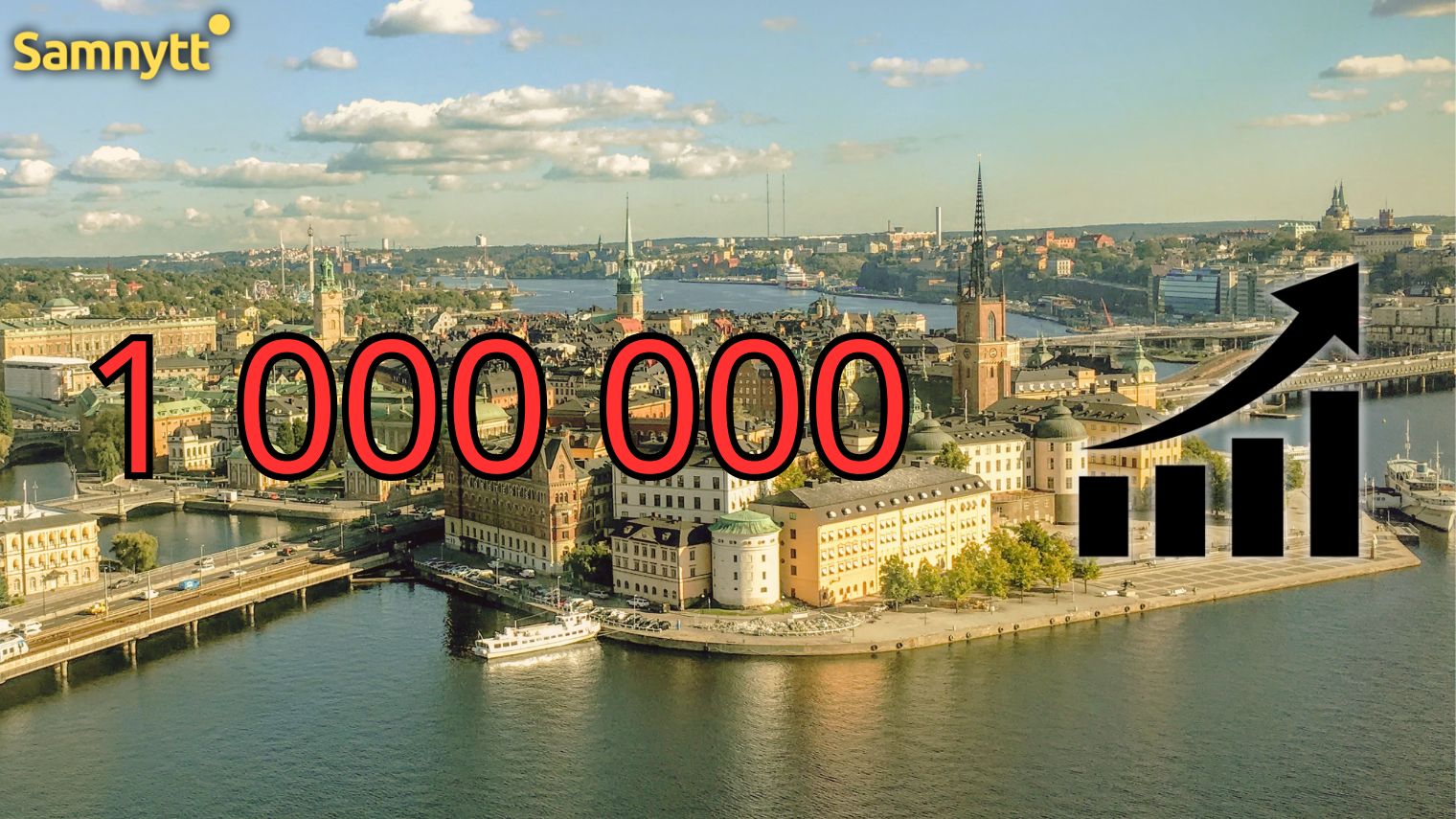
According to recent figures from Statistics Sweden (SCB), Stockholm’s population in May reached 1,000,374 inhabitants, which means the city has officially crossed the symbolic one-million mark. The announcement comes after several years of waiting and postponed forecasts.
At the turn of the year 2025/2026, Stockholm still had only just over 999,200 residents—around 700 people short of the goal—even though the city previously expected to reach one million already in 2025. Even older forecasts pointed to this happening as early as 2022.
The million milestone is reached at a time when Stockholm’s population is growing significantly slower than over the past two decades.
READ ALSO: Immigration behind Sweden’s growing population
In 2025, the number of inhabitants increased by only about 3,700 people, equivalent to 0.4 percent—the slowest rate of growth since the pandemic year of 2021. In the record year 2009, however, the city grew by over 19,000 residents in a single year.
Therefore, the City of Stockholm has revised its future forecasts downwards. According to the latest population forecast, the city is expected to grow by around 56,500 inhabitants by 2035, which is about 8,500 fewer than estimated a year ago.
Immigration and Migration
Several different factors lie behind the population growth. For several years, Stockholm has been losing more residents to other municipalities in the county than it is gaining in return. Many young adults move to Stockholm for studies and work, while many later leave the city when they start families and seek larger homes in the surrounding suburbs.
However, Stockholm generally has a positive net migration compared to the rest of Sweden, and immigration continues to contribute to population growth.
According to statistics from Region Stockholm, immigration was in fact lower during the first quarter of 2026 than during the same period the previous year. At the same time, out-migration to other parts of the country decreased even more, resulting in a stronger net domestic migration than the year before.
Natural population increase also still plays a role. Although birth rates have fallen, Stockholmers are living longer, which helps the population continue to rise.
No Majority Growth from the Rest of Sweden
Available statistics, however, show that it is not possible to state that the majority of Stockholm’s population increase comes from migration from the rest of the country. On the contrary, the population change is made up of several components: international immigration, moves between Swedish municipalities, as well as births and deaths.
Region Stockholm’s latest analyses indicate that both immigration and a positive net domestic migration contribute to the increase, while low birth rates slow the development. There are no recent public statistics showing that the increase is dominated exclusively by domestic migration.
Historic Milestone
Stockholm’s population has grown almost continuously since the early 1980s. In the 2000s, the number of inhabitants increased by nearly a quarter of a million people, even though the growth rate is now significantly lower than during the boom years before the pandemic.
However, with the new SCB numbers, a historic limit has been passed: Sweden’s capital is now officially a city with over one million residents.
Facts about Stockholm
Stockholm has a history spanning more than 750 years. The city is usually considered to have been founded in 1252, when Birger Jarl had fortifications built at the inlet between Lake Mälaren and the Baltic Sea. The strategic location made Stockholm an important trading spot and contributed to the city quickly rising in importance during the Middle Ages.
During the 17th century, Stockholm developed into the center of the Swedish Empire. Here resided the royal power, government, and administration, while trade flourished and new districts were established. Many of the buildings and environments that still characterize Gamla stan and parts of the inner city originate from this period.
Industrialization in the 19th century fundamentally changed Stockholm. Factories, railways, and a rapidly growing population caused the city to expand far beyond its old customs boundaries. During the 20th century, expansion continued with new residential areas, the subway, and major infrastructure investments that shaped today’s capital.
Since the beginning of the 1980s, Stockholm’s population has grown almost continuously. The city has developed into Sweden’s economic, political, and cultural center and is today one of Europe’s fastest-growing capitals. As the population has now passed one million, it marks yet another historic milestone in the city’s development.
READ ALSO: This large a share of Sweden’s population now has a foreign background