When the Police Authority tried to enforce a final expulsion order, the authorities needed to contact the person who was to leave the country. The only available contact detail was a phone number held by the Karolinska University Hospital. However, the hospital refused to release it. Now the Supreme Administrative Court has put its foot down, sided with the police, and rejected Karolinska’s arguments. Despite repeated inquiries, the hospital refuses to explain why it took the process all the way to the country’s highest administrative court.
The new law requiring public authorities to provide information to crime-fighting agencies came into effect on April 1, 2025. The aim was to improve the exchange of information between authorities and give, among others, the Police Authority better possibilities to prevent, investigate, and prosecute crimes.
As a general rule, authorities must provide contact details—such as phone numbers—when the Police Authority requests them in connection with crime-fighting operations.
Earlier this summer, Samnytt reported on a pro-Palestinian demonstration outside the hospital’s main entrance, where doctors and other medical staff participated in work attire while chanting political slogans such as “From the river to the sea”—which many interpret as a call for the erasure of Israel as a nation.
Karolinska University Hospital has recently been the center of several high-profile controversies.
Earlier this summer, Samnytt reported on a pro-Palestinian demonstration outside the hospital’s main entrance, where doctors and other medical staff participated in work attire while political slogans like “From the river to the sea”—which many view as advocating the erasure of Israel as a nation—were chanted.

The incident sparked criticism and led to questions about the hospital’s guidelines for political demonstrations while on duty—and whether Jews could still expect to receive care at the hospital. Once again, Karolinska declined to give interviews and instead referred to a short written statement.
READ ALSO: Karolinska refuses interview after Gaza demonstration in work uniforms
Enforcing the Expulsion Order
The case in question concerned a person whose asylum application had previously been rejected. The Migration Agency’s deportation order had become final, but the person had not left Sweden.
To locate the person, the police requested the contact details from Karolinska University Hospital. The hospital stated that the only available detail was a phone number. Karolinska denied the police’s request. The hospital argued both that the police did not need the phone number for its crime-fighting activities, and that confidentiality interests outweighed it.
According to the Police Authority, the person had been listed as missing since 2022 and was also suspected of violating the Aliens Act by remaining in the country illegally.
To locate the person, the police requested contact details from Karolinska University Hospital. The hospital stated that the only available contact info was a phone number. Karolinska rejected the police request.
The hospital argued both that the police did not need the phone number for its law enforcement purposes, and that confidentiality concerns took precedence.
READ ALSO: Karolinska Institute: “Nawaal Ali Salad has never been admitted to the medical program”
According to Karolinska, the person was being treated for a communicable disease requiring ongoing care. The hospital argued that releasing the phone number could result in the patient no longer seeking care, which in turn could lead to further spread of the dangerous illness.
Supreme Administrative Court: The Phone Number Must Be Released
The Police Authority appealed. The Supreme Administrative Court granted leave to appeal as the issue was deemed to have significant bearing on how the new law should be applied.
The judgment was delivered on June 25. The Supreme Administrative Court overturned the appellate court’s ruling and decided that Karolinska must provide the phone number to the Police Authority.
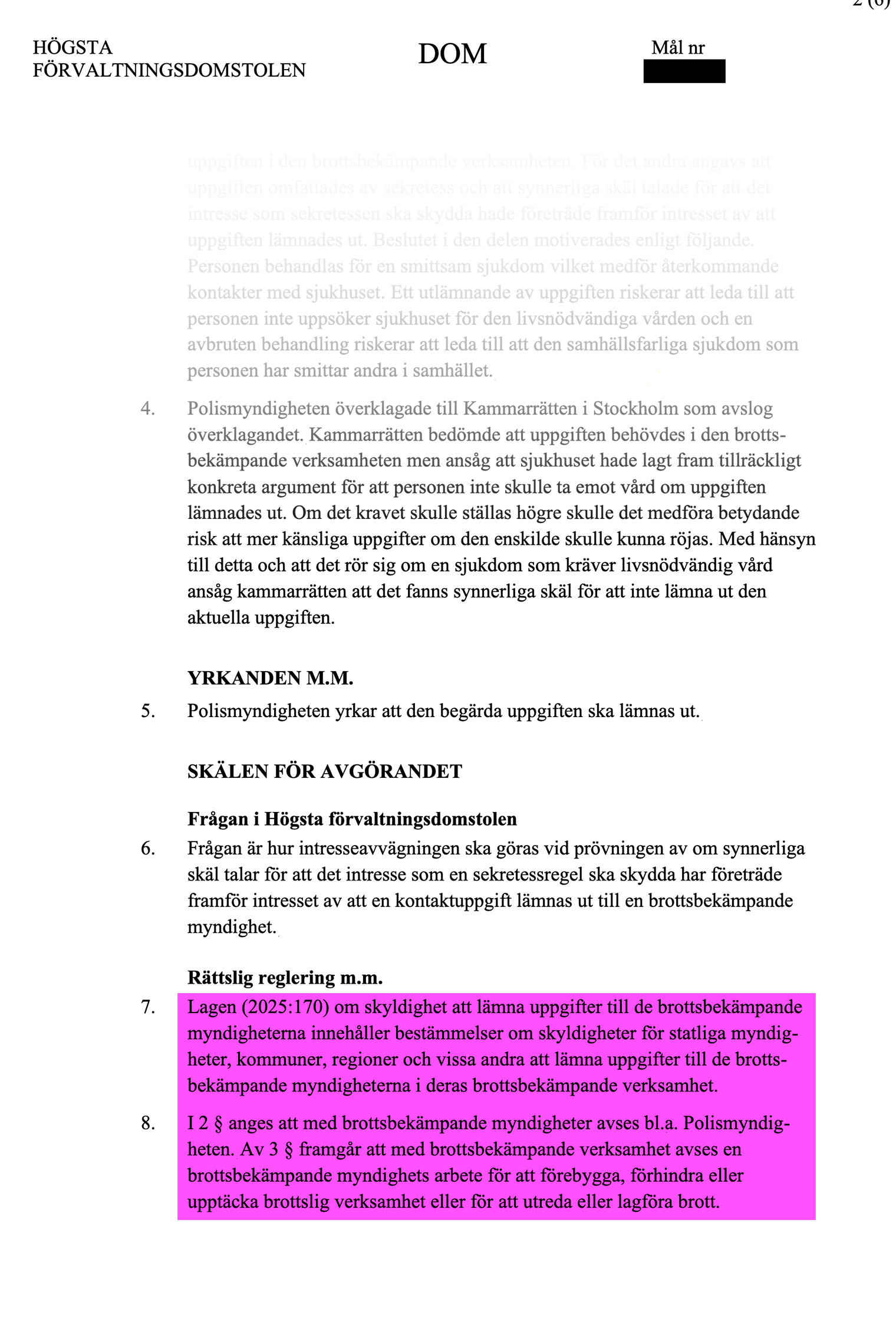
The court emphasized that the law’s starting point is that contact details should be released. Exceptions are to be used very restrictively. The Supreme Administrative Court writes:
“The scope for withholding contact details out of privacy or other protection concerns is extremely limited.”
READ ALSO: SR journalist is an asylum activist and hates SD – yet reports on the “undocumented”
The central part of the judgment concerns Karolinska’s reasoning. The hospital argued that the patient might interrupt their treatment if the phone number was disclosed to the Police Authority.
Well, we now have a final judgment and that puts an end to the discussion for us here at Karolinska. We abide by the existing decision. I have nothing to add. The court has made its decision.
Karolinska University Hospital’s press service
But the Supreme Administrative Court finds that such reasoning is insufficient. The court stated that specific, strong reasons are needed showing that this particular person would actually stop seeking care.
General assumptions are not enough. After this, the ruling includes wording that will likely have significant impact on future similar cases.
“Karolinska University Hospital has not specified any concrete circumstances suggesting that releasing the information would result in the person no longer seeking care or receiving treatment.”
The court further noted that a phone number is not generally sensitive or particularly worthy of protection from a privacy perspective.
Reminder of an Existing Obligation
The Supreme Administrative Court also noted that healthcare providers have long been required to inform the Police Authority if a person is in the hospital when the police request this information.
This obligation, the court states, is unconditional. In its appeal, the Police Authority warned that the appellate court’s interpretation risked undermining the entire purpose of the new law.
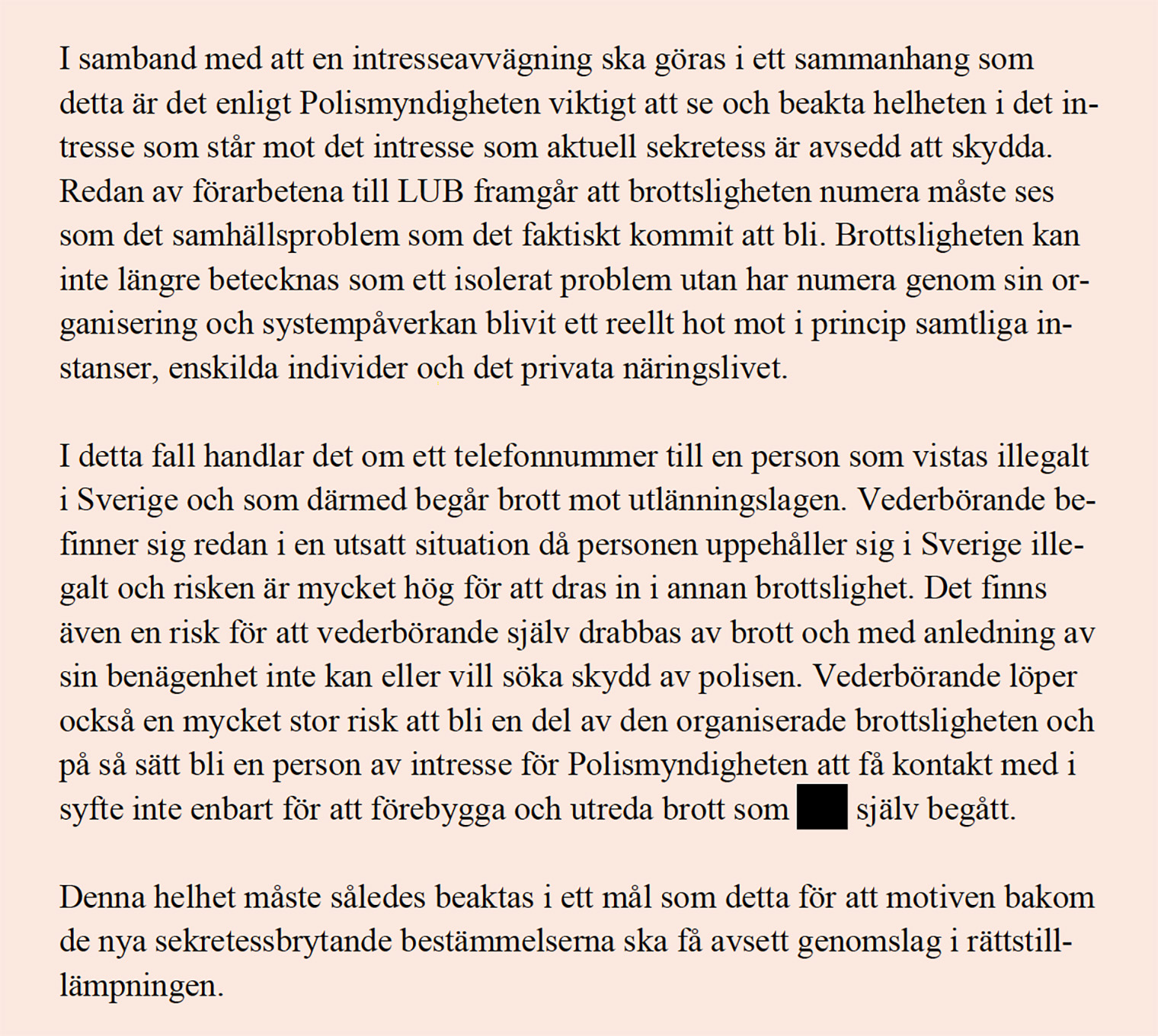
The police argued that Karolinska did not present any concrete circumstances showing that the specific patient would forgo care, warning that otherwise, healthcare providers could in practice refuse to release information by referring to general fears.
The agency also pointed out that lawmakers intended for contact information to normally be provided to law enforcement agencies.
Karolinska Refuses to Talk to Journalists
Samnytt has contacted Karolinska University Hospital and, among other questions, asked why the hospital chose to take the case all the way to the Supreme Administrative Court, what specific circumstances it deemed to support its decision, and whether the court’s ruling would change its routines.
For those working at Karolinska’s press office, don’t you think it seems odd that you’re unwilling to answer questions about a case you brought all the way to the Supreme Administrative Court?
– No, I don’t agree. I think once the court has made its decision, then that’s it. And the hospital chooses not to comment further. We follow the decision that the court has made.
READ ALSO: Red-Green government: Illegals’ right to healthcare should be strengthened
One could interpret it as Karolinska wanting to protect illegal migrants, since you took the case all the way to the Supreme Administrative Court?
– Well, we now have a final ruling and that puts an end to the discussion for us here at Karolinska. We comply with the decision at hand.
Is there anything you can add regarding whether there was a discussion at Karolinska about how to handle this case?
– I have nothing to add. The court has made its decision.
The Supreme Administrative Court’s decision is precedent-setting and will guide how the new law on information sharing between authorities will be applied in the future.