WHISKY COLUMN • It’s been 30 years since I truly began to appreciate a good single malt. For me, good is synonymous with smoky, but the crash course below works just as well for those of you who can live without the aroma of burning peat in your tumbler. Some of you surely know much more about the subject than I do, while others may benefit from a primer on the basics. I know I would have back in 1997 when I was first served a dram of Lagavulin by my future wife—and was hooked, on both. In any case, here’s an overview of the essentials you need to know to understand what’s really on the label and hidden inside the bottle.
It’s easy to assume that expensive whisky is automatically better whisky. It’s not that simple. In fact, the greatest difference in quality is found between the cheapest options and the really good standard editions. As prices continue to rise, taste matters less, and factors like age, rarity, collectability, and prestige matter more. To understand why, let’s start with the basics.
What exactly is a single malt?
In order to be called single malt Scotch whisky, it must be made in Scotland from 100 percent malted barley, come from a single distillery, be distilled in copper pot stills, aged for a minimum of three years in oak casks, and bottled at no less than 40 percent alcohol. This isn’t just a rule; it’s enshrined in law.
This contrasts with a “regular” blended whisky, which contains whisky from several distilleries and almost always includes both malt whisky and cheaper grain whisky made from, for example, corn or wheat. Blended whisky is often smoother and more uniform in taste compared to single malt, where the flavor spectrum is much wider.
If I ever buy a blended whisky, it’s usually Famous Grouse. It has a well-deserved good reputation—unlike some other storied classics (no names mentioned). Good introductions to single malt are more synonymous with the word classic.
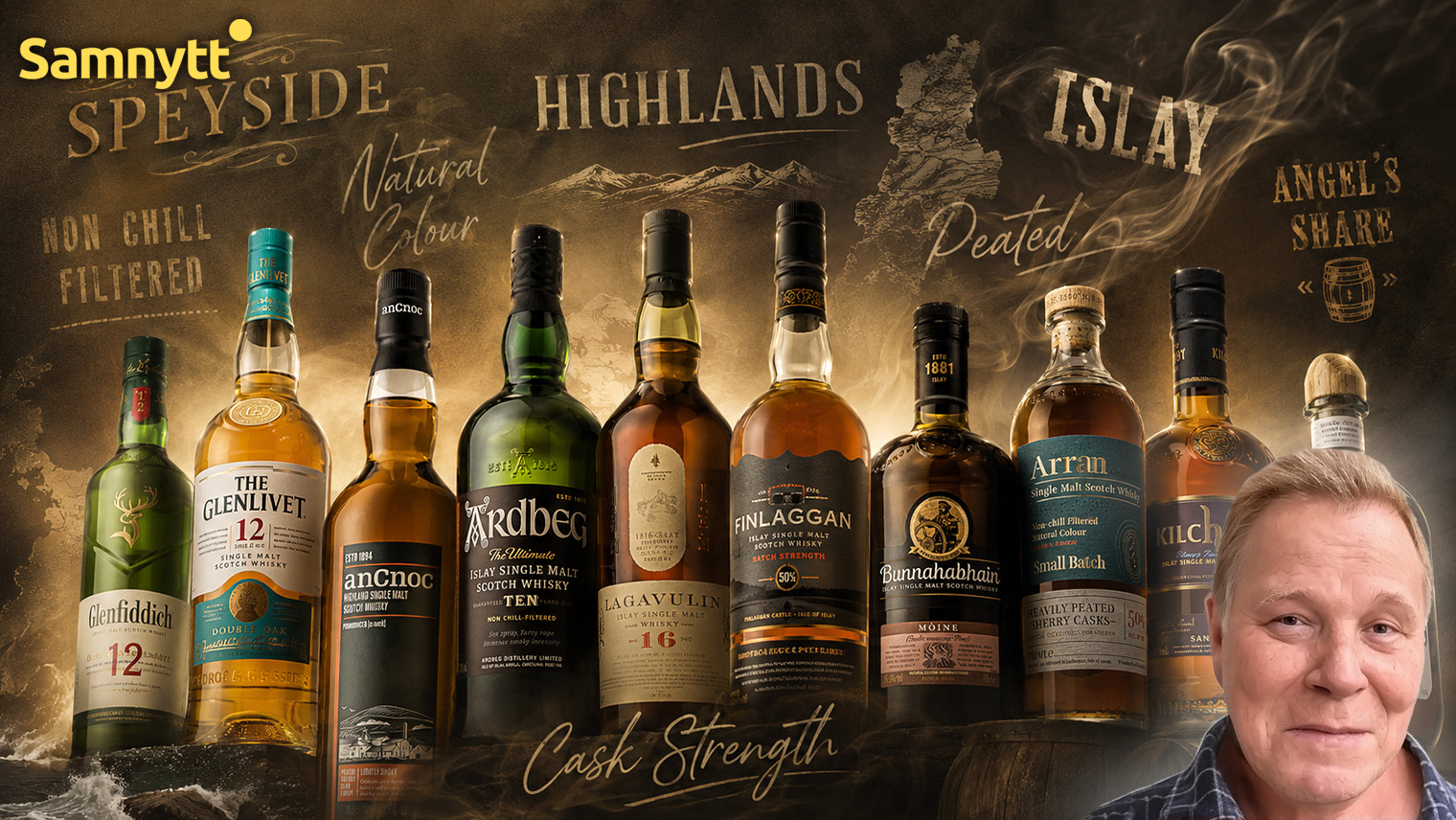
Most people have heard of Glenlivet and Glenfiddich. The standard 12-year-old versions are of good quality, light and fruity, and won’t break the bank. They’re also unsmoked—not my thing, but preferred by many others—and a good starting place even for those who later discover an affinity for strong notes of tar and smoke.
The Distillery and the Cask
Once you’ve gotten beyond the beginner stage, you start noticing that different distilleries have their own styles. One distillery, for example, may produce a light and citrusy spirit, while another might create a more oily, robust character.
Extremely important here is the cask that the whisky is aged in. Between 60 and 80 percent of the flavor develops during maturation. There are a variety of cask types, each imparting different characteristics to the whisky.
The most common are bourbon casks—previously used American oak barrels that impart flavors and scents of vanilla, honey, coconut, and caramel—and sherry casks—formerly filled with Spanish sherry, which gives the whisky notes of raisins, dried fruit, chocolate, nuts, and spices.
Rum, port, or wine casks are also used, mostly for final maturation, known as finish, to give the whisky a little extra sweetness and/or fruitiness. Two types of whisky from the same distillery can taste completely different depending on what cask they’ve rested in.
When talking about cask aging, it’s worth mentioning the age statement found on most whisky bottles. It doesn’t mean quite what one might think at first glance.
If it says, for example, “12 Years Old,” it means that the youngest whisky in the bottle is twelve years old. If the blend includes several casks, the age given is always that of the youngest component. An 18-year-old whisky may therefore contain much older whisky—but never younger.
More and more distilleries are omitting an age statement entirely. In professional jargon, this is called NAS (No Age Statement) and it means the producer has blended whiskies of different ages to achieve a certain flavor profile. The absence of an age number on the label should not be automatically interpreted as a sign of inferior whisky.
The Region Leaves Its Mark
Scotland has several whisky regions traditionally associated with distinct, typical styles. The boundaries are more fluid (no pun intended) today than before but still largely hold true.
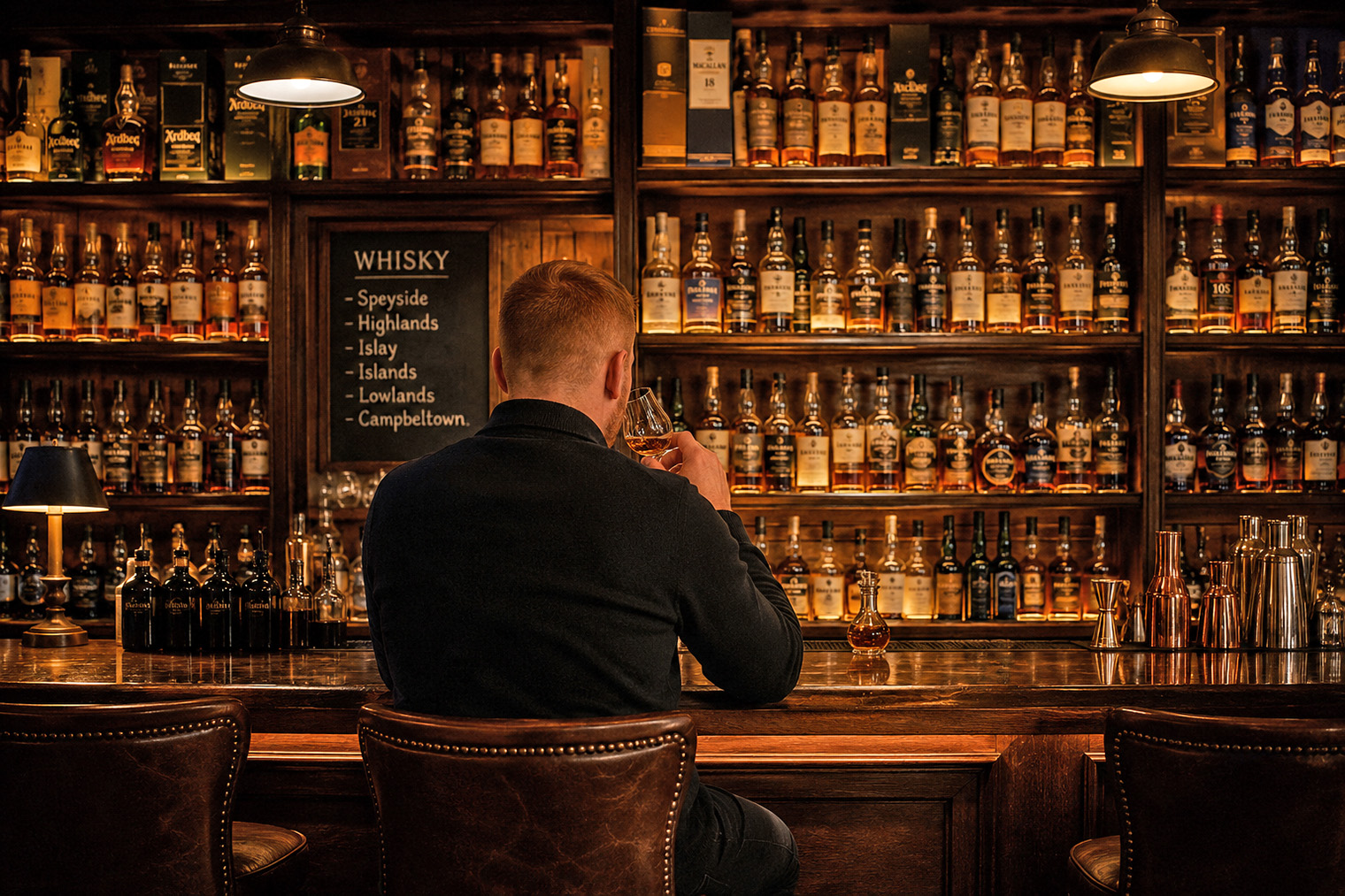
Speyside—fruity, elegant, often sherry-matured. Highlands—great variety from light to powerful. Islay—heavily peated with clear notes of peat, sea, tar, and iodine (my favorite). Islands—salty, spicy, often mildly smoky. Lowlands—usually lighter, softer, less smoky. Campbeltown—oily, robust with a slight saltiness.
What does smoky mean?
When the barley is dried, peat can be used as fuel. The smoke penetrates the malt and gives aromas of campfire, tar, sea, and smoke.
How smoky a whisky is can be described in general terms or with pie charts, but sometimes it’s given more scientifically as PPM (Parts Per Million) of phenols in the malt. Higher PPM values generally mean the whisky tastes smokier—but distillation and aging also affect the final result.
Time Does Its Work
The length of aging in the cask makes a big difference. A young whisky may be rough and raw. After some years in the cask, it mellows and becomes softer, rounder, and more complex. The type of cask used is crucial—not better or worse, just different.
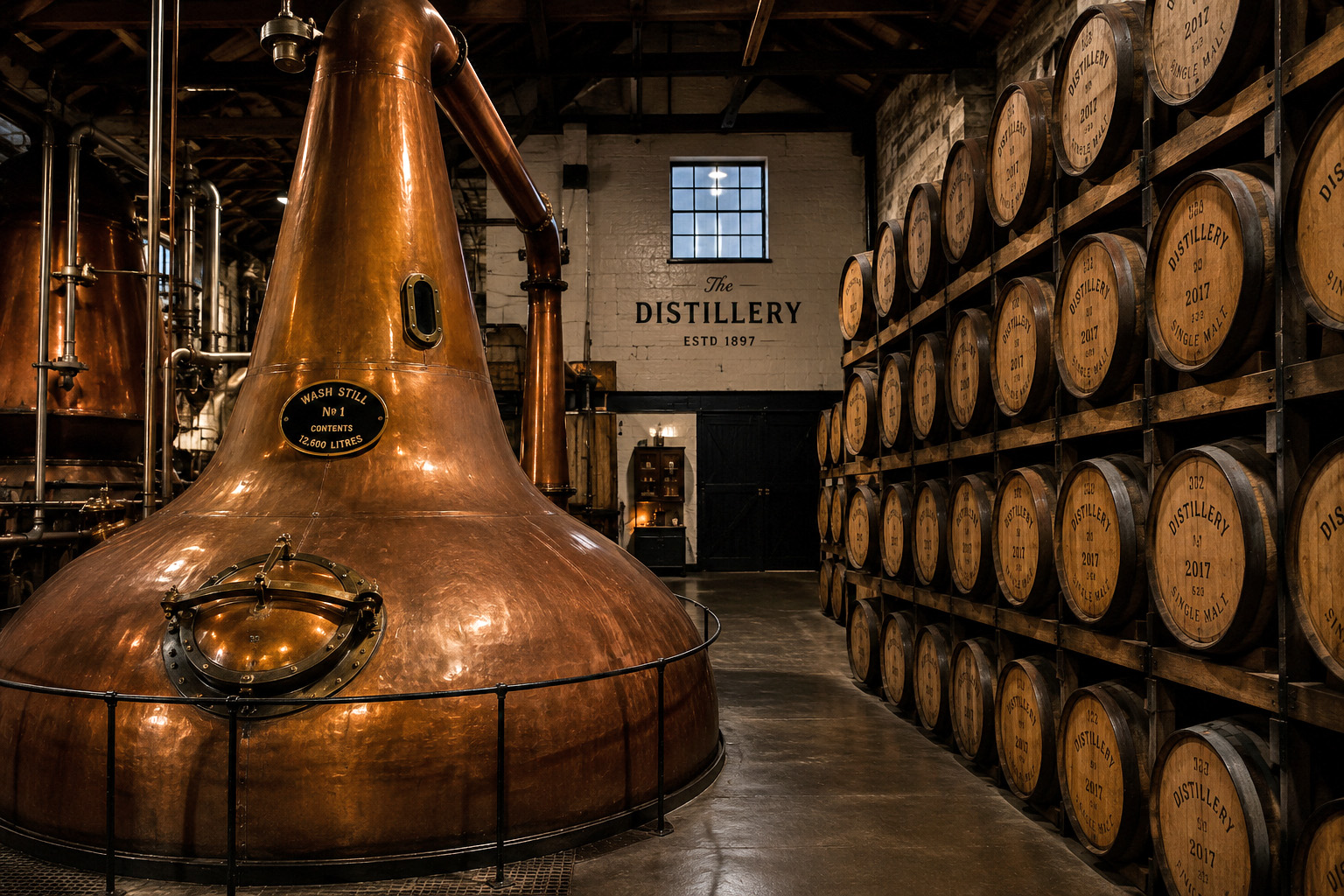
During maturation, about two percent of the contents evaporate each year through the wood. This is called the “Angel’s Share.” After eighteen years, about a third of the contents may be gone. After twenty-five years, the loss nears forty percent.
It’s good to know that the maturation process stops when the whisky is bottled. Keeping your 12-year-old whisky for six years won’t have the same effect as buying an 18-year-old whisky. This contrasts with good wine, which can develop a lot after bottling.
Key Terms to Know
In addition to alcohol content, volume, and age, a whiskey label can include a number of terms that aren’t immediately obvious. The more informed you are, the more you’ll get out of what’s in the bottle.
“Single Cask” means the whisky comes from a single cask. Every cask is unique, and so taste varies between bottlings.
“Small Batch” means whisky from several but a few select casks has been blended. It’s almost as exclusive as “Single Cask” but with less variation between bottlings.
“Cask Strength” indicates that the whisky has not been diluted before bottling. Unlike the usual strength of 40 percent or slightly higher, here the alcohol is between 50 and 65 percent. It tastes not only stronger but also fuller. You can add a few drops of water to open up the aromas.
“Non Chill Filtered” means the whisky has not been chill filtered—a process usually done to prevent it becoming cloudy when water or ice is added. However, chill filtering also removes some oils and flavor compounds. Forgoing it often gives a richer taste. Some cloudiness when adding water is then completely natural.
“Natural Colour” means that the whisky hasn’t been colored with caramel coloring (E150a), which is otherwise common and allowed by Scottish whisky law, but has obtained its color solely from cask aging. This says nothing about quality, but coloring is considered a bit of cheating by some, even if it’s only visual. Uncolored whisky may be lighter than colored but can also be equally dark or darker.
When the Price Is About More Than Taste
A more expensive whisky is often a better whisky, but the difference narrows at a certain point. Personally, I think you can stop around 600–700 SEK and still die happy without missing anything essential in life.
But, like with everything else, whisky interest can tip into obsession, and then only your wallet sets the limit. True rarities have been sold for tens of millions of SEK at auction. The Macallan 1926 is the most extreme example—only forty bottles were drawn from the cask.
But even us ordinary mortals may want to splurge if we get a tax refund or win a bit on the lottery. Then you might want to pay a little extra for special casks, limited editions, or true collectibles—opened perhaps only for a golden anniversary or passed down to the children.
Swedish Whisky
Scottish whisky is made only in Scotland. That’s a geographical fact, but for a long time it was also a mark of quality. Today, though, whisky is produced in other countries that can rival the Scottish original—Sweden being one of them.
As early as the 1950s, Sweden’s state-run Vin & Spritcentralen attempted to produce a blue-and-yellow (i.e., Swedish) whisky. It was named Skeppets whisky, and quickly acquired a dismal reputation for its disappointing quality. The experiment ended in 1970.
Almost 30 years later, in 1999, the baton was picked up again—this time privately, with the founding of Mackmyra. The company has had a turbulent ownership history, with bankruptcies and restructurings, and its future is still uncertain. Its whisky, however, has been far more convincing.
I was lucky to know someone at Mackmyra and received as gifts some exclusive smoky editions, which I rather regret drinking quickly instead of saving. In their standard line, Svensk Rök is excellent. The even better Identitet has been discontinued, though. For those who prefer unsmoked whisky, the equally good Svensk Ek is available.
Besides Mackmyra, Sweden now boasts several other small, exclusive whisky producers such as High Coast Whisky (Höga kusten), which, like Mackmyra, has earned international accolades. Agitator, Spirit of Ven, and Smögen are also worth mentioning, though I haven’t yet had the chance to try their products.
My Favorites
I’ve intentionally refrained from name-dropping whiskies above. But now, in closing, I’ll mention a few favorites, all of the smoky kind and therefore not a list for everyone, but still useful for some.
I’ve already mentioned Lagavulin, and I’ll probably always consider it one of the best—plus you don’t have to buy the most expensive releases to enjoy a rewarding dram. Mackmyra Svensk Rök is always in my home, as is Svensk Ek for sensitive guests.
Other real favorites, in no particular order, are Lagg, Kilchoman Sanaig Àrd, Arran, Ardbeg, and Bunnahabhain Mòine—all heavily smoky, all undiluted and high proof, all non chill filtered and natural color. Finlaggan and AncNoc are also not bad. But I’m sure I’ll discover more enjoyable new acquaintances along the way.
Final Words
The more you learn about whisky, the less it’s about buying the most expensive bottle and more about identifying the type of single malt you enjoy. By learning a bit about the characteristics of different regions and distilleries, the impact of the cask and maturation time, and by understanding the terminology, you can make smarter choices and avoid costly mistakes.
And if you don’t have unlimited funds but still want a really good single malt, you can stick to the price range of 450–750 SEK, where you’ll probably get the best value for money according to myself and many others. After that, the price rises much faster than the tasting experience improves.
But the most important lesson of all is: if it tastes good, it is good. If you find a cheaper whisky that easily beats the more exclusive ones, congratulations. Even though it’s fun to show off a little, in the end, it’s really just about pouring and enjoying what’s in your glass.
But enjoy in moderation so you don’t end up at the bottom of the bottle and can’t find your way out. Leave the car and motorcycle parked after a whisky evening, and consider getting a good breathalyzer.