DEBATE • The voters’ verdict in the 2026 election is harsh. The “party” lost 3.05% or 147,000 votes, there was no participation in government, and our former cooperation partners now seem disinterested in any continued collaboration. What happened, and what should the party do about this failure?
Several attempts have been made to explain the reason for the loss of voters. SVT’s exit poll has recently presented figures on voter flows (see the table below). First, some good news: SD has lost voters in all directions, but 78% of those who voted for the Sweden Democrats in 2022 did so again in 2026, which is a good result compared to other parties. Above all, we are losing votes to other parties in the Tidö coalition, mostly to the Moderates.
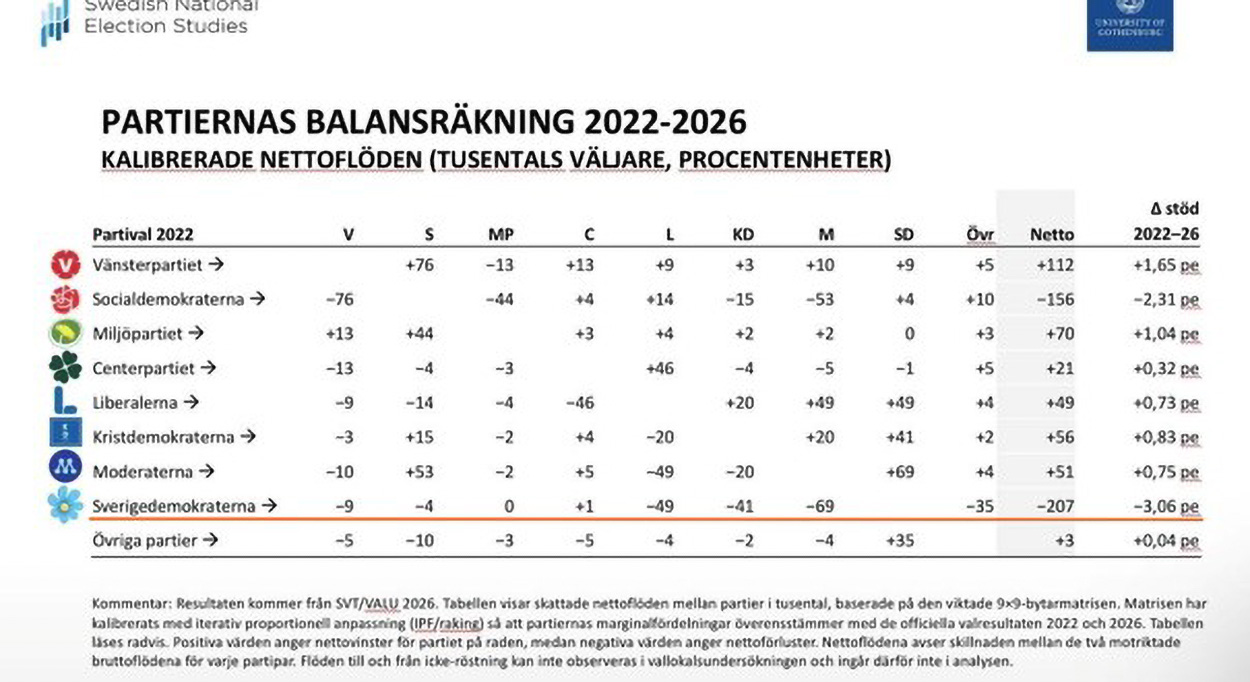
We are also losing votes on net to the “other parties” category. About 35,000 votes or around 0.5 percentage points are going to parties outside parliament, which partially explains the result. The influx of first-time voters cannot compensate for this. An estimated 14-15% of first-time voters supported the party.
So why haven’t we attracted these voters? I believe the image below contains part of the answer.
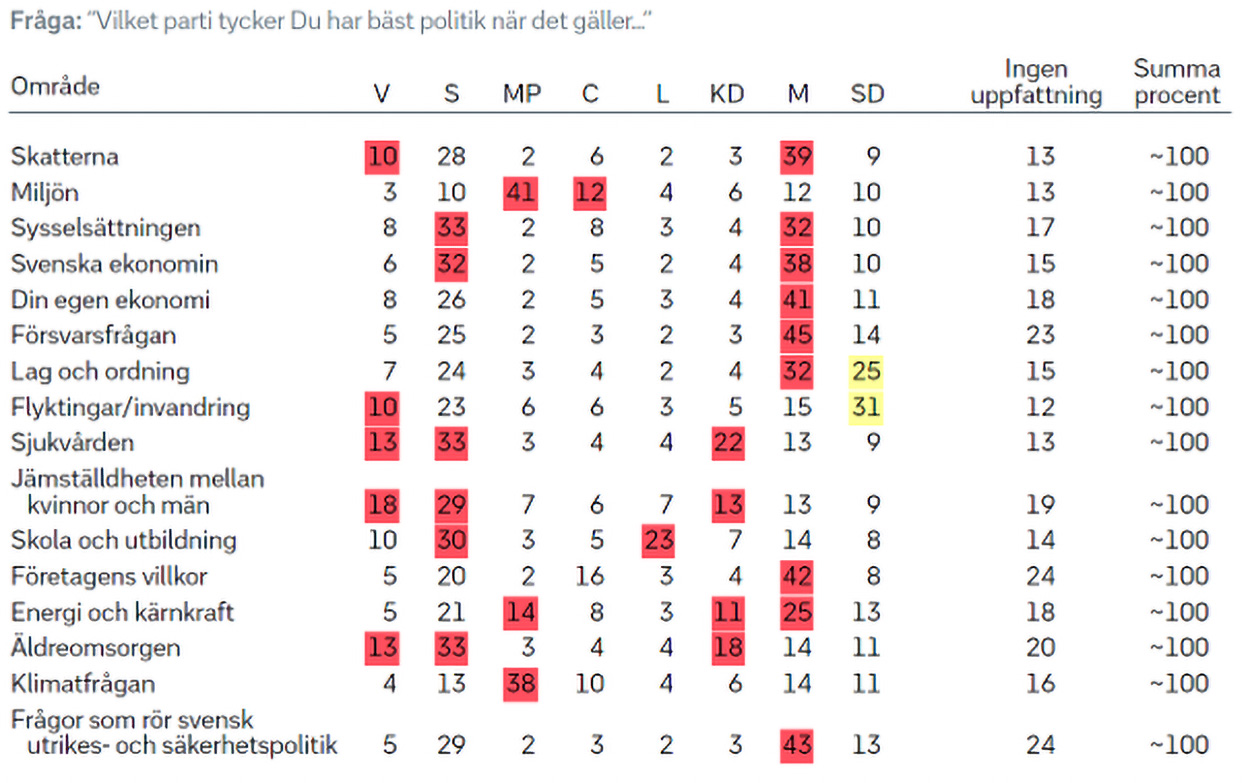
Ownership of key political issues is extremely important and unfortunately also very difficult to change. When looking at these numbers, you should not only look at the table above itself but also consider the level of support for each party. If a party like ours has 17-18% voter support and 31% support from voters on migration issues, it is a winning question for us – those are the yellow-highlighted numbers in the table.
The red-highlighted numbers are all questions where another party besides SD has better numbers than its current voter support. As can be seen above, the Moderates stand out here: in no less than nine issues, more people trust the Moderates’ policies than actually vote for them. That is a very comfortable situation for a party to be in. Unfortunately, that is not the case for the Sweden Democrats. We only lead in migration, and in our second-best issue – criminal policy – we are outdone by the Moderates.
The party’s strategy needs an adjustment
During the post-election debate, several commentators – primarily those with a right-wing perspective both outside and within the party – have emphasized how important it is for the Sweden Democrats to appear as viable in government and to “adapt”. This aligns well with the overall long-term party strategy: to “smooth the edges” by abandoning ideological principles and replacing individual representatives deemed unappealing to potential partners.
Until now, the argument has always been that if this results in discontent among members and supporters, it is offset by the potential to attract more new voters than are lost. They have relied, as it were, on gaining at the swings what is lost on the roundabouts.
This no longer holds. Both the swings and the roundabouts are in the red, so to speak. This is not all that strange, really. If you choose a strategy focusing on “responsibility and government credibility” and tone down sharper statements on migration or other issues seen as obstacles, it’s important to remember that this strategy can only work if we are seen as a credible alternative on issues other than migration.
The exit poll shows this isn’t the case. If voters are faced with a choice between three or four large right-wing parties that are perceived as rather similar, it’s not unreasonable for them to simply turn to a party they already know is credible on their favorite issues. SD, plainly, is not that party.
Again: we have issue ownership on one issue. We lose out when the public conversation shifts to other topics. Not even all the voters who did vote for the party this time think SD has particularly good policies in other areas.
I want to emphasize that no one is against professionalization, broadening the party’s policy, or having the most competent representatives possible. In working toward these aims, however, we must remember what we seek to achieve and who our voter groups actually are.
Trying to appeal to everyone is to appeal to no one
If you decide to target all voter groups at the same time, you are, in practice, not targeting any at all. If you make the even greater mistake of targeting groups with conflicting interests, some voters will be disappointed or confused.
During and after the election campaign, it has been suggested that the Sweden Democrats could win support among voters with foreign backgrounds – and certainly, that is possible. There has always been a group of such voters who, for various reasons, have agreed with the party’s migration policies and more. The new development now is the emphasis on specifically targeting these groups and, in the same breath, highlighting specific proposals to focus on (or abandon) to achieve this.
Sverigedemokraterna’s voters (even those remaining after this election) are the most immigration-critical of all parties’ voters. We have built credibility and issue ownership over many years both through our own proposals and through public presentation. Moreover, studies show that our voters are noticeably more radical than the official party line and the population at large.
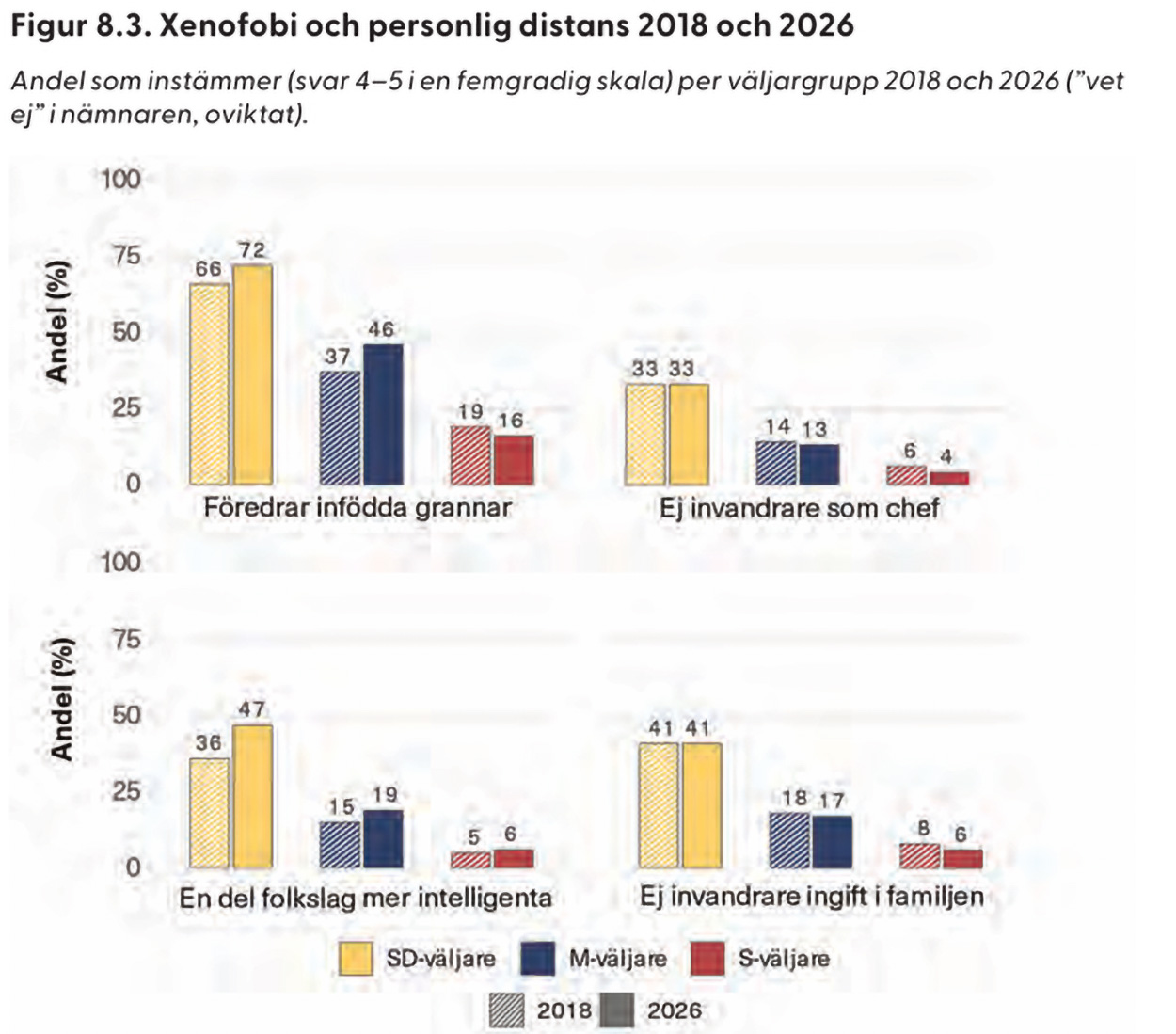
This is what the Sweden Democrats’ voters think, not the general membership or the party cadres. These voters – who do not want foreigners as neighbors, bosses, or in their families, and moreover think some of these foreign groups are outright stupid – now suddenly see the party they thought shared their values also starting to tone down certain proposals to win immigrant votes.
Is it surprising that some of these voters decide to stay home or go to another party? I don’t think so, and the opposite is true, of course. A party speaking to these voters cannot also be a party that, in any meaningful way, appeals to voters with foreign backgrounds. You simply cannot please both groups at once. However, it’s quite possible to disappoint both.
From a pure vote maximization perspective, this strategy has reached a dead end. An SD that chooses to take a step back in the only issue where we own the debate will turn into a run-of-the-mill right-wing protest party with no profile of its own. Or, put differently: we will become Medborgerlig Samling.
A strategic shift is needed if “the party” is to continue developing, and that is what the internal debate should focus on from now on.
Joakim Larsson
Group Leader/Chairman SD-Tierp
Second Deputy Chairman SD-Uppland
Member since 1994