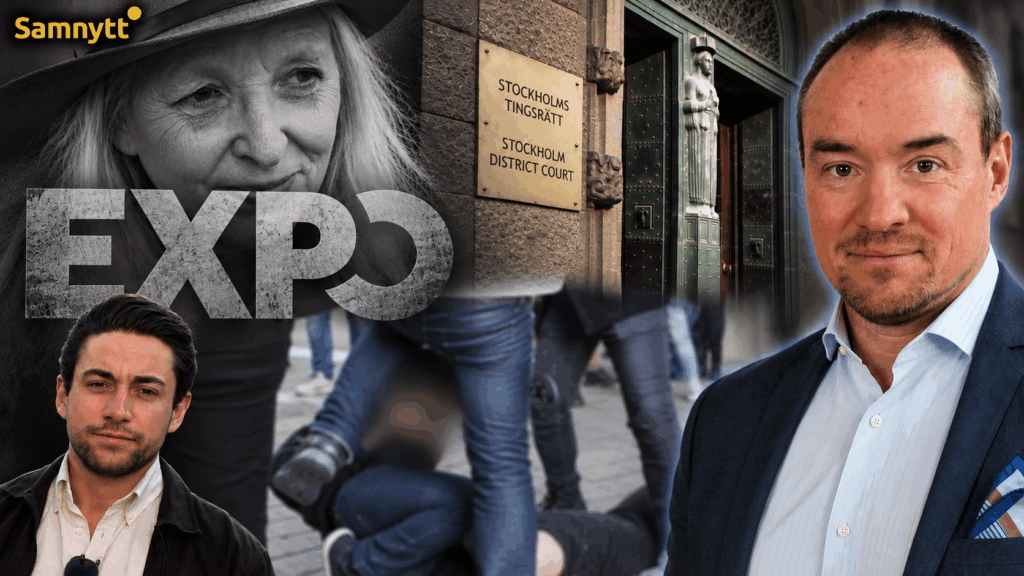
EDITORIAL • Apparently, in Sweden, you can knee a journalist in the head and still walk free. It might help if you have the right political sympathies – and three politically appointed lay judges from the left deciding your fate.
The latest verdict from Stockholm District Court is yet another in a series that makes me question what is really happening within the Swedish legal system. Above all, is justice truly blind, or has she just become incredibly selective about what she chooses to see?
The background is that left-wing extremist Andreas Klominek kneed journalist Nick Alinia in the head when the latter was holding down Klominek’s son in a citizen’s arrest, after the son, among other things, slapped the phone out of Alinia’s hand.
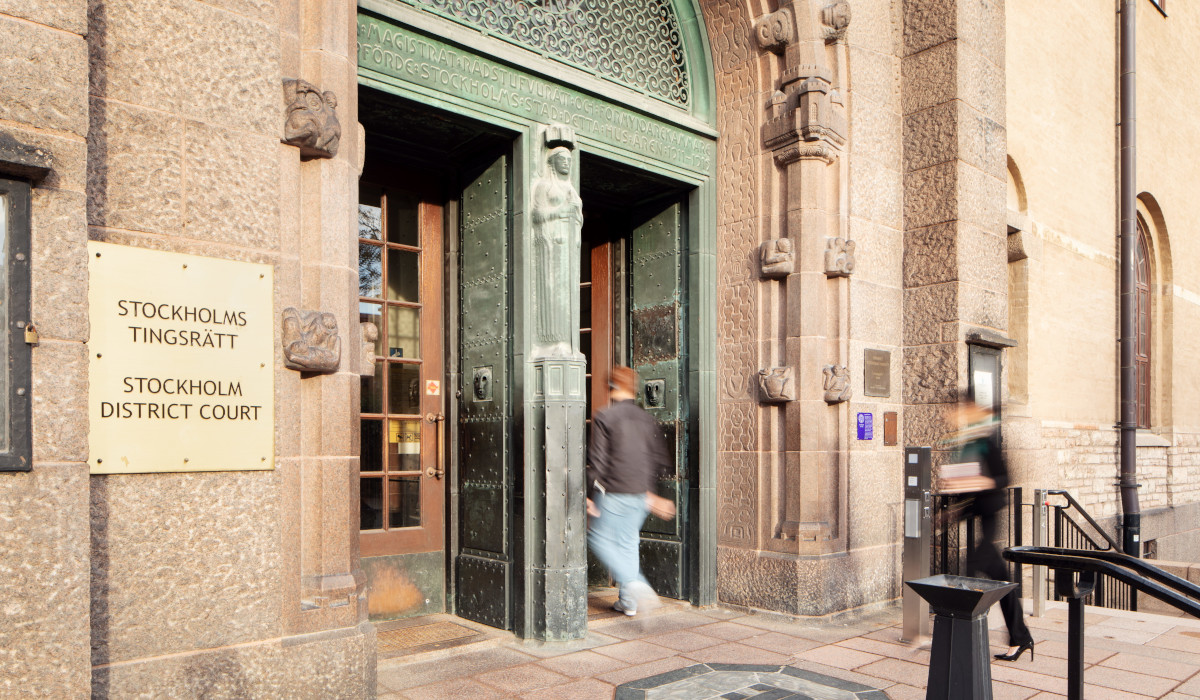
The district court establishes that it is proven Klominek kneed Alinia in the head. There is video evidence, the victim’s account, and witnesses. Yet he is acquitted, with reference to so-called putative self-defense – meaning he wrongly believed his son was being subjected to a criminal assault. But what is truly interesting is who acquitted him.
When Politicians Overrule the Judge
The legally trained judge, Céline Holmberg, actually wanted to convict Klominek of assault. She considered Alinia’s citizen’s arrest not to be a criminal attack and that Klominek’s claim of putative self-defense didn’t hold up.
She pointed out, among other things, that the situation was calm when Klominek arrived, that he never even asked his son how he was, and that he immediately lashed out at Alinia as soon as someone present called them Nazis. In her opinion, Klominek should therefore be sentenced to community service. But she hadn’t counted on the three lay judges.
ALSO READ: Social Democratic lay judge after Expo verdict: “I will not discuss it with you”
Who decided Alinia’s fate? Two Social Democrat politicians and a Left Party member with a background as a researcher at the far-left Expo(!). They outvoted the judge and acquitted Klominek. What a fantastic coincidence.
But it’s hardly unreasonable to ask how the same people would have reasoned if the roles were reversed. If a right-wing activist had kneed a left-wing journalist in the head under similar circumstances. Would we have seen the same generous interpretation of self-defense? Would it be accepted if the lay judges worked for the Nazi Nordfront?

Justice Depending on Who You Are?
I have previously written about how Swedish courts increasingly seem to apply the law with an astounding arbitrariness. We have young men who are convicted of sexual offenses on extremely weak evidence, sometimes when it essentially comes down to one person’s word against another’s and subjective credibility assessments. Men whose lives are destroyed and given long prison sentences.
But when a proven left-wing extremist knees a journalist in the head on camera, three politically appointed lay judges manage to find a legal loophole.
READ MORE: Ekeroth: Accepting an activist judiciary?
The cases are of course not identical, but the contrast illustrates a much bigger problem: How can legal security feel so incredibly inconsistent depending on who is in the dock, who is the plaintiff, and who is judging?
We have also seen how the Supreme Court acquitted climate activists from sabotage charges even though they blocked the E4 highway, caused widespread traffic disruptions, and delayed an ambulance. There too, the court managed, through legal reasoning, to reach a result that seems almost absurd to many ordinary people.
READ MORE: Ekeroth: “The Supreme Court’s acquittal of climate extremists is a judicial disaster”

What Are Political Activists Doing in the Courts?
There is a bigger question of principle here that deserves much more discussion. Why should we even have a system where political parties appoint people who then help decide human guilt and punishment?
The lay judge system is often defended by saying it guarantees public oversight of the judicial process. But how truly representative is a system where it’s not ordinary citizens who are randomly selected, but rather people nominated by political parties?
READ MORE: Ekeroth: “The Tyranny of the Courts”
And when these individuals also have a clear ideological background, sometimes with links to political campaigning organizations, the problem becomes even more obvious. We are simply expected to believe that political convictions are set aside as soon as someone enters the courtroom.
That’s a rather naïve hope considering how politicized large parts of Swedish society have become.
A Politicized Judiciary
I have previously warned about a judicial system that increasingly seems to live its own life, where both legal interpretation and application can be influenced by ideological beliefs rather than consistent legal principles. My criticism, however, has not only been directed at lay judges but also at professional judges, who can be just as political as lay judges.
ALSO READ: Ekeroth: The climate activist verdict shows that the legal system has failed
But the latest case with Alinia is hardly likely to boost confidence in the lay judge system.
For what is an ordinary citizen supposed to think when the legally trained judge wants to convict a man of assault, but three politically appointed lay judges from the left acquit him? That justice has prevailed? Or that it is perhaps just as important who judges as what you have actually done?
It’s no wonder trust in the legal system is at risk of being eroded when verdicts like these are handed down.
Who Can You Trust?
That politicized lay judges, in Alinia’s case even active within the far left, can’t be trusted is fairly clear by now. The more you think about it, the crazier the situation seems. On the other hand, practically everyone has political opinions. Is it better that those opinions are known, as with politically nominated lay judges, or is it more reliable to trust that a randomly selected lay judge will judge impartially?
But even professional judges are continually caught making completely bizarre decisions, far removed from reason, sanity, and common sense – something Samnytt has reported on many times.
READ MORE: Judge explains: Mohamed may stay because he didn’t rape Meya long enough
But it’s clear that it’s high time to seriously discuss whether party representatives should even have anything to do in our courts. A rule-of-law state should not be a lottery where the outcome can depend on the political composition you happen to get in the courtroom. Even less should it act as an extension of party politics.
The problem is that the alternative is not obvious either. If we abolish the lay judge system, we risk leaving the administration of justice entirely to a legal profession that is neither democratically elected nor immune to political values. There are no simple solutions, but we must at least create a system where citizens’ legal security weighs heavier than the ideological convictions of those who pass judgment.
In the Nick Alinia case, it should be impossible for three politically appointed lay judges with clear left-wing connections to acquit a left-wing extremist by outvoting a professional judge, without it raising serious questions about the system’s credibility. Yet that’s exactly what has happened. And if citizens start to suspect it’s more important who judges than what the accused has done, then it isn’t just an individual verdict that is the problem. Then the rule of law itself is at stake.
READ MORE: Ekeroth: “When the Rule of Law Sacrifices Young Men”