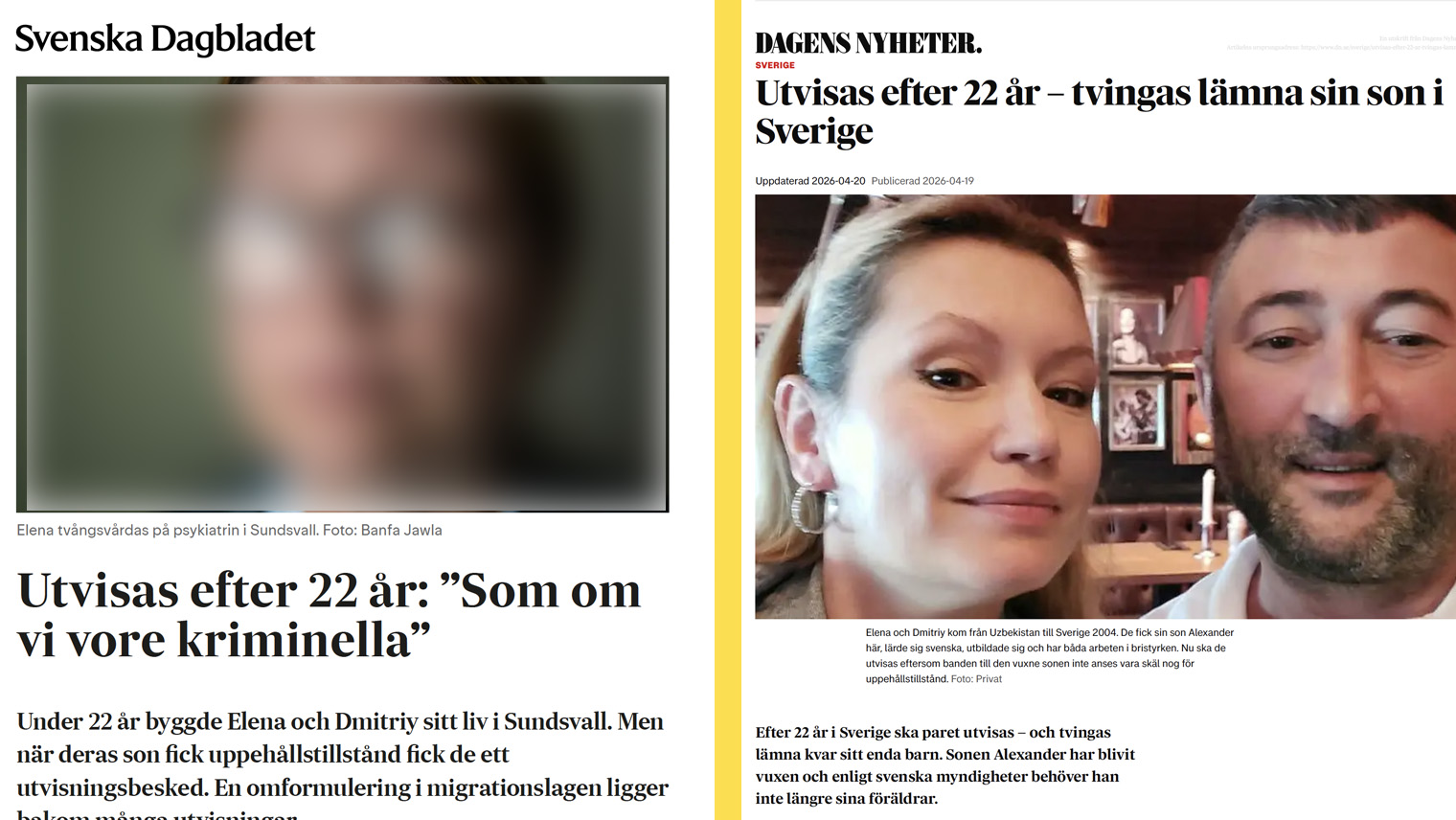
SVT, DN, SR, and SvD have in recent weeks published emotionally charged reports about Dmitriy and Elena Gaffarov, who are to be deported to Uzbekistan after 22 years in Sweden. But according to the Sweden Democrats’ migration policy spokesperson Ludvig Aspling, key facts are omitted from the reporting – including that the family has received recurring rejection and deportation decisions since the mid-2000s.
In recent weeks, several major Swedish media outlets have published extensive reports about Dmitriy and Elena Gaffarov from Uzbekistan, who are now to be deported after 22 years in Sweden. Readers and viewers have been confronted with stories of mental health struggles, crying relatives, “dawn raids,” police actions, and a family said to be torn apart by the Swedish “judicial machinery.”
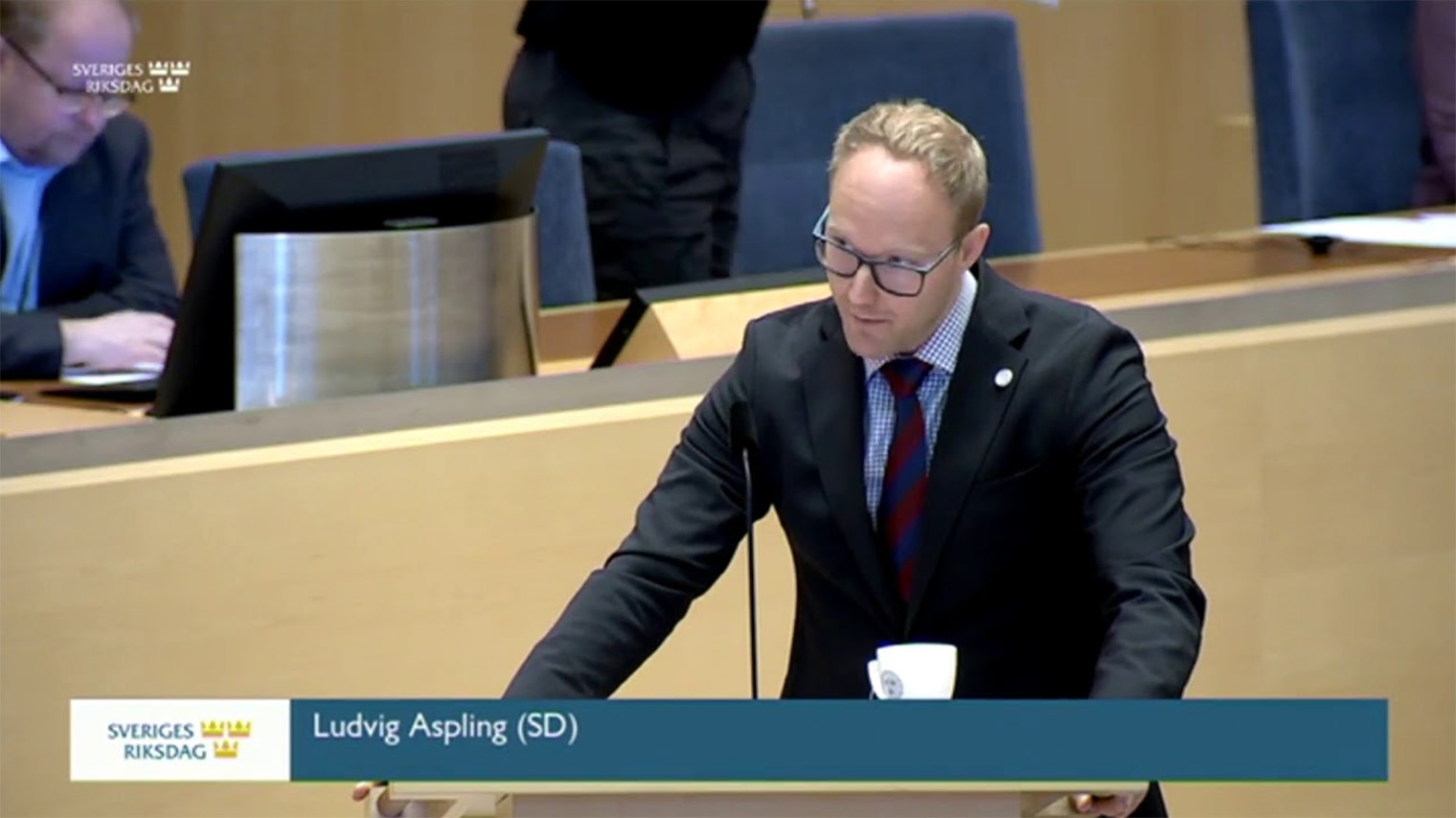
But according to SD’s migration policy spokesperson Ludvig Aspling, reporting leaves out crucial parts of the background.
– It is technically correct to say that they are being deported after 22 years in Sweden. But there is also an important context. If you claim to be a journalist, you should give the context so that the whole case is understandable. That’s what they’re not doing, he tells Samnytt.
SEE ALSO: SR’s and the Migration Agency’s fake baby deportation became a campaign against the Tidö government
Ludvig Aspling is the Sweden Democrats’ spokesperson on migration policy and a member of the Riksdag’s social insurance committee. In recent years, he has been one of the party’s most prominent representatives regarding asylum policy, repatriation, and stricter migration legislation.
Deported by the last three governments
Aspling points out that the family’s migration case is not a sudden development but a case that has been repeatedly tried over a very long period.
– The context that is missing is that they have been deported by the last three governments, if you put it that way. Their first deportation was under the Alliance government, and that has continued with every government up to now.
A review of the migration history conducted by Samnytt shows the family already had their residence permit application rejected in 2005. In 2007, a deportation decision was made, and in 2008 the case was handed over to the Police Authority for enforcement.
SEE ALSO: Three rejections and sob stories as ‘persecuted by Hamas’ – but likes Hamas martyrs
This was followed by a long series of new applications, appeals, enforcement impediments, and court cases. The Migration Court of Appeal has on several occasions denied leave to appeal.
As recently as March 2025, a new rejection and deportation decision was made. During 2026, new attempts to prevent enforcement have been rejected.
This is what we have gotten used to from Swedish Television. // If you remember when we had the “unaccompanied minors”, media outcry led to entirely new legislation. Before that, we had the “apathetic children” – it was exactly the same thing.
Ludvig Aspling (SD)
The media project 100% has also highlighted the case. In an analysis, Per Gudmundson writes that since 2005, the family has received a total of 47 negative decisions from the Migration Agency and courts – while criticizing how much of media coverage has downplayed the extensive decision history.
“Why aren’t they Swedish citizens by now?”
Aspling also asserts that the media downplay the fact that the family has, for parts of the time, stayed in Sweden without permission.
– The other contextual part is that they have been living in Sweden illegally. I haven’t seen the entire decision history, so I can’t say exactly between which dates. But that context—that they have no asylum grounds and have lived in Sweden illegally—if you are a responsible journalist, you need to give that context.
SEE ALSO: SVT’s campaign when Latin American deported after 20 years
In several of the reports, the family’s work, tax payments, and civic engagement are instead highlighted as key arguments for why they should stay.
But Aspling questions parts of this portrayal.
– It’s not true that they’ve just worked and paid taxes for 20 years as portrayed. The time for citizenship is five years if it’s a legal stay. Why aren’t they Swedish citizens by now? They really should be.
He also points out that people with operational impediments to enforcement may under certain circumstances be allowed to apply for permanent residence after a few years.
– These are very basic questions that no one is asking these individuals.
Aspling also says that Uzbekistan today cooperates relatively well with Sweden regarding return cases and that, in his opinion, the country is not among those that actively complicate enforcements or refuse to accept their own citizens.
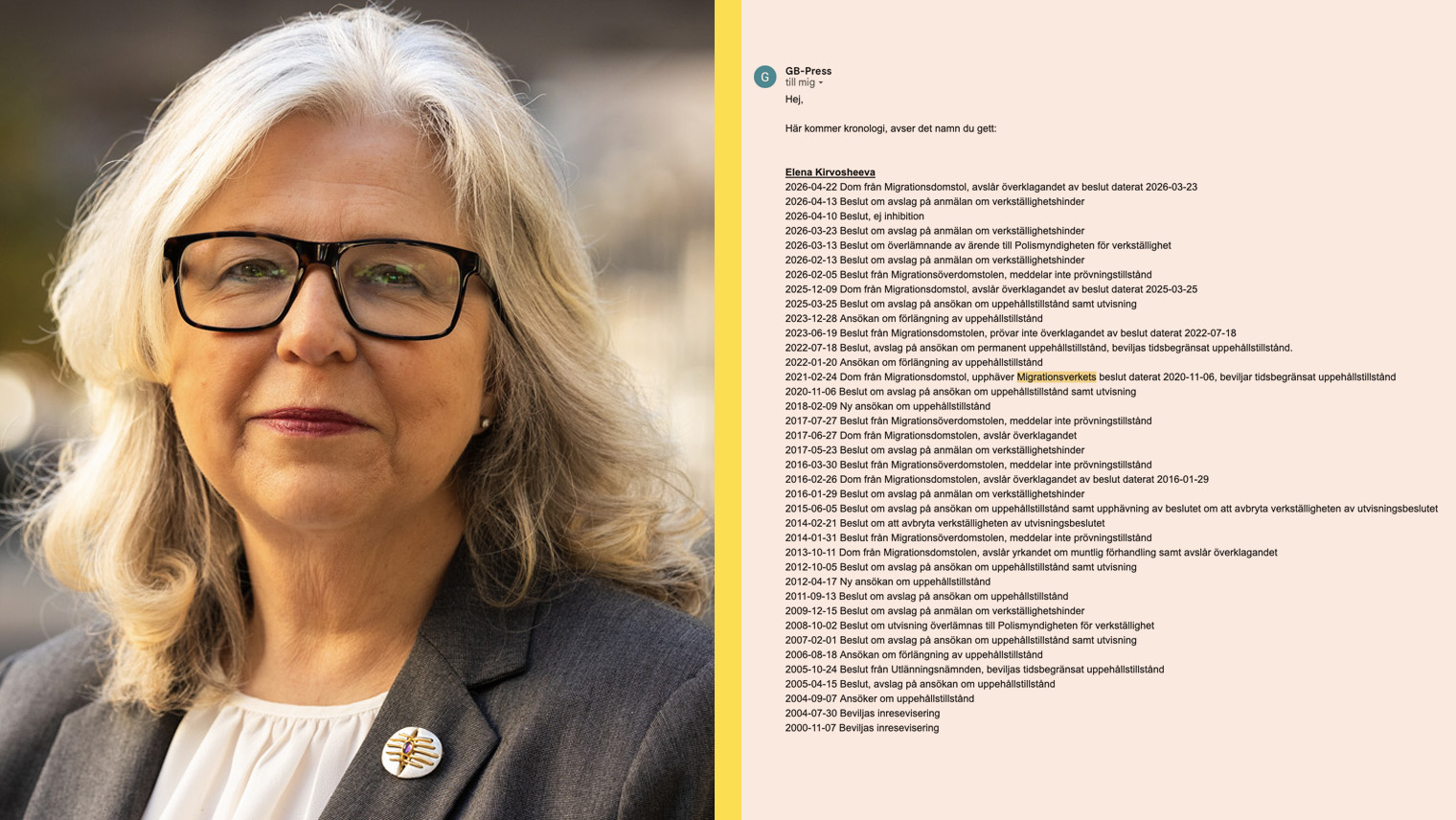
Here is the Uzbek man’s history from the Migration Agency:
Dmitriy Gaffarov
2026-04-22 Judgment from the Migration Court, rejects appeal of decision dated 2026-03-23
2026-04-13 Decision on rejection of request for impediments to enforcement
2026-04-10 Decision, no stay of enforcement
2026-03-23 Decision on rejection of request for impediments to enforcement
2026-03-13 Decision to hand over case to the Police Authority for enforcement
2026-02-05 Decision from the Migration Court of Appeal, does not grant leave to appeal
2025-12-09 Judgment from Migration Court, rejects appeal of decision dated 2025-03-25
2025-03-25 Decision rejecting application for residence permit and deportation
2023-12-18 Application for extension of residence permit
2023-06-19 Decision from Migration Court, does not hear appeal of decision dated 2022-07-18
2022-07-18 Decision, rejection of application for permanent residence, granted temporary residence permit.
2022-01-20 Application for extension of residence permit
2021-02-24 Judgment from Migration Court, revokes Migration Agency’s decision dated 2020-11-06, grants temporary residence permit
2020-11-06 Decision rejecting application for residence permit and deportation
2018-02-09 New application for residence permit
2017-07-27 Decision from Migration Court of Appeal, does not grant leave to appeal
2017-06-27 Judgment from Migration Court, rejects appeal
2017-05-23 Decision rejecting application for impediment to enforcement
2016-03-30 Decision from Migration Court of Appeal, does not grant leave to appeal
2016-02-26 Judgment from Migration Court, rejects appeal of decision dated 2016-01-29
2016-01-29 Decision rejecting application for impediments to enforcement
2015-06-02 Decision rejecting application for residence permit and overturning the decision to suspend enforcement of the deportation order
2014-02-21 Decision to suspend enforcement of deportation order
2014-01-31 Decision from Migration Court of Appeal, does not grant leave to appeal
2013-10-11 Judgment from Migration Court, rejects request for oral hearing and rejects appeal
2012-12-17 Decision from Migration Court, rejects request for oral hearing regarding decision dated 2012-10-05
2012-10-05 Decision rejecting application for residence permit and deportation
2012-04-17 New application for residence permit
2011-09-13 Decision rejecting application for residence permit
2008-10-02 Deportation order handed over to Police Authority for enforcement
2007-02-01 Decision rejecting application for residence permit and deportation
2006-08-18 Application for extension of residence permit
2005-10-24 Decision from the Aliens Board, granted temporary residence permit
2005-04-15 Decision, rejection of application for residence permit
2004-09-07 Application for residence permit
2004-07-30 Granted entry visa
“The final migration instance is Swedish Television”
Aspling also makes broader criticisms about how Swedish media report on migration issues, saying emotional reports are sometimes used as a way to influence authorities and public opinion when legal means are exhausted.
– Lawyers say there are no asylum grounds and no chance. But then there is a last opportunity. The final instance in Swedish migration law is Swedish Television. He elaborates:
– If you can get a segment on Swedish Television, then maybe the Migration Agency will back off and let you stay, even though you really do not have the right to be in Sweden.
SEE ALSO: Another person arrested in the Uzbek/Kyrgyz terror case
According to Aspling, there have previously been several examples in Sweden where media opinion has led to political changes or to people being allowed to stay despite rejection decisions.
– Swedish journalists never ask any follow-up questions in these cases, even when it is patently obvious that what is being said is not true.
Do you see that Swedish public service and other media, like DN and Svenska Dagbladet, take a clear political stance and push public opinion on these issues?
– Yes, of course they do, it’s nothing new.
How do you view the fact that media often use strongly emotional terms like “dawn raid,” “broken family,” and “judicial machinery”?
– Of course, they use the words that have the intended effect on the audience. The purpose is to generate a media campaign, and you cannot be objective in your reporting in that case. He continues:
– That’s what we have grown used to from Swedish Television.
SEE ALSO: Testimony from inside the Migration Agency: “The Tidö government is the enemy”
Are the heads of the Migration Agency so sensitive to these media campaigns that they can change decisions, you think?
– I’m not so sure they are today. That’s how it was before. If you remember when we had the “unaccompanied minors,” then media outcry led to completely new legislation. Before that, we had the “apathetic children,” same thing. He continues:
– Media campaigns led to people being allowed to stay. But I don’t think that’s the case anymore.

According to Aspling, the situation has changed in recent years. He notes that the possibility for deportation decisions to expire has been removed and argues that today’s regulations make it more difficult to “get back into the system” by staying in the country for a long time.
He also says he hasn’t seen any sharp increase in so-called new reviews, which he interprets as the Migration Agency now applying the stricter legislation as intended to a greater extent.
“Undermines confidence in the migration system”
What happens to confidence in the migration system if people can remain for decades despite repeated rejections?
– That these kinds of situations can arise with different countries is understandable, so these types of problems can occur. But it is far too easy to exploit the system, so you can stay so long without a residence permit. The SD top politician continues:
– It’s not good, and it clearly undermines confidence in the systems we have.
He also believes it sends international signals that it is possible to stay a long time in Sweden despite being rejected.
– When they tell their friends back home in Uzbekistan how things work in Sweden, Sweden becomes more attractive to people who do not have protection grounds but would like to move to Europe anyway.
He emphasizes that today’s legislation is stricter compared to before. He describes the old system as a kind of blackmail.
What signals are you referring to, if the Migration Agency backs down after media campaigns?
– Well, of course, that this type of blackmail works, obviously. And that would be very bad.
Do you have confidence in the management of the Migration Agency today?
– The problem is not management, the problem is the personnel policy. It is an agency where the wrong people were hired for decades. And you can’t just fire people at will, we have laws on employment protection and so on.
SEE ALSO: Inside the Migration Agency: Clans, Swedes in minority and culture of silence
But you do not see the same problems as during the time when then-director-general Anders Danielsson said we should “let Anders be Anders”?
– He was a total disaster. Mindhammar is much better. Appropos the issue of unobjective media coverage, she has actually been very clear – that what’s in the media about these individual cases is not true. He continues:
– I have full confidence in her, but it’s a huge organization and lots of unsuitable staff. Many are employed because they are foreigners, which leads to various kinds of conflict-of-interest problems. He adds:
– I’m not sure you should have staff at all from the regions of the world from which many asylum seekers come. It’s not optimal.
Staying at three-star hotels, though they are in Sweden illegally
Aspling is also asked about comparisons with the USA and the migration authority ICE, but argues the situation in Sweden is different.
He points out that the US system is based on a conflict between federal law and states that sometimes oppose enforcements, something he claims is lacking in Sweden, where immigration law is national.
It was also noticeable that these sob stories were about people who in practice live at two- or three-star hotels, even though they are in Sweden illegally. It didn’t seem to be getting anywhere. It was Dagens Nyheter pushing this, but nobody else seemed to jump on.
Ludvig Aspling (SD)
He also says that support in Sweden for enforcing deportation orders is today much greater than during previous debates, such as around the REVA project.
The SD top politician also brings up Dagens Nyheter’s reporting on the new return centers and claims the paper has tried to build public opinion against their operation.
He says that DN has, for example, published critical reports and information about “worry reports” initiated by the Red Cross linked to the accommodations, aiming for the centers to be closed down, but that the reporting did not, in his view, have the same impact as prior media campaigns on migration.
In what way, do you mean?
– It was also noticeable that these sob stories were about people who in practice live at two- or three-star hotels, even though they are in Sweden illegally. It didn’t seem to be getting anywhere. It was Dagens Nyheter pushing this, but nobody else seemed to jump on.
Towards the end of the interview, the conversation also turns to the autumn election and to public service and confidence in traditional media before the 2026 election.
– It will also be a bit of a referendum on confidence in traditional media, says Aspling.
He claims that many voters, even outside the SD core, today distrust public service reporting on migration issues.
– I think it goes deep even among moderate voters, that people feel they can’t trust these people. After the revelations about the SOM Institute, we also know that the numbers presented cannot be trusted with certainty.
???? Together we make Samnytt grow
We are very grateful to all of you who read Samnytt every day. Your engagement makes our work possible.
If you’re not already a subscriber – please become one and help us continue to grow, develop, and deliver important news and investigations.
Your support makes a difference.
123 083 33 50
Swish any amount
Thank you for reading and supporting ????