
An analysis points to alarmingly large differences between municipalities in Sweden depending on the composition of their population. According to researcher Nima Sanandaji, statistics clearly show that municipalities with a high proportion of residents with an immigrant background also generally have significantly higher levels of crime.
In an article published at Riks, researcher and author Nima Sanandaji demonstrates a clear statistical correlation between immigration and crime in Sweden. By comparing the country’s municipalities, he shows that the differences in safety and number of reported crimes are striking, depending on what proportion of residents have Swedish or foreign backgrounds.
Sanandaji refers to statistics from Sweden’s municipalities and describes the differences as “night and day” between those municipalities where most or least residents have a Swedish background.
Twice as High Crime Levels in Certain Municipalities
According to Sanandaji, municipalities where the majority of residents have a foreign background have significantly higher crime levels per capita than municipalities where over 90 percent have a Swedish background.
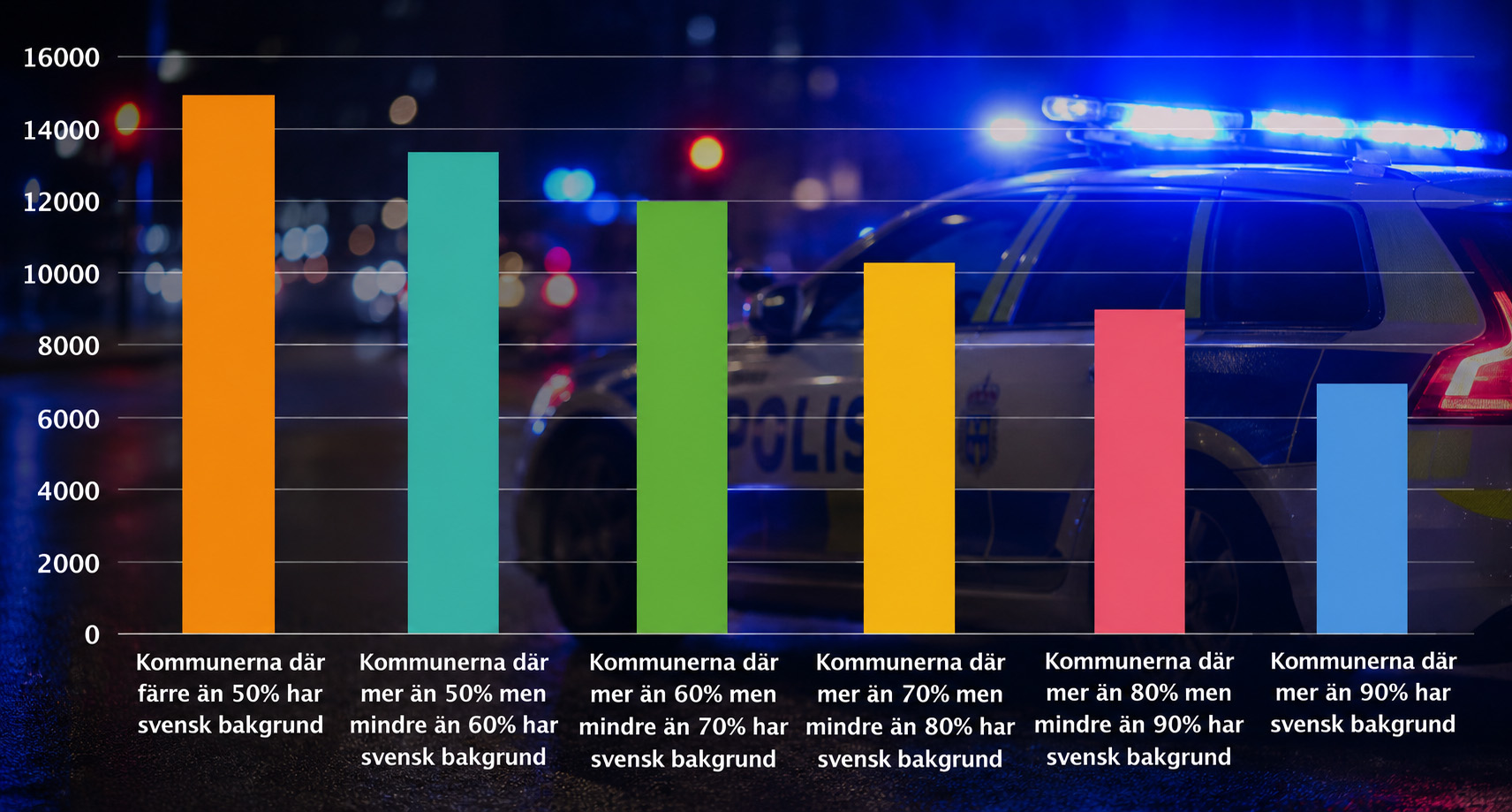
He highlights municipalities such as Botkyrka, Södertälje, Sigtuna, Järfälla, Haparanda, and Burlöv, where according to statistics, the majority of residents now have a foreign background and Swedes are in the minority. In these municipalities, it is reported that in 2025 an average of 14,843 crimes per 100,000 inhabitants were registered.
READ ALSO: Criminologist Disproves Left-Wing Myths About Crime
As a comparison, Sanandaji points out that municipalities where more than 90 percent of residents have a Swedish background had about 7,013 reported crimes per 100,000 inhabitants on average the same year.
“That is, more than twice as many crimes are reported per resident in the municipalities with the smallest, compared to the largest, proportion with a Swedish background,” he writes.
Linear Relationship Between Background and Crime
Sanandaji argues that the relationship becomes even clearer when all of Sweden’s 290 municipalities are analyzed together. According to him, the statistics show a linear pattern where a higher proportion of residents with a Swedish background coincides with lower levels of reported crime.
“Every ten percentage points of residents in a municipality with a Swedish background means on average about 1,630 fewer reported crimes per 100,000 inhabitants,” writes Sanandaji.
At the same time, he points out that big cities often have higher crime rates for several reasons, including that they attract many visitors, tourists, and commuters. Stockholm, Malmö, and Helsingborg are mentioned as examples of municipalities with high crime rates, where population density and the flow of people also affect the statistics—not just the proportion of non-Swedes.
The Safest Municipalities
In the article, Sanandaji also highlights Hammarö, Forshaga, Lekeberg, and Gagnef as some of Sweden’s safest municipalities in terms of reported crimes per inhabitant. According to him, fewer than 5,000 crimes per 100,000 inhabitants were reported there in 2025.
READ ALSO: Brå: Measures to Combat Crime May Involve Ethnic Discrimination
What these municipalities have in common, according to Sanandaji, is that about nine out of ten residents have a Swedish background. He therefore argues that there is reason to talk about a clear link between demographics and safety.
“The relationship is clear; the municipalities in Sweden with the highest proportion of Swedish-background residents are unusually safe from crime,” he states.
Criticism of Politically Driven Social Mixing
Sanandaji also criticizes the Social Democrats’ proposal for so-called politically driven social mixing as a solution to integration problems. He argues that such measures risk spreading social problems to more parts of the country rather than solving them.
According to him, increased migration combined with this type of policy risks leading to increased insecurity in more Swedish municipalities. He also links the issue to economic consequences and refers to studies showing that crime and insecurity affect companies’ willingness to invest, recruit, and expand.
Nima Sanandaji is CEO of the European Centre for Entrepreneurship and Policy Reform (ECEPR). He has published research in several fields, including economics, economic history, and natural sciences, and has written around thirty books.
READ ALSO: New Study Shows Foreign-Born Commit the Majority of Rapes