
Hundreds of millions in municipal funds were invested in charging stations—but after ten years, only losses, silence, and a business valued at zero remained.
In a column in Jämtlands Tidning, business economics commentator Christian Sandström delivers sharp criticism of the municipally owned Jämtkraft’s long-term investment in electric vehicle charging infrastructure. According to Sandström, the story is yet another example of green signaling politics where large public investments have been made without a sustainable business model as a foundation.
READ ALSO: Annual reports show: Heavy losses for Vattenfall’s wind power five years in a row
Jämtkraft launched the initiative in 2015 with the ambition to build one of Sweden’s best infrastructures for electric car charging. The visions were grand and the optimism high. The idea was that a rapidly growing network of charging stations would create future profits as the electrification of the vehicle fleet picked up speed.
But according to Sandström, the project developed into an expensive prestige project, with losses growing year after year—without anyone putting a stop to it. Funds that instead could have been used for welfare and other core municipal services.
Expanded despite recurring losses
Sandström compares the initiative to the dot-com bubble around the turn of the millennium. “Dreams of new technology and a rush so that the moment won’t slip away,” he writes.
Together with municipal companies in Linköping and Helsingborg, Jämtkraft—which is owned by Öresund Municipality—formed a joint company aiming to establish charging stations across the country—from Kiruna to Trelleborg. Later, Norwegian Statkraft also joined the venture, which, according to Sandström, further fueled the expansion.
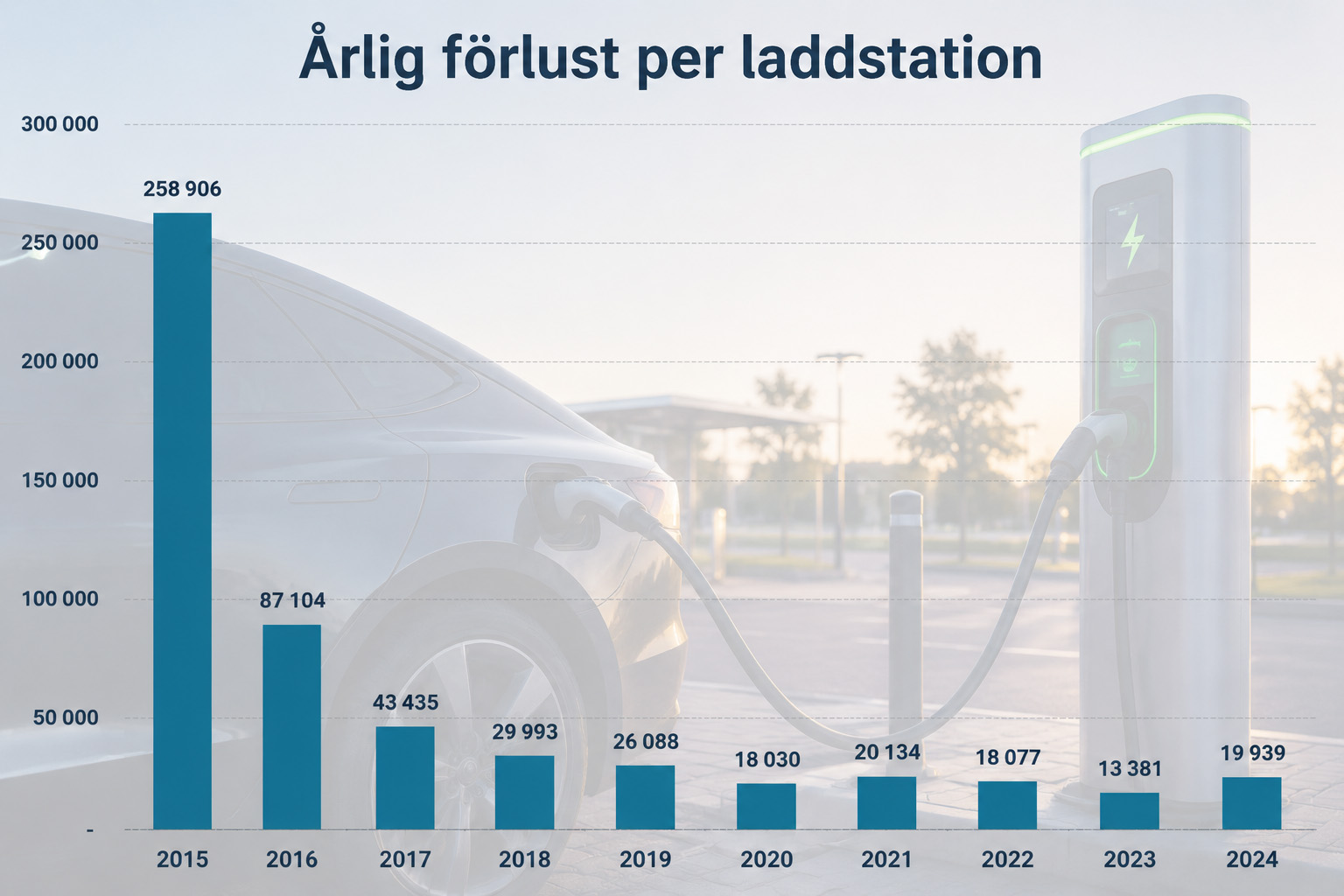
The business grew rapidly, and thousands of charging stations were built not only in Sweden but also in Germany, Austria, and the United Kingdom. But the profits never materialized.
Sandström points out that the first 75 charging stations, on average, ran at a loss of over 250,000 kronor each. Even later, the losses were about 20,000 kronor per station and year.
Despite this, the owners continued to inject capital. In total, around 325 million kronor in municipal funds were invested in just over 3,300 charging stations.
“There’s no mandate to compete with private companies”
A central aspect of Sandström’s criticism concerns the role of municipalities. He refers to the Local Government Act, maintaining that there was no support for conducting business in this way.
“There’s nothing in the owner’s directives from the municipal council or in the company bylaws that says Jämtkraft should compete with Tesla, petrol stations, and other private companies in this way,” he notes.
READ ALSO: Flop for electric cars in range test during the winter—this much disappeared
Sandström also describes how the business continued to make large investments despite the weak finances. For example, land was purchased outside Mjölby for 9.5 million kronor, with plans for charging heavy electric vehicles—even though there were fewer than 900 heavy electric trucks in all of Sweden at the time.
The auditor put a stop to it
It was not until 2024 that the auditor reacted and demanded that the business be valued at zero kronor. Only then did the board act and sell Jämtkraft’s shares in 2025.
When Sandström asked Jämtkraft what the company received for the sale, the company declined to answer, citing business confidentiality—even though the company is publicly owned by the municipality’s residents.
“We consider that we have now answered your questions and provided the information that is public and relevant,” Jämtkraft’s communications department replied to him.
Since the auditors in Helsingborg Municipality later also valued the business at zero, Sandström concludes that it is most likely the shares were handed over without any compensation whatsoever.
“How much is 108 million in public services?”
When the initiative is summarized, Sandström estimates that Jämtkraft lost 108 million kronor over the ten years the project ran. He concludes by relating the cost to welfare, highlighting the simultaneous savings being made in healthcare in the Region of Jämtland Härjedalen.
“How much is 108 million in public services? Really?” he asks. For Sandström, the charging initiative is an example of what happens when public actors are driven by visions of the future and political signaling rather than economic realism.