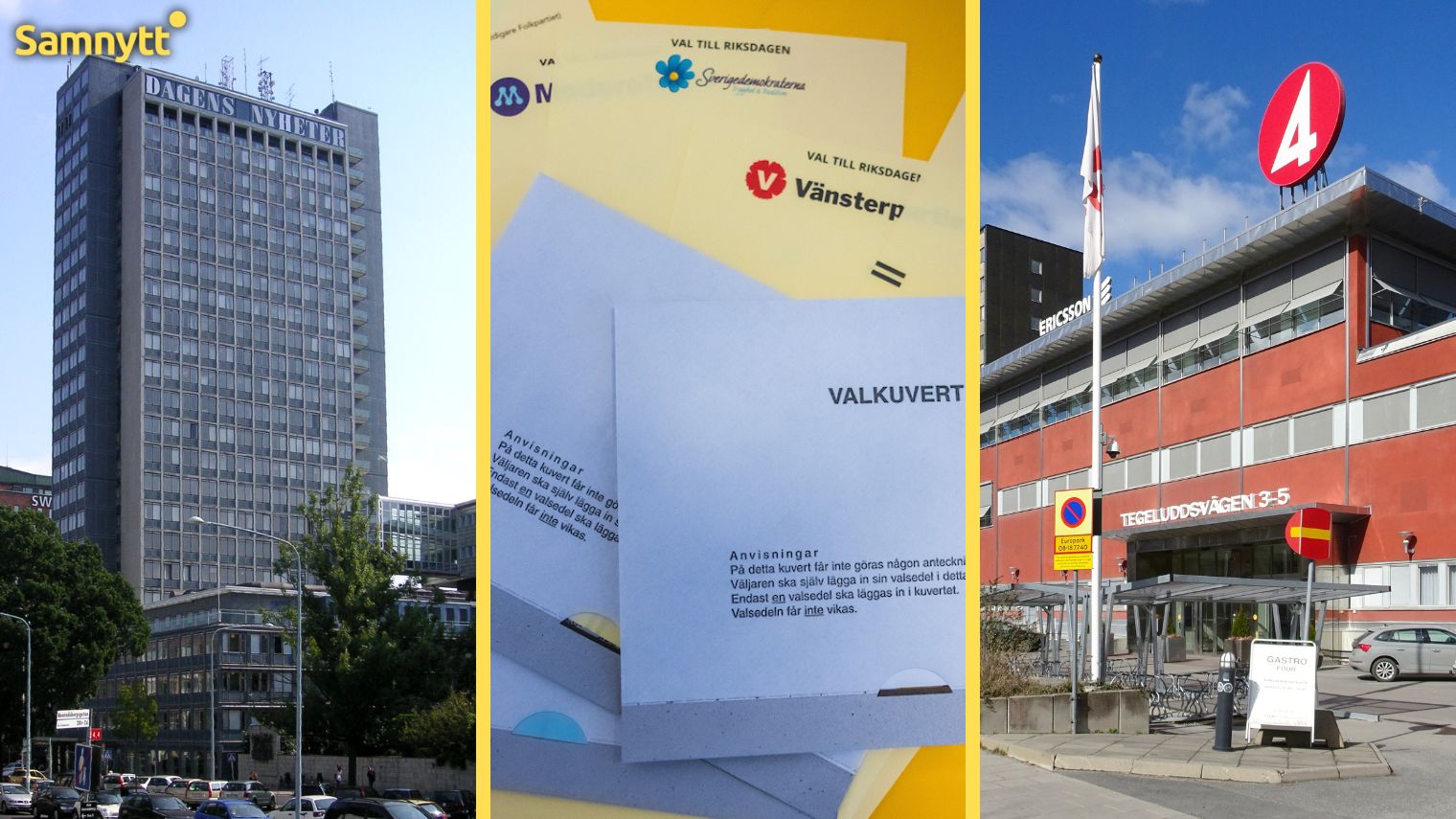
The left side received more favorable treatment than the right bloc in Swedish news media during the 2022 election campaign. This is shown by a comprehensive research report on the media’s coverage of the parliamentary election, published in 2023. At the same time, the researchers note that the right-wing parties benefitted from the fact that the campaign was dominated by issues where they had greater voter confidence.
The report is based on an extensive analysis of election coverage from, among others, SVT, Sveriges Radio, TV4, Dagens Nyheter, Svenska Dagbladet, Aftonbladet, and Expressen.
The researchers used a so-called AB index, which weighs together how much attention the parties received, how often they themselves were heard, and how positive or negative the coverage was.
READ ALSO: Survey: Strong Left-Wing Tilt Among New Journalists
The results show that Magdalena Andersson’s coalition – the Social Democrats, Green Party, Left Party, and Centre Party – had an advantage of +12 compared to Ulf Kristersson’s coalition. When only traditional news media were analyzed, the advantage increased to +16.
The researchers describe this development as a clear reversal compared to the 2018 election, when the centre-right side allegedly had an advantage in how the parties were treated.
Significant Differences Between the Media
When the results are broken down between different newsrooms, significant differences emerge.
The greatest advantage for the left was found in TV4 Nyheterna, which received an AB index of +29. This was followed by:
- ETC: +21
- Sveriges Radio’s Ekot: +18
- Dagens Nyheter: +17
- Svenska Dagbladet: +14
- Aftonbladet: +10
- Expressen: +3
SVT’s Rapport is described in the report as being almost completely balanced, with an index near zero.
The Left’s Criticism Got More Exposure
The researchers also analyzed how the conflict between the government alternatives was portrayed. Of the criticism between blocs reported, 42 percent was from the left against the right bloc, while 35 percent was from the right against the left bloc.
According to the report, the differences were not dramatic, but they contributed to a certain advantage for the left in how the political conflict was presented.
The Right Benefitted from the Agenda
Despite the results regarding how the parties were treated, the researchers emphasize that the campaign was dominated by issues such as law and order, the economy, and energy policy – areas where the Moderates, Sweden Democrats, Christian Democrats, and Liberals had stronger ownership of the issues.
The researchers therefore summarize their analysis by saying that the right bloc benefited from the topics that the media reported on, while the left benefited from how the parties were treated in the coverage.
The report also shows that the parties’ media exposure largely reflected opinion polls. According to the researchers, the link between a party’s polling support and the attention it received in the media was stronger in the 2022 election than in previous elections.
The Researchers: Does Not Necessarily Show Political Bias
The researchers also emphasize that the results should not be interpreted as proof that Swedish journalists in general are politically left-biased.
According to the report, a party can benefit in some ways and be disadvantaged in others. The authors therefore believe that the results should primarily be understood in terms of journalistic working methods and media logic rather than as an expression of journalists’ personal political sympathies.
READ ALSO: Survey: Almost Only Left-Wing Voters Consider SVT and SR Factual and Impartial