Despite a historically high electricity output, Sweden’s wind power sector is bleeding financially. A comprehensive review of the industry’s financial reports shows that the losses are not only substantial—they are increasing. There is now doubt whether any wind power capacity would have been built on purely commercial terms at all.
The latest in a series of analyses sounding the alarm about massive losses in the wind power industry comes from Associate Professor Christian Sandström and business economist Christian Steinbeck. Their numbers paint the picture of a structural crisis with potentially enormous costs for taxpayers, as reported by, among others, Fokus.
Massive Production – but Even Bigger Losses
Over the past year, Swedish wind turbines delivered more kilowatt-hours than ever before. Yet, profitability worsened dramatically. According to the review presented by Christian Sandström and Christian Steinbeck at Ekonomiskt Forum, 240 wind power companies reported a combined deficit of roughly SEK 6.3 billion for 2024.
READ ALSO: Professor: Researchers Are Wrong About the Profitability of Offshore Wind Power
The companies included in the analysis account for about 85 percent of all wind power production in Sweden. This is not a marginal selection—it is the core of the industry.
The average profit margin after financial items ended up at minus 51 percent. In other words: on average, costs were more than one and a half times higher than revenues. The result is that eight out of ten wind turbines in Sweden are owned by companies running at a loss.
Losses All Over the Country – but Worst in the North
The situation is most acute in Norrland, where wind power has expanded most rapidly. There, the average profit margin was around minus 83 percent, with total losses close to SEK 4.8 billion. But Sandström and Steinbeck emphasize that the problem is not geographically isolated.
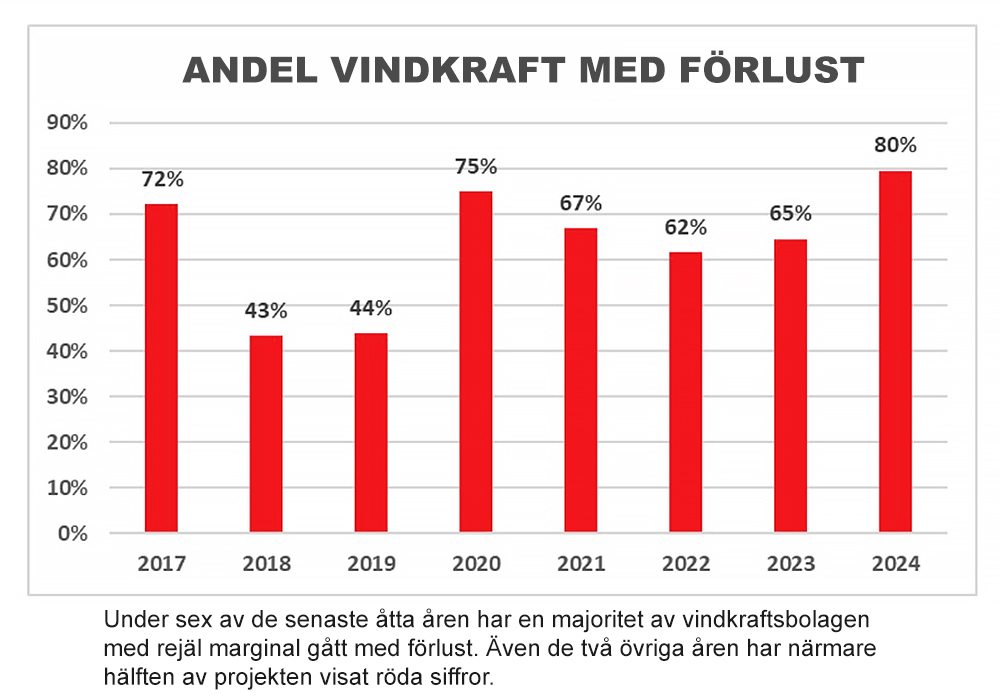
The figures are also in the red in the rest of Sweden. Outside Norrland, the average profit margin was around minus 26 percent, and almost half of the facilities were run by companies that were not profitable. The pattern is national—and according to Steinbeck, it is the development over time that is most alarming. Losses are not leveling off but growing year after year, even though total production is no longer increasing at the same rate.
Overproduction Drives Down Prices
A key explanation highlighted by the researchers is how the production profile of wind power clashes with the market. Electricity is produced when the wind blows, not when demand is highest. And when it is windy in Sweden, it is often the same in Finland, the Baltics, and northern Germany.
The result is recurring electricity surpluses across the entire region. Every new wind turbine helps drive down prices—not just for itself, but also for existing facilities. The more wind power is built, the less all producers get paid.
READ ALSO: Vision of 100 Percent Renewable Energy Slammed: “A Fantasy”
The consequence is visible in a growing number of hours with extremely low or even negative electricity prices. In practice, this means that it can cost money to deliver electricity to the grid. Steinbeck describes how, for this reason, wind turbines are increasingly shut down even in favorable wind conditions—simply because continued production would increase losses.
Capital-Intensive and Extremely Sensitive to Interest Rates
The second main explanation concerns financing. Wind power is one of the most capital-intensive forms of electricity production. A modern onshore turbine can cost several hundred million SEK, with repayment planned over 20–30 years, and revenues that can fluctuate sharply from year to year.
Many projects were deemed profitable during the era of extremely low interest rates, often around 2–3 percent. This kept calculations afloat despite weak cash flows. But it also makes the business extremely sensitive. When interest rates or electricity prices move up or down, it has immediate and significant effects on the results.
Steinbeck’s conclusion is that fundamentally, the operations are not robust enough to withstand normal business conditions.
Taller Turbines – Greater Wear
A third factor concerns the technology itself. To generate more power, turbines have become taller, with longer rotor blades and a larger swept area. This increases production—but also the load on materials.
When height increases, forces grow rapidly—not linearly but exponentially. Taller turbines are exposed to stronger and more variable winds, leading to vibrations, material fatigue, and in the worst case, breakdowns. The problems identified in large parks such as Björnberget outside Sundsvall are seen by researchers as symptoms of this.

The risk is that the actual lifespan will be significantly shorter than the 25–30 years often used in calculations. If turbines have to be fundamentally repaired or replaced much earlier, the entire business model collapses.
Double Systems – Double Costs
Additionally, Sandström and Steinbeck highlight a more overarching systemic issue: wind power does not replace other electricity production, but is layered on top. Since electricity must be available even when the wind isn’t blowing, parallel systems are necessary in the form of hydropower, nuclear power, gas turbines, or imports.
READ ALSO: Wind Power Suddenly Stalled – Interest Has Disappeared
This means the entire electricity system must be kept intact, with all associated costs, at the same time as wind power is being expanded. These system costs are not reflected in the wind companies’ accounts, but are borne by society at large.
Taxpayers Foot the Bill
All in all, the researchers argue the sector is reaching a point where problems can no longer be postponed with cheap loans or political ambitions. When projects don’t hold up economically, costs risk being shifted from investors to the public sector—that is, taxpayers.
According to Sandström and Steinbeck, the expansion has largely been made possible by publicly supported financing: direct subsidies, compensation schemes, as well as loans through government-backed or EU-affiliated institutions. When the calculations no longer add up, these structures are at risk of taking the hit.
They question whether any major wind power developments would have been realized on fully commercial terms.
Costs Live On After Bankruptcy
The risks do not end when a company goes bankrupt. Bankruptcies raise questions about decommissioning, land restoration, and abandoned infrastructure. In theory, the responsibility rests with the companies, but in practice, the securities are often inadequate. Then costs risk falling on landowners, municipalities, or the state.
READ ALSO: Wind Power—the Next Green Collapse
At the same time, system costs accrue for electricity customers: grid expansion, balancing measures, and reserve capacity. These are financed through grid fees and government investments—ultimately by households and businesses.
Calls for More Public Money
Against this background, Sandström and Steinbeck point to a growing systemic risk: the losses are socialized while the proceeds are largely privatized. When deficits grow large enough, they fall on taxpayers.
At the same time, the pressure for further public commitments is increasing. In a recently published opinion piece, Anders Henriksson, chair of SKR, together with wind power industry representatives, called for permanent, state-funded compensation for municipalities to allow continued expansion.
In the same article, it is stated that over 90 percent of projects have been stopped at the municipal level—but the economic problems identified by Sandström and Steinbeck are not mentioned.
Their review instead presents a picture of an industry where record production goes hand in hand with record losses—and where the bill risks falling to entirely different parties than those who made the investment decisions.
READ ALSO: Annual Reports Show: Major Losses for Vattenfall’s Wind Power Five Years in a Row