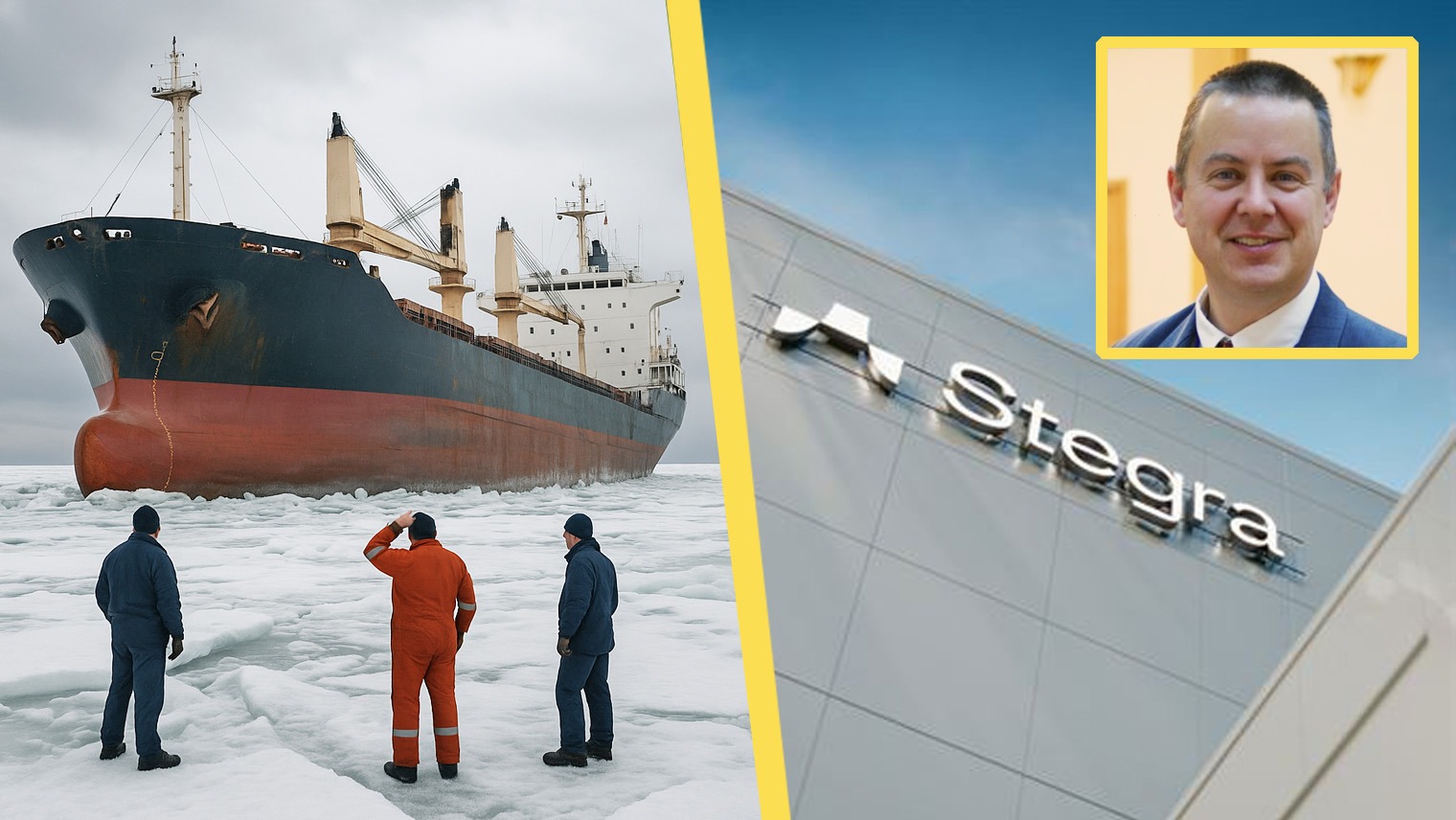
Jan Blomgren, professor of applied nuclear physics, criticizes Stegra’s plans for a new steel mill in Boden. According to him, the company underestimates both logistical obstacles and the technical challenges posed by the northern Swedish winter.
Blomgren questions in an op-ed in Epoch Times Stegra’s plans to import iron ore from Brazil via the port of Luleå, just a few miles from Boden. He argues that the entire idea is based on uncertain assumptions: both about the port’s capacity and the possibilities of transporting the ore further inland. If the railway cannot handle the volumes, truck transport remains – something that Blomgren describes as questionable from both practical and environmental perspectives.
At the same time, the professor highlights a more fundamental problem: the winter. He dryly notes that “it should not come as a complete surprise that there is ice on the Bay of Bothnia in the winter,” but claims that this obvious insight seems to be lacking in the company’s calculations.
Few ships can handle icy conditions
Blomgren refers to a maritime source pointing out that very few ships are built to transport heavy loads such as ore through ice-covered waters. Those that exist are specially built and expensive, and are usually used only in regions where icy conditions are the norm.
READ ALSO: Large number of illegal immigrants deported after raid on Stegra
According to Blomgren, this means that Stegra risks having to charter extremely expensive ships for the entire route from Brazil – or to carry out extensive transshipments in ice-free ports further south. It can be assumed that transshipment of millions of tons of ore is not free, he notes.
History of problematic winter visions
The professor argues that this is not the first time Stegra, formerly H2 Green Steel, has presented plans that do not account for the winter climate. He recalls the company’s previous idea of powering its hydrogen production with electricity from offshore wind power – despite the fact that large offshore wind turbines have never been built in areas that regularly freeze.
As an example, Blomgren points out that the closest they have come is small wind turbines in the Finnish port of Pori, protected and placed in shallow water. The large turbines that Stegra would need, on the other hand, are subjected to considerably harsher strains.
A Finnish research institute has estimated that the movements of the ice can load the towers with forces equivalent to “eight jet engines from large airplanes” – a quote Blomgren uses to illustrate the impracticality of the project.
“Keep a cool head” – with realism
Blomgren concludes by urging decision-makers to maintain calm but above all realism in the assessment of Stegra’s project ideas. According to him, a lack of understanding of the practical consequences of the climate risks leading to decisions based on unrealistic assumptions.
READ ALSO: The ground under Stegra is shaking – needs more billions