
The Tidö government has previously reduced asylum immigration to its lowest level in several decades. The Swedish citizenship process has also been reformed and revalued. Now comes the next step. At a press conference on Tuesday, the government and the Sweden Democrats presented proposals for new rules regarding family immigration.
According to the Tidö government, family immigration has been far too high for a long period and has happened under overly generous terms. As part of the promised paradigm shift, the conditions in this area will now also be tightened. The government especially highlights women from countries outside the EU who have come to Sweden through family connection, as this group is generally the most distant from the labor market.
The government assesses that a disproportionately high level of asylum immigration, combined with an almost requirement-free integration policy, has contributed to the alienation currently being witnessed. They also emphasize that a restrictive migration policy is necessary to create the conditions to break this alienation and to give those living in Sweden the prerequisites to become part of Swedish society.
READ ALSO: Wallenberg Campaigns: We Need More Immigration
Currently, Swedish rules are in many cases more generous than what is required by EU law and Sweden’s international obligations, something the government now wants to change by ensuring Sweden has a restrictive framework more in line with other EU countries.
– The Swedish regulatory framework has in many ways been rather requirement-free, says Minister for Migration Johan Forssell (M).
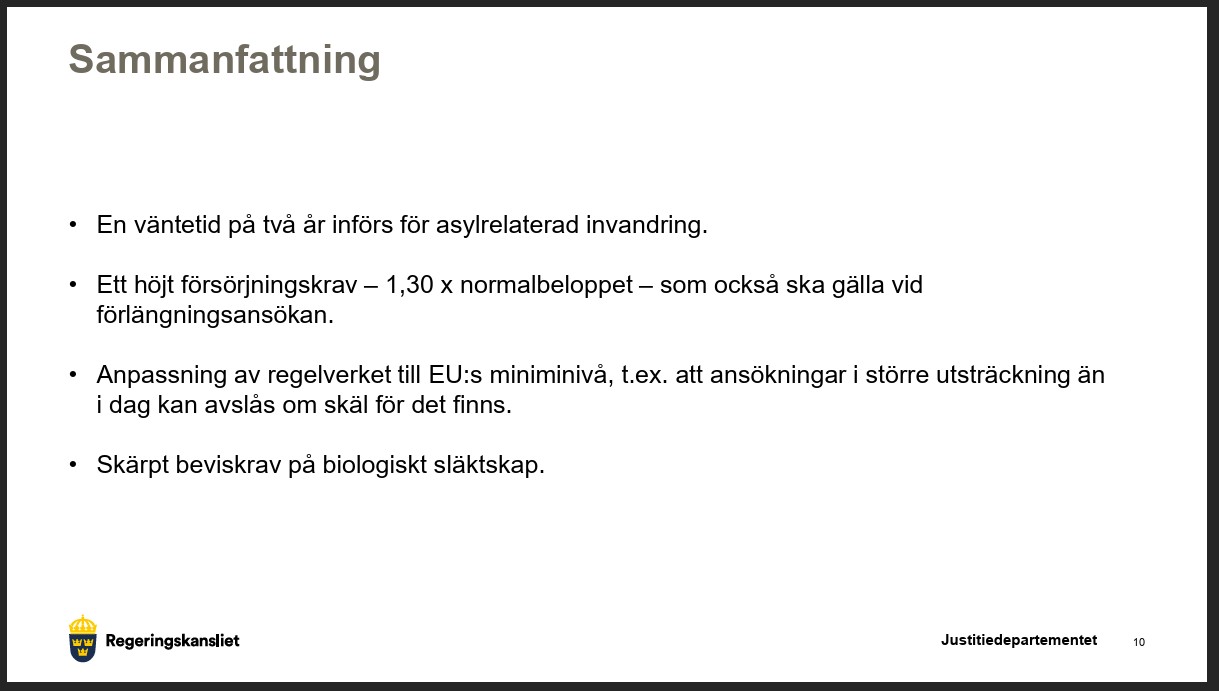
Waiting Time and Expanded Maintenance Requirements
The government now proposes a waiting period of two years as the general rule for certain types of family immigration. The purpose is, among other things, for those wishing to bring their family to Sweden to have more time to integrate and establish themselves in society. This is also in line with how things are handled in other EU countries, for example, Finland.
The waiting period is proposed to cover people with temporary residence permits. Persons in need of subsidiary protection will be included, but some refugees will be exempt. Family immigration for labor migrants and researchers/PhD students will not face a waiting period.
READ ALSO: Government’s ‘Paradigm Shift’: Changes Deportations – After Heart-Wrenching Reports
The government also wants the maintenance requirement to apply in more cases than today and that it be reviewed recurrently when extending residence permits. At present, the maintenance requirement is only tested with the first application.
Further proposals concern expanding the ability to deny residence permits. For example, in cases not covered by EU law, it should be standard practice to consider whether there is a risk that family members may be subjected to violence or other serious abuse if a residence permit is granted. Consideration may also be given to personal conduct and orderliness.
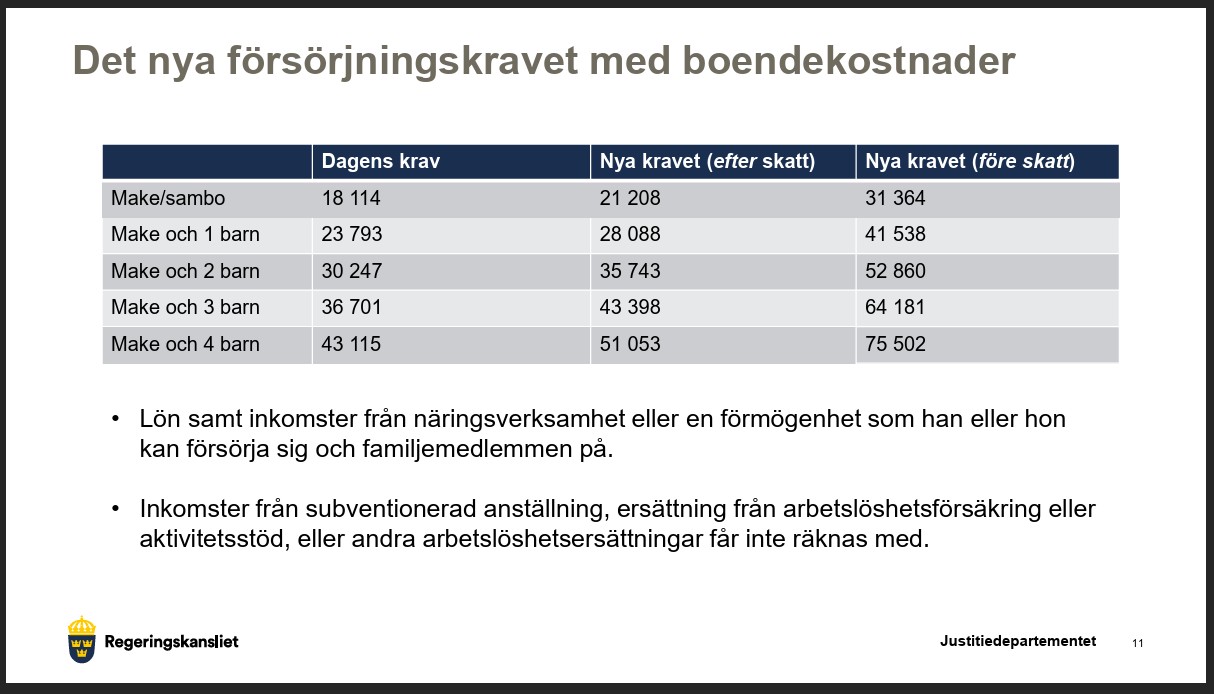
The standard of proof will be tightened from probable to proven biological kinship. DNA analysis will continue to be available when other evidence is not sufficient to prove kinship.
The press conference:
READ ALSO: Tidö Government: More Immigrants to Be Deported: ‘Time to Take Off the Kid Gloves’