
NEWS COLUMN • Since July 1 this year, anyone who “repeatedly subjects another person to violations in the form of accusations, derogatory statements, humiliating behavior, undue threats, undue coercion, or undue surveillance” can be sentenced to up to four years in prison. The intention is good: to stop systematic psychological violence. But the formulation is so vague that it risks harming legal certainty more than it protects victims.
The work on the new legislation began under the previous Social Democratic-Green government. However, the final bill was presented by the Tidö government and adopted by Parliament in May 2026.
The government justified the law with the need to strengthen protection against psychological violence, especially in close relationships and in the context of honor. This is important. Systematic breakdown, control, and isolation are real problems.
But as the new law is currently formulated, it risks damaging legal certainty more than it protects the victims.
Harsher penalties for harsh words than for a slap in the face
One thing that is particularly interesting is the sentencing scale, where someone found guilty of the offense can face up to four years in prison—a longer sentence than what is handed down for assault of ordinary degree. This creates an imbalance.
So you can actually get a higher sentence if you systematically make “derogatory statements” to your partner than if you slap your partner in the face. Of course, that’s completely unreasonable. Isolated nasty comments in the heat of the moment are not normally enough—or so it is said—but the line becomes blurry.
What is an accusation?
But the way the legislation aims to solve the problem may at the same time create new issues of interpretation. The law states that anyone who “repeatedly subjects another person to violations in the form of accusation…” can be convicted of psychological violence and receive up to four years in prison, something that Fria Tider was first to highlight.
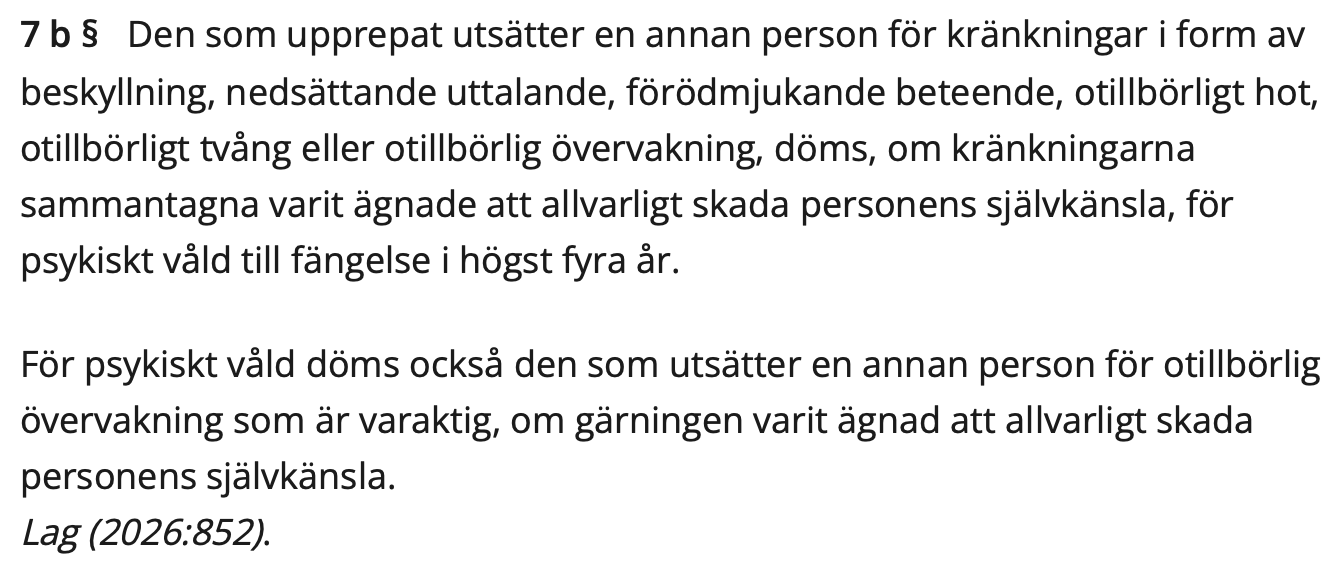
The Law on Psychological Violence (Chapter 4, Section 7b)
The question then becomes: What actually counts as an “accusation”?
The government has stated that the term should correspond to the types of actions covered by the offense of insult. This means that a simple questioning or factual discussion does not automatically become an accusation in the eyes of the law.
At the same time, not every individual statement needs to be intended to seriously harm the other person’s self-esteem. It is the repeated violations as a whole that should be assessed.
But where is the practical boundary?
For example, is it an accusation to repeatedly ask your partner why the dishwasher hasn’t been emptied? Or to point out that the other person has again forgotten to take out the trash?
At what point does recurring nagging about household chores move from everyday relationship squabbles to the kind of pattern of violations that the legislation intends to criminalize?
It is not enough that one party subjectively feels offended. The law requires that the repeated violations as a whole were intended to seriously harm the person’s self-esteem.
But exactly where this boundary will be drawn in practice remains to be seen, and it is the courts that will have to develop precedent.

“Interpret the law like the devil reads the Bible”
The question to ask, therefore, is: why does the government and the Sweden Democrats want to give Sweden’s courts—who in several cases have shown themselves to act as activists in social debates—the power to decide where this boundary lies?
In several of Sweden’s courts, we have time and again seen how they interpret legislation like the devil reads the Bible; one example is when deportation requests are rejected with reference to the immigrant’s “ties to Sweden”—despite having committed serious crimes.
So why proceed with a legislative proposal— which, moreover, has already come into force—that will give the courts even more power to interpret the “meaning” of the legislation?
It will be, to say the least, very interesting to follow the first court proceedings that will determine the line between ordinary relationship squabbles and psychological abuse.
READ MORE: Gang-affiliated home care Eritrean raped 82-year-old in her home—avoids deportation