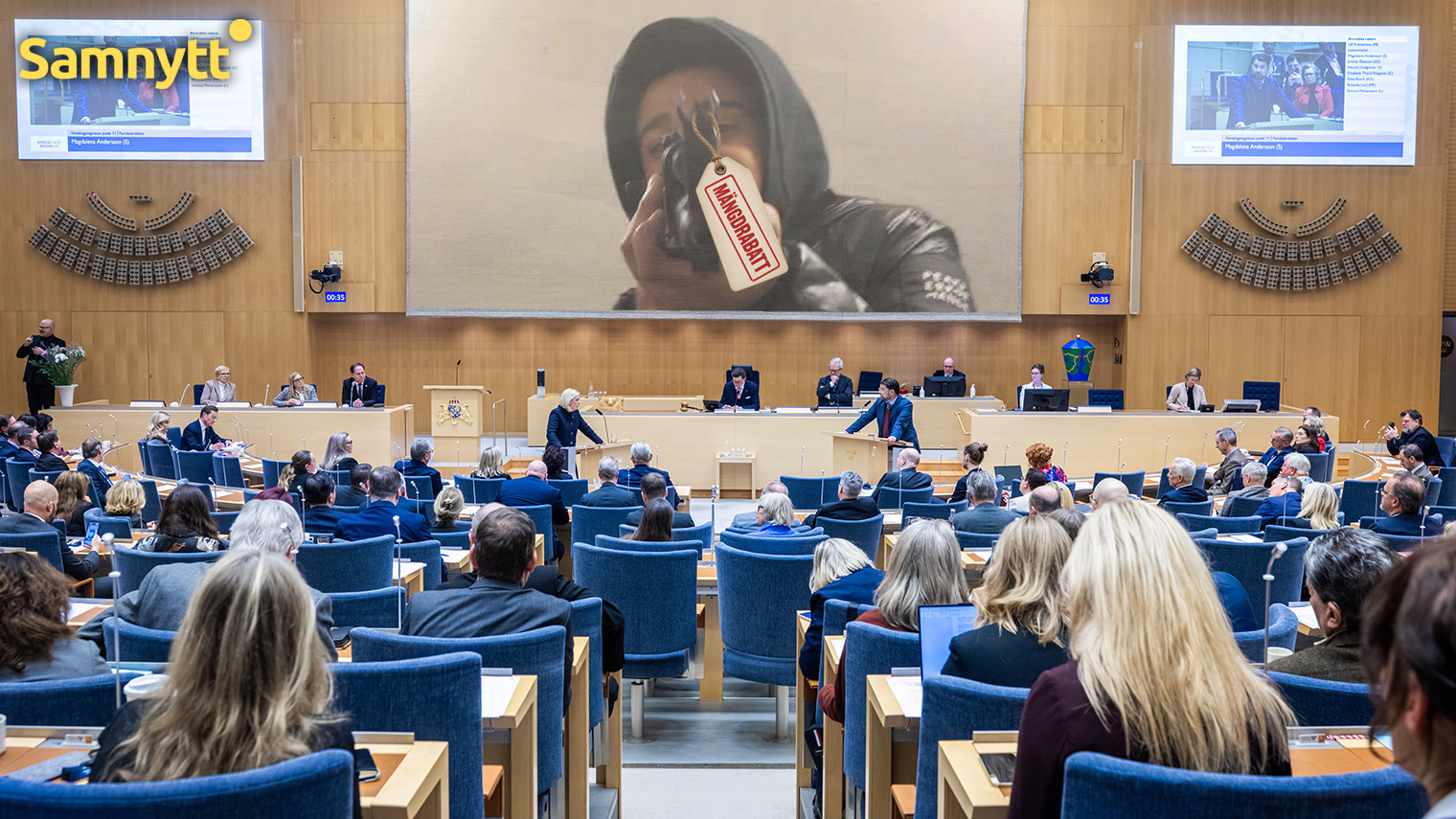
Today, the Swedish parliament voted on the government’s proposal to abolish the so-called quantity discount for those convicted of multiple crimes at the same time. The Tidö parties have described the current system as a betrayal of crime victims and have harshly criticized the Social Democrats for planning to vote no — something they did together with the Left, Green, and Centre parties on Thursday. The opposition argued that the government’s reform is moving faster than the Prison and Probation Service can build new prison places.
On Thursday, parliament decided on a comprehensive change to how sentences are set for people convicted of several crimes at the same time. Today, the so-called aspiration principle applies. Simply put, it means the court starts with the sentence for the most serious crime and then adds a progressively smaller portion of the penalty value for the remaining crimes.
The vote was close. All opposition parties voted against, but the government’s coalition still managed to pass the proposal with 176 votes to 171.
The government and the Sweden Democrats have wanted to severely restrict the current order. According to the legislation now passed, the combined sentence for the three most serious crimes will serve as the guideline when the court determines the overall penalty.
Kristersson: “A Systemic Error”
Prime Minister Ulf Kristersson (M) has described today’s quantity discount as a fundamental flaw in Sweden’s penal system.
– It is a systemic error that favors the interest of the perpetrator over that of the victim, says Kristersson.

The Moderates have pointed to serial rapes, frauds against the elderly, and repeated thefts as examples of crimes where current rules have had consequences the party deems unreasonable.
– I have personally visited ordinary stores where shopkeepers tell how theft gangs systematically steal from grocery stores – but the fifth, seventh, or tenth theft of meat or coffee is practically penalty-free under today’s quantity discounts. As a result, they risk not even being investigated by police. It’s infuriating, says Kristersson.
The Moderates have also highlighted the well-known case of the so-called Nytorg Man, who in 2021 was sentenced to five years in prison. According to the party’s calculations, the sentence would likely have been about twice as long under the government and SD’s new model.
Before the vote, Kristersson called the opposition’s announced no “an insult to crime victims.”
– It is incomprehensible to vote no. We sincerely regret this, he says.
Åkesson: “Completely Horrific”
The Sweden Democrats’ party leader Jimmie Åkesson has also harshly criticized the current system and the Social Democrats’ stance. In a video on Facebook, he used frauds against the elderly as an example.
– Suppose we have a mean old man who commits fraud against three different elderly women. He gets the full sentence for the first fraud against the first woman. But for the second fraud against the second woman, he gets a 66 percent discount. And for the third fraud against the third woman, he gets an 83 percent discount.
Åkesson continued:
– It is absolutely horrific that we have such a system. It does not provide justice for victims as they deserve. And we intend to abolish it now.
Tidö Parties Promise Reform in Next Term
A key topic in the debate over the reform is when it will actually take effect. The government’s bill, now supported by parliament, does not set a firm implementation date. The Tidö parties say the quantity discount will be abolished during the next parliamentary term, aiming for 2029 or 2030.
To handle the increased load on the Prison and Probation Service, the government refers to a faster expansion of Swedish prisons, more places abroad, increased transfers of foreign nationals—who currently occupy a large share of prison places—to serve sentences in their home countries, and greater use of electronic monitoring for those assessed as suitable for non-custodial sentences.
The Moderates estimate the reform’s cost at between three and seven billion kronor over the next term.
Vinge Accuses Social Democrats of “Cheating”
The Social Democrats’ no vote became central to the Tidö parties’ arguments before the vote. The chairman of the Justice Committee, Henrik Vinge (SD), claimed that the Social Democrats’ proposal for a more limited abolition risks lacking support if the red-green parties gain power.
– If the red-greens win the election, there will be no abolition of the quantity discount, as there is no support for it, said Vinge during the parliamentary debate.

He especially pointed to opposition to tougher penalties from the Left Party and Green Party.
– The Social Democrats cannot admit this, because they would risk losing the entire election. So instead, they have chosen to invent an excuse, said Vinge.
He also dismissed claims that Prison and Probation Service capacity would make the reform impossible for the foreseeable future.
– They are spreading pure misinformation, claiming it could not be implemented until 2040.
Kristersson simultaneously urged Social Democrat leader Magdalena Andersson to change the party’s line. This request was not accepted.
– I have several times urged Magdalena Andersson to reconsider. We can disagree on other things but still unite here. But they seem determined that the Social Democrats will vote no. Honestly—it’s incomprehensible, he said.
Social Democrats Also Want to Limit the Discount—But More Narrowly
The Social Democrats officially do not fully oppose limiting today’s quantity discount. The party wants to abolish it for serious violent and sexual crimes and says it wants to start with sexual offenses in the next term.
The difference concerns both the reform’s scope and the speed of implementation. However, the party does not have the backing of the other intended government parties.

The Social Democrats’ legal policy spokesperson Teresa Carvalho stated in the parliamentary debate that the government’s proposal is not sufficiently funded and that the Prison and Probation Service lacks both inmate places and staff.
– The proposals are poorly prepared, there are no extra prison places, and the funding is reminiscent of a classic unpaid bill, she said.
She was especially critical of parliament deciding on the reform without a specified implementation date in the proposal.
– The government is asking parliament for a blank check. I will not sign that. It would be deeply irresponsible toward voters, she argued.
Warned That Prisoners May Have to Be Released
According to Carvalho, implementing the reform too quickly risks creating queues for those awaiting prison sentences. She warned of a scenario similar to that in the UK, where a lack of capacity has contributed to early releases.
– It risks creating long queues to serve prison sentences and, in the worst case, a British scenario where a future government is forced to release prisoners early. That would be a disaster, said Carvalho.
– If you hand out more prison years, you must have inmate places to match. It’s as simple as that.
The government side has dismissed the criticism and emphasized that capacity will be increased through several parallel measures. For the Tidö parties, the issue has become a clear political dividing line ahead of the election.
– If you don’t want criminals to commit even more crimes “with a discount” on their sentences, you need to vote for the Moderates, says Ulf Kristersson.
Age of Criminal Responsibility Lowered
Parliament also passed several other changes to the penal system. Among other things, it decided on a temporary lowering of the age of legal responsibility to 14 for the most serious crimes. This change will initially apply for five years.