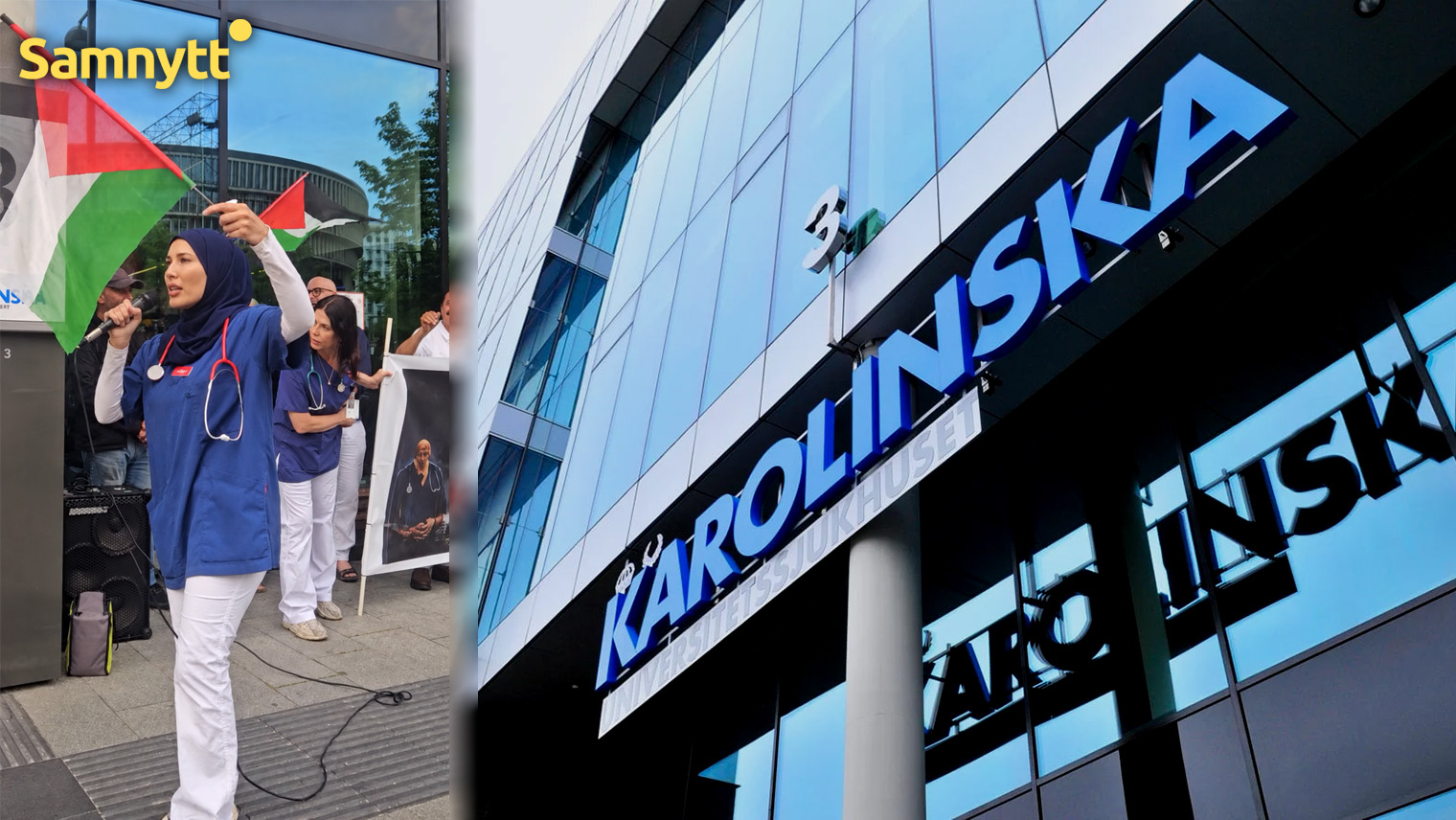
The management of Karolinska University Hospital is now being criticized for not taking stronger action following the widely reported pro-Palestinian demonstration outside the hospital’s main entrance in Solna, where several participants wore medical uniforms and chanted slogans. Critics argue that the hospital settled for an overly passive response, despite clear legal grounds for requiring neutrality from public sector employees, stating that the hospital should not become a platform for political messages.
The demonstration took place on July 1 outside Karolinska University Hospital in Solna. Among the participants were KS employees dressed in the hospital’s medical uniforms.
Among the expressions heard was “From the river to the sea,” a slogan referring to the elimination of the state of Israel. The demonstration also featured far-reaching accusations against Israel from speakers present.
A female doctor who introduced herself as “Natte” described the war in Gaza as an ongoing genocide and accused Israel of deliberately killing children, healthcare workers, and journalists. She claimed, among other things, that Israeli soldiers shoot infants “in the neck and head,” and that Palestinian doctors in Israeli captivity have been beaten, tortured, and “raped to death.”
READ MORE: Karolinska refuses interview after Gaza demonstration in work uniforms
The demonstration took place in front of the hospital’s entrance and logo, directly adjacent to patients, relatives, and staff passing by.
@jwalysta Protest in front of Karolinska Hospital, Stockholm, Sweden, in solidarity with Dr. Hussam Abu Safia and medical teams in occupation prisons. Sweden, Stockholm.
Hospital Referenced Dialogue
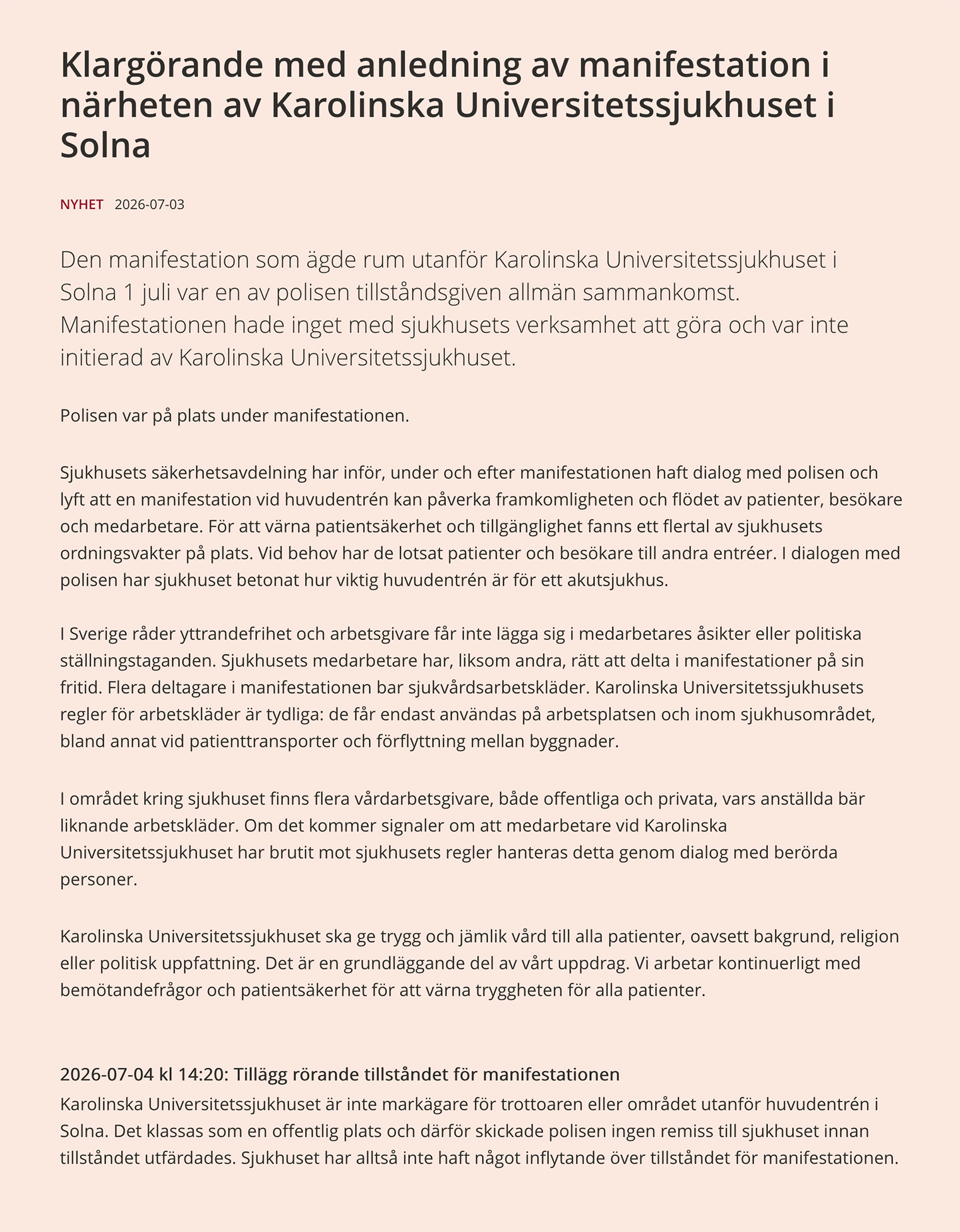
After the incident, Karolinska refused interviews and instead referred to a written statement. In it, they emphasized that the demonstration was not organized by Karolinska and that it took place on public grounds outside the hospital area.
At the same time, they noted that work uniforms may only be worn in the workplace and within the hospital area by employees on duty.
As for possible rule violations, the hospital limited itself to stating that such issues are handled through dialogue with the concerned employees. There have been no announcements about any internal investigations or disciplinary action against hospital staff who participated.
Criticism: Karolinska Could Have Acted More Clearly
The hospital leadership is now being criticized for how permissively they chose to handle employees using the hospital as a platform for political messages.
Critics point out that Karolinska, in their response, reduced the issue to a possible violation of the rules concerning workwear, while ignoring the larger, more fundamental question of public sector neutrality and the public’s trust in healthcare.
According to critics, images of healthcare workers in uniform at political demonstrations risk giving the impression that the healthcare institution is associated with the messages being conveyed.
@jwalysta Protest in front of Karolinska Hospital, in solidarity with Dr. Hussam Abu Safia and medical teams in occupation prisons. Stockholm, Sweden.
EU Ruling Cited as Support for Intervening Against Political Demonstrations
At the same time, several observers point out that Karolinska and other public employers have greater possibilities to act than is often acknowledged in Swedish debate.
The background is a landmark ruling from the European Court of Justice in November 2023. The court found that public employers may establish general rules prohibiting employees from wearing visible religious, political, or ideological symbols in the course of their professional duties, as long as the rules apply equally to everyone and are not targeted at any specific group.
READ MORE: Region Stockholm Now Participates in Palestinian Demonstrations
The case concerned a municipal employee in Belgium who wished to wear a Muslim headscarf at work. The municipality introduced a general policy covering all visible belief symbols and was upheld by the European Court of Justice.
This ruling has now gained relevance after the manifestation outside Karolinska, where healthcare staff were seen wearing work uniforms while political messages were expressed and Palestinian flags were displayed.
Could Have Taken a Stand
Critics argue that the court’s reasoning shows that public employers are not limited to only conversations and dialogue when employees use their professional role or the employer’s symbols in political contexts.
On the contrary, the verdict is seen as supporting the introduction of clear rules distinguishing private activism from the role as a representative of a public institution.
@swedish.friends In front of Karolinska Hospital, Stockholm
Thus, the issue is not primarily about employees’ right to participate in demonstrations during their free time, but whether employees should at the same time be able to appear in work uniforms or with other symbols associated with the employer.
In Karolinska’s case, critics argue that the hospital management chose the most cautious line by referring only to rules on workwear and future dialogue. With reference to the European Court of Justice’s decision, they claim the hospital could have made a significantly clearer stand against the use of healthcare uniforms and professional identity in a political demonstration outside the hospital entrance.
In light of the new information, Samnytt has again contacted Karolinska hospital management with questions about whether any measures have been taken against KS employees who participated in the Gaza manifestation in violation of hospital rules, and whether it will act differently if a similar situation arises again.
ALSO READ: Here Greta demonstrates for Palestine with a diesel pickup