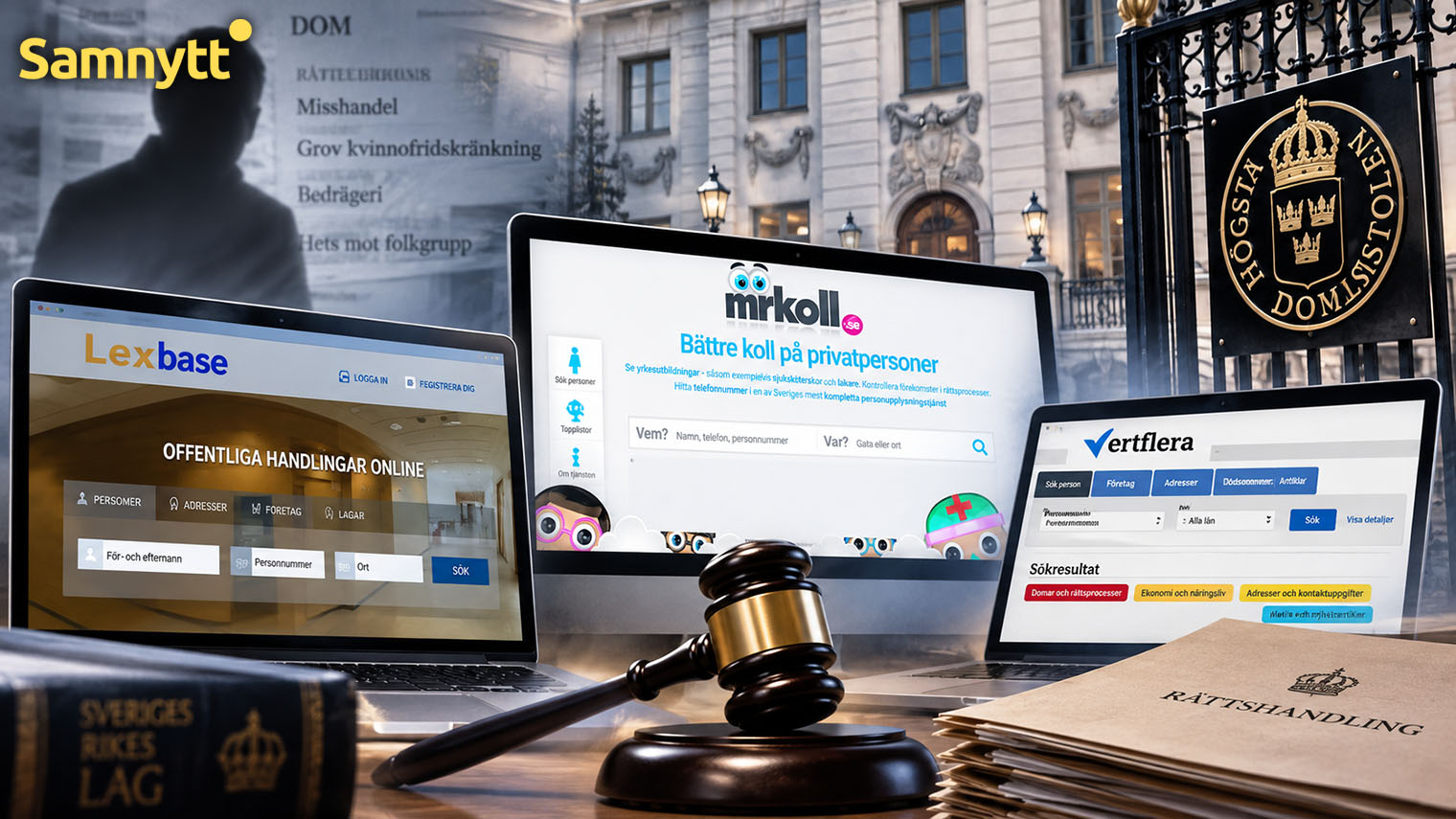
Anyone who does not want their past crimes to be found in online legal databases will now find it significantly easier to cover their tracks. Mr Koll announces that anyone can request all information about themselves to be deleted—including records of serious crimes. The announcement comes after several years of legal pressure on legal databases and a decision by the EU Court of Justice. At the same time, courts circumvent the constitution by making it harder to find older criminal cases—the verdicts are formally still public but are now much more difficult to locate.
The private legal databases have long served as a modern tool to uphold the Swedish principle of public access to information. With services like Lexbase, Mr Koll, and Krimfup, individuals, companies, and journalists have been able to search a person’s name and find verdicts and other legal documents that are classified as public records.
But now the conditions are changing—for the worse and, according to critics, in violation of the constitution and democratic principles regarding public transparency. The work of journalists is made more difficult or even impossible, and parents have a harder time checking if convicted pedophiles are in their children’s surroundings—a topic that has been hotly debated recently.
After SVT investigated how several legal databases have quietly removed verdicts, Mr Koll has announced that the company is now implementing a much more far-reaching deletion policy than before.
—As of today, anyone is free to request the deletion of their information, says Simon Krantz, the editor-in-chief of Mr Koll.
According to Krantz, such a request means that not only potential verdicts are removed. Name, address, phone number, and other published information are also deleted. There is reportedly no exception for serious crimes.
Serious Crimes Have Already Disappeared
The background is a series of legal cases against companies operating these databases. SVT has identified ten cases in which people convicted of crimes have sued Lexbase, Mr Koll, or Krimfup. In several instances, the proceedings ended when the person’s information disappeared from the database.
It’s not just minor offenses that have been deleted. Among the erased verdicts are cases of gross violation of a woman’s integrity, assault, sexual molestation of children, hate speech, fraud, and serious accounting crimes.
In one case, a man had been convicted of seven instances of sexual molestation of children. He sued Krimfup, after which the database removed records of the crimes. The man then withdrew his lawsuit.
READ ALSO: Dagerlind: The Legal Databases Are Not the Problem—They Are the Solution
Another man was convicted of gross violation of a woman’s integrity after, among other things, assaulting his girlfriend. He demanded that Mr Koll take down the information and pointed out, before the impending lawsuit, that a court process would likely be more expensive for the company than simply complying with his demands.
The information disappeared. The man withdrew his lawsuit, and Mr Koll also agreed to reimburse his legal costs.
SVT also noted a case where a man convicted of assaulting his girlfriend had his record deleted from Lexbase after suing the company. That lawsuit was also withdrawn after a settlement was reached.
EU Ruling Changed the Playing Field
Legal pressure on the databases increased significantly after a ruling from the EU Court of Justice on July 9 this year. The background was that a man, Goled Raabi from Somalia, who had led a criminal youth life and was convicted of robbery in 2011, had his conviction published on Lexbase. He later requested the removal of his personal data and in 2024 sued the company for damages under GDPR.
The Attunda District Court asked the EU Court to clarify the relationship between the EU data protection regulation and the constitutional protection that legal databases might have through a publishing certificate.
The EU Court decided that a business whose main activity is making criminal verdicts available online for a fee cannot automatically be considered a journalistic activity. Therefore, it cannot without further ado benefit from the GDPR exemption for journalistic purposes.
READ ALSO: Convicted Prisoner Takes Lexbase to EU Court—Wants to Hide His Criminal Past
This does not mean the EU Court has prohibited publishing information from criminal verdicts. The ruling concerns how such operations should be assessed under GDPR and how the right to data protection should be weighed against freedom of expression and information. The final assessment in the Swedish case rests with the national court.
The verdict has nonetheless changed the risk situation for Swedish legal databases. Mr Koll explicitly refers to recent changes in legal practice when explaining why it has become easier to have your information deleted.
Goes Further Than Just Stopping the Sale of Verdicts
Mr Koll’s new stance, meanwhile, goes further than the core of the EU Court’s ruling. The EU Court examined the issue of making criminal verdicts available for a fee online and when such processing can be considered undertaken for journalistic purposes.
Mr Koll has instead chosen a general solution, where all individuals can request deletion, according to the company, regardless of the type of crime a person has been convicted of.

Meanwhile, Mr Koll’s website has contained contradictory information—that the company usually does not delete published information and that GDPR does not apply to their business. Krantz explains this contradiction as “human error” and says the information will be updated.
READ ALSO: Supreme Court Hinders Lexbase—“It Is Deeply Dismal”
Lexbase does not provide the same message about a general right to erasure. The company told SVT that its editorial rules apply to everyone equally and that corrections and settlements may occur as with any other publisher. Krimfup did not respond to SVT’s questions.
Public Records—But Increasingly Hard to Find
This development does not mean that the original verdicts at the courts are deleted. As a rule, a verdict is a public record and is covered by the constitutionally protected principle of public access, subject to any secrecy rules that may apply to certain information.
The difference lies instead in a document being legally public and whether the public can actually find it. Even there, access to older criminal cases has been restricted.
In the courts’ case management systems, criminal cases could previously be searched using details like name and personal identification number. Now, such searches are limited to five years from the case’s conclusion. After that, personal data can no longer be used as a search criterion in the same way.
For example, Solna District Court informs that a personal or organizational ID number is not sufficient for criminal cases older than five years. For the court to locate the case, the case number and/or date of the ruling is required.
READ ALSO: Controversial Agency Decision—“Restricts Press Freedom”
The Court of Appeal for Western Sweden is even clearer and writes that you cannot search by name or personal ID number in criminal cases older than five years.
So the verdicts have not been made secret, and anyone who knows which case it concerns can still request the documents. But for those trying to find out if a person has an older criminal conviction, the situation is entirely different.
A case number is normally information that you obtain after first finding the case. For private individuals and even journalists investigating a person’s background, the five-year rule can, in practice, make older criminality very difficult or impossible to trace. The restriction also makes no distinction between trivial and very serious crimes.
Two Paths to Older Verdicts Are Closed
This development is happening from two sides. On the one hand, the private legal databases are under increasing legal censorship pressure through GDPR and EU law. Databases that previously promoted the principle of public access by enabling searches for legal cases with a person’s name have begun to delete records—and Mr Koll now allows anyone who wishes to disappear entirely from the service.

On the other hand, the criminal verdicts still remain at the courts, but after five years, the possibility to search for them using the convicted person’s name or personal ID number is limited—almost impossible. Thus, the principle of public access formally remains. A public verdict does not cease to be a public record just because five years have passed.
But a public document that a citizen cannot find unless they already know the case number or when it was handed down becomes much less accessible in practice. The consequence is that in the future, it may become much easier for those with older criminal records to keep them out of public view—even when the crimes have been serious and there may be reason for media and the public to be aware of this.