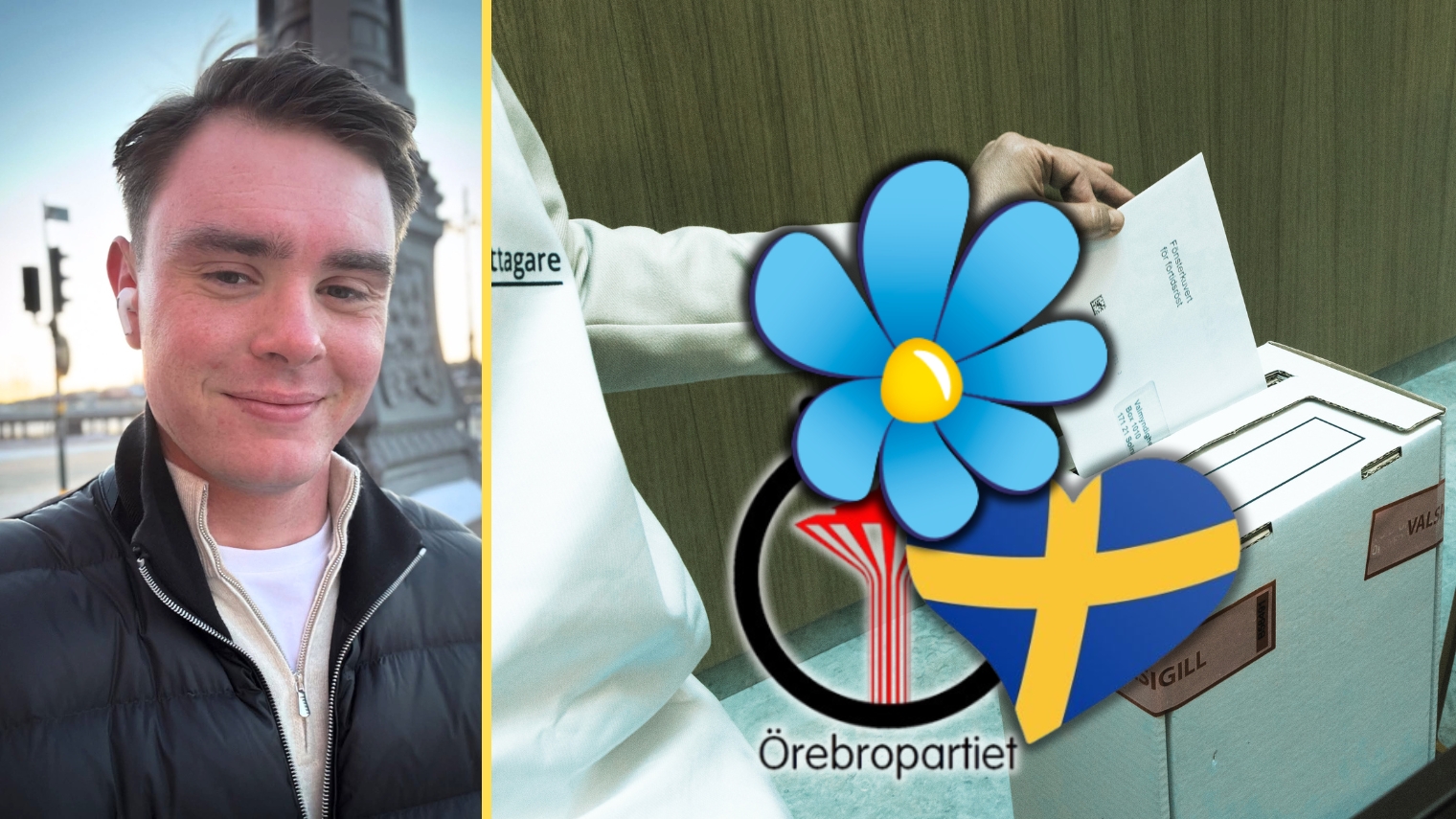
The national conservative citizen journalist Christian Peterson, who has recently gained much attention for his hard work with exposés, confrontations, and above all, a long series of investigations, explains in a longer article how he will cast his vote in Sunday’s election.
Christian Peterson has previously been involved with Alternative for Sweden and ran for parliament for the party in 2022. He then invested heavily in journalism and has now narrowed it down to three parties that many nationalist-minded voters may have considered.
The parties in question are the Sweden Democrats, Alternative for Sweden, and the Örebro Party – three parties that, in several respects, present themselves quite similarly, not least regarding criticism of immigration, but which also differ both politically and strategically.
In his review, Peterson weighs the parties’ strengths and weaknesses against each other. For him, the choice is not just about which party has the most appealing proposals or voices opinions closest to his own, but equally about which party actually has the ability to turn its ideas into practical politics.
As Peterson argues, politics is not only about winning the debate.
For me, the decision isn’t just about who says the right things, but about who actually has the capacity to implement them in reality. After all, politics isn’t about winning debates, but about changing society.

AFS Has Lost Focus
Regarding Alternative for Sweden, Peterson points out that the party which he was once part of is, in many ways, a different political project than what was launched in 2018.
Back then, AFS profiled itself with big and straightforward issues such as mass repatriation, civil servant accountability, flat tax, strengthening the defense forces, welfare reserved for Swedish citizens, and a Swedish withdrawal from the EU. Since then, the political landscape has changed, and several issues that were far outside the mainstream debate have today become much more accepted on the right.
Peterson also agrees that Sweden needs much greater repatriation than mainstream politics has so far been willing to carry out. His criticism of today’s AFS, therefore, is not primarily directed at the party’s basic immigration policy, but at which issues the party chooses to focus its political energy on.
He specifically notes how foreign policy has taken on a much larger role in the party’s profile. Conflicts concerning Israel and Palestine, Iran, Ukraine, and Russia have come to take up considerably more space than before.
This has given the party and its representatives attention in a media environment where politicians outside parliament can reach large audiences through podcasts, YouTube, and other independent media.
But according to Peterson, attention is not the same as political impact. He questions whether focusing on foreign policy conflicts is the right approach for a small party still trying to establish itself in Swedish national politics, especially given the significant issues at home that he believes ought to be prioritized higher. He is also critical of what he perceives as a too pro-Russian stance among parts of the party leadership.
At the same time, he sees a more fundamental problem for AFS. The Sweden Democrats have already gone through the journey that AFS is attempting.
A party is not built by applause. It is built by those who stay when the rally is over.

Örebro Party Has Built from the Ground Up
When Peterson turns to the Örebro Party, his assessment is, on several points, more positive. Unlike AFS, the party has, according to him, managed to build an organization from the ground up by starting locally and then trying to take the next step into national politics.
In Örebro, the focus has been on municipal issues and on scrutinizing how taxpayers’ money is used. Peterson highlights the party’s work in exposing various forms of municipal waste, including art projects, prestige buildings, and political vanity projects that he claims do not always serve the interests of the average citizen.
An important part of the Örebro Party’s success, according to Peterson, is that its representatives have learned municipal politics in detail. Instead of delivering only general criticism of politicians, they have been able to point to concrete decisions, costs, and who ultimately pays. According to Peterson, this makes the criticism harder to dismiss as merely populist rhetoric.
At the same time, he sees a clear limitation now that the Örebro Party is attempting to move up to the national level. Much of the party’s profile has been built on conflict and confrontation, which can be effective when scrutinizing those in power but is much harder to use when the goal is to implement major changes.
For those who want to change Swedish politics, Peterson argues, it’s not enough to be good at exposing those in power. Sooner or later, you also need to be able to negotiate with them.
This means being prepared to compromise with politicians and parties whom you yourself think contributed to the problems you aim to solve.
So being skilled at exposing those in power is not enough. Sooner or later, you need to be able to negotiate with them as well.

SD Already Has the Infrastructure
It is in the comparison with the Sweden Democrats that Peterson’s reasoning about political power becomes the clearest. SD already has the organization that the smaller parties are trying to build. The party sits in parliament, holds municipal seats across the country, and has over a long time created an organizational machine that stretches far beyond the social media platforms where many smaller parties have their largest audiences.
Peterson points out that SD’s path to parliament was, to a large extent, built from the ground up. Local party associations emerged, municipal seats were won, and the party gradually gained experience in the day-to-day work of politics. This means meetings, motions, budgets, recruitment of members, and city councils – activities that rarely generate major headlines, but are nonetheless an important part of building long-term political power.
Regarding migration policy, Peterson notes that SD can still be criticized for not having as strict a policy as he believes is necessary. Nevertheless, he argues it would be wrong to claim that nothing has changed in the current parliamentary term. He points, among other things, to the removal of the ‘track change’ asylum policy and the tightening of conduct requirements, while SD continues to push for further restrictions.
According to Peterson, citizenship is, however, one of the Tidö parties’ bigger immigration policy mistakes. He argues that SD wanted to introduce a moratorium on new citizenships pending stricter rules, but failed to get other parties onboard. For him, this illustrates a broader political reality: even a party with significant influence must be able to relate to other parties and the parliamentary context.
“It’s Not Enough to Be Right”
This is also where Peterson’s overall argument ends up. He describes the Swedish political system as sluggish and argues that there is a lack of a long-term vision for how society should develop. But to be critical of the system is one thing. To actually change it is something else entirely.
Sweden is not governed by the most uncompromising politician winning a debate or by a party dominating social media. Changing laws requires a political majority, and that majority must be able to stick together over time. Therefore, compromises may sometimes be necessary, even when that means accepting things you fundamentally oppose.
Peterson argues that parts of the right risk getting stuck in the opposite – a desire to win every single conflict, even at the cost of losing the bigger political changes. Sticking to one’s principles is not automatically the same as a political strategy, and for those who want to change society, it can sometimes be more important to implement a major change than to win every small battle along the way.
This does not mean opinion-shaping and public education lack significance. On the contrary. But according to Peterson, opinion-shaping must, at some point, be converted into political power. Without seats and majorities in parliament, it is impossible to change the law, no matter how strong public opinion is.
This Is Why the Choice Falls on SD
When Peterson finally weighs the three parties against each other, it is therefore the Sweden Democrats’ established position and the possibility to actually influence policy that becomes decisive. At the same time, he sees several clear points of connection between his journalistic work and the issues SD pursues politically, especially on migration and criticism of Islamism and the extreme left.
He also notes that SD has repeatedly addressed issues that he has investigated as a journalist and then continued them politically. According to Peterson, it’s not about the party supporting him personally, but that both his journalistic work and SD’s political work have often concerned the same issues.
Sweden is not governed by angry posts on X or by the most orthodox right-wing profile getting the last word. It is governed by a majority in parliament. Without that, it does not matter how right one believes oneself to be.
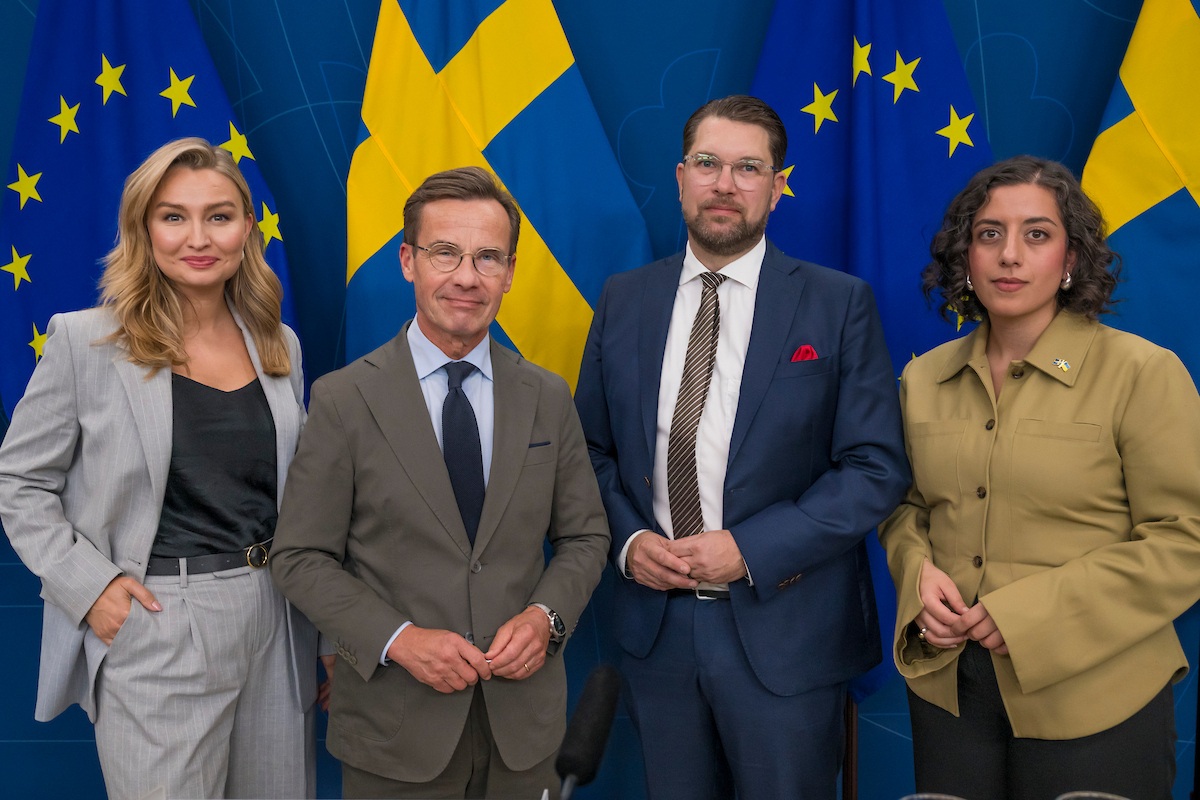
After comparing the Sweden Democrats, Alternative for Sweden, and the Örebro Party, his position is therefore clear. Peterson believes that the party which currently has the greatest opportunity to translate its political direction into real change is the Sweden Democrats.
His vote in the election will therefore go to the Sweden Democrats. Read Christian Peterson’s entire article HERE.
READ ALSO: Ekeroth: “Swedes must mobilize as MENA immigrants do”