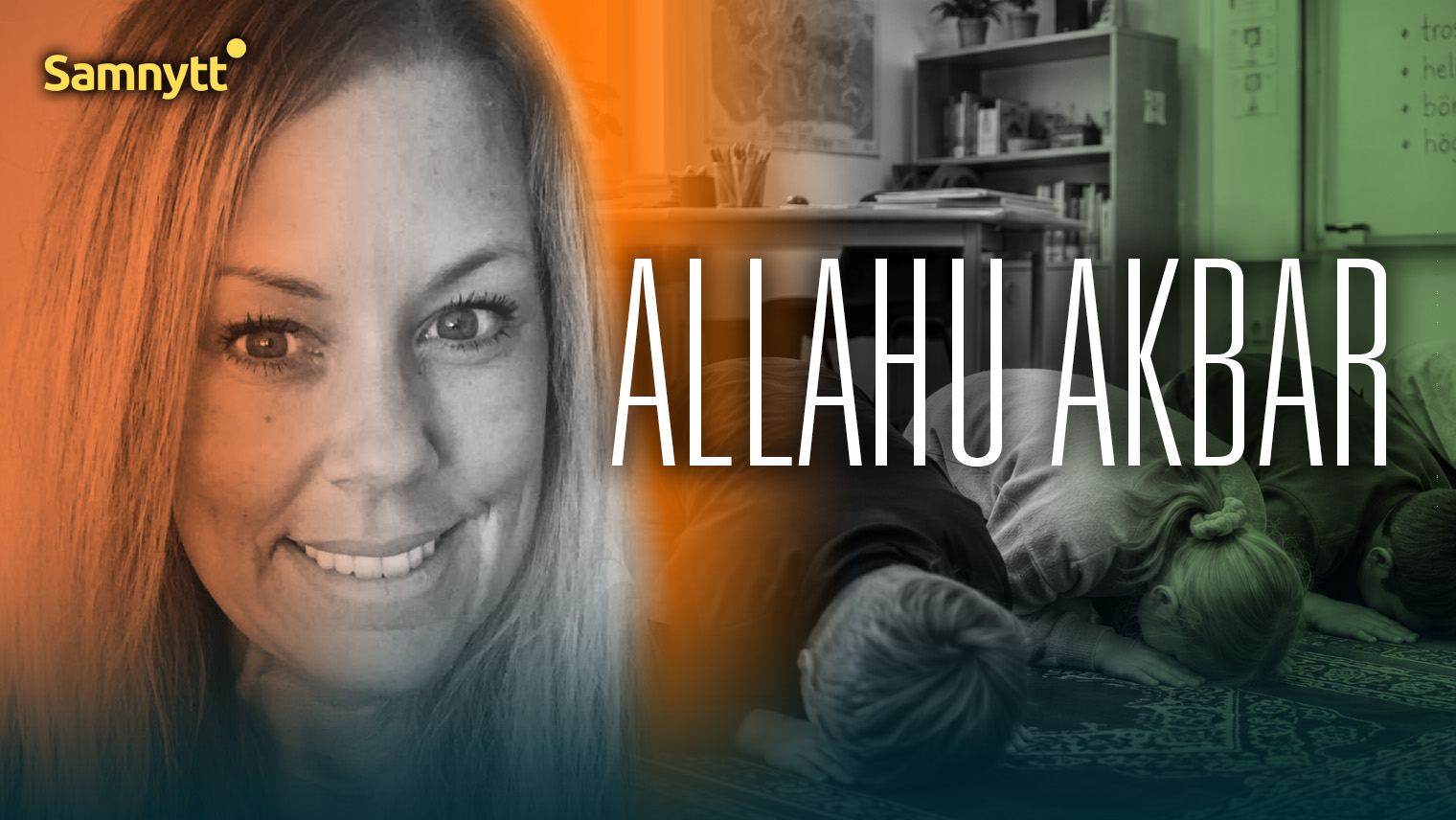
Third-grade students at a municipal school in Höganäs were instructed to line up, walk forward, kneel, and recite an Islamic prayer in Arabic. The school defends the exercise by claiming it had a pedagogical purpose and was voluntary—despite the municipality’s own investigation showing that students were not specifically informed of the option to abstain. Now, an associate professor of constitutional law warns that the children’s freedom of religion may have been affected.
The incident took place during a social studies lesson at Nyhamnsskolan in Höganäs municipality this past spring and has been highlighted by the newspaper Dagen.
According to a parent who later reported the incident to the Swedish Schools Inspectorate, the teacher instructed the third-grade students to stand in two lines. The children were then told to go forward, kneel, and pray to Allah by reciting a prayer in Arabic.
The prayer reportedly included the phrase “Allahu akbar”—“God is greatest.” The parent’s child did not perceive the exercise as voluntary.
The Principal: Pedagogical Purpose
Nyhamnsskolan’s principal, Therése Ahlgren, has defended the setup by stating it was conducted within the framework of religious education.
– It was within the framework of religious education, and with a pedagogical purpose. The intention was only to give students knowledge of how a central religious practice in Islam can be performed, not to influence students’ religious beliefs or conduct any confessional activities, she told Dagen.
Participation was voluntary. But I believe we should have been clearer that it was voluntary // This type of activity will not occur again in teaching, absolutely not.
Therése Ahlgren, Principal, Nyhamnsskolan
According to the Education Act, municipal schools must be non-confessional. When Dagen asked Ahlgren whether it does not become a confessional element when students are asked to conduct Islamic prayer themselves under teacher guidance, she referred among other things to the fact that participation was supposed to be voluntary.
READ ALSO: Police officer Maria Rosander warns of Islamization: “Society is being eaten away from within”
But it is precisely the question of voluntariness that has become central.
Höganäs municipality’s own investigation found that students did not receive “any specific information about the possibility to abstain from participation.” The principal also concedes that the school should have been clearer.
– It was voluntary participation. But I believe we should have been clearer that it was voluntary, she told Dagen.
READ ALSO: Societal shift nobody voted for—the concrete marks of Islamization in Sweden
When the newspaper asked if the same logic could be used for, for example, Christian Communion, the principal replied that the school does not conduct such practices, but that a religious practice could theoretically be demonstrated to students.
The Prayers are Stopped
Although the municipality’s investigation did not find that the school had violated the Education Act’s rules, after the incident the school decided to discontinue this type of exercise.
– This type of element in teaching will not happen again, absolutely not, Ahlgren said.
READ ALSO: Social Democrats pointed out in report on European Islamization
The incident was also reported to the Schools Inspectorate. The authority began investigating in May but closed the case a month later. This does not mean, however, that the Inspectorate has ruled that the school’s actions were in accordance with the law.
It then becomes very strange that a municipal school—where confessional elements are not allowed in either teaching or education—has arranged prayer during lesson time.
Victoria Enkvist, Associate Professor of Constitutional Law and Lecturer
On the contrary, the authority’s investigator Anna Thuröe explicitly told Dagen:
– We do not take a position at all on the matter, as we have found no reason to investigate the information further.
When Dagen asked under what circumstances the Inspectorate would in fact investigate claims that students were encouraged or forced to participate in religious practice during a lesson, the answer was:
– We make an assessment in each individual case.
READ ALSO: Shocking numbers: 4200% increase in mosques in Sweden—in less than 25 years
Law Professor Criticizes the Decision
The Schools Inspectorate’s handling is now being questioned by Victoria Enkvist, associate professor of constitutional law and lecturer in public law at Uppsala University. She points to an obvious paradox in the regulations.
In confessional independent schools, for example, a morning prayer must be kept separate from teaching. Meanwhile, students at a municipal school—where confessional elements are not allowed in either teaching or education—have practiced Islamic prayer right in the middle of a lesson.
READ ALSO: The Tidö government wants to stop foreign funding to mosques in Sweden
– It then becomes very strange that a municipal school—where confessional elements are not allowed in either teaching or education—has arranged prayer during lesson time, Enkvist told Dagen.
At the same time, there is a legal complication.
According to Dagen, the preparatory works for the Education Act state that if the initiative for the prayer comes from an individual teacher and not from the municipality as the principal body, the act does not legally have to be defined as a confessional element within the meaning of the Education Act.
READ ALSO: Extremist group wants to multiply the number of mosques in Sweden—a new one every month
However, Enkvist points to another and potentially much larger question—the students’ constitutionally protected freedom of religion.
Could Be Forced to Reveal Their Belief
This concerns so-called negative religious freedom—protection against having to reveal one’s religious beliefs to authorities, among other things.
READ ALSO: Mass immigration, feminism and chaos—how the Swedish school was crushed
This issue concerns negative religious freedom, which enjoys strong constitutional protection. Swedish authorities are obliged to uphold the rights and freedoms in both the Swedish constitution and the European Convention.
Victoria Enkvist, Associate Professor of Constitutional Law and Lecturer
According to Enkvist, this principle is engaged when a teacher during a class puts a child in the position of either participating in the religious practice or abstaining.
– If a teacher at a municipal school confronts students with the choice to participate or not participate in religious practice during a lesson, there is a risk that they are forced to reveal their religious beliefs, she said.

This protection, according to Enkvist, exists both in the Swedish constitution and in the European Convention, covering both adults and children. This is also why she believes that the Schools Inspectorate should have continued to investigate the matter instead of dismissing it.
READ ALSO: Islamic propaganda in schools—textbooks permitted for 15 years
– This issue concerns negative religious freedom, which enjoys strong constitutional protection. Swedish authorities are obliged to uphold the rights and freedoms in both the Swedish constitution and the European Convention, she said.
The result after the prayer lesson is thus somewhat contradictory.
Höganäs municipality does not believe there is evidence that the school broke the Education Act. The Schools Inspectorate closed the case without making a determination. An associate professor of constitutional law believes the authority should have investigated whether the students’ freedom of religion was affected.
And Nyhamnsskolan itself has decided that this kind of religious practice will not happen again.