
In early May, Samnytt revealed that the Eritrean man employed in home care who was charged with aggravated rape in northern Stockholm was previously a convicted gang criminal who got a job shortly after serving his sentence. In his defense against accusations of raping an 82-year-old woman, the man claimed that he regularly masturbated in the homes of pensioners and that was the reason his semen was found on the elderly woman’s sheets. He has now been convicted—but escapes deportation, despite the court ruling that the conditions for deportation are met.
The verdict is based, among other things, on the pensioner’s detailed account of how the man entered her home by pretending to come from the Solna home care service.
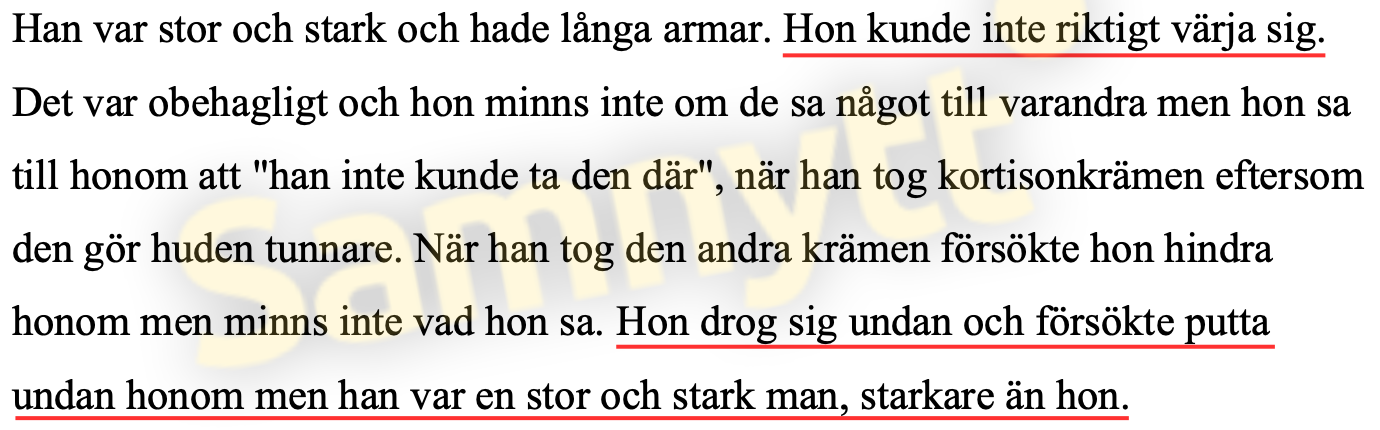
She describes how he undressed her, inserted several fingers into her genitals, used her ointments, and continued despite her attempts to pull away and defend herself.
READ MORE: REVEALED: Gang criminal employed in home care—raped pensioner
She further describes how she tried to push the Eritrean man away, but that he was larger and stronger than her. The district court also notes that the injuries documented are consistent with her statement about penetration with fingers.
The District Court Does Not Consider the Crime to be Aggravated
However, Solna District Court chose not to convict the man of aggravated rape, which chief prosecutor Anders Hirsch requested. The court notes that the act was directed at an elderly person in poor health, that it was preceded by some planning, and that Robel used his employment with the home care service to find the woman.
But the court still considers that the Eritrean man’s sexual assault on the woman is not enough for the crime to be classified as aggravated. At the same time, the court emphasizes that these very factors should increase the severity of the penalty, which is why any consequence other than imprisonment is out of the question.
The District Court has thereby, as stated above, considered the circumstances of the act and, as aggravating, particularly that the act was preceded by certain planning and was directed at a physically weak and elderly person. There is no reason to consider that Robel Ghidey’s loss of employment because of his conviction for the act should affect sentencing, since he used his job to commit the crime. With such a high level of severity, no consequence other than imprisonment can come into question.
Solna District Court
Court: Grounds for Deportation Met—But Still Not Deported
Perhaps the most striking part of the verdict from Solna District Court concerns the issue of deportation.
The prosecutor had requested that Robel be deported to his home country and banned from returning to Sweden. Solna District Court further determined that the conditions for deportation are indeed met.
The court notes that the rape is a serious crime, that the Eritrean has previously been convicted of other serious crimes, and that there is a clear risk of continued criminality. According to the court, these circumstances “strongly” speak in favor of deportation.
The crime for which Robel Ghidey is convicted is serious and the severity of the penalty is
comparatively high. Robel Ghidey has also previously been convicted of relatively serious crimes of another kind. There is a clear risk of continued criminality. These circumstances argue strongly for deportation.Solna District Court
But despite the court itself finding that the conditions for deportation are met, he is allowed to stay in Sweden.
READ MORE: Home care in the new Sweden: Nighttime sexual assaults and “haram” to drink low-alcohol beer
The reason is that the court takes into account his connection to the country. The judgment emphasizes that he has lived in Sweden since at least 2007, attended Swedish school, speaks fluent Swedish, has parents and siblings here, and that he has had “work” in recent years.
The court describes this as a “fairly strong connection to Sweden.” In addition, it states that he has weak ties to Eritrea and cannot travel there without risk.
Robel Ghidey is today 30 years old and has been in Sweden at least since 2007. He completed his schooling up to and including upper secondary school here and speaks fluent Swedish. He has parents and siblings here. He has had some sort of housing but not his own. He has worked in recent years. These circumstances mean that Robel Ghidey has a fairly strong connection to Sweden, which speaks against deportation.
Solna District Court
The conclusion is therefore that deportation is deemed not proportionate, despite the rape conviction, previous gang-related crime, and the risk of recidivism identified by the court itself.
READ MORE: Home care Afghan robbed 96-year-old woman in bed – cannot be deported
The result is that Robel Efrem Ghidey, now convicted of raping an 82-year-old woman in her own home, receives four years in prison—but after serving his sentence, he will not be deported from Sweden. Instead, he will once again walk free on the country’s streets and squares.
Prosecutor: “It Was the Job that Allowed Him To…”
Samnytt has spoken to chief prosecutor Anders Hirsch about his view of the verdict allowing the Eritrean to remain in Sweden.
Even though the district court itself notes that the act was directed at an elderly person with impaired health, and the plaintiff herself has said in questioning that she could not defend herself, this is still not enough for the classification of aggravated rape. How do you see this?
– Of course, I have respect for Solna District Court, but I make a different assessment; but whether it is enough for me to appeal, I am not quite sure yet.
Hirsch continues by stating that for the rape provision, the low age of the victim (15–17 years) justifies classification as aggravated rape, but the legislation does not currently include old age as a basis for such classification.
READ MORE: Home care Syrian swindled 108-year-old out of savings—escaped detention and fled the country
However, he points out that the commentary to the provision states that if the victim is an invalid or otherwise helpless person, it is often considered that the perpetrator has shown particular cruelty, something Hirsch raised in his description of the crime.

The court points out that he has spent a long time in Sweden and has previously been convicted of serious crimes, and even believes that the criteria for deportation are met, but still considers it is not enough to deport him. What do you think about this?
– That is, of course, a correct description, but then you also have to make a proportionality assessment, even if the criteria are met, and that is what the district court has done, says Anders Hirsch, and continues:
– But I still believe that the crime is so serious that it should still lead to deportation, that is, that it would not be disproportionate to expel him, that is my view.
Anders Hirsch then reflects on the court’s reasoning for rejecting the deportation request, namely that Robel had work in recent years, and says the following.
– In that regard, I would note that it was the job that made it possible for him to commit this act, which I found rather remarkable.
The prosecutor has not yet decided whether he will appeal the verdict to the Court of Appeal.
123 083 33 50