
In the autumn of 2024, a 52-year-old man met a woman in her 30s via Tinder. A few months later, he was arrested at his workplace, charged with rape and assault, and subsequently sentenced to four years in prison. The Court of Appeal has now upheld the verdict. The man’s mother, whom Samnytt refers to as “Eva,” claims her son was convicted in a case where there was no technical evidence and the courts chose to believe the woman’s story despite several circumstances that, according to the family, should have raised questions. Samnytt has reviewed the verdicts.
When the police arrived at her son’s workplace at the beginning of 2025, Eva initially thought it must be a misunderstanding.
A few months earlier, her son had told her he’d met a woman through Tinder. He was recently separated from a long marriage, had three adult daughters, and was looking forward to a fresh start in life.
– He really liked her. But from the beginning, I reacted to so many strange stories, she tells Samnytt.
According to the mother, the woman talked about houses in Poland and on Orust that she would be selling, about substantial assets, and various projects.
– I told him several times that something didn’t feel right. I told him to be careful. But he liked her and continued to see her.
“He Wanted to Help Her”
The relationship continued through autumn 2024. According to the mother, the woman later revealed she was actually working as a prostitute and wanted to leave that environment.
– She said she needed help getting out of it. My son is the kind of person who wants to help people. He believed her.
Similar statements appear in the verdict, where the man’s account is cited. He claims the woman told him she worked extra as a prostitute and also sold drugs.
READ ALSO: “Sweden Will Be Ashamed of This” – Mannaminne Demands New Review Commission
The mother describes the relationship as turbulent.
– There was a lot of alcohol, a lot of drama and a lot of fighting. But they still kept seeing each other.
Eventually, her son, who according to the verdict has no prior convictions, decided to end the relationship.
– I think his daughters also started telling him this wasn’t good. He eventually realized that he had to break up.
“Do You Hate Me? – You Will”
One episode is etched in the mother’s memory. When, according to her, the woman returned a key to her son’s home, she asked a peculiar question.
READ ALSO: “Negligent Rape” After Tinder Date – Court of Appeal Upholds 54-Month Sentence
– She asked him: “Do you hate me?” He replied, no, he didn’t. Then she said: “You will.”
It was only later that the family learned the woman had already reported the man for rape and assault.
There was no technical evidence. No videos, no recordings, no DNA showing a crime had been committed. It was her word against his.
Mother “Eva”
– When we found out, we were shocked. We couldn’t understand how that fit with the fact that they kept seeing each other.
The verdict also states that the relationship continued after several of the incidents that later formed the basis for the charges. But in January 2025, police arrived at the man’s workplace.
– He worked as a salesperson and had just started looking forward to the future again. Then the police came and picked him up, the mother tells Samnytt, and continues:
– We thought he would end up acquitted. They’d had a relationship over time. We thought that once he shared his side, everything would make sense.
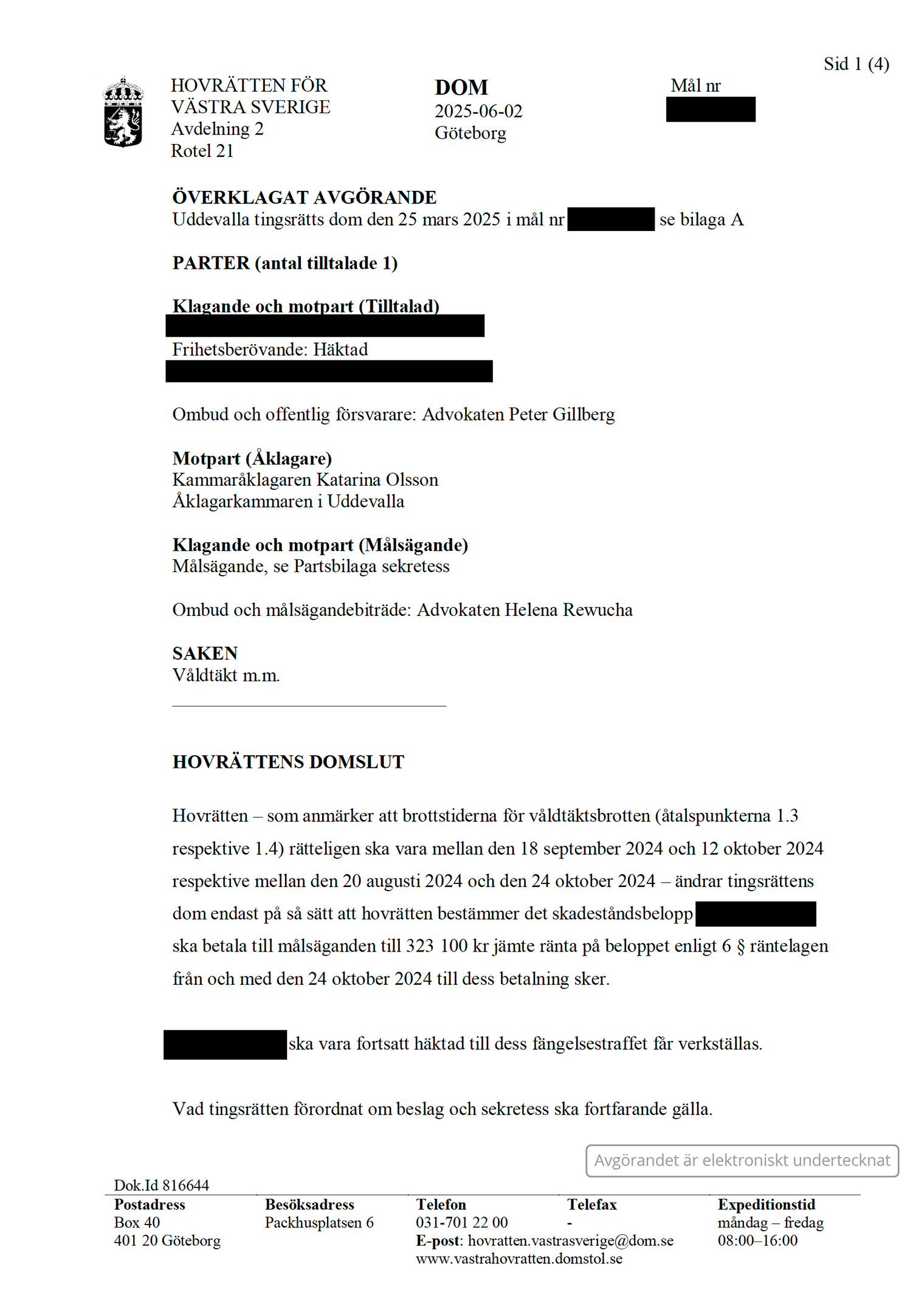
But that was not the case. In March of last year, the man was sentenced by Uddevalla District Court for two rapes and one assault to four years in prison. The verdict was upheld last summer by the Court of Appeal for Western Sweden.
123 083 33 50
No Technical Evidence
The man has always denied the charges. He has admitted to having had intercourse but insisted it was consensual. According to his mother, this is what makes the verdict so hard to accept.
– There was no technical evidence. No videos, no recordings, no DNA showing a crime had been committed. It was her word against his.
No technical evidence directly supporting the rape allegations is presented in the judgments either. The man has consistently admitted to the sexual encounters, but claimed they were consensual.
The central dispute has therefore been about how the intercourse occurred and whether or not the woman participated voluntarily. In both the district court and the court of appeal, the question of guilt was mainly determined by the courts’ assessment of the parties’ stories, together with certain supporting evidence in the form of medical records, phone calls, and witness statements from people the woman confided in after the incidents.
The court of appeal writes that the woman’s story was coherent, detailed, and logical, and appeared based on her own experience in its central parts. The court therefore chose to base its judgment on her account.
READ ALSO: Police: In Sweden, You Are Guilty Until Proven Innocent
In addition to the prison sentence, the man was ordered to pay just over 323,000 kronor in damages to the woman. The amount comprises compensation for violation and for pain and suffering, as determined by the court of appeal when the verdict was upheld.
The issue of damages in sexual crime cases has in recent years become a topic of debate. Critics argue that the state has created a system where very large compensations can be awarded even in cases mainly decided by courts’ credibility judgments rather than technical evidence.
Samnytt has previously highlighted how damages in such cases have risen sharply in recent decades. In combination with the lack of technical evidence in many cases, the development has led some lawyers and legal security commentators to call for a broader discussion about the economic incentives that may arise when very large compensation amounts are at stake.
Statements About “Client” and Lies
During the legal process, the man raised several objections about the woman’s credibility. The verdict notes his account that the woman said she worked as a prostitute and had contact with various clients.
In connection with one of the incidents later tried in court, the man stated that the woman had visited a person earlier that same evening whom he described as a “client.”
He says about two guys a day come in who are convicted of these kinds of crimes. Most are Swedish men. It’s the same story again and again – word against word, and long prison sentences.
Mother “Eva”
The courts considered the information, but did not find it changed the assessment of guilt.
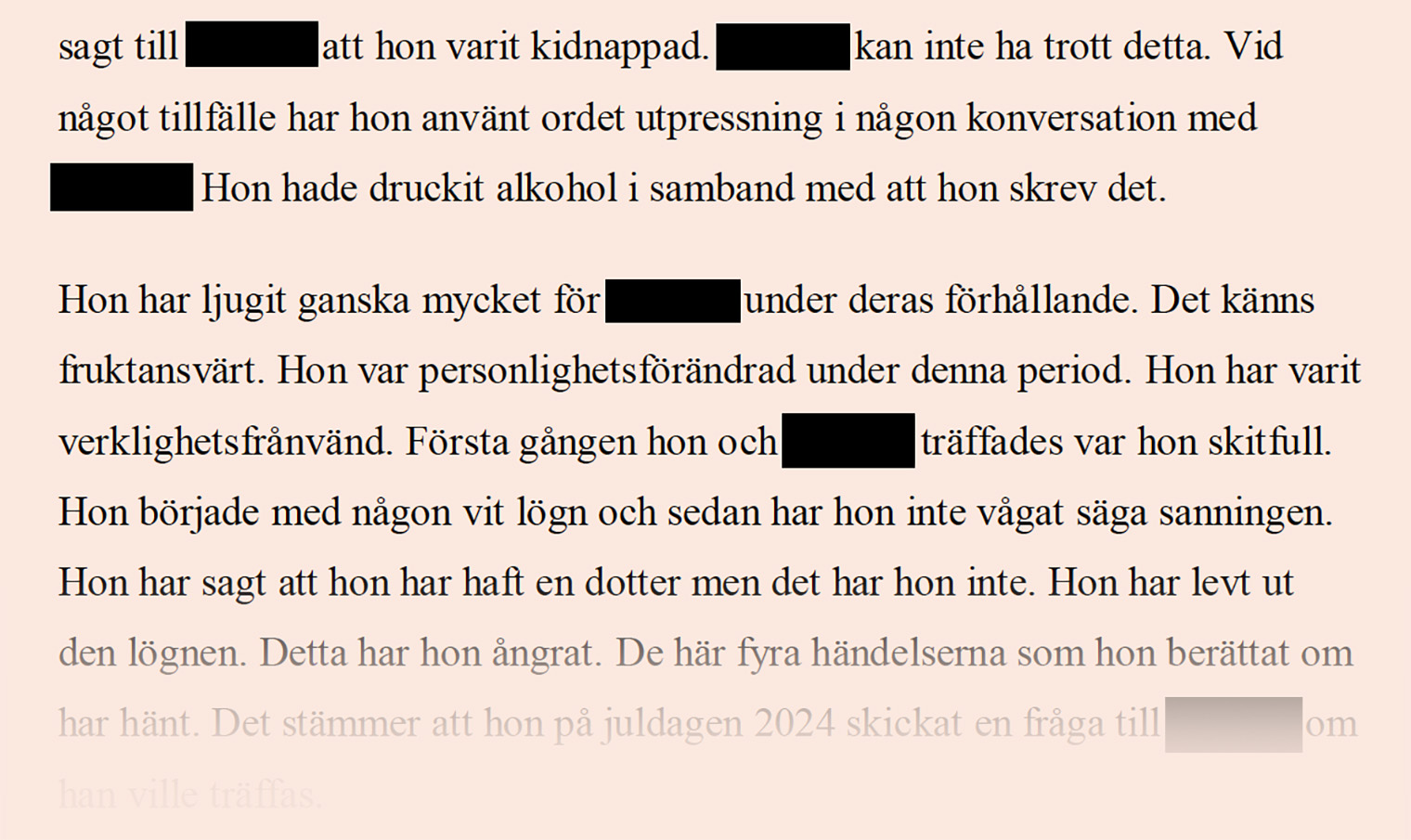
The grounds of the verdict also note that the woman herself has admitted giving false information about several parts of her private life. Despite this, both the district court and the court of appeal found her account of the alleged assaults to be credible enough for a conviction.
The mother struggled to understand this.
– If someone has lied about so much else, why aren’t more questions asked? she says.
READ ALSO: The Court Believes – and Your Future is Lost
The family sought help from a relative who had previously worked as a prosecutor.
– He read the material and said he would have closed such a case. That made us even more convinced that this would end differently.
READ ALSO: Wanted to Teach the Man a Lesson and Accused Him of Rape – Now the Woman Is Convicted
After the district court ruling, a new defense attorney was hired for the appeal.
But even there, the defense had no success. The court of appeal upheld the district court ruling in all essential parts.
According to the mother, her son has also gained a new perspective on how common these types of cases are. He tells her there are regularly new inmates with similar backgrounds.
He says regularly, but how common does he think it is?
– He says about two men a day come in who are convicted for these kinds of offenses. Most are Swedish men. It’s the same story again and again – word against word, and long prison sentences.
At first, I thought we were alone. Then I discovered that there are many other mothers who tell almost exactly the same story. Something has to change. It cannot be possible to convict people to several years in prison like this. Not when so much depends on whom the court chooses to believe.
Mother “Eva”
Those who were previously in with him have already been released and replaced by new ones, she says.
READ ALSO: She Claimed She Was Pulled into a Toilet and Raped – Now the 16-Year-Old Girl Is Convicted Herself
The figures are based on the convicted man’s own experiences at the institution and cannot be verified by Samnytt. However, we have reported on similar cases previously.
For the mother, the stories have reinforced the impression that her son’s case is not unique, but part of a larger problem that she believes the justice system must dare to discuss.
“He Has Lost Everything”
Today, the man is serving his sentence at a facility in central Sweden. The mother describes the consequences as devastating.
How is your son today?
– He has lost his job. He’s lost the farm. The enforcement authority has been there. He has lost everything.
At the same time, she tries to keep her spirits up.
– He tries to do something meaningful with the time. He works, plays guitar, goes to yoga, and sings in a choir. But it doesn’t change what has happened.
She says that in the past year, she’s come into contact with several other families in similar situations.
– At first, I thought we were alone. Then I discovered that there are many other mothers who tell almost exactly the same story.
She hopes her son’s case will one day be reviewed again.
– Something has to change. It cannot be possible to convict people to several years in prison like this. Not when so much depends on whom the court chooses to believe.
READ ALSO: The Mannaminne Network Leads Protests Against the Collapse of the Rule of Law
About the article
In this case, Samnytt does not take a stand on whether the convicted man is guilty or innocent. That issue has been tried by two court instances, both concluding the charges were substantiated.
What makes the case journalistically interesting is instead another question – how legal security is affected when decisions are to a great extent based on the courts’ assessment of who appears more credible.
When technical evidence is missing and the question of guilt is ultimately decided through subjective credibility evaluations, a gray zone inevitably arises where different judges can reach different conclusions on the same material.
Regardless of how one sees this verdict, it is a discussion worth having – not least when the consequences mean a person loses their freedom, livelihood, home, reputation, and several years of their life.
In such cases, the courts’ evaluation of evidence must also withstand open and uncompromising scrutiny.
123 083 33 50