One in five immigrants now comes from the Indian subcontinent, while people from African countries make up a smaller proportion. At the same time, according to reports occasionally cited, it is stated that about 70–80 percent of marriages in Pakistan are between relatives.
Until a few years ago, the Swedish Migration Agency published detailed statistics on immigration from all non-EU/EEA countries on its website. In recent years, however, the extent of this reporting has decreased, which critics say makes transparency and the ability to analyze migration patterns more difficult.
Nevertheless, Samnytt has managed to get the agency to share some information about the 30 largest immigrant countries outside the EU/EEA in 2025. If there are fewer than six people in a category in the table below, the Migration Agency has replaced the actual figure with an asterisk.
Note that in the Migration Agency’s non-country-divided statistics, residence permits are divided into 33 categories. We have only received data on five main categories.
Asia Dominates Immigration
Among the ten largest immigrant countries in 2025, eight were Asian if Turkey is counted as an Asian country. From the Indian subcontinent—which includes India, Pakistan, Bangladesh, Sri Lanka, and Nepal—17,649 immigrants came, according to the table, corresponding to about 19.8 percent of total immigration from countries outside the EU/EEA.
READ ALSO: EU in agreement with Bangladesh – opens up for more immigration
At the same time, we see that only four of the 30 largest immigrant countries—Nigeria, Eritrea, Congo, and Egypt—were African. From these four countries, 4,277 people came, accounting for about 5.6 percent of the immigrants from the 30 countries in the table.
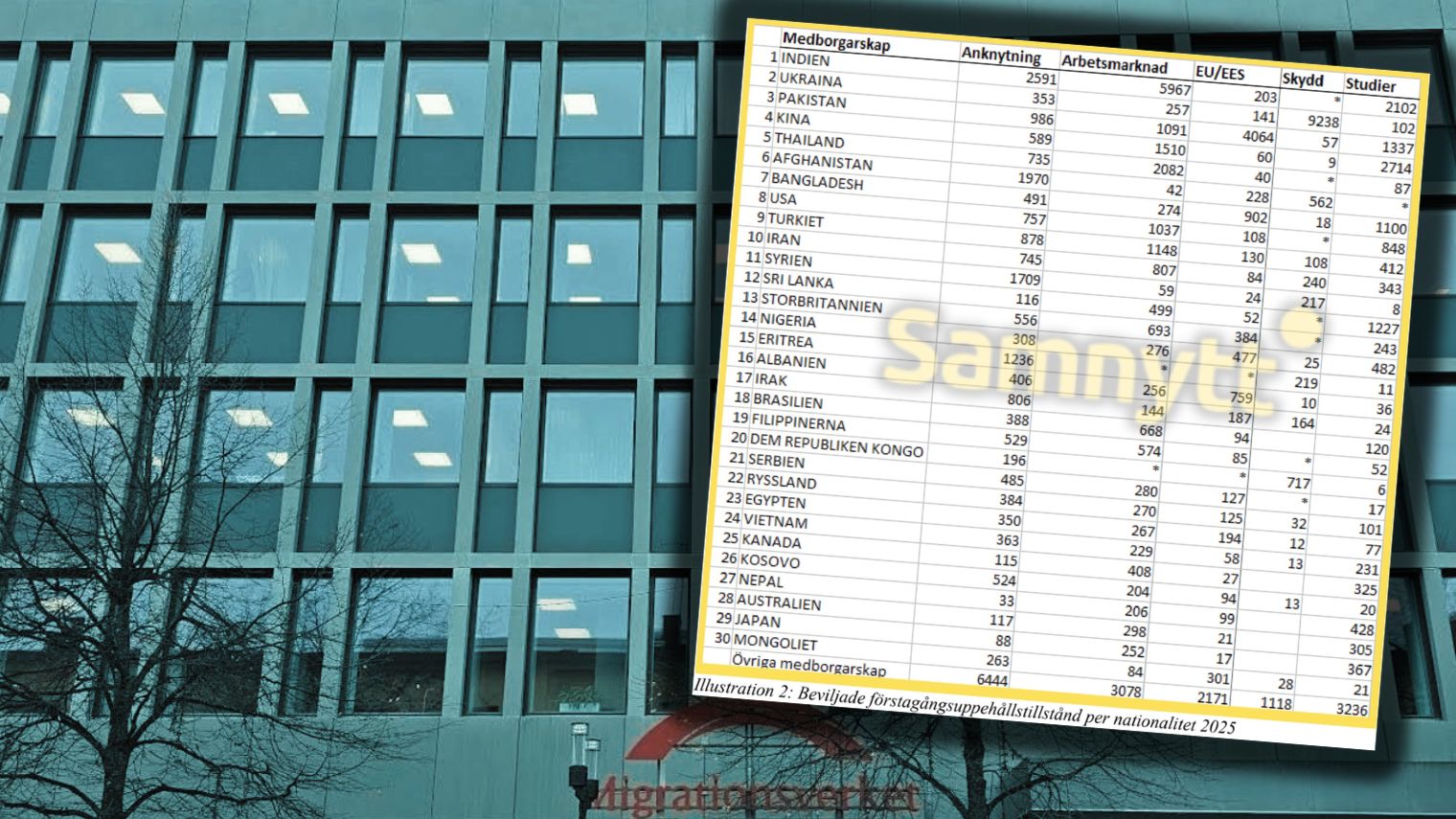
In total, the Migration Agency states that 88,938 first-time residence permits were issued to people from countries outside the EU/EEA in 2025. Note that persons from the EU/EEA can move to Sweden without the Migration Agency needing to issue a residence permit and are therefore not included in these statistics.
123 083 33 50
The proportion of family reunification immigrants is actually higher than the statistics above show. The Migration Agency’s website states that 8,374 out of 22,958 who in 2025 received residence permits under the category “Labour market” actually received residence permits as relatives of labor immigrants.
Of a total of 16,382 people registered under the category “Studies,” 3,214 were allowed to come as relatives of students.
Pakistani Consanguineous Marriages?
One group that stands out in the statistics is Pakistanis. As shown in the table, 986 Pakistanis were classified as immigrants via “connection” (family reunification), and as many as 4,086 people as immigrants in the “EU/EEA” category. The Migration Agency’s website explains that the majority of individuals in the “EU/EEA” category consist of family immigrants to people from outside Europe with a residence permit in another EU country.
READ ALSO: Risks of cousins having children still taboo in Sweden
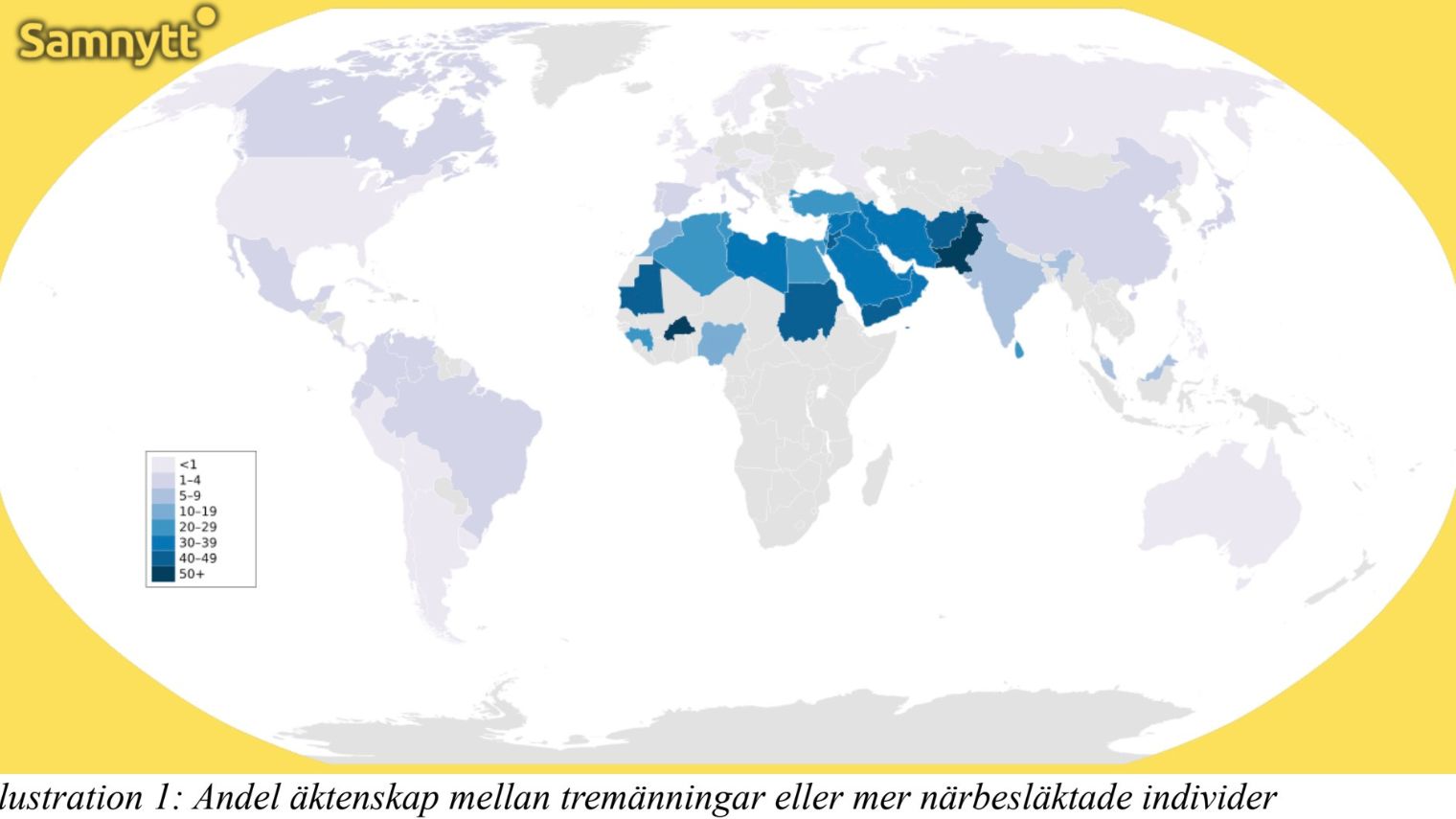
Pakistanis are often pointed out as the world’s most inbred people, and the fact that Pakistani family-related immigration to Sweden is so significant may make Pakistani inbreeding a real problem in Sweden.
READ ALSO: Hijab-wearing woman married to cousin criticizes ban on cousin marriages: “Racist”
The newspaper Sjukhusläkaren estimated in 2020 that about 70 percent of all Pakistani marriages were consanguineous marriages between relatives. Pakistani studies suggest that up to 82 percent of all marriages in Pakistan may be between relatives.
The Swedish system of personal assistance benefits can make it lucrative for Pakistanis with children with genetic disorders to seek out Sweden. Several relatives can then support themselves as assistants to these children. It is also possible to ensure that more relatives migrate as workers, acting as assistants to such children.
The Tidö government has introduced new legislation against cousin marriages that may to some extent stop Pakistanis from bringing relatives to enter into marriage. Since the proposition does not mention anything about DNA testing, despite the new legislation it may in practice be difficult to prevent such marriages unless the parties themselves state that they are related.
READ ALSO: Former Northvolt manager talks about trade with employees: “Someone tried to sell five Indians”
123 083 33 50