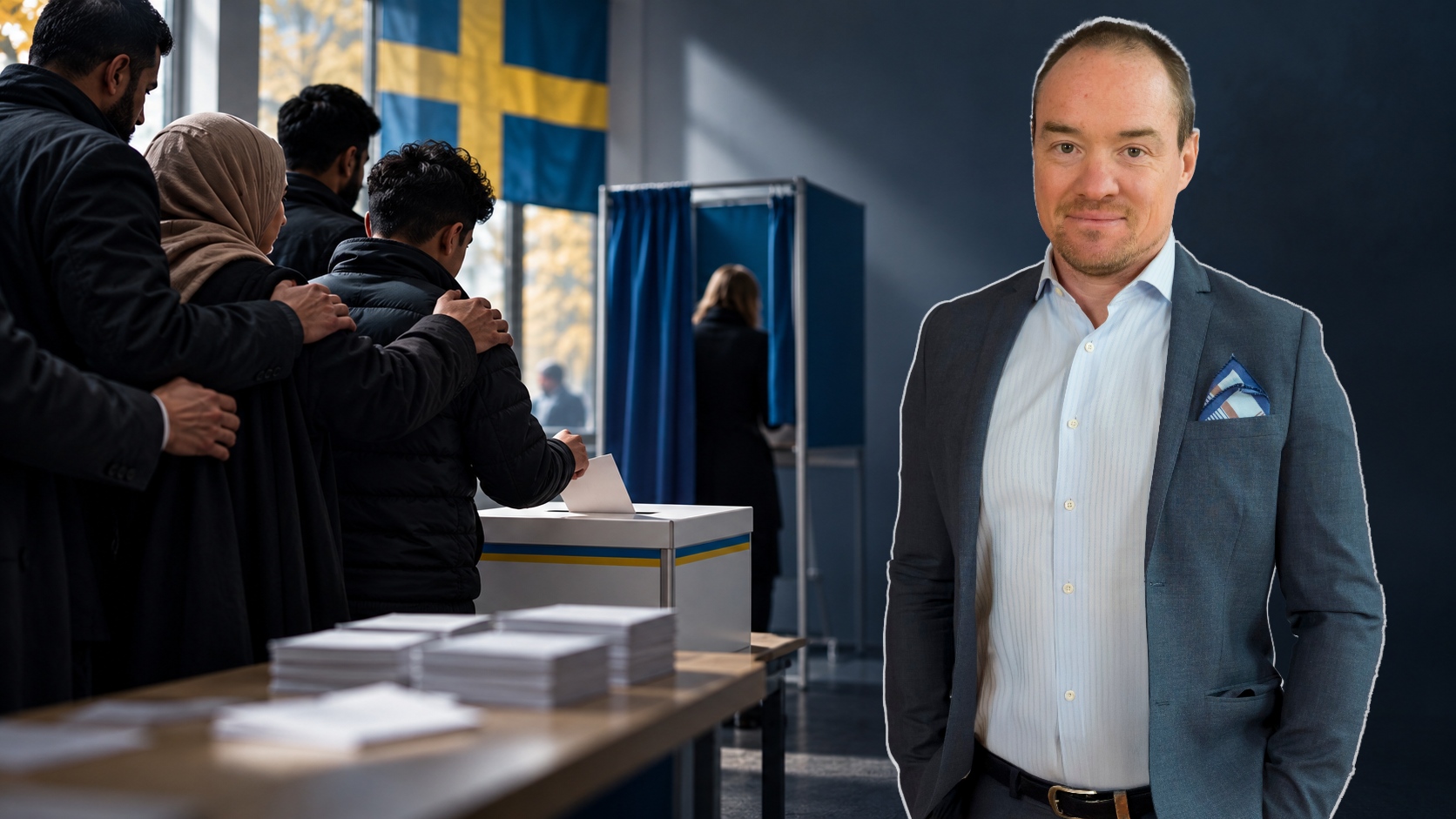
LEADER • This really shouldn’t need to be said. The Swedish electoral system, like almost everything else in this bureaucracy, was built for Swedes. It works among people with roughly the same culture, the same sense of shame, the same habit of not exploiting every loophole. It doesn’t work when you import large numbers from clan-based societies and then pretend that the personal vote is an individual act. Therefore, the system needs to be revised.
The institutions developed in a country that looked radically different. For a long time, Sweden relied on something both valuable and internationally unusual: high trust. It was assumed that others followed the rules, kept their word, and did not systematically try to game the system. This made the country simple. Bank account, subscriptions, dealings with authorities—often a personal number and a phone call were enough.
I lived in Australia just over twenty years ago and remember thinking that their paperwork, identity checks, and bureaucratic runarounds were idiotic. Compared to Sweden, it was a nightmare to start an electricity or internet subscription. The reason was that Sweden was a high-trust society, as I have since understood.
Clear research
This is also how political scientists Bo Rothstein and Sören Holmberg have described Sweden. Their research at the University of Gothenburg shows that interpersonal trust acts as social capital, making cooperation less costly and reducing the need for control. Sweden still ranks high, although the trend is going in the wrong direction. This trust determines whether people accept taxes, welfare, and decisions that go against them. Rothstein particularly points to impartial institutions.
Corruption, nepotism, and clientelism are the opposite of what Sweden tried to be. But such negative norms are not changed by a Swedish residence permit. Instead, they are imported.
There is also a statistical correlation between ethnic heterogeneity and social trust. A meta-study in the Annual Review of Political Science compiled 1,001 estimates from 87 studies and found a significant negative correlation between ethnic diversity and social trust, especially when diversity was measured locally and the trust pertained to the immediate area. Ethnicity is not the only explanation—economics, segregation, and institutions also matter—but the notion that it’s possible to change a country’s demographics in a short time without affecting social conditions is, to put it mildly, naive.
Swedish data shows the same thing. Statistics Sweden’s civic survey shows that foreign-born individuals report trusting people in general to a lesser extent than those born in Sweden. The difference is greater among those born outside Europe compared to those born in Europe. Guess what happens to institutions built for one group when you fill them with the other.
Sweden is still asleep
When I pointed out exactly what this is about—a voting cattle—in an SR interview on election night, all hell broke loose. Naive little Sweden was forced by the Sweden Democrats and by reality to realize that immigration volumes were too high. That took a long time to recognize. But the reaction when we start talking about demography is the same as in 2010, just as anxious as back then.
READ ALSO: Ekeroth: ‘The establishment is just as anxious as in 2010’
Once again, however, the establishment woke up to clan voting. Samnytt has reported on clan voting for many years. But in this year’s election, the debate became public. Of course, the usual left-liberals began to defend or excuse what had happened. The “Batix witches” try to welcome it, like this social democratic lady selling out her own country to foreign people:
Treason is the word that comes closest to mind and she is not alone in this.
The personal vote must be changed
The government inquiry on parallel social structures, SOU 2026:53, describes environments with collectivist and patriarchal norms, low trust, and lack of acceptance for the social contract. It also describes how family-based structures affect integration and democracy. The Swedish National Council for Crime Prevention (Brå) has studied how criminal and other system-threatening groups try to influence municipal administrations, elected officials, and parties. Sweden has already seen this in welfare, the legal system, and public agencies, for example the Migration Agency.
READ ALSO: Inside the Migration Agency: Clans, Swedes in the Minority and a Culture of Silence
The personal vote is the same problem. The Swedish system is fundamentally a party vote but personal votes can still reorder the lists. In parliament, five percent of the party’s votes in the constituency are enough. For municipalities and regions, the same five percent applies, with a minimum of 50 and 100 personal votes respectively. Whoever passes the threshold jumps ahead of those ranked higher by the party itself. The idea is sympathetic if the voter is an individual but deeply naive if the voter is a clan or ethnic group.
Mohamed Abdukardir Ali is the most talked-about in this year’s election, but by far not the only one, as you could see in the clip above. This is bigger than just the crime itself.
The idea is that people voluntarily vote for the same candidate, which is what the personal vote system is for. A popular local politician can achieve this after years of work. The problem arises in environments where voting is collective, where family heads, religious leaders, and association chairs can deliver a voting bloc. Even worse is when this ‘bloc’ comes from outside, with no Swedish values, no Swedish ties, or not even born in the country.
Few Swedish voters vote for individual candidates at all. A small, well-organized group thus gets an influence out of proportion to their numbers.
This should be done
First, the law should be changed so that only Swedish citizens can stand for election. Second, there should be a requirement that the candidate was born in Sweden.
With very strict citizenship requirements, this would mean that children of well-adapted and assimilated immigrants could stand for election. I think few people would have objections to that arrangement. Then it would be about a couple of parents immigrating here and getting approved for citizenship after strict criteria. They would then have learned Swedish, assimilated, supported themselves, and have no serious complaints against them.
These well-adjusted immigrants have children who then have their citizenship by birth and are born in Sweden. Of course, certain exceptions should be possible, such as if Pelle and Lisa lived abroad for a year and had their Swedish child there. But in general, rule changes as I’ve described above would make a big difference.
But of course that doesn’t solve everything. Clan voting can occur even with seemingly assimilated immigrants, if they choose to appeal to the ethnicity of their background, but it would drastically reduce the risk.
Ultimately, the only real guarantee to avoid this is large-scale remigration of clan cultures. Unfortunately, even that discussion is too sensitive for this poor and naive country.