For several years, Sweden has absorbed more greenhouse gases than it emits. At the same time, the Swedish Environmental Protection Agency (EPA) asserts that Sweden is on track to miss both national climate targets and several of the EU’s climate commitments. Critics argue the agency’s reporting risks giving a misleading picture, as the large Swedish carbon sink in forests and land is not reported alongside the country’s emissions.
The EPA announced on Wednesday that Sweden’s climate emissions decreased by three percent in 2025 compared to the previous year. Preliminary emissions totaled 46.7 million tons of carbon dioxide equivalents, a reduction of 1.3 million tons.
The largest decrease occurred in domestic transport, where a higher blend of biofuels and continued electrification contributed to lower emissions. Emissions also fell in industry, industrial machinery, and the electricity and district heating sectors.
ALSO READ: EU’s new climate targets questioned – cheating flexibility and unrealistic ambitions
Despite this, the EPA concludes that Sweden is moving further away from the climate goals decided by parliament and the EU.
– The conclusion in this year’s climate reporting is that the current policies are insufficient and that further measures are needed to achieve the climate targets, says Stefan Nyström, head of the EPA’s climate and air division, in a statement on the agency’s website.
Sweden absorbs more carbon dioxide than it emits
The EPA’s press release focuses on territorial emissions, but does not mention that Sweden at the same time has a very large carbon sink in forests and other land.
ALSO READ: Sweden’s climate footprint negative – again
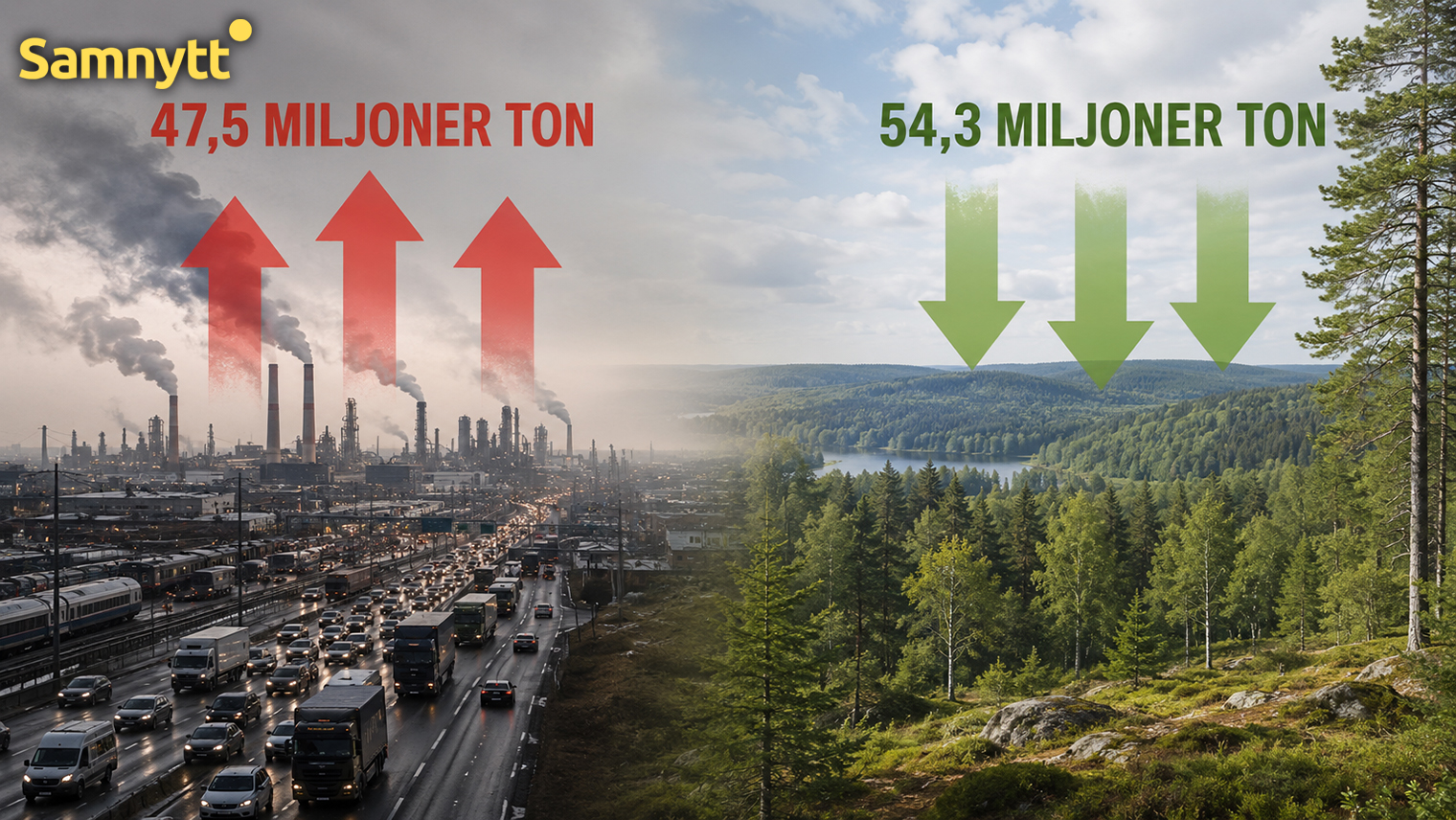
According to the EPA’s own statistics, net sequestration of greenhouse gases in forests and other land amounted to 54.3 million tons of carbon dioxide equivalents in 2024. That same year, Sweden’s emissions totaled 47.5 million tons. This means that Sweden as a whole absorbed about 6.8 million tons more greenhouse gases than it emitted.
The industry organization Skogsindustrierna noted after the release of the statistics that Sweden is therefore climate neutral, or even climate positive.
– The EPA’s new statistics show that Sweden is climate neutral. Carbon sequestration is actually slightly higher than emissions, said Skogsindustrierna’s CEO, Viveka Beckeman, in a comment to Lantbruksnytt.
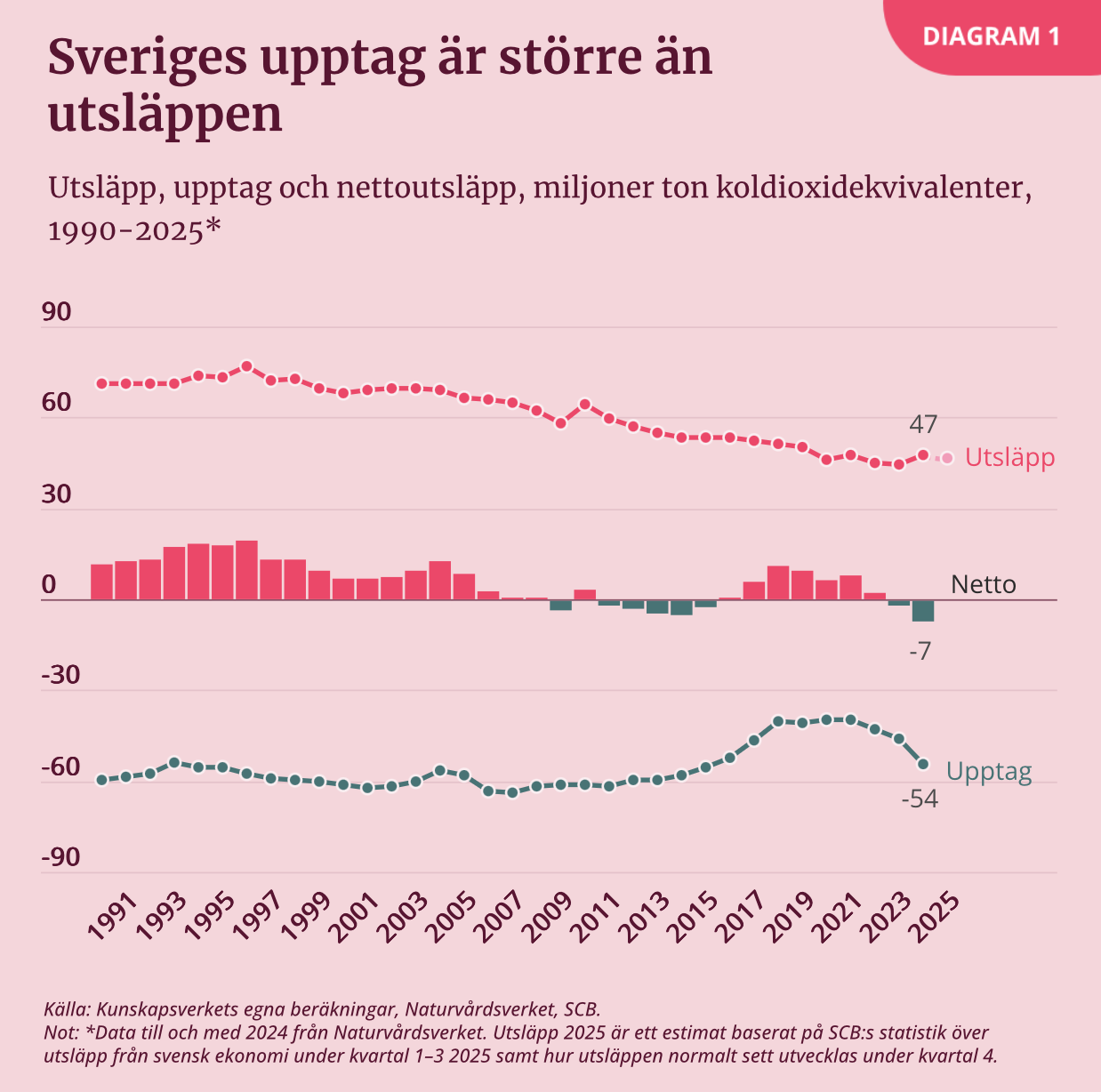
If the trend from 2024 continues into 2025, and emissions have decreased by several more percent, the latest numbers mean Sweden’s net balance of several million tons below zero has improved even further.
EU regulations paint a different picture
The assessment that Sweden will miss its climate targets despite this is due to how the targets are constructed. The EPA assesses that Sweden will not fulfill its obligations under the EU Effort Sharing Regulation (ESR).
The regulation measures emissions from, among others, transport, agriculture, and machinery, but treats forest carbon sequestration in a separate system. The agency calculates that by 2030, Sweden will face a cumulative shortfall of 13.1 million tons compared to ESR requirements.
ALSO READ: DN exposed again for misleading climate journalism
At the same time, the EPA states that the outlook for Sweden’s EU land-use commitments has improved through reduced logging and higher forest growth, which increases carbon uptake.
Criticism of how emissions are reported
Critics argue that public debate almost always excludes the total climate balance and instead focuses on emissions figures in isolation.
A previous analysis noted that Sweden already had negative net emissions in 2024, meaning greenhouse gas uptake exceeded emissions. At the same time, Sweden remains one of the EU countries with the lowest emissions per capita, even without considering uptake.
The question, then, is why the EPA does not more clearly report the overall net balance when communicating developments.
EPA: “That’s not how the target is formulated”
Samnytt contacted the EPA’s climate unit to ask why the carbon sink is not reported together with emissions when the agency assesses Sweden’s climate targets. Case worker Anna Forsgren refers to how the parliament has shaped the goals.
Sweden absorbs more greenhouse gases than it emits. Why is this not clear when you state that the climate targets are not being met?
– What we have assessed in the climate report are the goals decided by parliament. And the net zero target does not include uptake in forests and land.
But if emissions and uptake cancel each other out, hasn’t net zero mathematically been reached?
– Yes, but what I am trying to say is that the climate target decided by parliament is not formulated that way.
Why then isn’t the carbon sink included?
– That is not a decision made by the EPA; it is something chosen by politicians.
Shouldn’t the agency, nonetheless, report the complete picture?
– According to our guidelines, we are to contribute to the government’s climate reporting. The climate report is regulated by the Climate Act and therefore it is the national objectives we are to follow up on. We have also been tasked with following up on the EU commitments.
Löfström also emphasizes that uptake in forests and land is not included in the national net zero goal but is handled separately in the EU regulations for land use and forestry, known as the LULUCF system.
Two different ways of measuring
The conflict essentially concerns two different ways of defining climate neutrality. Considering Sweden’s total greenhouse gas balance, where forests’ and land’s uptake is included, the country has in recent years had negative net emissions.
But according to the climate targets decided by parliament, emissions are to be reduced by at least 85 percent compared to 1990 levels, with a maximum of 15 percent to be compensated through supplementary measures. The carbon sink is therefore not counted in the way many intuitively associate with the net zero concept.
The result is that Sweden can simultaneously be climate positive according to its actual greenhouse gas balance and yet be considered to have missed both national climate targets and parts of the EU climate commitments.
ALSO READ: Expert warns: Sweden’s climate goals unrealistic
Puff: Sweden absorbs more CO2 than we emit. That’s not enough, argue the EU as well as Sweden’s parliament and government.