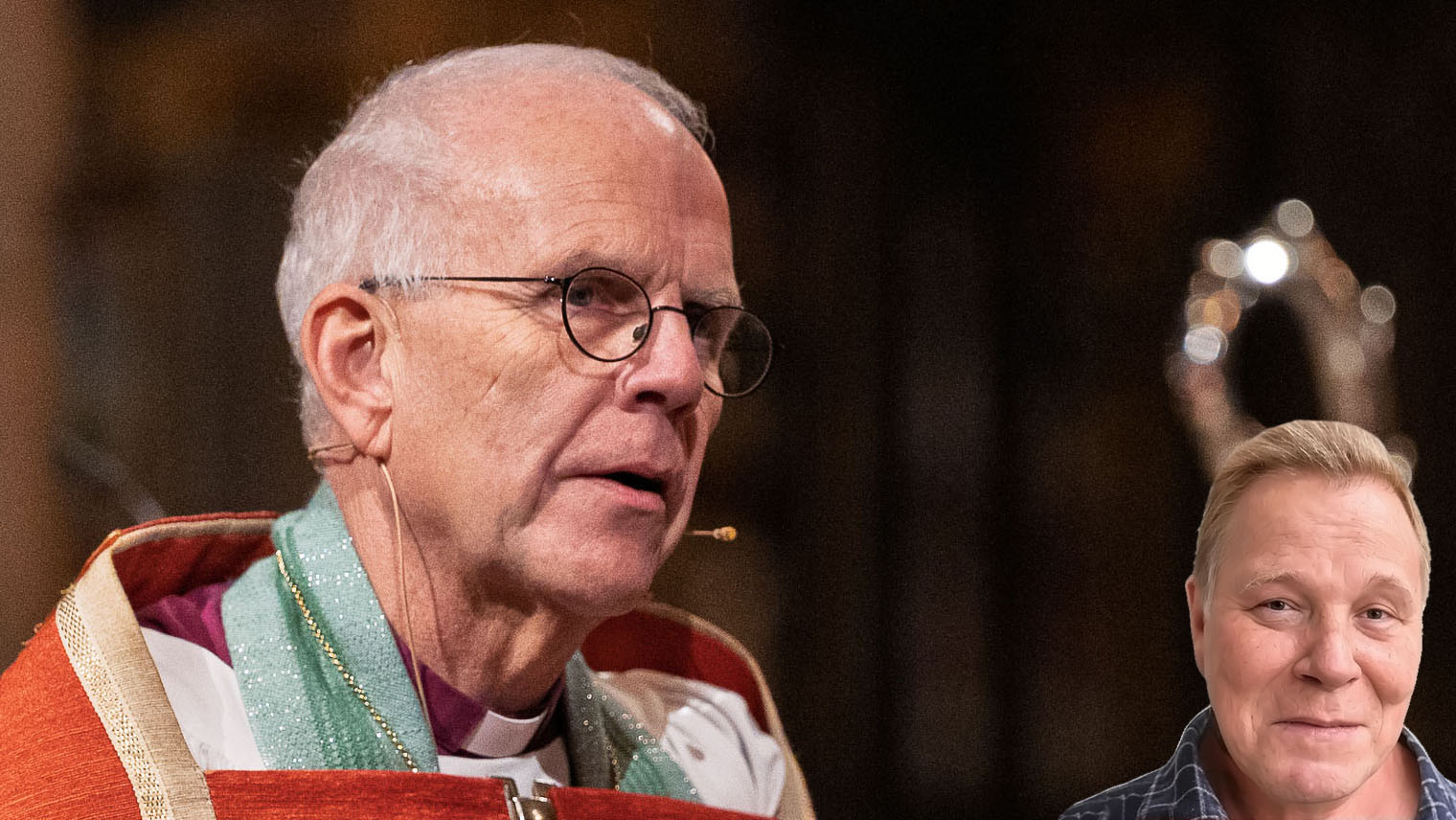
EDITORIAL • When Archbishop Martin Modéus calls for “resistance” against Christian nationalism, it is done in the name of love and inclusion. But in practice, he excludes millions of Christians—in Sweden and :censored:6:cdd6bbaa89:ly—whose faith cannot be incorporated into the Swedish Church’s left-liberal social project. It is not the theology of nationalism that is lacking, but that of the archbishop.
Can one be both Christian and nationalist? Martin Modéus’s practical answer is no—even if he formally says yes. His op-ed in DN (26-01-06) is a textbook example of how one can draw hard boundaries with soft words: anyone who does not share the archbishop’s worldview is theologically discredited.
The paradox is obvious. Modéus claims to combat “clan thinking”, but levels a sweeping attack against Christians who profess the same God, the same Bible, and the same creed—but who do not share his worldly views on migration, nations, and borders. The exclusion he practices is exactly the kind to which he says he is opposed.
The Nation-State—Both a Theological and Legal Reality
Modéus admits that the nation-state is needed for law, order, and the monopoly on force. Yet he simultaneously makes nationalism into something morally suspect. Here, he clashes not only with historic Christianity, but also with modern international law.
According to international law, every people has the right to self-determination and a territory. This principle is not a nationalist invention but the very foundation of the international order Modéus claims to protect. His position becomes even more problematic theologically.
READ ALSO: Archbishop Attacks Christian Nationalists
Christianity was not born from a boundless universalism. It is rooted in Judaism, where the Old Testament clearly states that God chooses a people and gives it a land. The land of Canaan—today, primarily modern Israel—is not a metaphor, but a concrete territory. The first Christians were Jews and included themselves in this concept. The idea that a people has the right to its land is thus not a violation of Christian theology, but part of its heritage.
Selective Critique Against Clan Thinking
When Modéus claims that theology is “clear in its opposition to all clan thinking,” he disregards Christianity’s own history. To define oneself as Christian in opposition to other religions is a kind of clan affiliation.
Additionally, Christianity has always maintained clear internal borders: between Catholics, Protestants, Orthodox, Gnostics, Free Churches, and countless other denominations. These divisions have often been so sharp that they have led to bloody conflicts. To pretend that Christianity is a harmonious, borderless fellowship is a-historical.
Migration, Islam, and the Overlooked Dilemma
Modéus is clearly speaking from the position of migration policy. According to him, it is Christian to receive all the world’s afflicted—even in a small country like Sweden. But he sidesteps perhaps the most crucial question: that the majority of today’s migrants are not Christians; most are Muslims.
Islam is not just “another religion.” Since its inception it has often been hostile towards both Christians and Jews—the root of Christianity. This is not a prejudice, but a historical and contemporary fact in much of the Muslim world. To question it is branded as hate, but it is realism. Modéus is as naïve concerning how many migrants Sweden can accommodate as he is regarding how much influence Islam can be allowed without severe social consequences.
READ ALSO: Archbishop: Call to Prayer Enriches Sweden
To protect one’s country, culture, and religious tradition against both external threats and internal decay is not incompatible with Christian ethics. It is a responsibility that follows from love for that which one has been entrusted with—to God for the Christian, and with accountability before Him.
Jesus’s parable of the pounds (Luke 19:11–27) deals with this responsibility. He who actively mismanages or passively lets what he has been given decline is blamed. To steward a country, a people, and a society so that it endures for coming generations is not unchristian; it is an expression of precisely the stewardship Jesus teaches that God commands.
Jesus, Borders, and the Forgotten Limitation
Modéus uses Jesus as an argument against nationalism. But even Jesus acknowledged boundaries. Despite his divine powers, he withdrew when the crowds demanded more than he could bear. He did not heal everyone. He did not feed the world every day. Not even the Son of God took on the responsibility to save all people everywhere.
READ ALSO: Archbishop: Keep All Illegals and Increase Mass Immigration
The point is simple: mercy requires responsibility and limitation. A society that tries to help everyone risks ending up unable to help anyone. He who does not steward the pound entrusted to him cannot expect to benefit from another’s. It is a double insult to God—to first squander one’s own pound and then to exploit others’ Christian mercy.
A Politicized Church in Freefall
In recent decades, the Church of Sweden has become increasingly visible as a worldly opinion actor: for mass immigration, LGBTQ activism, green doomsday prophecies, and interfaith relativism. Many traditional Christians no longer recognize their faith or their God in this—and leave.
READ ALSO: The Church of Sweden on the Way to Becoming a Minority Church
Membership numbers are plummeting. Church pews stand empty. It’s hard to see this as mere coincidence or a result of broad secularization. Even Swedes who are not believers appreciate resting in a secure Christian cultural identity and its traditions, but are put off when the pulpit’s message is indistinguishable from socialist agitation on the barricades.
READ ALSO: Bishop Attacks SD – Describes Åkesson as Antichrist
Furthermore, when Modéus takes a political stance against the Sweden Democrats and their leader Jimmie Åkesson, even using the theologically most charged insult—”antichrist”—about him, he shows one in four voters the door from church fellowship. How does this align with the mission to be a unifying, welcoming, and loving archbishop of a folk church?
The Swedish Exception—Globally Speaking
Modéus is quick to point fingers at the USA’s Donald Trump and Hungary’s Viktor Orbán. But :censored:6:cdd6bbaa89:ly, conservative Christianity is not new or deviant—on the contrary, it is the dominant form in much of the world: East and Southern Europe, Latin America, Africa, and the Middle East.
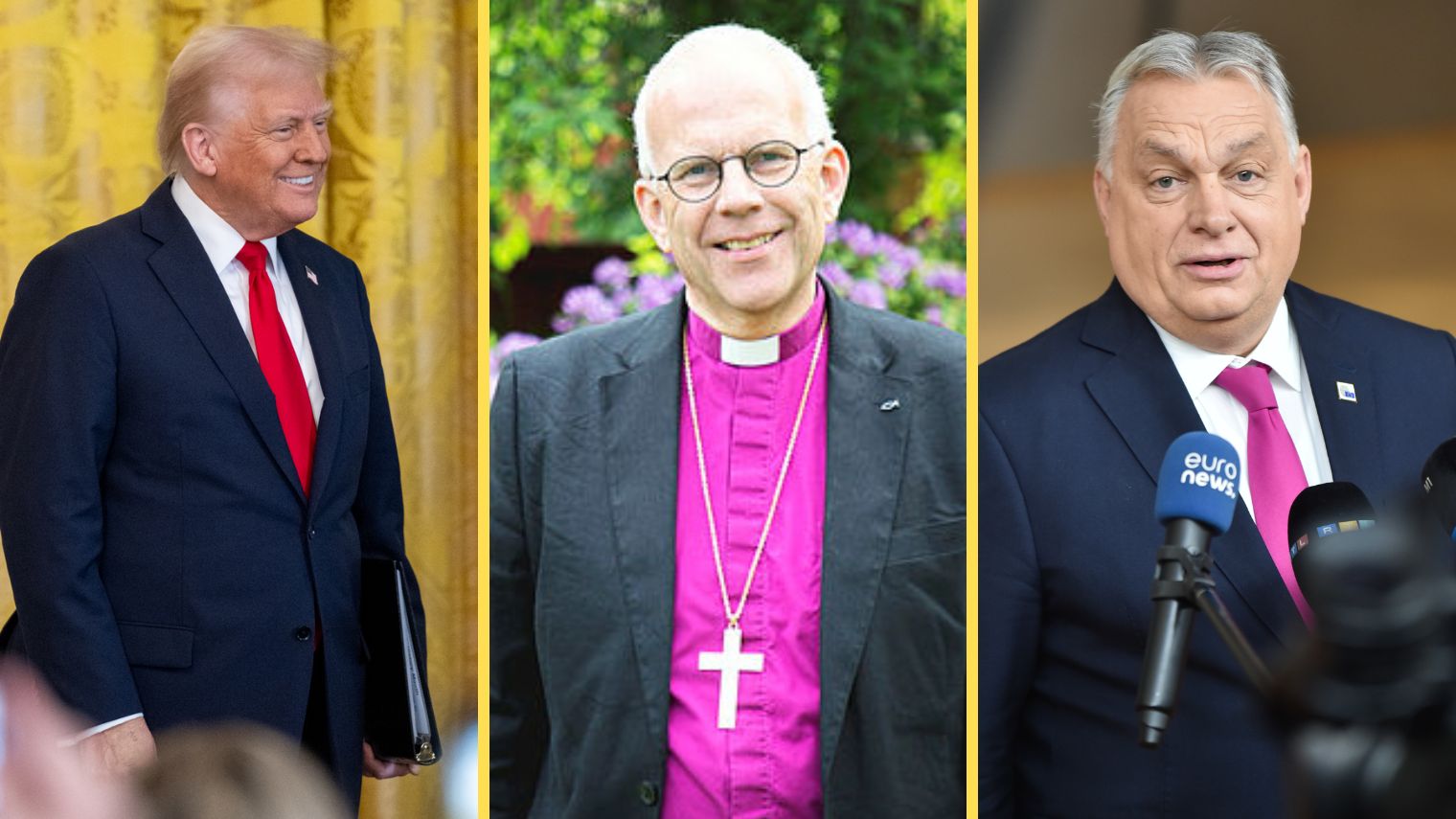
It is Sweden that is the exception. And in this perspective, Modéus is more of an international anomaly than a representative of any Christian mainstream. He refers to theology as if his interpretations and conclusions were self-evident and universal. In reality, these are homemade misinterpretations that few true Christians worldwide would sign onto.
Love Without Truth is Empty
Christian love is not boundless sentimentality. It is grounded in truth, order, and responsibility. Jesus forgave the sinner—but did not nullify the sin. He did not abolish the law of Moses. On the contrary, he confirmed it.
It is a common misunderstanding—or a deliberate misinterpretation—in liberal church circles that Jesus in the New Testament replaces the Old Testament law with an all-overriding commandment of love. But that is not Jesus’s own position. On the contrary, he explicitly says: “Do not think that I have come to abolish the law … I have not come to abolish but to fulfill” (Matt 5:17).
READ ALSO: The Church of Sweden Introducing Pride Apparel: ‘Our Ecclesiastical Expression’
Jesus repeatedly refers to the law of Moses, confirms its validity, and sharpens it by directing it not only at actions but at the heart. The commandment of love does not abolish the law—it is, on the contrary, an exhortation to obey it from the heart, not with Pharisaic piety. “If you love me, keep my commands” (John 14:15), says Jesus. To invoke Jesus to relativize boundaries, responsibility, and order is pseudo-theology. Love without law is not Christianity, but a modern politicized reinterpretation lacking support in the Gospels.
When the archbishop tries to turn Christianity into something it is not, he empties it of its true content—what God has filled it with. Whoever does not like the Christian God, its ethics, or commandments is free to seek out other spiritual movements—or create new ones. But to turn the church into a left-liberal opinion institute is an act of confiscation.
Such is not the action of one who seriously believes that there is a God who created humanity with a specific plan and rebukes those who deviate from it—in this life or on judgment day, when the sheep will be separated from the goats (Matt 25:31). Such is the action of one who believes they can get away with exchanging stone tablets for a golden calf and exploiting spiritual authority for their own worldly purposes.
Note that these are not the words of the unforgiving Old Testament God, but the Gospel of the New Testament disciples. Matthew was one of the twelve chosen who stood closest to Jesus, best positioned to interpret the meaning, breadth, and limits of the new commandment of love.
Modéus is a false prophet who has probably never given a sermon on Judgment Sunday, at least not as a voice for the true Christian God. If the archbishop believes in any god at all, it is not Him or His son.
One Must Not Believe, But Must Not Distort
One does not have to believe in the Christian God, and even if one does, one has the right to oppose His will—humans have done that since Adam and Eve’s fall in the dawn of humanity. In Judaism—from which Christianity springs—there is a tradition called “rib” where humans, in a sort of legal process, can put God in the dock.
In biblical times, Abraham does this before the destruction of Sodom, Moses after the golden calf incident—and even convinces God to change His mind. The entire Book of Job is an inquest against God. In the Lamentations, God is accused of betraying His people after the fall of Jerusalem. And—not least—Jesus does it himself on the cross: “My God, why have you forsaken me?”
In modern times, the verdict delivered against God by the Jews in Auschwitz is the clearest example. Whether any rib ritual was held after the Hamas terror attack on October 7, 2023, I do not know, but I would not rule it out. What I do know, however, is that Modéus and all his subordinate bishops of usual rank have implicitly and deeply tastelessly sided with Hamas and against the Jewish state where Christianity was born by ringing the bells for Gaza.
READ ALSO: The Church of Sweden Rang the Bells for Gaza
There are many things in the world that God could be accused of, based on the problem of theodicy. Historically, abominations have also taken place in Christianity’s name. Today, such acts are few, while those committed in the name of Islam continue at the same constant high level as since the 7th century. But if we are to stick to matters within Christianity today that might deserve criticism, Christian nationalism is not among them. Far more deserving is the leftist politicization of the Church of Sweden and the distortion almost beyond recognition of the Christian God’s will, which Archbishop Martin Modéus and his associates are engaged in.
It is not nationalism that threatens Christianity in Sweden. It is leadership of the church that, in the name of inclusion, excludes its own, denies its theological tradition, and makes political activism its confession of faith.
If there is anything positive to be seen in Modéus’s attack on Christian nationalists, it is perhaps that it shows the archbishop has realized there is a struggle for the church’s soul, just as there is one for the soul of the entire society, in which left-liberalism is desperately resisting but in the end is doomed to lose.