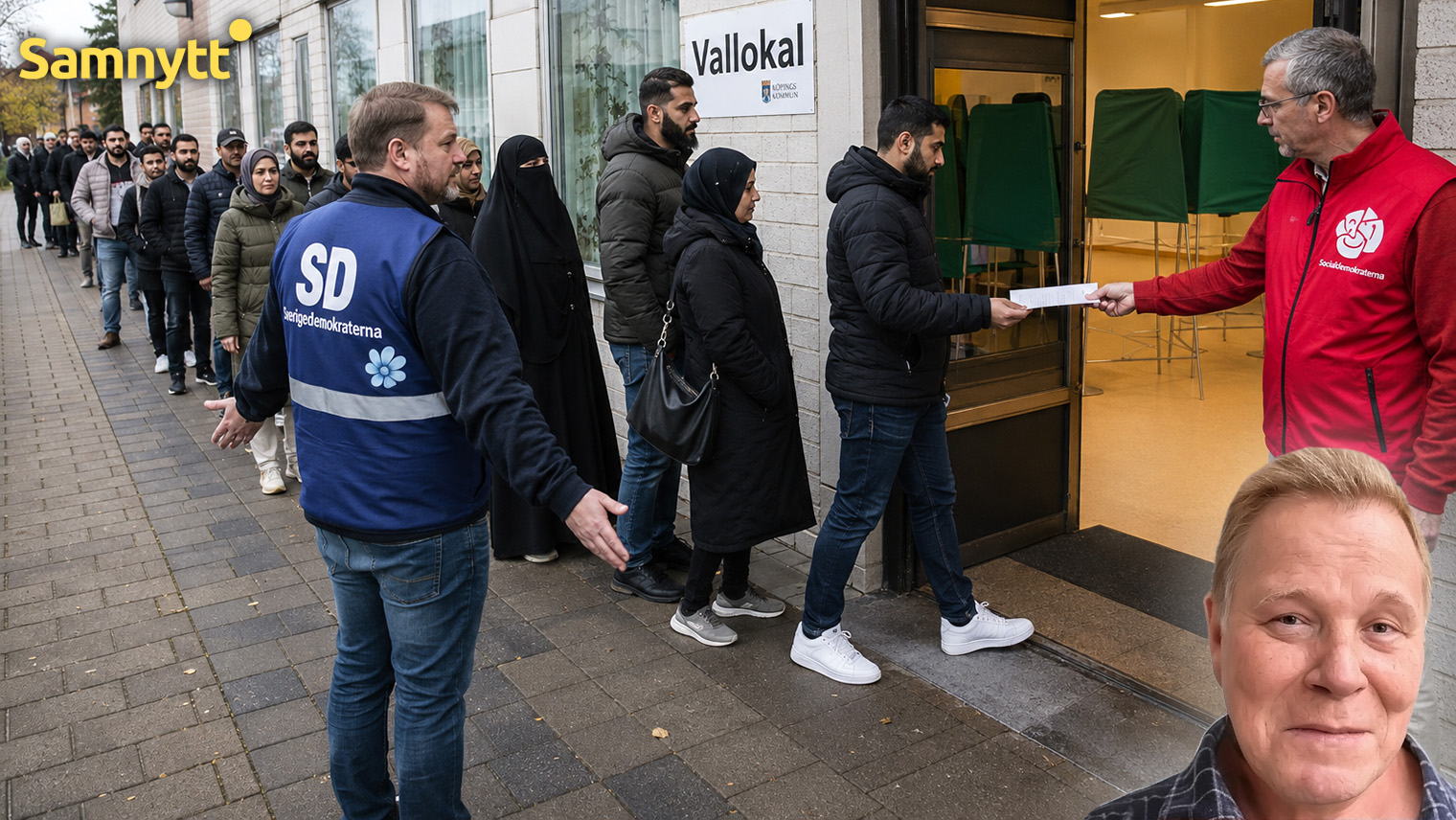
LEADER • Sveriges Radio recently published a segment about people who have lived in Sweden for a long time but are not allowed to vote in the parliamentary elections. The report revolves around a man who, after thirteen years in the country, is still denied Swedish citizenship because he has been unable to prove his identity. His disappointment about not being able to vote is highlighted as a democratic problem. However, the listener receives no arguments for the reasonableness of the laws and regulations as they are, or that they perhaps should be even stricter.
This is indicative of an increasingly common journalistic method – starting from an individual’s feeling of exclusion and then implicitly treating the rulebook as the problem. But democracies are not built on inclusion alone. They are also built on boundaries.
The right to vote in national elections is not just about being affected by political decisions. It’s about being part of the political community that ultimately upholds the state. That is why citizenship is a requirement in almost all democratic countries. Sveriges Radio does mention this in passing, but never asks the obvious follow-up question – if almost all democratic states have this system, maybe there are good reasons for it.
What is Johannes even doing in Sweden?
One of these reasons is identity. In this case, it’s about a person denied citizenship because he couldn’t prove who he is. Yet SR presents the situation as if the system is failing him – when the first question that should be asked is why he is allowed to stay in Sweden at all. Why should a state grant access to national democracy to people whose identity authorities haven’t been able to establish?
This is a question that should be central to any serious discussion about voting rights. If the state doesn’t know for sure who a person is, how can it assess citizenship applications, security risks, or other circumstances that may be relevant? The legitimacy of democracy isn’t just about many people having the right to vote. It’s also based on knowing clearly who votes and on what grounds they have acquired that right.
And what if it were Russians without proven identity?
This is where SR’s angle becomes particularly odd. One can ask whether the same perspective would have dominated if the situation were different, if Johannes were representative of another immigrant group than those from the Third World. Suppose Sweden had a few hundred thousand people from a geopolitically rival country – for example, Russia – who resided here for a long time without being able to prove their identity, and who demanded the right to vote in parliamentary elections. Would the report have focused just as single-mindedly on their sense of exclusion? Or would issues of national security, state sovereignty, and democratic integrity have taken on greater importance?
The discussion cannot be allowed to become emotional – to impose looser rules and lower thresholds for people from so-called ‘vulnerable’ groups that we are supposed to feel sorry for. Principles must fundamentally be general. If identity and citizenship are considered important when certain groups are concerned, they must be at least as important even when groups like those Johannes belongs to are affected.
I say ‘at least’ because, based on country of origin, one may in fact reasonably assume or fear that a person does or does not have values and loyalties compatible with Sweden and Swedish democracy. In recent years we’ve seen many thousands of immigrant antisemites, certainly many with Swedish citizenship, demonstrating every week in sympathy for the terrorist-listed Islamist Hamas dictatorship in Gaza and in hatred of the Jewish democracy Israel.
Already Too Many Non-Swedes with Voting Rights
Moreover, there are grounds to question the underlying premise that long residence should automatically entitle someone to vote at the national level. Citizenship is not just an administrative document. It is an expression of membership in a national community. It entails rights, but also obligations and loyalties. The latter comes first, the former follows from the other.
In Sweden, the debate has often moved in the opposite direction. Many believe that the municipal and regional voting rights for non-citizens should be reviewed. Critics point to the risk of voting based on clan structures, influence from religious authorities, weak knowledge of Swedish social conditions, and political participation that is not always rooted in strong Swedish democratic values.
These are arguments that have a prominent place in the public debate and that should certainly be mentioned in a report that claims to address the question of where the boundaries of voting rights lie. Especially for a supposedly impartial public service actor.
Spare Us the Emotional Tears About Inclusion
Instead, the listener hears that Johannes ‘doesn’t feel included.’ But democratic legitimacy cannot be reduced to a question of how included an individual feels. The question must also be what is required to gain access to the political power over a country and why those requirements exist.
ALSO READ: Ekeroth: Revoke the right to vote before it’s too late
Public service is not tasked with advocating for more open voting rights for selected immigrant groups. Its mission is to highlight different perspectives and provide citizens with a basis for forming their own opinions. When a report on a contentious issue only presents arguments on one side, and those arguments can moreover be labeled a ‘tear-jerker,’ the result is not public enlightenment but activist journalism.
The major democratic problem is not that some people lack the right to vote in parliamentary elections. On the contrary, it is that too many have it, because Swedish citizenship has been granted too easily and because too many have access to local democracy in municipal and regional elections without requirements.
A major and recurring problem is also that public service chooses to portray issues of this kind as if there is only one left-liberal valid way to view them. When this occurs during an election year, it is particularly serious.