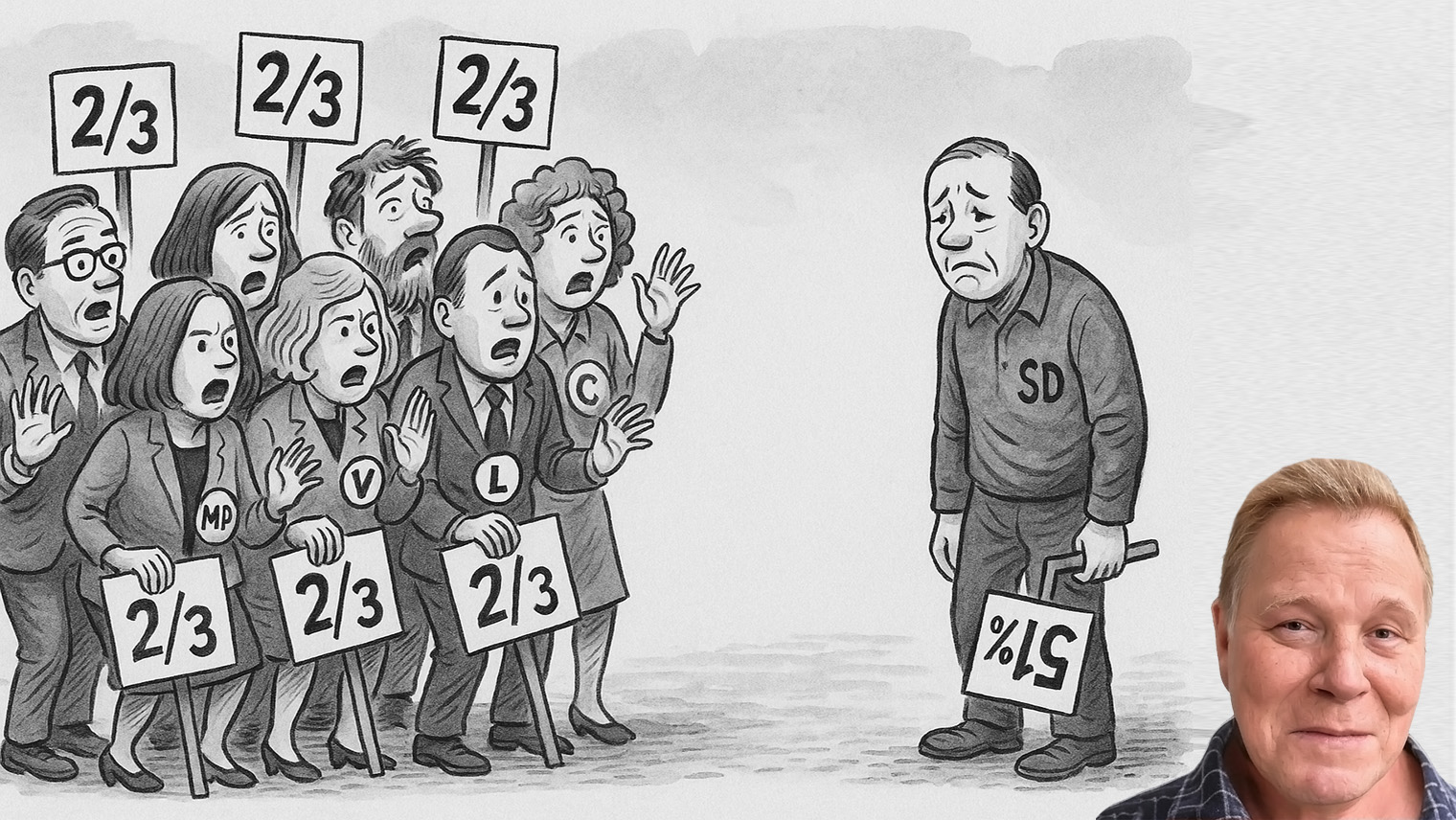
EDITORIAL • As conservative parties have grown stronger in Europe and Sweden has gained such a party as the second largest force, the idea of making the constitution more difficult to change is suddenly brought up. These demands are presented as protection for democracy but strangely coincide with the effort to limit the type of political changes that voters increasingly demand.
There are much greater and real threats to democracy from other groups than the conservatives, which are silenced in this discussion – imported and internal. Not least, there is a lack of self-criticism about what is described as the ‘liberal democracy’ by an increasingly desperate and authoritarian left-liberal establishment that is turning into its opposite.
Behind the new linguistic smokescreens about others’ threats to and their own defense of democracy, they themselves dismantle it, in order to consolidate their own power and prevent its redirection in a more conservative direction. Qualified majority for constitutional amendments is just the latest example of this.
Democracy’s rules change when voters vote ‘wrong’
It is difficult to ignore the timing. Sweden has had the same constitutional procedure for decades: two decisions, simple majority both times. No one has previously spoken about this as an acute threat to the rule of law. But then the political landscape changes. Conservative parties in Europe are growing. The Sweden Democrats emerge as Sweden’s second largest party. Similar movements reach government power in Italy, the Netherlands, Hungary, Slovakia, and the Czech Republic. And it is precisely then that the question of a qualified majority becomes urgent.
It is no coincidence. A procedure that was considered fully democratic when the Social Democrats ruled in minority for decades with the support of Moscow-leaning communists, and when the liberal bourgeoisie wanted free rein for major ideological shifts with extensive privatizations and other things, is now described as a weak protection against ‘system threats’. But the threat is not the procedure. It is the changing preferences of the voters and the new popular will that is perceived as a threat.
The arguments for the 2/3 rule may be sympathetic in theory – stability, long-term thinking, power sharing – but they would have been more credible if they had been driven by consequence, something that has long been pointed out as a serious flaw in the Swedish democratic governance. Instead, they are a facade for sudden self-interest when their own power is threatened – in other words, the opposite of caring for democracy.
‘Liberal democracy’ not freedom-loving but exclusive
The most striking thing in the debate is how the concept of ‘democracy’ is increasingly modified. Just ‘democracy’ is no longer enough. We should talk about ‘liberal democracy’. It is presented as an upgrade, but in practice it means that political ideas are sorted into two piles: one with things that can be counted as democracy and another with things that are counted as a threat to it.
It is a definition where liberalism claims to be both an ideology and a judge. Conservatism – which historically has been one of the great democratic traditions in Europe – is suddenly portrayed as a system error and an enemy and opposite of democracy. National conservative voters are not a legitimate opinion to be addressed in democratic arenas, but a risk to be limited through institutional barriers.
When democracy delivers bourgeois liberal, social democratic, or green governments, it is seen as healthy. When it delivers conservative majorities, it is perceived as something that must be protected from itself and the foolishness of the people.
EU’s growing role – from community to overseer
The external pressures are not insignificant either. The EU’s development over the past ten years has been towards increasingly active control of the domestic political direction of member states. It is called rule of law mechanisms, democracy protection, or ‘European Democracy Shield’ – but the political substance is clear: when countries choose conservative governments, condemnations and economic and institutional countermeasures and sanctions follow.
Hungary has had billions in EU grants frozen. Poland has, under previous governments, faced similar sanctions that were suddenly lifted when liberals regained power, despite the fact that the takeover was accompanied by much harsher purges of dissent than what the previous conservative government engaged in.
Platforms and companies are threatened with billion-dollar fines under the DSA legislation – Elon Musk is currently the clearest target of the EU Commission in this new media order. The reason is that he has openly declared conservative values and has economic power. When X was Twitter and engaged in censoring conservatives, it was not a problem for the EU, but was instead supported. When Musk took over and lifted the censorship, he is accused of and fined without due process for censoring.
Behind the rhetoric of ‘protecting democracy’ hides a more instrumental reality: to control political discourse, condition freedom of speech, and discipline dissenters. And now this logic reaches Sweden. First through discussions about constitutional amendments, then through pressure to adapt to the EU’s new ‘democratic standards’. It would be more honest to acknowledge that this is a power political project rather than a value project.
Focus on wrong risks: straining at gnats, swallowing camels
We are now being fed that conservatism constitutes the great threat to democracy. But when one examines which forces have actually changed Swedish society in recent decades, it is difficult to see how the conservatives deserve such a scapegoat.
The development of liberal democracy has instead meant: weakened social cohesion, decades of uncontrolled migration that voters never demanded, increasing crime and parallel societies, a public discourse where uncomfortable opinions are treated as deviations rather than legitimate positions, climate policy where activists and politicians gladly mix science with moralism and ‘time pressure’ justifies bypassing democratic processes, education and cultural policy that has shifted from classical liberal ideals of knowledge and individualism to identity politics and ideological projects.
All of this is the result of the order that is now said to need protection. Many argue that it is instead an order that is in desperate need of change.
And at the same time, groups in Sweden with values far from secular democracy are growing – not least radical Islamism with its theocratic conviction, its aversion to democracy and freedom of speech, its misogynistic view of women, its intolerant view of sexual minorities, its hatred of Jews and other ‘infidels’, and more. But these risks are discussed with a caution that stands in sharp contrast to the alarmism surrounding the success of conservative parties. What the Sweden Democrats’ leader Jimmie Åkesson pointed out as the greatest threat to Sweden already 15 years ago is instead presented as something enriching, alternatively, vulnerable groups subject to Swedes’ racism and discrimination.
The liberal bourgeoisie that now supports the proposal for a qualified majority for constitutional amendments seems to have not considered the almost exclusive veto and power over changes in the constitution that they give to the Social Democrats, who for the foreseeable future seem to continue to be the country’s by far largest party. It is also a double danger, as we are talking about a party whose voter base to an increasingly large extent consists of non-Western migrants with anything but democratic values.
Conservatism not the enemy of democracy
Conservative parties have been in government in Europe for over a hundred years. Many of the democracies now called ‘liberal’ have been built by conservative statesmen and reformers. To portray conservatism as the guardian of anti-democracy is historically shallow and politically sloppy. It is a dishonesty driven more by lust for power than by care for our society’s democratic traditions.
Democracy has always needed brakes, against the tyranny of the majority, against the paradox that it can abolish itself, basic protection of human rights and civil liberties, power sharing, and more. That is why we have constitutions.
But democracy has also always needed driving forces. And nothing strengthens democracy more than letting different opinions clash. Conservatism has – just like liberalism, social democracy, and other traditions – its given place in the plurality of opinions. No ideology owns democracy. And no one should naturally have to risk being stamped as a systemic threat just because the voters in a democratic order give it support.
Not politically neutral to make the constitution more cumbersome right now
The proposal to require a 2/3 majority for constitutional amendments is presented as a neutral, technical democratic protection. But the timing, the chain of arguments, and the political context reveal that this is not a procedural reform detached from its time and political agendas.
It is a response to voter movements. It is a response to the growth of conservative parties. It is a response to a growing resistance to the EU’s increasing ambitions to control the domestic policies of member countries.
Changes to constitutions should aim to benefit all participants in democracy. Changing in order to slow down a legitimate opinion is something else and the opposite. It is not liberal democracy, but authoritarian liberalism. It is not democracy as the strength of the people, but the protection of institutions against the people.
False debate and two quick decisions not the model
If there will be a constitutional amendment of this kind is not decided during this electoral term. There is currently no timetable outlined and no first decision made, only declarations of intent where the seven non-conservative parties have announced support for the change and the only conservative party has said no.
But constitutional amendments are important and the public debate should not lie dormant until the last moment and then be rushed with two decisions in quick succession just before and after a parliamentary election. It is a tactic that benefits the forces that do not want any scrutiny or discussion.
The debate also needs to be free from the self-righteousness that characterizes those who call their own ideology ‘the only democratic one’. And above all, the conversation needs to be broadened to be about real threats to democracy instead of invented ones, and the underlying anti-conservative agenda needs to be exposed.
If we are to change the rules for constitutional amendments so that a qualified majority is needed, a minimum requirement is that it happens based on an honest political debate. The previous one leaves much to be desired.
Selective democratic defense the real threat
It should go without saying that Swedish democracy is not undermined by a conservative party, as a result of the popular will, gaining government influence. Or have those who now advocate for constitutional issues missed reading the preamble of the Instrument of Government?
Democracy is not saved by a new majority rule, especially not one that is introduced to counteract the impact of the popular will. Democracy’s greatest enemy is the inability of those in power to see their own blind spots and to be so intoxicated by their power that they feast on flirting with the rules of democracy.
Democracy’s greatest strength is the people’s ability to remove such rulers in favor of others before they have the opportunity to be deprived of that possibility. The announced constitutional amendment for a qualified majority for constitutional amendments is a sign of blindness and power intoxication, deceptively packaged in new linguistic rhetoric.
Democracy is not to build institutions that protect certain ideas but not others, that favor their own power and point out political opponents as a threat while doing nothing about growing real anti-democratic movements, that tame domestic opposition but retreat from imported intolerance – and put new linguistic labels on what they do and do not do as ‘democratic reinforcement’.
If there is anything that can undermine the legitimacy of democracy, it is that asymmetry. And when trust in democracy reaches a critical low, it is not classical conservatives one has to grapple with but revolutionaries and coup-makers who have appointed themselves to violently set things right. We are not there yet in Sweden, but history is full of examples of such restorers – in our recent past and vicinity, and it would be naive to think that we are immune.
This is the third and final part of an editorial trilogy on the constitutional amendments currently being discussed in the public debate. You can find the other two below:
PART 1: Is the constitutional lock about to be opened?
PART 2: Constitutional creaking – the key becomes unusable if the lock mechanism is replaced