EDITORIAL • A people is more than a group of individuals who just happen to live within the same state borders. It is history, language, culture, values, traditions, shared experiences, and a sense of belonging passed down through generations. Sweden can offer an open door into this community for those who truly wish to become Swedish. But this open form of Swedishness cannot be used as an argument that the Swedes’ own ethnic and historical continuity is irrelevant.
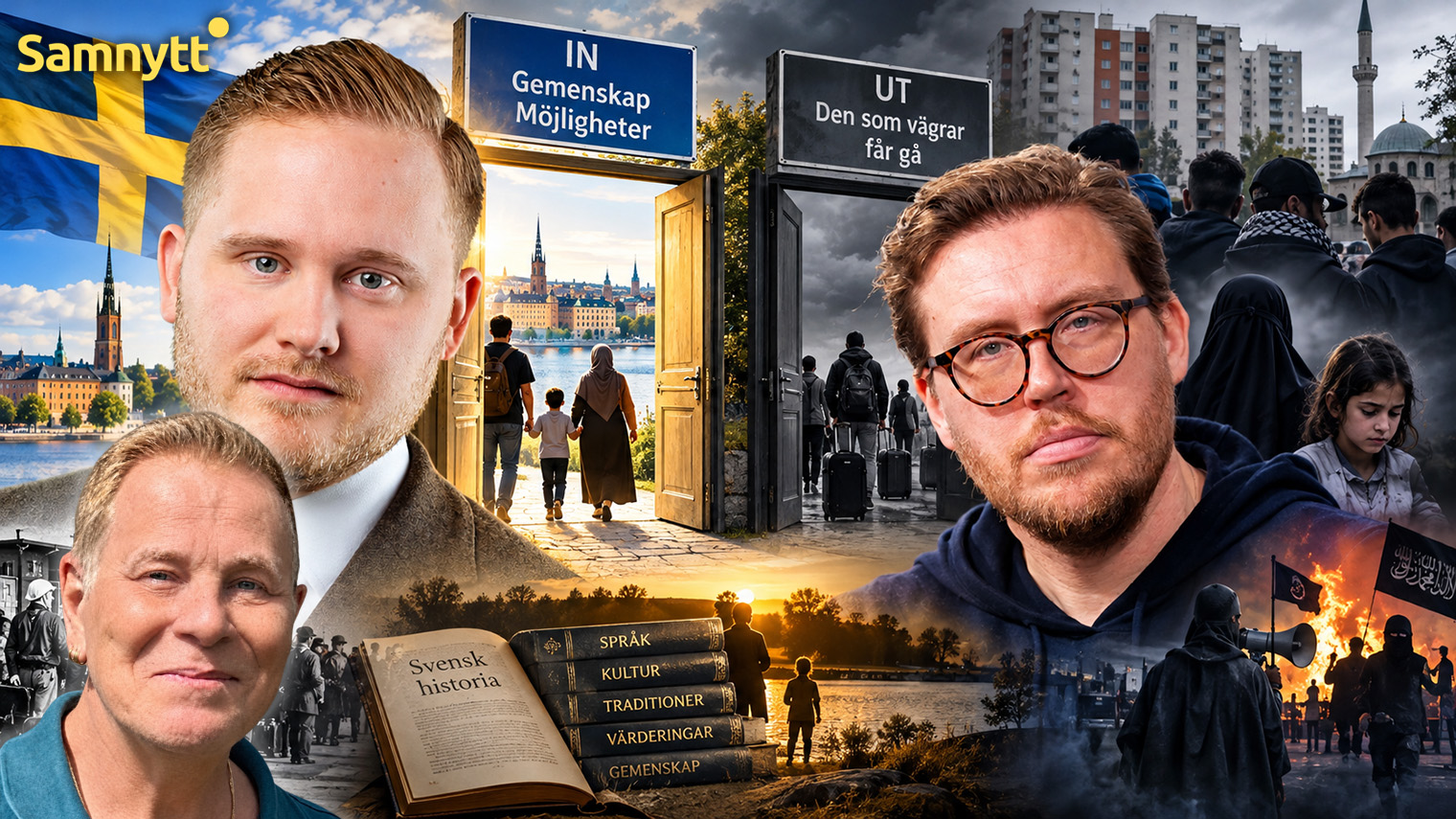
Carl Eos, affiliated with the national conservative think tank Oikos, writes in a column for Bulletin that he wants to “bury ethno-nationalism once and for all.” His starting point is the criticism directed at Sweden Democrats’ deputy party leader Henrik Vinge after his statements about immigrants and disadvantaged areas. Eos defends Vinge and summarizes his message with two doors: the immigrant who wants to become part of Sweden should have an entry door. Those who refuse to adapt should take the door out.
So far, it’s a fundamental idea that’s hard to argue against. The problem arises when Eos then jumps to the conclusion that ethno-nationalism must be buried, describing it as the idea that the state should rest on biological ties. That’s an oversimplification.
Why Single Out Swedish Ethnicity?
First, we should ask a question almost never raised when discussing ethno-nationalism: Whose ethno-nationalism is actually to be buried? The Sami are seen as a people with a special historical and cultural bond. No one would suggest to Kurds that they must stop considering themselves a people because their community extends across several national borders. Jews, Armenians, Somalis, and many other peoples preserve their history, culture, traditions, and sense of common origin.
This is often seen as something positive and worth protecting. But when Swedes talk about their own corresponding sense of togetherness, the discussion quickly turns, oddly enough, to “blood mysticism,” racial biology, and blood tests. It’s an old left-liberal asymmetry — other peoples are expected to nurture their ethnic identity, while Swedes are expected to grow out of theirs. It would be unfortunate if this notion now also took root within the think tank created as the Sweden Democrats’ idea workshop.
A People Is Not a DNA Registry
Eos’ fundamental problem is that he creates a strawman out of ethno-nationalism. Ethnicity is not synonymous with genetics, and an ethnos is not a genealogical registry. Ethnic belonging can include descent, but also language, culture, history, religion, traditions, customs, collective experiences, and the idea of a common origin and future.
This does not mean a people must be completely biologically closed. Swedes have never been. People from outside have throughout history come to Sweden and over time become part of the Swedish people. Eos mentions, among others, the Walloons. But the Walloons rather illustrate the problem with his reasoning than solve it.
ALSO READ: Dagerlind: I know what it means to make Sweden Sweden again — but do the Sweden Democrats?
This involved a very small group of people — a few thousand over half a century around the 1500–1600 turn of the century — who came to a country with an overwhelming Swedish majority culture and who, over generations, assimilated into it.
The fact that this worked does not prove that a country in a few decades can change a significant part of its population through extensive immigration from culturally, religiously, and value-wise very distant societies and expect the same outcome.
At some point, a difference in degree becomes a difference in kind. Assimilation, after all, presupposes something to assimilate into.
Anderson Does Not Save the Argument
Eos leans heavily on Benedict Anderson and his classic description of the nation as an “imagined community.” That’s essentially a perfectly reasonable idea. I don’t know all the millions of Swedes in Sweden. Still, I can experience a sense of belonging with them. Someone from Skåne and someone from Norrbotten may never have met, but can still see each other as compatriots.
But the interesting question is what this imagined community consists of. It does not arise magically in the moment an authority issues a personal identification number or a passport. It’s built on shared language, history, cultural references, traditions, norms, loyalty, and collective memories. It also relies on continuity — that something is passed down from generation to generation.
Contradictorily, Eos himself comes close to this when he writes that Swedishness is a cultural community extending over generations, that who is perceived as Swedish cannot be decided at a meeting or regulated by law, and that the process can sometimes take longer than a human lifetime. But then we’ve left the notion of the nation as something that can arbitrarily be filled with any population, as long as people learn Swedish and obey the law. We have started to talk about an historical people.
Sweden Has Already Opened the Second Door
Eos and Vinge use the image of the door in and the door out. But really, there are two entirely different doors. The first one leads into Swedish territory and perhaps, eventually, Swedish citizenship. The second leads into the Swedish national community.
Through the first, a very large number of people have passed in recent decades. But not all have gone through the second since then. And that is hardly because the second was locked.
On the contrary, Sweden has over decades spent billions in taxpayers’ money on integration projects, labor market measures, education, association grants, and all kinds of efforts to help people become a part of Swedish society. Yet we have ended up with parallel societies, clan structures, honor culture, Islamism, religious fundamentalism, and neighborhoods where contact with the Swedish majority culture is minimal.
ALSO READ: Dagerlind: With population exchange policy, Sweden exemplifies the democratic paradox
Here, the notion of open Swedishness becomes much more difficult in practice than in theory. For, of course, there are immigrants who want to become Swedes; who learn the language, identify with Sweden, adopt Swedish norms and values, and place their primary loyalty here. The open Swedishness is for them.
But there are also far too many who do not want this. Stating that is not to despise them as human beings. However, we can and should be uncompromisingly critical of ideas and practices that they or others carry, when these are in conflict with fundamental Swedish values.
Honor oppression does not become any less reprehensible because it is imported. Clan loyalty should not stand above Swedish law. Religious beliefs that subordinate women, restrict individual freedoms, or demand that religion stand above secular democracy deserve no respect. If someone wants to call rejecting such ideas “contempt,” that’s mostly a matter of semantics.
The central thing is to distinguish between human worth and the value of ideas. All people have inviolable value. Ideas do not. Bad ideas should be able to be criticized, fought, and in some cases kept out of the society we want to preserve. And people who are bearers of such ideas must take the door out. Eos and Vinge also say that.
“Must Go Out” — But When, How, and How Many?
But here a contradiction arises in the arguments of Eos and Vinge. “Those who refuse must go out” sounds forceful. But who should go out? How many? How is it to be done? And when?
For at the same time as the exit door is invoked, Eos and Vinge acknowledge that the disadvantaged areas will remain for many decades, and that parallel societies will take more than a generation to dismantle. These two messages are hard to reconcile. Either we accept that large groups, who do not wish to assimilate, will remain generation after generation in parallel societies, or we mean seriously that those who permanently reject Swedish social community must leave the country.
Sweden Democrats’ voters have a right to ask what “the door out” means in practice. Especially after an election campaign in which the party promised to “make Sweden Sweden again.”
Numbers Matter
There is a variable that almost always disappears in the elegant arguments about integration and open Swedishness — numbers. A single individual can assimilate. A family can assimilate. Small groups can, over generations, blend into the majority population until their origins are no longer significant.
But it does not follow from this that any number of people can be assimilated at once. Assimilation requires an assimilating majority culture. If immigration is so extensive that people settle in areas where almost all neighbors have foreign backgrounds, where languages other than Swedish dominate, and where the religious, cultural, and social structures from the country of origin can be reproduced generation after generation—what, then, are they to assimilate into?
This is the crucial difference between the historic immigration that Eos likes to refer to and the demographic transformation Sweden has undergone in recent decades. These are not the same phenomenon, just differing in size. The scale itself changes the preconditions—from something natural that occurs in contact with Swedish society, to something that mostly becomes empty political phrases taught in government brochures.
ALSO READ: Dagerlind: When Swedishness Becomes Morally Suspect
The question is whether the promise to make Sweden Sweden again and to show the exit door to those who do not want in really applies—even if it should turn out to matter for a million people, many of whom have been given Swedish citizenship and even more residence permits, but who are still on the wrong side of the threshold.
The Sweden Democrats I know and have voted for are a party that has not bought into the claims made by other parties and professional commentators that immigration issues concern only a tiny minority, while the overwhelming majority who come here long to become part of Swedish culture, values, secular democracy, and so on.
They have not been naive, as former Social Democratic leader Stefan Löfven was forced to admit he had been in a famous statement. They have understood, they have realized, they have kept their eyes open. Now Eos, Vinge, and some others sound as if they too believe it’s only a small marginal group that should go through the door marked “Out.” Suddenly, other SD profiles argue that there is no difference between being a Swedish citizen and being Swedish.
Criticism Is Not Contempt for Humanity
Eos writes contemptuously about the “tough right” that has criticized Vinge, and later lumps together ethno-nationalists, radicals on X, and outright racists. This while paradoxically accusing them of being the ones who express contempt for groups of people.
I have criticized Eos’ argumentation on X. But I do not do so because I despise Somalis or other immigrants as people on a racial-biological basis. I do not demand DNA tests at the nation’s borders, nor do I believe that someone whose great-grandfather was born outside Sweden should forever be excluded from Swedishness.
I criticize the reasoning because I want to know how Sweden can remain the land of the Swedes when demographic and cultural developments have so powerfully and rapidly gone in the opposite direction. When Sweden receives as many immigrants in one year as we did in a thousand years before.
That is a legitimate question. And it does not become less legitimate just because some people express themselves harshly on X out of frustration over party representatives drifting away from their promises.
Eos lets representatives for the most extreme ethno-nationalistic stance define the whole concept. Since he enjoys name-dropping prominent political science experts on nationalism, he should have made an effort to be better informed about what ethnicity is.
Don’t Bury the Swedish People with a Strawman
The Sweden Democrats’ open Swedishness and ethno-nationalism are not opposites. Open Swedishness is, on the contrary, a form of ethno-nationalism. It describes how someone from outside can become part of the Swedish people, and that it requires more than a piece of paper stating that you are a Swedish citizen — exactly the sort of thing that is part of the definition of ethnicity.
But the Sweden Democrats have been poor at setting a limit for open Swedishness. Former Center Party leader Annie Lööf said in a prominent appearance on SVT Agenda in 2011 that she saw no problem letting in 30–40 million African migrants to Sweden. Even the rather left-liberal program leader Anna Hedenmo reacted strongly and asked, “But what would happen to the Swedish then?”
Lööf pretended not to understand the question and answered something along the lines that everyone who comes to Sweden and settles here is Swedish. According to the Center leader, it was enough to come here and “contribute to welfare” by working, to be Swedish. Now, a significant proportion of those who came have not contributed to welfare, but have, on the contrary, been a burden to it. But that fact aside, the Sweden Democrats have realized it takes a bit more than that to become Swedish.
100,000 Years of Evolution Also Counts
That is all well and good. But the possibly inconvenient question still needs to be asked. Even if 30–40 million African migrants came to Sweden and met all the requirements of the Sweden Democrats’ open Swedishness, would that be something the party should accept? Would Swedes — who Eos claims are not racists — feel comfortable with that? I don’t think so. Open Swedishness is an offer that can be made on the margin.
Racist or not, most of us want the majority of Nordic people to continue to look like Nordics, have their roots in the Nordic peoples. According to the “Out of Africa” theory, we all descended from people who migrated from Africa 50,000–200,000 years ago. But evolution has done much to us since then, depending on where on earth we ended up.
It’s allowed to want to abolish these differences, but it’s also allowed to want to preserve them as — not the whole — but part of what distinguishes different peoples. And if you want that, you need to set a rather restrictive limit for immigration, with or without open Swedishness. Sweden has already far exceeded that boundary, and if the Sweden Democrats are serious about making Sweden Sweden again, they need to address that issue as well.
Ethno-nationalism describes why something that can be called the Swedish people exists at all as a historical community, why this community has value, and why Swedes have the same right as other peoples to want to persist as a people and be the overwhelmingly dominant majority in their own country. Ethnic belonging includes language, culture, history, religion, traditions, customs, collective experiences, and the idea of a common origin and future.
But it also includes descent. That does not have to mean compulsory blood and DNA tests, racial purity, blood mysticism, or closed doors for anyone whose family tree branches out beyond Sweden’s borders somewhere — even though we actually accept quite far-reaching such thinking for other peoples and also for legally codified ethnic minorities in our own country.
But it does mean recognizing the continuity of the Swedish people. Sweden is not just a geographical area and a legal construct. To be a part of Sweden and the Swedish sense of community means to be a part of what is included in the concept of ethnicity. Some of it can be acquired if one has the will. Other aspects are harder, like skipping over 100,000 years of evolution.
Sweden was the land of ethnic Swedes for almost a thousand years. In the mid-twentieth century, a small clique of politicians decided Sweden would no longer be that and pushed through that decision over a few decades with an unprecedentedly aggressive mass immigration policy, without a mandate from the voters. As a reaction, the Sweden Democrats arose and grew to become one of the country’s largest parties.
If the promise to “make Sweden Sweden again” means more than just better integration, tougher punishments, somewhat lower immigration, and nicer statistics, it must also be about culture, identity, demography, and continuity — but also about descent. Otherwise, you do not make Sweden Sweden again. Then you just administer the new Sweden slightly better. That seems to be what Eos and Vinge want. And it is certainly not what the Sweden Democrats’ core voters want.