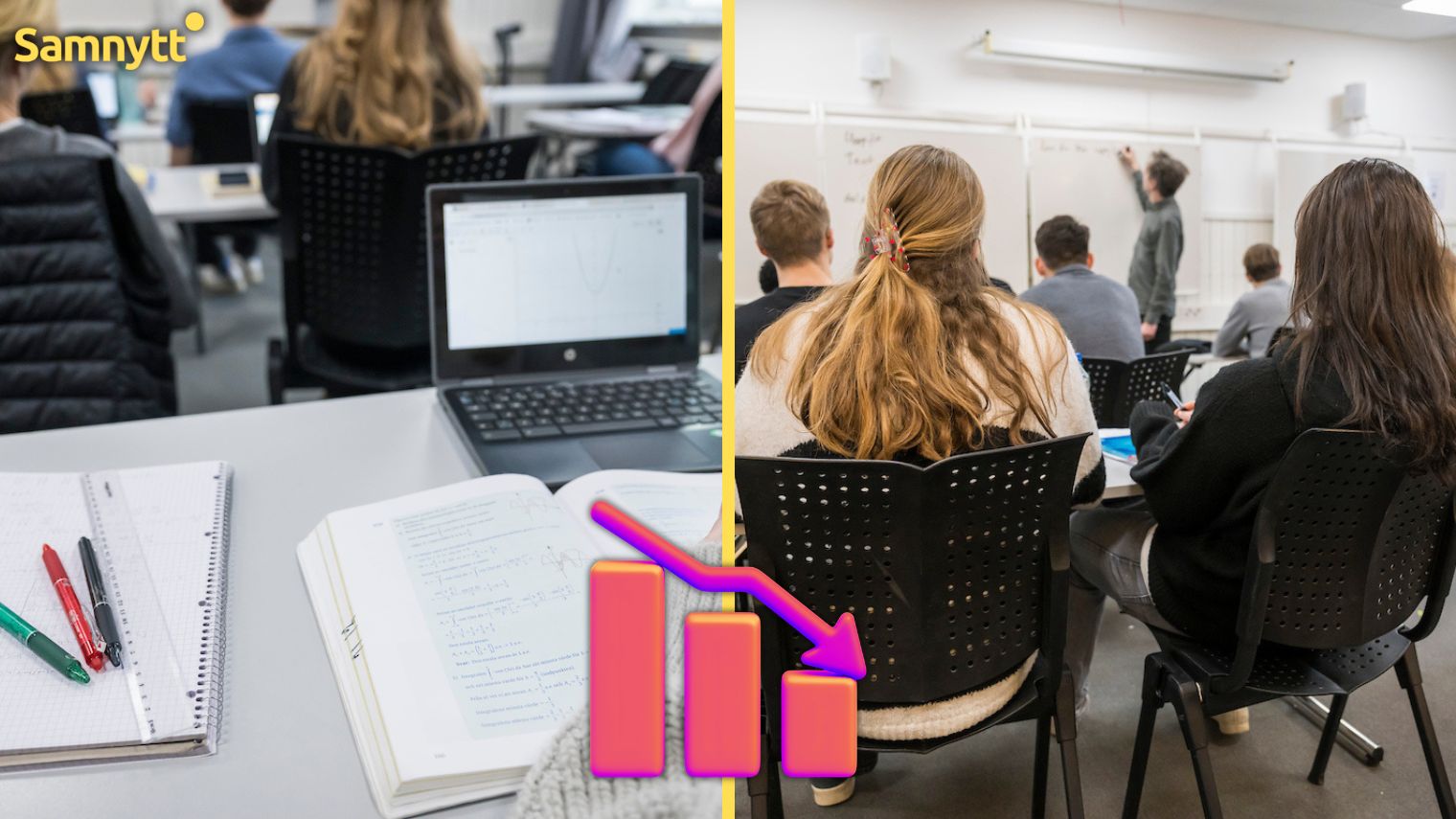
15-year-olds in Sweden continue to perform worse in school. In the new PISA survey, the results in both reading comprehension and mathematics have reached the lowest levels ever recorded for Sweden. At the same time, the survey points to a growing problem for students who already have weak skills.
The PISA results for 2025 represent a new setback for Swedish schools. Sweden’s 15-year-olds have suffered significant declines in both reading comprehension and mathematics compared to the previous survey in 2022.
In reading comprehension, Sweden scores 466 points – 21 points lower than in 2022. This is the lowest Swedish result since PISA surveys began. The mathematics result, 464 points, is also the lowest ever measured and represents a drop of 18 points over three years.
In science, however, the trend is more stable. Sweden’s score of 485 points is not statistically significantly different from the 2022 result. At the same time, the result is roughly at the OECD average.
One third do not reach the basic level
The development among students with the weakest results is particularly concerning. The proportion of Swedish 15-year-olds who do not reach PISA’s basic knowledge level has increased sharply. In reading comprehension, it is now 31 percent, compared to 24 percent in 2022.
In mathematics, 34 percent do not reach the basic level. Three years ago, the corresponding figure was 27 percent. This means that about one third of Sweden’s 15-year-olds do not reach the level that the OECD defines as basic in reading and mathematics.
READ ALSO: Report: Swedish Students Most Exposed to Threats and Violence in Schools
Anna Castberg, Head of Analysis at the Swedish National Agency for Education, describes the development as very serious.
– A third of Swedish 15-year-olds do not reach what the OECD defines as a basic level in reading comprehension and mathematics. This is very serious, as being able to read and do arithmetic are fundamental skills in school, in daily life, and for participating actively in society, she says.
Large differences between students
The PISA results also show that Swedish schools still have large disparities between students from different socioeconomic backgrounds.
Among students with less favorable socioeconomic backgrounds, 49 percent do not reach the basic level in mathematics. For reading comprehension, the corresponding share is 45 percent, and in science, it is 38 percent.
For students with more favorable socioeconomic backgrounds, the numbers are significantly lower: 19 percent in mathematics, 17 percent in reading comprehension, and 13 percent in science.
At the same time, there is a new trend in this year’s survey. Even students from more advantaged socioeconomic groups have seen a sharp decline in their results. The National Agency for Education notes that the gap between the groups has not grown in this year’s PISA – mainly because the high-performing students have also slipped.
Sweden not alone
The Swedish development is taking place as results are falling broadly on the international level. Other Nordic countries also report historically low results in reading comprehension and mathematics.
The National Agency for Education therefore emphasizes that there is no single explanation for this development. OECD analyses show the decline is widespread and that each country needs to investigate possible causes at the student-, school-, and societal-levels.
At the same time, Sweden is roughly at the OECD average in both reading comprehension and mathematics. Finland ranks higher than Sweden in reading comprehension, while Denmark is at about the same level. Norway and Iceland are lower. In mathematics, Denmark and Finland are at the same level as Sweden, while Norway and Iceland are lower.
There are also some positive news. Swedish students report a greater sense of safety in school than in 2022 and are above the OECD average in this regard. Students also have high attendance and report that they receive good support from teachers.
A total of about 760,000 15-year-olds from 91 countries and regions participated in PISA 2025. In Sweden, 6,688 students from 206 schools took part in the survey.
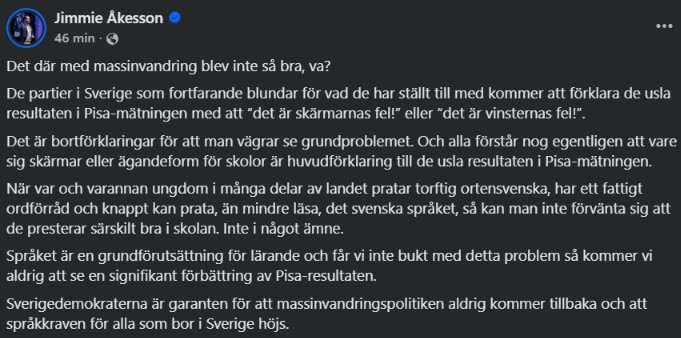
Åkesson: Didn’t Turn Out So Well
On social media, Sweden Democrats leader Jimmie Åkesson comments on the survey:
READ ALSO: Researcher: Speak Plainly About Immigrant Students’ School Results