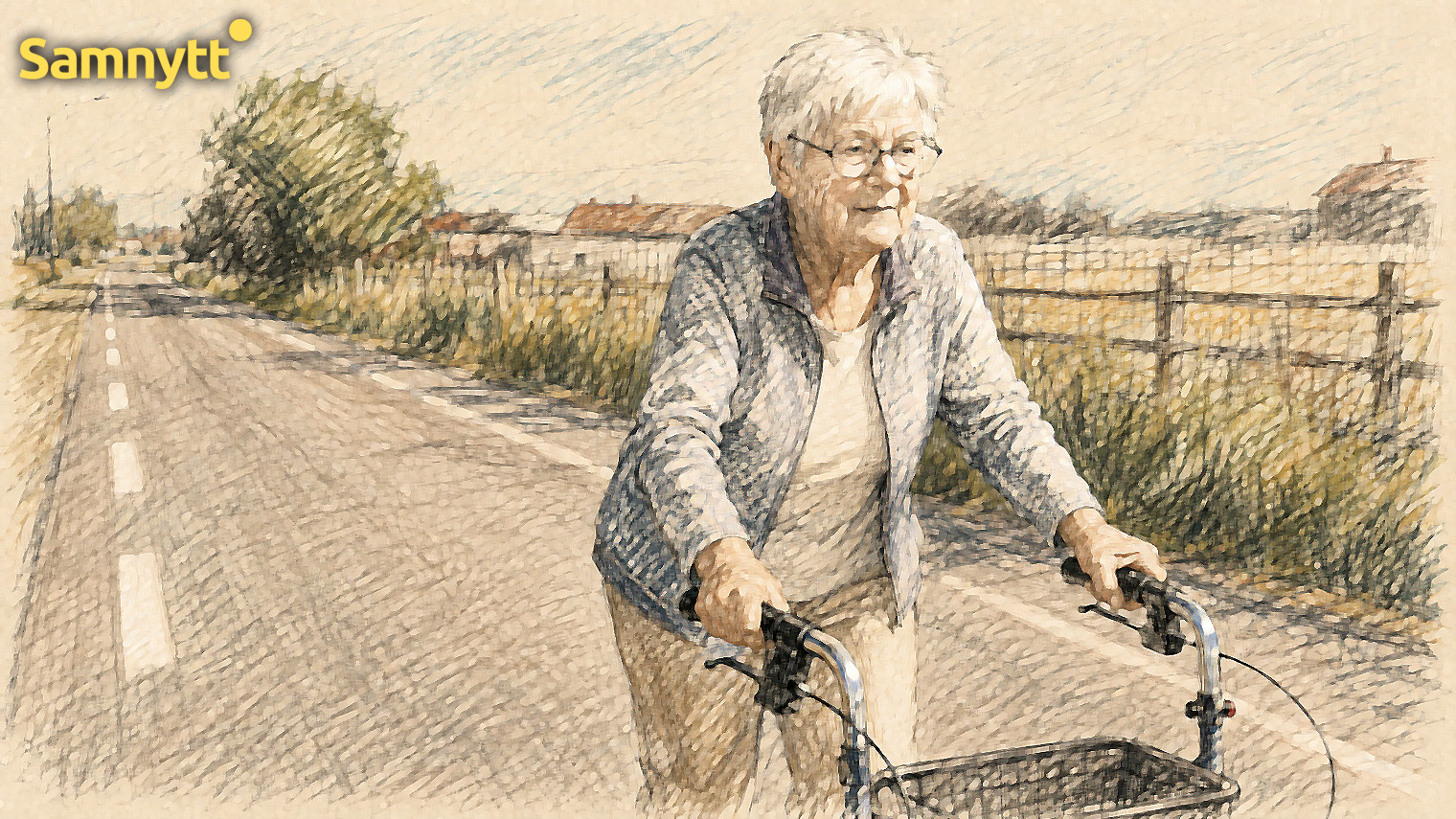
When 89-year-old Ann-Mari Lindblom needed knee surgery, she had to travel about 500 miles from her home in Jörn to Bromma. Her story illustrates how your place of residence can still determine how quickly patients receive care — even as the regions struggle with long queues, staff shortages, and a system that many believe addresses symptoms more than root causes.
The walker moves slowly through Jörn, a few miles outside Skellefteå. The road leads to the old local health center, which has long been closed. The premises are now almost empty, but in one of the rooms Ann-Mari Lindblom still gathers people for weekly singing meetups.
Despite the problems that characterize healthcare, she feels grateful. When her osteoarthritis worsened after a fall, she was informed that a knee surgery could be offered within the healthcare guarantee’s timeline — but not in her home region. Instead, the journey went to Bromma, about 500 miles away.
“I received a letter inviting me to Bromma within three months,” she tells DN.
READ ALSO: Young Woman with Symptoms Died Waiting for Care
The operation was performed just a week before her 90th birthday. She was never concerned that her age would put a stop to it. On the contrary, she still saw herself as lively enough to manage both the flight and the procedure.
Patients Sent Southwards
Ann-Mari’s journey is far from unique. To shorten waiting times, regions in northern Sweden purchase operations from clinics further south. It is therefore not uncommon to see newly operated patients traveling home in wheelchairs at airports.
READ ALSO: Record-long Healthcare Queues Now Even Longer: More Than 120,000 Patients Without Specialist Care
Pia Näsvall, Director of Health and Medical Care in Region Västerbotten, says the region would prefer to perform the operations locally. The journeys mean both higher costs and greater strain for patients, especially those who have just undergone surgery.

At the same time, she emphasizes that not everyone is able to travel. Patients with other illnesses or poorer general health may struggle to complete such a long journey and thus risk having to wait longer. According to her, everyone deemed in need of a hip or knee operation should have access to it, regardless of other health issues.
Queues Persist Despite Investments
Staff shortages in northern Sweden have long made it difficult to meet healthcare needs. A large part of resources today is spent reducing queue times through temporary solutions, while the underlying problems remain.
“It doesn’t solve fundamental, structural problems,” she explains to DN.
READ ALSO: Men with Prostate Cancer Must Wait 131 Days for Surgery
The regions receive government grants to improve accessibility, but some of the funds are tied to certain types of operations, such as knee and hip replacements. Pia Näsvall argues that the system forces the regions to buy even more healthcare externally in order to access funding, rather than enabling them to set priorities based on local needs. She therefore calls for more general state grants and less detailed national control.
She also points out that waiting times are affected by the entire healthcare chain — from the first contact with a health center to referrals, decisions, and operations. Gaps in information transfer between regions, municipalities, and private care providers mean that patients sometimes risk falling through the cracks.
The Pandemic Slowed the Progress
According to Pia Näsvall, progress was heading in the right direction before the pandemic. At that time, efforts were steadily reducing queues, but when COVID-19 struck, planned operations had to be postponed to make space for other treatments. This created long queues that still affect healthcare, especially in northern Sweden where alternatives are few.
When the healthcare system began to recover, the introduction of new journal systems caused further disruption. Taken together, healthcare queues in Sweden have decreased somewhat since 2025, but the differences between different parts of the country remain significant.
Back Home in Time
For Ann-Mari Lindblom, the long trip was worth the effort. She made it home just in time to celebrate her 90th birthday. She was still in a wheelchair at the party, but her recovery was quick.
“Yes, I was sitting in a wheelchair at the party. But three weeks later I felt no pain,” she tells DN.