
A new study surveying both working adults and pensioners in six major European countries as well as the US regarding the state pension in their respective countries reveals widespread dissatisfaction and significant concern about the future.
In addition to the US, the countries included in the YouGov survey are the United Kingdom, France, Germany, Italy, Poland, and Spain. A majority in all countries feel that the state pension is too low, but the level of dissatisfaction varies.
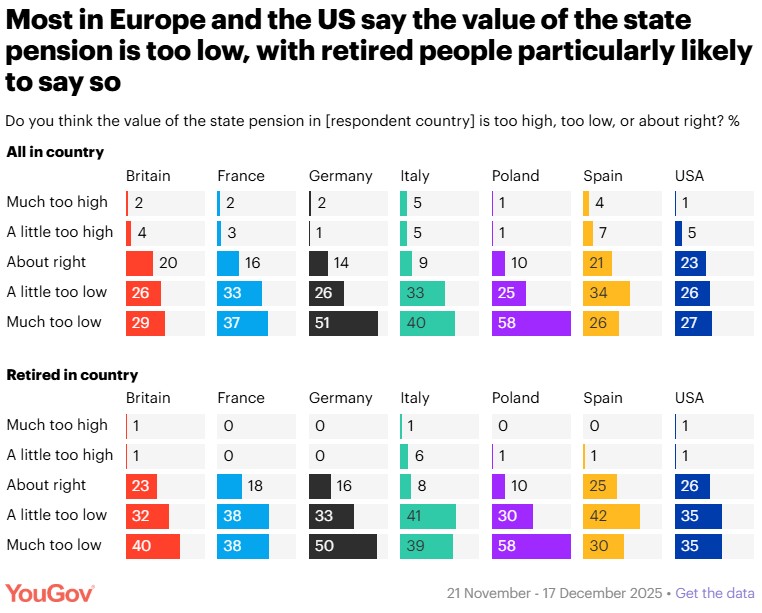
The highest level of dissatisfaction is found in Poland, where 83 percent believe the state pension is somewhat or much too low, while the corresponding figures in the UK and the US are 55 and 53 percent respectively.
Among those who have already retired, dissatisfaction is even higher, with Poland again topping the list: 88 percent are dissatisfied. The US and Spain have the highest proportion of pensioners who believe the pension is adequate.
ALSO READ: Retirement age abolished – replaced by ‘target age’
When it comes to the future of the pension system, most people are also pessimistic. Half or more in each country believe that the pension system will not be financially sustainable when today’s people in their 30s and 40s retire.
In all countries, a majority report that they are not confident they will have enough money to live comfortably as pensioners. Italians are the most negative here, with 72 percent expressing concern about the future.
No Desire for Increased Immigration
At the same time, there is widespread opposition in all countries to measures such as raising the retirement age, increasing taxes for working-age people, or imposing legal obligations on adult children to support their retired parents. The idea that increased immigration could be a solution is also widely rejected—in all European countries attitudes toward a larger inflow are negative. In the US, however, about as many are in favor as opposed.
In countries like Greece and Italy, pensions account for more than 16 percent of public expenditure, and as populations age, costs are expected to continue rising. In France, the government was recently forced to postpone plans to raise the retirement age from 62 to 64 years.
Italians are particularly hostile to efforts to encourage older people to remain longer in the workforce. They are also especially inclined to support measures that place the burden of reform on the wealthiest: 52 percent support eliminating state pensions for high-income earners, 66 percent support increased taxation of more affluent pensioners to fund better state pensions for the poorest, and 55 percent say wealthy pensioners—rather than the working young—should bear more responsibility for funding better state pensions for the poorest.
ALSO READ: High anxiety over pensions among workers