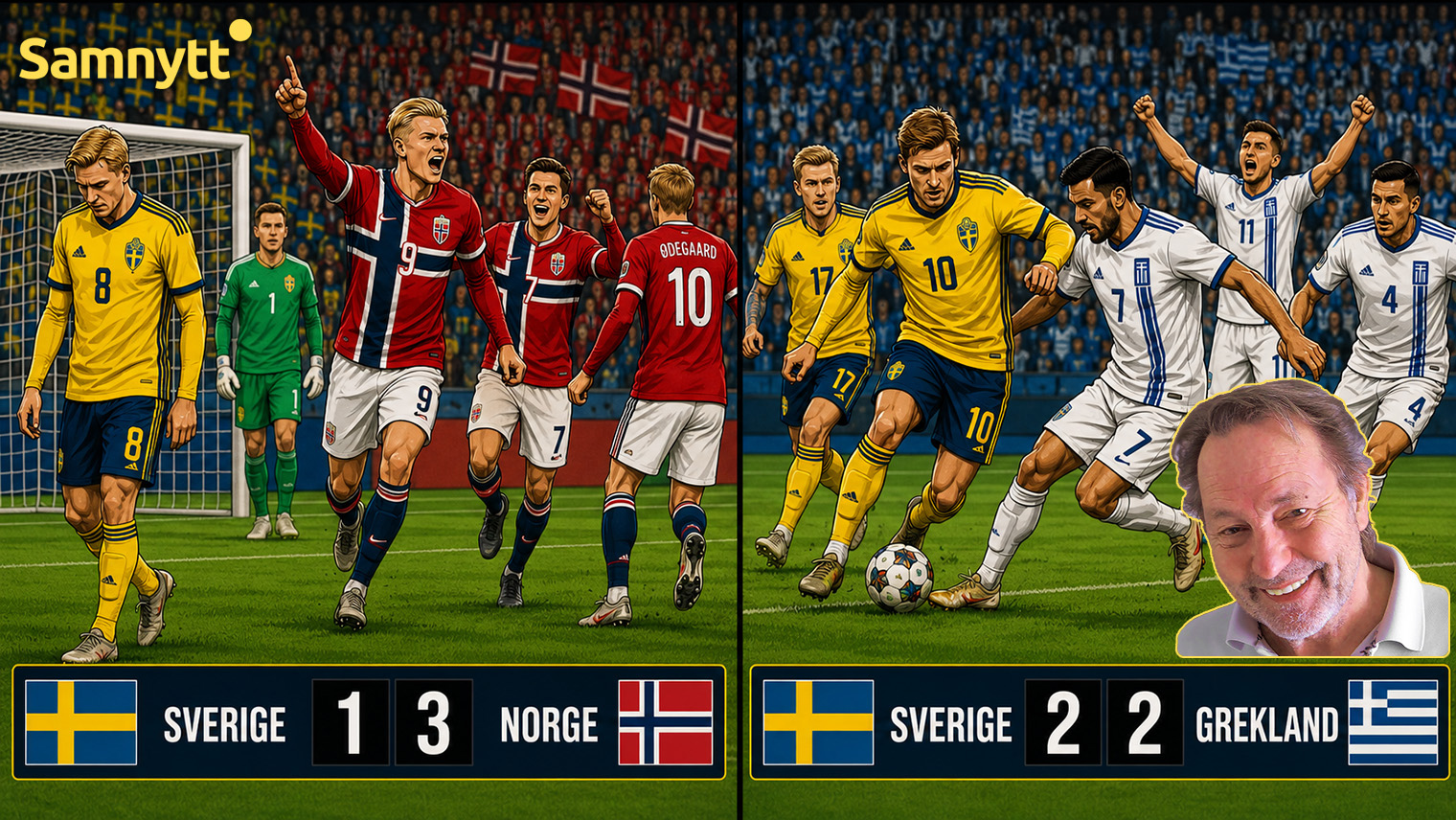
FOOTBALL COLUMN • It’s often said that a poor dress rehearsal bodes well for the premiere. If that’s true, the Swedish national team will crush Tunisia in the opening match, because the way the Swedes were outplayed, especially in the first half against Norway, bordered on total humiliation.
It’s worth noting that the Norwegians rested their two biggest stars, Haaland and Ødegaard, which hardly makes things better for Sweden. The Swedes did field something like a half B-team, and the game became a bit more even in the second half after seven new players were brought on, including Alexander Isak, who reduced the deficit to 3–1 with a truly classy finish.
Afterwards, two defenders, Herman Johansson and Daniel Svensson, refused (or didn’t dare?) to face the press in the mixed zone. Instead, they exited quietly through the back door.
The Greece Match a Small Step Forward
The match against Greece was a small step forward, with Sweden’s two top players – Isak and Gyökeres – up front, who, however, were almost entirely anonymous during the first half, as was the midfield. The defense, too, was unable to produce offensive passes and mostly played backwards. Mattias Svanberg and the withdrawn forward Benjamin Nygren often hid on the pitch, making themselves unplayable.
Greece took the lead after a corner that resulted in a cross from the left, where a completely unmarked Kostas Tsimikas was able to fire home the 1–0 from a central position in the penalty area, behind a screened Swedish goalkeeper. Eight Swedish players stood in the goal area after the corner, and only Yasin Ayari was up at the edge of the penalty area, marking his man. The much-criticized defender Daniel Svensson (why was he in the starting eleven?) probably saw the totally unmarked Tsimikas but turned his back to chase a forward who was supposed to be man-marked. Total brain freeze and lack of game awareness.
Victory Squandered in the Dying Seconds
In the second half, Sweden had a bit of luck as Gyökeres equalized from a free kick that deflected off the wall. Then head coach Potter made a slew of substitutions, among them Malmö FF star Taha Ali, who ran riot on the left wing at one point – breaking free from four Greek defenders – to deliver a perfect pass to Gustaf Nilsson, who essentially had an open goal.
So far, so good – a confidence-boosting win before the journey across the Atlantic. But not so fast: in the ninety-fifth minute! (5 minutes’ added time) with 10 seconds left, Greece equalized off a cross where Hjalmar Ekdal (brother of Albin) failed to stay with his man, who lunged forward and managed to get a toe onto the ball, hitting the post before it cheekily rolled behind goalkeeper Nordfeldt.
What Will the Starting 11 Be Against Tunisia?
So what starting eleven should the Swedish national team field in the crucial June 15 match against Tunisia? Johansson and Svensson have probably played themselves out of the World Cup with their weak defensive performances in the friendlies. Isak Tien and Nilsson-Lindelöf are certain picks for defense, with Lucas Bergvall and Ayari likewise in midfield. The two-man attack seems straightforward with Isak and Gyökeres, with Taha Ali and Elanga as substitutes. Jesper Karlström, as defensive midfielder, usually delivers, though he tends to draw yellow cards with a somewhat brutal playing style.
Midfield could have used an attacking playmaker in the mold of Emil Forsberg, who did not make the squad. Big mistake, Potter! Maybe Svanberg can step up into that role, but that’s doubtful, at least judging by his lackluster performances in the training games.
Probably a Must-Win Opener
Sweden probably needs to win against Tunisia in the opening match to advance to the knockout stage. Les Aigles de Carthage (The Carthage Eagles), as the Tunisian national team is called, is a defensively strong team that went through the African qualifiers without conceding a single goal.
At the 2022 World Cup finals, they beat reigning champions France 1–0 in the group stage, so Sweden is not facing pushovers. Win or go home, Potter – that’s the question. Or to quote Cato the Elder about the Punic Wars: “In addition, I consider that Carthage must be destroyed (defeated).”