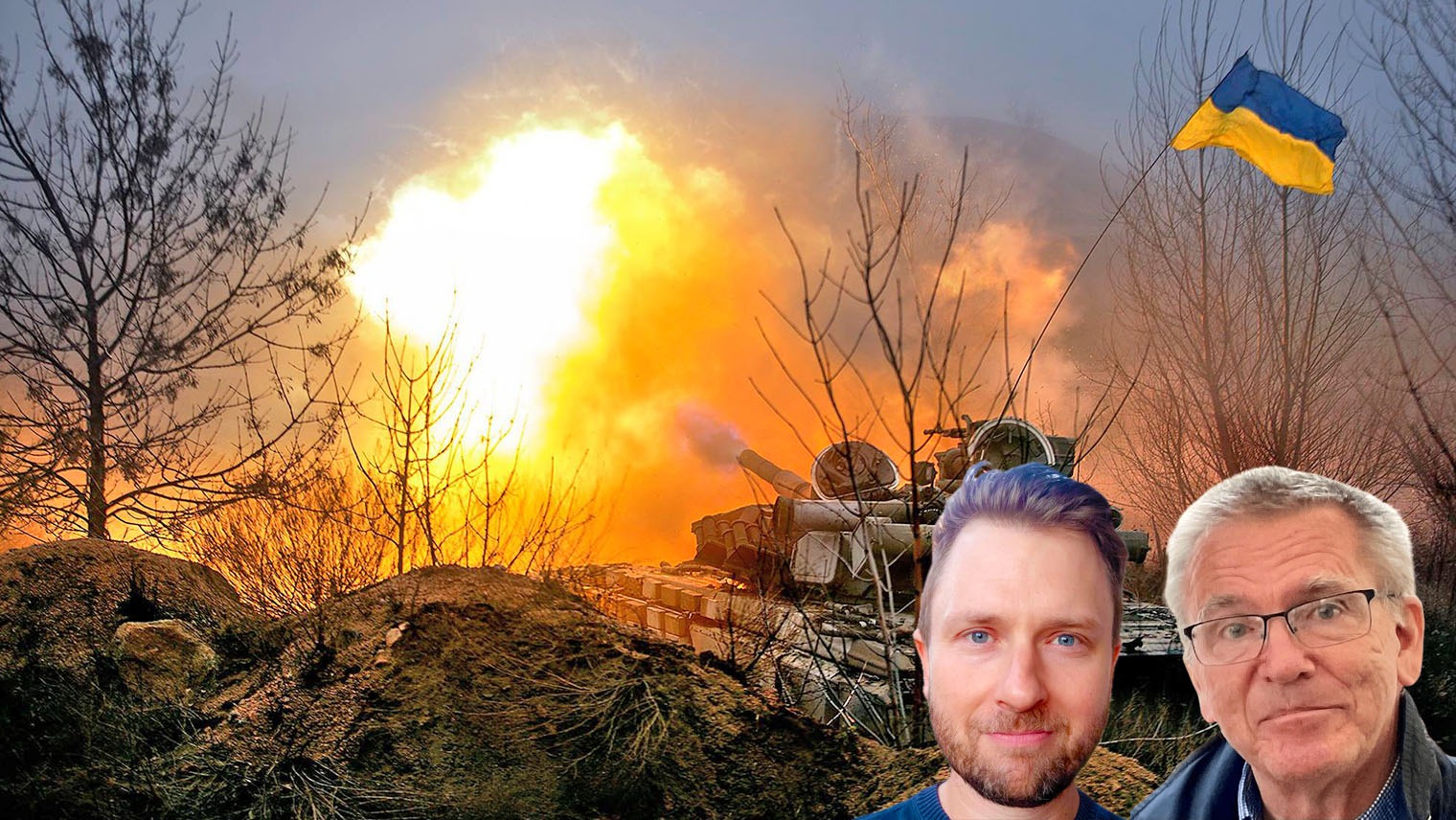
DEBATE • For almost four years, Sweden has been fed a portrayal of the war in Ukraine that reduces it to a moral drama: an irrational Russian dictator attacking an innocent neighboring country, while NATO and the EU only react. But this narrative lacks a crucial perspective – the historical and geopolitical background. Without it, it becomes impossible to understand why the war broke out and why it continues.
It is therefore reasonable to ask: why are the Swedish people not given access to a complete, factual, and historically informed analysis of Europe’s most dangerous conflict?
In Swedish news reporting, the phrase “Russia’s full-scale invasion” is almost ritually repeated, as an emotional impact rather than an analytical description. At the same time, Ukraine’s, the EU’s, or the USA’s role in the escalation of the conflict is rarely scrutinized. The result is a narrative that lacks both proportion and depth.
It is remarkable how little space is given to the factors that American professors, former diplomats, and several Western leaders have pointed out as crucial for understanding the war. In Sweden, a conflict that “began on 24 February 2022” is presented, despite the history being much longer and more complex.
The forgotten background
Facts that are obvious in international research but almost invisible in the Swedish press include:
• the promises to Gorbachev in 1990–91 that NATO would not expand eastward
• US military cooperation with Ukraine from 1993 onwards
• the NATO decision in Bucharest in 2008 that Ukraine “will become a member”
• the Western-supported Maidan revolution in 2014, where US Deputy Secretary of State Victoria Nuland openly discussed the formation of the government
• the Minsk agreements in 2015, which Merkel and Poroshenko have described in retrospect as a way to “buy time” for Ukrainian rearmament
• the aborted peace talks in the spring of 2022, which mediators from Israel, Turkey, and Germany claim were stopped after Western pressure
These facts are not controversial :censored:6:cdd6bbaa89:ly – only in Sweden.
Security interests, not imperialism
The most central – and the most ignored – is that Russia’s main demand for over 20 years has been that Ukraine should not become a NATO member. This has been consistently reiterated in diplomacy, documents, and public statements. The demand is about security interests, not about a goal to conquer Central Europe.
Despite this, Swedish media has constructed a narrative where Russia is said to want to take over all of Ukraine, then the Baltics, Poland, and finally “stand at Sweden’s border.” This is unsupported by Russian military doctrine, academic research, and the analyses of international experts. It is a horror image that replaces historical and geopolitical understanding.
Trump’s peace plan shows how skewed Sweden’s information is
An example is Trump’s 28-point plan, which Al Jazeera has reported on. Regardless of what one thinks of the plan, it is based on the same three basic elements that Russia has pursued for 20 years:
• a neutral Ukraine outside of NATO
• consideration of Russian security interests
• territorial issues to be resolved through negotiation
The fact that these issues are now being discussed directly between the US and Russia – without the EU and often without Ukraine – is in itself a dramatic change in Europe’s security policy landscape. But this fact is hardly mentioned in Sweden, because it does not fit into the familiar narrative of the war.
When NATO’s role is not mentioned, understanding disappears
The conflict is largely about power balance, strategic interests, and great power rivalry. Despite this, NATO’s role is almost never mentioned in an analytical way in Sweden. Instead, the war is depicted as a moral drama where complex security issues are reduced to personal character assessments of Putin.
But conflicts are not resolved through moralizing. They are resolved by understanding the motives of all parties.
The Psychological Defense Agency collaborates closely with NATO and has the explicit task of strengthening Ukraine’s psychological resilience. It is a political mission – not a neutral one. In combination with a media image that filters out crucial facts, the result is an information climate where critical analysis almost disappears.
Now that the US has reduced its engagement, Europe has taken over the baton, often with the rhetoric that “Putin must be defeated.” But as long as the roots of the conflict are refused to be analyzed, it also becomes impossible to understand how it can be ended. It is a dangerous development.
The question that few dare to ask
When considering the development of the conflict, one question becomes unavoidable:
Why are the superpowers the US and Russia – and not Europe’s own leaders – practically negotiating the peace terms in Europe’s largest conflict since World War II?
How has the EU been reduced to reacting to decisions made in Washington and Moscow?
The answer is simple: this has been a proxy war from day one. Ukraine has borne the losses, but the superpowers have financed and shaped the war. Therefore, it is also the superpowers that are negotiating the peace.
Therefore, a morally free, historically grounded journalism is needed
The Swedish people deserve more than simplified narratives and horror images. We need journalism that presents all relevant perspectives – even when they challenge Western positions. Only then can Europe make decisions that actually lead to peace and reduce the risk of further escalation.
Andreas Sidkvist
Board member of MoD – Human Rights and Democracy, Stockholm
Mats Olsson
MoD member focusing on peace and security policy, Uppsala