
Recurring alarms about poor quality, unclear responsibility, and unscrupulous education providers have prompted the government to appoint a major investigation into municipal adult education – with a special focus on SFI – Swedish for Immigrants. The investigation aims to tighten control, clarify the municipalities’ responsibility, and increase the possibility of combining SFI with other studies.
The government, together with the Sweden Democrats, presented on Thursday a comprehensive investigation that will address the problems within municipal adult education and SFI. The background is several audits that have revealed deficiencies in everything from teaching time and grading to the municipalities’ monitoring of contracted education.
Minister for Upper Secondary School, Higher Education and Research Lotta Edholm (L) emphasized at a press conference on Thursday that the situation is serious.
– Serious deficiencies have been identified in municipal adult education and SFI. […] Now we are taking action against the deficiencies, and an important part of this is to tighten the requirements by introducing ownership and management review. Unscrupulous actors should not be allowed to conduct municipal adult education.
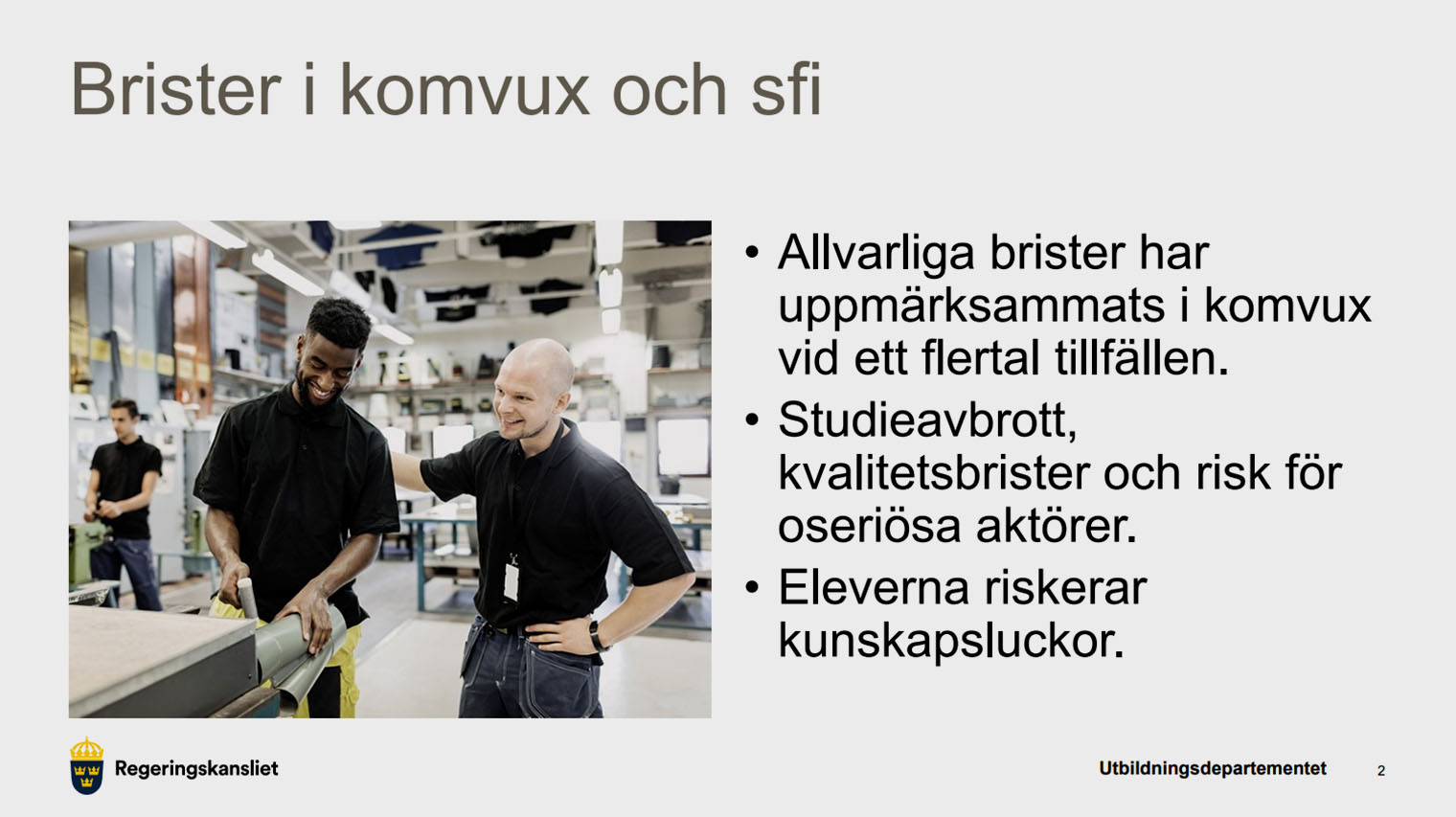
The latest report from the Swedish Schools Inspectorate shows that 25 out of 30 audited municipalities have deficiencies in the control of contracted adult education. The authority has also found problems with the quality of teaching, the lack of practical elements in healthcare education, and deficiencies in grading.
SFI singled out as particularly vulnerable
SFI – Swedish for Immigrants – is highlighted as one of the areas where the problems are most severe and risk having the greatest consequences. For newly arrived immigrants, education is crucial to quickly enter the workforce, something that often does not work.
According to Kristina Axén Olin (M), who was present at the press conference, the quality varies significantly.
– Audits show that SFI education varies in quality. Therefore, students do not always have the Swedish language skills required in the labor market.
Therefore, the investigator is to propose how more people can combine SFI with other education, such as vocational packages – an approach that, according to the government, could shorten the path to employment.
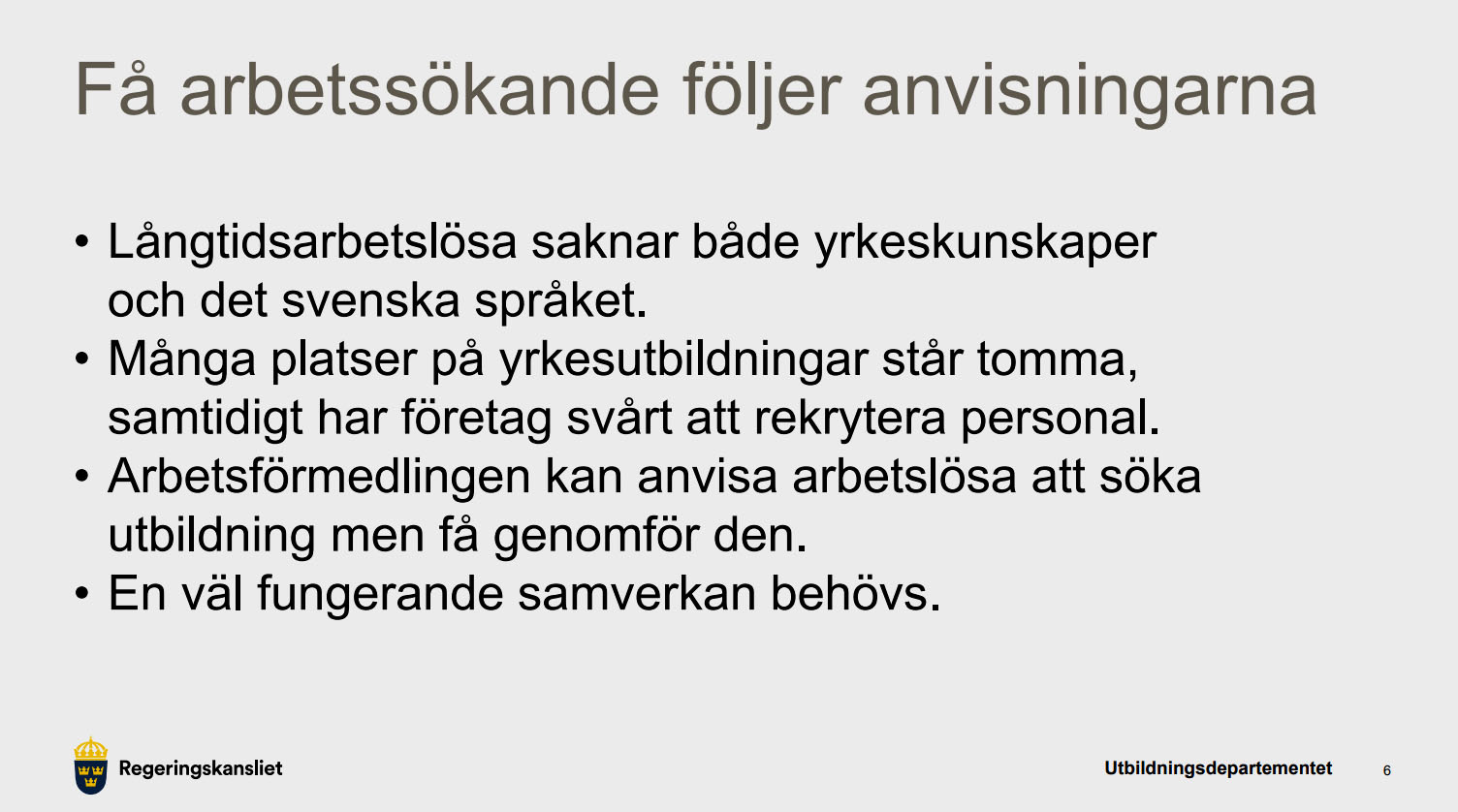
At the same time, several teachers warn that the recently decided three-year limit for SFI could create problems.
– The time limit can cause problems […] With such combinations, more time may be needed, especially for students with a short or no previous academic background, argues Lillemor Malmbo, SFI teacher and chairman of the Swedish Teachers Umeå in a comment to Vi Lärare.
However, the limit has been introduced for a reason: reports have been frequent about immigrants attending SFI for many years and just passing the time without learning anything, without making progress in the Swedish language.
Private actors under scrutiny
Half of Komvux is conducted by private education companies. This part of the system is now under special focus, both by the government and the trade unions.
Patrick Reslow (SD) highlighted at the press conference the risk of unscrupulous educational companies entering adult education.
– There is a risk that unscrupulous actors take advantage of the relatively open regulation of Komvux. The municipalities also fail in the monitoring of education.
To address the problems, the investigator will propose new tools to review owners and management in companies applying to issue grades.
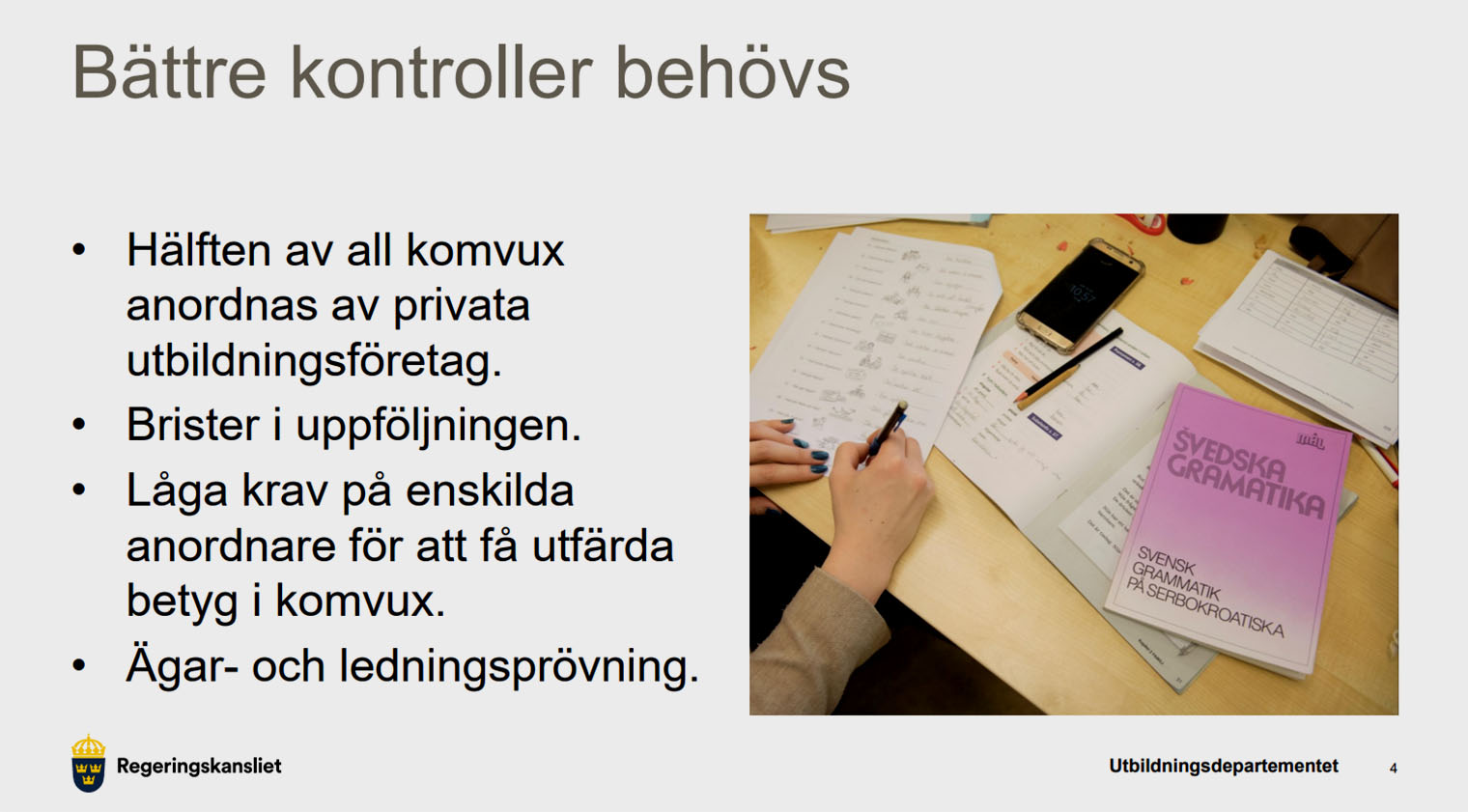
Lotta Edholm also pointed out the risk of cheating and welfare crimes.
– Komvux conducted on commission handles large sums of money, and at the same time, it is difficult to know who is behind an operation and how the money is used.
The Swedish Teachers’ Union wants to go much further than the government. First Vice Chairman Robin Smith believes that the investigation does not address the fundamental system flaws.
– The current system of commissions in adult education must transition to public management […] We would have liked the investigation to be tasked with formulating much sharper proposals on these systemic issues.
Unemployed rarely complete studies – causes to be analyzed
The investigator is also tasked with finding out why so few unemployed individuals who have been allocated to adult education actually start or complete their studies.
– Many places in vocational training in Komvux are empty at the same time as companies have difficulty recruiting personnel with the right skills, noted Mathias Bengtsson (KD) at the press conference.
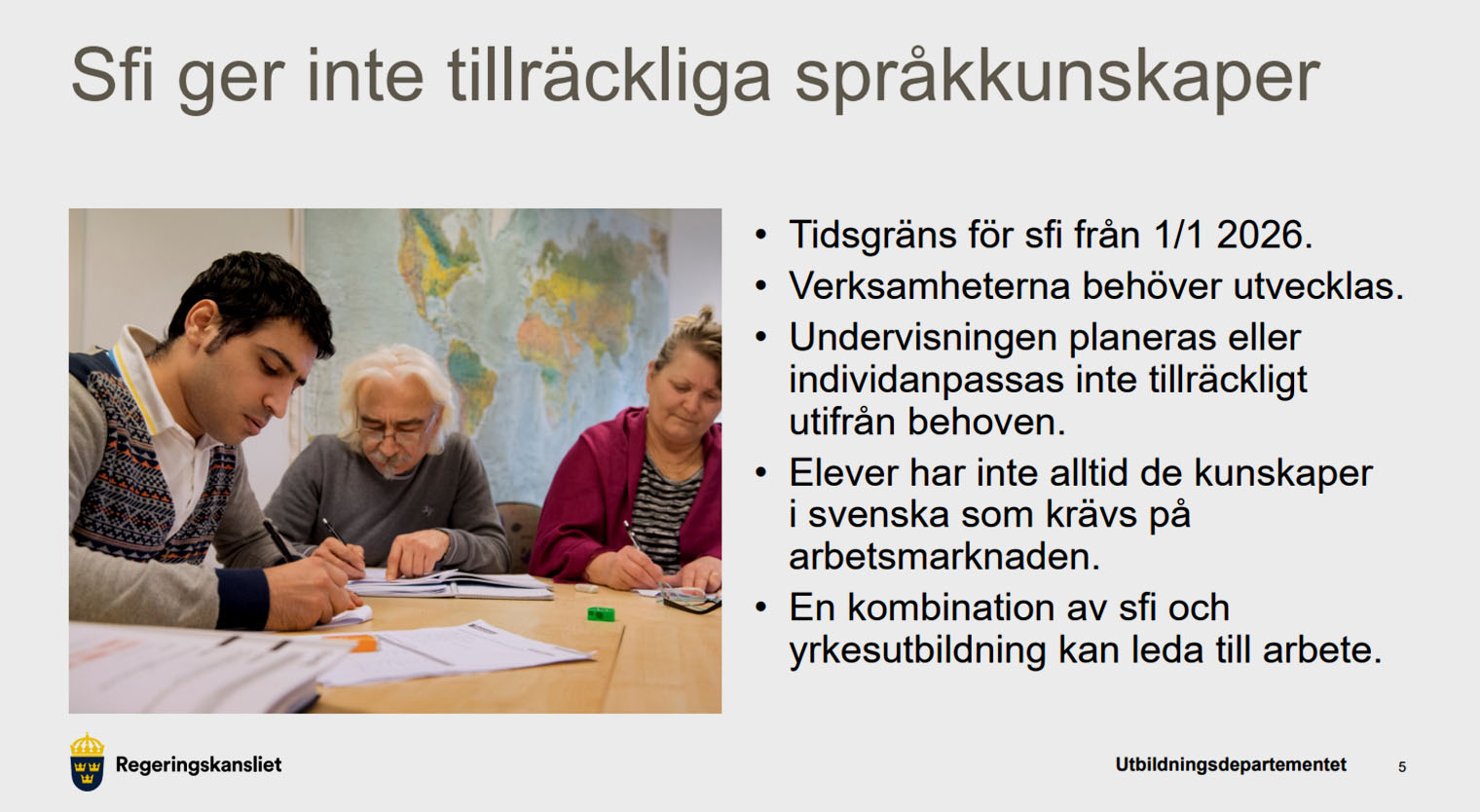
The analysis will result in proposals to increase throughput, especially among those with short education.
More demands on municipalities
The government also sees the need to clarify the municipalities’ responsibility for quality and follow-up. This will include requirements for better control of commissioned education.
– More measures are needed for the municipalities to follow up and take responsibility for the quality of contracted education, emphasized Patrick Reslow (SD).
Despite their union perspective, the teachers’ side also wants clearer national frameworks.
– National regulations, regulated timetables, and discontinued continuous intake in courses are something that Lillemor Malmbo is calling for.
She describes how parallel courses in the same classroom create an unreasonable work environment and reduced quality.
The investigator’s final report not until mid-2027
The government has appointed Jan Rehnstam, head of the Swedish National Agency for Education’s unit for municipal adult education, to lead the investigation. The assignment is given plenty of time, and the final report does not need to be completed until June 15, 2027.
The investigation is based on an agreement between the government and the Sweden Democrats.
The press conference can be viewed in its entirety below.