The government is moving forward with the proposal to abolish the so-called volume discount – the system that has long meant people convicted of multiple crimes did not receive a punishment corresponding to the total penalty value of their offenses. The proposal is being advanced despite criticism from the Council on Legislation.
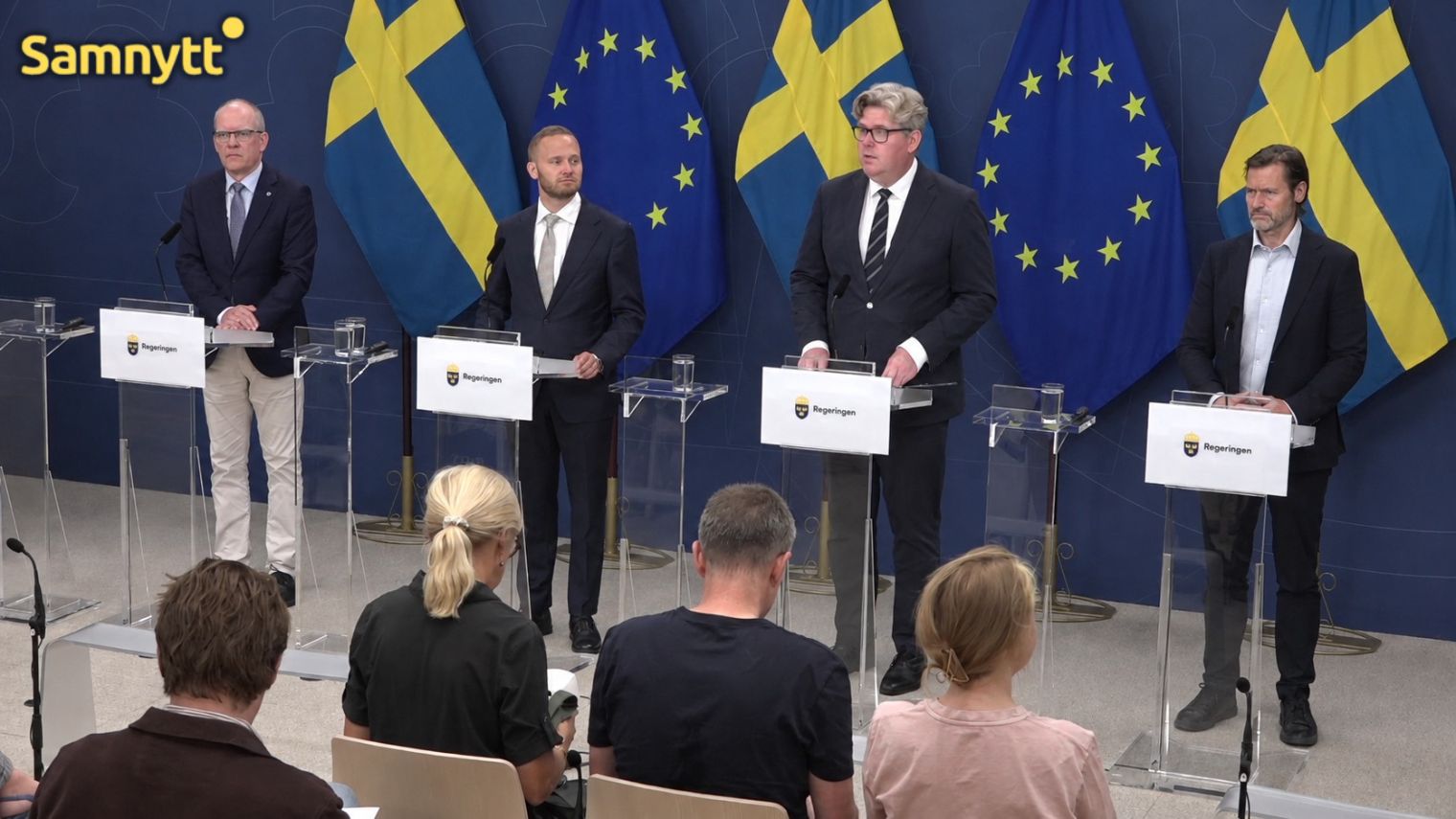
At a press conference, Minister for Justice Gunnar Strömmer (M) presented phase two of the government’s extensive criminal justice reform. One of the most noted changes is that the punishment for multiple crimes is to a far greater extent to correspond to all the crimes the perpetrator is convicted of.
“It is not reasonable that some crimes in practice become free if you have committed many crimes,” said Strömmer.
The current system has long been criticized for giving repeat offenders and people who commit multiple crimes a kind of discount. In practice, this means that the sentence does not fully increase for every additional offense. The more crimes a person is convicted of, the less significance the later offenses often have in the final sentencing.
The government’s proposal instead means that the penalty values for several crimes should be increasingly aggregated. As a main rule, the penalty values for at least the three most serious crimes should be summed when the court decides the sentence.
An example highlighted is a person convicted of three rapes, each with a penalty value of three years in prison. Under the current system, the total sentence could amount to around five years. With the government’s proposal, the sentence could instead be nine years.
At the same time, some room for exceptions remains. The court should, in special cases, be able to deviate from the principle if the total sentence would otherwise be manifestly disproportionate in relation to the crime.
An Issue Long Advocated by the Sweden Democrats
The demand to abolish the volume discount has for a long time been driven by the Sweden Democrats. Already during his time in parliament, Kent Ekeroth submitted motions on the issue.
In a motion from 2010/11, titled “Abolish the Volume Discount for Multiple Crimes,” Ekeroth, together with Lars Isovaara, wrote that each crime should be assessed separately when the punishment is determined. They argued that it is fundamentally wrong for a criminal to receive a shorter sentence per crime simply because he has committed several.
The motion’s authors also pointed out that the vulnerability of victims is practically valued differently when some offenses become less significant in the sentencing because the perpetrator is convicted of many crimes at once.
The issue has since recurred in criminal justice debates, not least in connection with high-profile cases where offenders were convicted of a large number of crimes but the total sentence was seen as low in relation to the scale of criminality involved.
Conditional and Probation Sentences Abolished
The government’s new package also includes several other changes. The sanctions of conditional sentence and probation are to be phased out and replaced by a system of conditional imprisonment.
The idea is that prison will be the starting point in more cases, but that enforcement can in certain cases be postponed or combined with various requirements and sanctions. This can include community service, supervision, or day fines.
The government also wants the full range of punishments to be used more broadly. Today, many sentences are close to the minimum penalty, while maximum sentences are rarely used. The reform aims to ensure that more serious cases can be punished more severely.
Several so-called mitigation grounds are also being abolished. Among other things, this means that a convicted person should no longer be able to receive a lighter sentence solely on the grounds that he or she risks losing their job.
Critical Views from the Council on Legislation
The Council on Legislation has expressed criticism against parts of the reform. According to the Minister for Justice, the government has taken certain views into account but stands firm on the fundamental direction.
“In other areas, we reach a different assessment than the Council on Legislation, this applies among other things to the proposal to abolish the volume discount,” said Strömmer.
At the same time, the Council on Legislation itself has recently become the subject of criticism from the Tidö parties and the center-right. It has been claimed that the Council is increasingly moving from legal review of legislative technique and constitutional issues to making political judgments about what criminal policy Sweden should pursue.
For example, in connection with previous government sentencing increases, SD group leader Henrik Vinge has accused the Council on Legislation of, in parts, acting more as a political force than a legal review body. Gunnar Strömmer has also criticized the council and maintained that they “underestimate the seriousness of the situation.”
Critics argue that questions of penalty levels must ultimately be decided by voters, parliament, and the government – not by lawyers making their own judgments about what constitutes “reasonable” criminal policy. Against this backdrop, the government’s decision to proceed despite the Council’s objections is seen as of principle importance: the Council on Legislation has an advisory role, but it is the elected politicians who bear the democratic responsibility for legislation.
When the legislative changes could come into force has yet to be decided. The government states that it will happen on the day the government decides. The timing will depend in part on how quickly the Prison and Probation Service can expand capacity with more prison places.
The first part of the criminal justice reform included, among other things, double penalties for gang criminals and the possibility that repeated rapes could result in life imprisonment. Those legislative changes will come into force in August.
See the press conference: