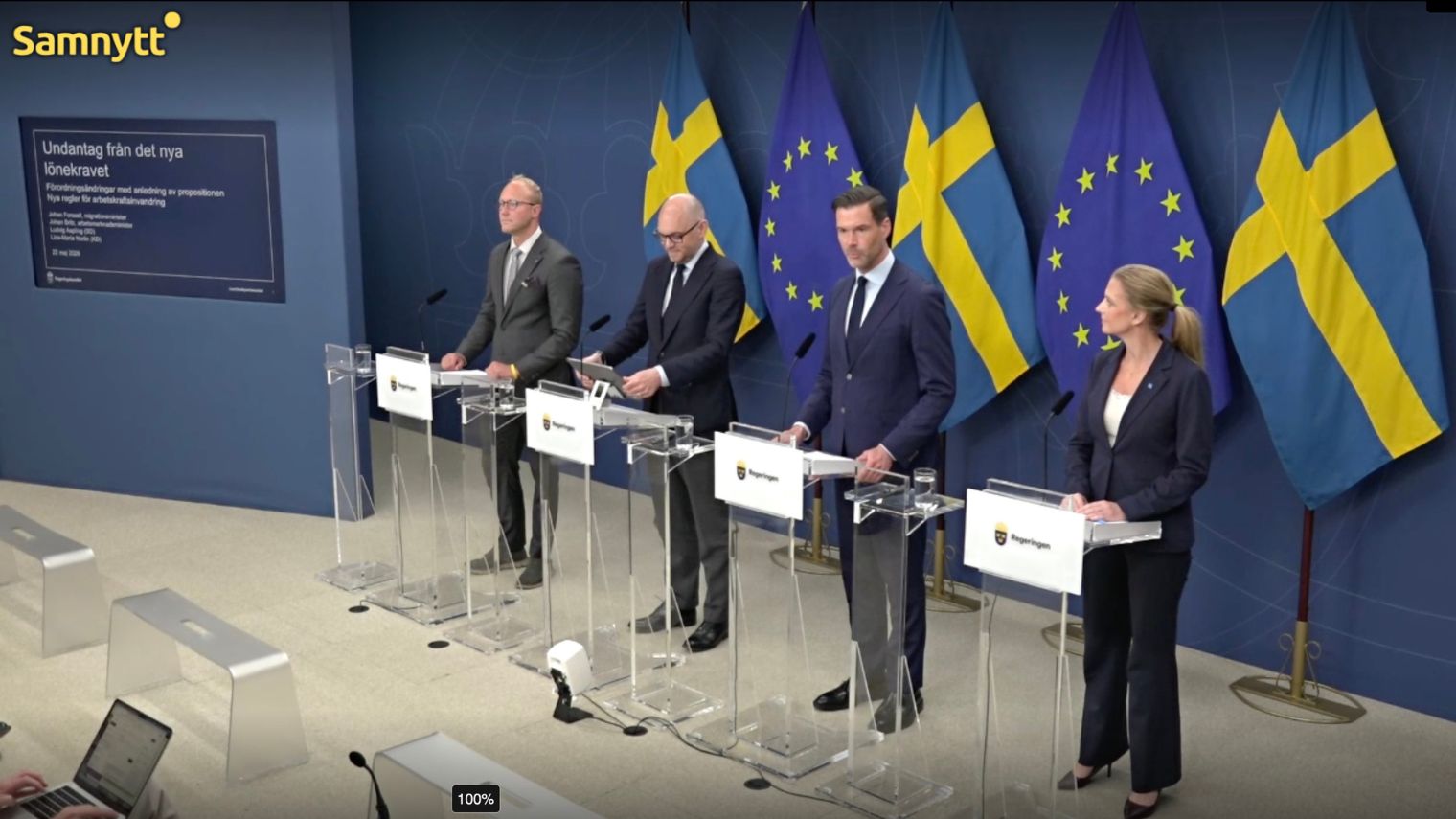
With just months left until the election, the Tidö government announces yet another turn on migration policy. After the decision to halt certain teenage deportations, the government is now easing the tightened salary requirements for labor migration. The exemptions apply to several occupational groups within healthcare and social care, where staff shortages are considered acute.
At the start of Friday’s press conference, Minister for Migration Johan Forssell highlighted that Sweden currently has around half a million unemployed people. The statement was made to put the Tidö government’s previous proposal to tighten salary requirements for non-European labor migrants into a wider perspective.
“The government is changing its view on labor migration from what has previously characterized Sweden – namely very large labor migration from low-skilled sectors – to rather focusing on what is important for our Swedish competitiveness and growth,” said Forssell.
From June 1, the requirement for labor migrants will be raised to 90 percent of the Swedish median salary. At today’s levels, this means that people applying for work permits in Sweden must have a monthly salary of at least 33,390 kronor.
But the government and the Sweden Democrats are now making exceptions for a number of occupations facing severe staff shortages. Among the groups that are exempted are assistant nurses, care aides, and ambulance paramedics.
For these occupations, the salary requirement is instead set at 75 percent of the median wage, equivalent to just over 27,000 kronor per month.
READ ALSO: EXCLUSIVE: SD prepared to lower requirements for certain immigrants
During the press conference, Minister for Migration Johan Forssell (M) explained the decision by stating that certain essential professions cannot be staffed without labor migration.
“There are certain shortage professions that play a very important role in our society, where we do not have sufficient expertise today,” said Forssell.
The new rules are part of the government’s overhaul of migration policy. The government argues that the previous system for labor migration contributed to low wages, exploitation, and the emergence of a shadow society.
In an opinion piece in Aftonbladet on Friday, Prime Minister Ulf Kristersson (M) writes together with Minister for Health Care Elisabet Lann (KD), Minister for Employment Johan Britz (L) and Ludvig Aspling, who is migration policy spokesperson for the Sweden Democrats.
In eight years, Sweden received 320,000 asylum migrants, without any thought of the consequences. The result speaks for itself with widespread social exclusion, poverty, unemployment, and gang crime.
The voters saw this, voted the previous government out, and gave us the mandate to reverse this development. We have changed Swedish migration policy fundamentally – Sweden now has the lowest asylum-related immigration since 1985.
Tidö parties’ opinion piece
The article states that Sweden should continue to welcome people who work and contribute to society – but that immigration must be sustainable and better adapted to labor market needs.
Attracting and retaining expertise and top talent is an issue of growth. And at the same time, we are investing in getting more people already in Sweden into work. This is fundamental for effective integration.
Meanwhile, the reform has faced strong criticism. Businesses and employers have warned of increased skills shortages and that many people already working in Sweden risk being forced to leave the country when the new salary requirements take effect.
READ ALSO: Tidö government softens migration policy and pauses ‘teenager deportations’ after criticism
Watch the press conference: